


 journal menu


issue contents
April 2008 issue
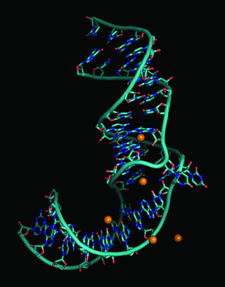
Cover illustration: The tertiary structure of hepatitis C virus IRES subdomain IIa showing an L-shaped helical conformation (p. 436). Two uridine bases are rotated out into the solvent altering the conformation of the RNA backbone. This unique RNA structure is stabilized by bound divalent metal ions. The RNA backbone is shown as blue; Sr2+ atoms are colored orange.
editorial


Free 
research papers


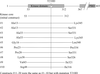
The crystal structure of the kinase domain of wild-type polo-like kinase 1 (Plk-1) has been determined after identifying suitable domain borders via a parallel cloning and expression approach and upon generation of a selective designed ankyrin-repeat protein (DARPin) which served as a crystallization tool.
PDB reference: kinase domain of Plk-1, 2v5q, r2v5qsf
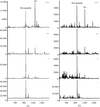
Heavy-atom derivatization is routinely used in protein structure determination and is thus of critical importance in structural biology. In order to replace the current trial-and-error heavy-atom derivative screening with a knowledge-based rational derivative-selection method, the reactivity of more than 40 heavy-atom compounds over a wide range of buffer and pH values was systematically examined using peptides which contained a single reactive amino-acid residue.
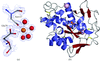
The adaptation of enzymes to low temperatures and seawater salinity has been investigated on a structural level. The crystal structure of V. salmonicida endonuclease I is presented and compared with the corresponding enzyme structures from V. cholerae and V. vulnificus.
PDB reference: V. salmonicida endonuclease I, 2pu3, r2pu3sf
Open access
access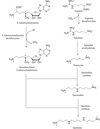
The crystal structures of two arginine decarboxylase mutant proteins provide insights into the mechanisms of pyruvoyl-group formation and the decarboxylation reaction.
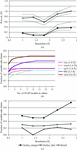
Torsion-angle sampling, as implemented in the Protein Local Optimization Program (PLOP), is used to generate multiple structurally variable single-conformer models which are in good agreement with X-ray data. An ensemble-refinement approach to differentiate between positional uncertainty and conformational heterogeneity is proposed.
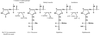
The crystal structures of the homodimeric diphthine synthases from A. pernix K1 and P. horikoshii OT3 were determined by X-ray diffraction. The present study suggests the biological importance of the asymmetry in the dimeric structure of this enzyme for the effective recognition of a large substrate, EF-2.
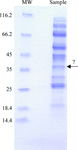
A protein from E. coli was crystallized from an inhomogeneous protein sample and identified as Gab protein by structure determination. The obtained structure is compared with a previously deposited structure of the same protein and potential ligand binding is discussed.
PDB reference: Gab protein, 2r6s, r2r6ssf
Open access
access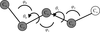
A novel method that uses the conformational distribution of Cα atoms in known structures is used to build short missing regions (`loops') in protein models. An initial tree of possible loop paths is pruned according to structural and electron-density criteria and the most likely loop conformation(s) are selected and built.
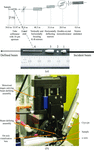
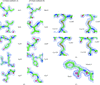
An X-ray mini-beam of 8 × 6 µm cross-section was used to collect diffraction data from protein microcrystals with volumes as small as 150–300 µm3. The benefits of the mini-beam for experiments with small crystals and with large inhomogeneous crystals are investigated.
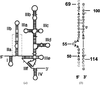
The structure of the HCV IRES subdomain IIa has been solved at 2.3 Å resolution in the presence of Mg2+ and Sr2+. The results provide additional insight into the specific interactions that stabilize the unique conformation.
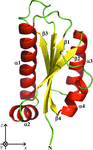
The crystal structure of peptidyl-tRNA hydrolase 2 from P. horikoshii OT3 has been determined in two different crystal forms. The present study suggests the practical importance of the dimeric structure for tRNA binding.

Multiple crystal structures are reported of cross-linked actin dimers. Interactions that are conserved across crystal structures suggest detailed interactions that are likely to be present in F-actin filaments.
short communications
Two acostatin heterodimers interact together to form an αββα tetramer.
PDB reference: acostatin, 3c05, r3c05sf