 | Acta Crystallographica Section E Acta Crystallographica Section E CRYSTALLOGRAPHIC COMMUNICATIONS |


 journal menu


organic compounds
| CRYSTALLOGRAPHIC COMMUNICATIONS |
 access
Melaminium sulfate

aInstitute of Crystalline Materials, Shandong University, Jinan 250100, People's Republic of China
*Correspondence e-mail: [email protected]
In the title compound, C3H8N62+·SO42−, the melaminium cations and sulfate anions are interconnected by N—H⋯N and N—H⋯O hydrogen bonds, forming a layer in the (101) plane. The layers are connected through multiple hydrogen bonds and π–π stacking interactions (centroid–centroid distance of about 3.4 Å).
Related literature
For related literature, see: Janczak & Perpétuo (2001a![[Janczak, J. & Perpétuo, G. J. (2001a). Acta Cryst. C57, 873-875.]](../../../../../../logos/arrows/e_arr.gif "Janczak, J. & Perpétuo, G. J. (2001a). Acta Cryst. C57, 873-875.") ,b); Martin & Pinkerton (1995); Dewar et al. (1985).
,b); Martin & Pinkerton (1995); Dewar et al. (1985).
![[Scheme 1]](bt2656scheme1.gif)
Experimental
Crystal data
|
Refinement
|
|
 ; (ii)
  ; (iii)
  ; (iv)
  ; (vi)
  ; (vii)
 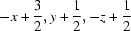 .
. Data collection: APEX2 (Bruker, 2005); cell refinement: APEX2; data reduction: APEX2; program(s) used to solve structure: SIR97 (Altomare et al., 1999); program(s) used to refine structure: SHELXL97 (Sheldrick, 1997); molecular graphics: SHELXTL (Bruker, 1997); software used to prepare material for publication: WinGX (Farrugia, 1999).
Supporting information
contains datablocks global, I. DOI: 10.1107/S1600536807067463/bt2656sup1.cif
Structure factors: contains datablock I. DOI: 10.1107/S1600536807067463/bt2656Isup2.hkl
0.126 g (0.001 mol) of melamine was dissolved in 50 ml hot water. To this solution 4 ml 98% sulfate acid was slowly added. After several days, colorless crystals of (I) appeared.
The H atoms bonded to the ring N atoms were located in difference Fourier map and their positions and displacement parameters were refined freely. The amino H atoms were added geometrically and treated as riding, with N—H = 0.86 Å and Uiso(H) = 1.2Ueq(N).
Data collection: APEX2 (Bruker, 2005); cell APEX2 (Bruker, 2005); data reduction: APEX2 (Bruker, 2005); program(s) used to solve structure: SIR97 (Altomare et al., 1999); program(s) used to refine structure: SHELXL97 (Sheldrick, 1997); molecular graphics: SHELXTL (Bruker, 1997); software used to prepare material for publication: WinGX (Farrugia, 1999).
![[Figure 1]](./bt2656fig1thm.gif) | Fig. 1. View of the asymmetric unit of (I) showing the atom-labelling scheme. Displacement ellipsoids are drawn at the 50% probability level. H atoms are represented by circles of arbitrary size. |
![[Figure 2]](./bt2656fig2thm.gif) | Fig. 2. Diagram showing the hydrogen bonds of the melaminium cation. symmetry codes: (i) x, y + 1, z; (ii) -x + 1, -y, -z + 1; (iii) -x + 1, -y + 1, -z + 1; (iv) -x + 1, y, -z + 1/2; (v) -x + 1, y + 1, -z + 1/2; (vi) -x + 3/2, y + 1/2, -z + 1/2; (vii) x, -y, z + 1/2; (viii) x, -y + 1, z + 1/2; (ix) x - 1/2, -y + 1/2, z + 1/2. |
![[Figure 3]](./bt2656fig3thm.gif) | Fig. 3. The molecular packing of (I) in the unit cell showing the hydrogen-bonding interaction (dashed lines). |
| C3H8N62+·SO42− | F(000) = 928 |
| Mr = 224.21 | Dx = 1.889 Mg m−3 |
| Monoclinic, C2/c | Mo Kα radiation, λ = 0.71073 Å |
| a = 18.5787 (3) Å | Cell parameters from 2920 reflections |
| b = 8.6272 (2) Å | θ = 2.8–27.5° |
| c = 12.7945 (4) Å | µ = 0.42 mm−1 |
| β = 129.739 (1)° | T = 293 K |
| V = 1576.94 (7) Å3 | Prism, colorless |
| Z = 8 | 0.32 × 0.27 × 0.26 mm |
| Bruker APEX2 CCD diffractometer | 1794 independent reflections |
| Radiation source: fine-focus sealed tube | 1672 reflections with I > 2σ(I) |
| Graphite monochromator | Rint = 0.013 |
| ϕ and ω scans | θmax = 27.5°, θmin = 2.8° |
| Absorption correction: multi-scan (APEX2; Bruker, 2005) | h = −24→19 |
| Tmin = 0.879, Tmax = 0.900 | k = −6→11 |
| 3793 measured reflections | l = −16→16 |
| Refinement on F2 | Secondary atom site location: difference Fourier map |
| Least-squares matrix: full | Hydrogen site location: inferred from neighbouring sites |
| R[F2 > 2σ(F2)] = 0.031 | H atoms treated by a mixture of independent and constrained refinement |
| wR(F2) = 0.089 | w = 1/[σ2(Fo2) + (0.041P)2 + 3.6165P] where P = (Fo2 + 2Fc2)/3 |
| S = 1.00 | (Δ/σ)max < 0.001 |
| 1794 reflections | Δρmax = 0.48 e Å−3 |
| 136 parameters | Δρmin = −0.45 e Å−3 |
| 0 restraints | Extinction correction: SHELXL97 (Sheldrick, 1997), Fc*=kFc[1+0.001xFc2λ3/sin(2θ)]-1/4 |
| Primary atom site location: structure-invariant direct methods | Extinction coefficient: 0.0037 (5) |
| C3H8N62+·SO42− | V = 1576.94 (7) Å3 |
| Mr = 224.21 | Z = 8 |
| Monoclinic, C2/c | Mo Kα radiation |
| a = 18.5787 (3) Å | µ = 0.42 mm−1 |
| b = 8.6272 (2) Å | T = 293 K |
| c = 12.7945 (4) Å | 0.32 × 0.27 × 0.26 mm |
| β = 129.739 (1)° |
| Bruker APEX2 CCD diffractometer | 1794 independent reflections |
| Absorption correction: multi-scan (APEX2; Bruker, 2005) | 1672 reflections with I > 2σ(I) |
| Tmin = 0.879, Tmax = 0.900 | Rint = 0.013 |
| 3793 measured reflections |
| R[F2 > 2σ(F2)] = 0.031 | 0 restraints |
| wR(F2) = 0.089 | H atoms treated by a mixture of independent and constrained refinement |
| S = 1.00 | Δρmax = 0.48 e Å−3 |
| 1794 reflections | Δρmin = −0.45 e Å−3 |
| 136 parameters |
Geometry. All e.s.d.'s (except the e.s.d. in the dihedral angle between two l.s. planes) are estimated using the full covariance matrix. The cell e.s.d.'s are taken into account individually in the estimation of e.s.d.'s in distances, angles and torsion angles; correlations between e.s.d.'s in cell parameters are only used when they are defined by crystal symmetry. An approximate (isotropic) treatment of cell e.s.d.'s is used for estimating e.s.d.'s involving l.s. planes. |
Refinement. Refinement of F2 against ALL reflections. The weighted R-factor wR and goodness of fit S are based on F2, conventional R-factors R are based on F, with F set to zero for negative F2. The threshold expression of F2 > σ(F2) is used only for calculating R-factors(gt) etc. and is not relevant to the choice of reflections for refinement. R-factors based on F2 are statistically about twice as large as those based on F, and R- factors based on ALL data will be even larger. |
| x | y | z | Uiso*/Ueq | ||
| S1 | 0.65733 (3) | 0.06360 (5) | 0.27385 (4) | 0.02105 (15) | |
| O2 | 0.63929 (12) | 0.11467 (16) | 0.36667 (16) | 0.0369 (4) | |
| O4 | 0.70593 (10) | −0.08710 (15) | 0.32413 (17) | 0.0348 (4) | |
| C2 | 0.84604 (12) | 0.9717 (2) | 0.65207 (17) | 0.0210 (3) | |
| N5 | 0.86032 (10) | 0.82418 (17) | 0.63479 (15) | 0.0215 (3) | |
| N3 | 0.95352 (12) | 1.16685 (18) | 0.54108 (18) | 0.0312 (4) | |
| H3A | 0.9834 | 1.1488 | 0.5118 | 0.037* | |
| H3B | 0.9448 | 1.2607 | 0.5534 | 0.037* | |
| O3 | 0.71951 (10) | 0.17704 (15) | 0.28119 (15) | 0.0309 (3) | |
| N2 | 0.80592 (11) | 1.00382 (18) | 0.70342 (17) | 0.0277 (3) | |
| H2A | 0.7879 | 0.9301 | 0.7272 | 0.033* | |
| H2B | 0.7974 | 1.0988 | 0.7136 | 0.033* | |
| C3 | 0.92125 (12) | 1.0513 (2) | 0.56700 (18) | 0.0222 (3) | |
| N4 | 0.93490 (11) | 0.90603 (17) | 0.54780 (16) | 0.0236 (3) | |
| N1 | 0.91024 (13) | 0.64908 (18) | 0.55885 (18) | 0.0317 (4) | |
| H1A | 0.9372 | 0.6259 | 0.5259 | 0.038* | |
| H1B | 0.8889 | 0.5768 | 0.5787 | 0.038* | |
| O1 | 0.56934 (11) | 0.0514 (2) | 0.13681 (16) | 0.0440 (4) | |
| N6 | 0.87638 (11) | 1.08607 (18) | 0.61675 (16) | 0.0232 (3) | |
| C1 | 0.90174 (12) | 0.7934 (2) | 0.57868 (17) | 0.0219 (3) | |
| H6 | 0.8684 (18) | 1.183 (3) | 0.626 (2) | 0.042 (7)* | |
| H5 | 0.8388 (18) | 0.749 (3) | 0.651 (3) | 0.044 (7)* |
| U11 | U22 | U33 | U12 | U13 | U23 | |
| S1 | 0.0277 (2) | 0.0160 (2) | 0.0288 (2) | 0.00029 (15) | 0.0224 (2) | 0.00143 (15) |
| O2 | 0.0657 (10) | 0.0212 (7) | 0.0574 (9) | −0.0009 (7) | 0.0549 (9) | −0.0015 (6) |
| O4 | 0.0425 (8) | 0.0182 (6) | 0.0605 (10) | 0.0067 (6) | 0.0408 (8) | 0.0085 (6) |
| C2 | 0.0228 (8) | 0.0197 (8) | 0.0233 (8) | −0.0007 (6) | 0.0160 (7) | −0.0004 (6) |
| N5 | 0.0284 (7) | 0.0166 (7) | 0.0289 (7) | −0.0010 (6) | 0.0226 (7) | 0.0004 (6) |
| N3 | 0.0438 (9) | 0.0183 (7) | 0.0528 (10) | −0.0030 (7) | 0.0407 (9) | −0.0011 (7) |
| O3 | 0.0416 (8) | 0.0189 (6) | 0.0502 (8) | −0.0047 (5) | 0.0377 (7) | −0.0022 (6) |
| N2 | 0.0395 (9) | 0.0202 (7) | 0.0418 (9) | −0.0002 (6) | 0.0345 (8) | −0.0006 (6) |
| C3 | 0.0246 (8) | 0.0201 (8) | 0.0274 (8) | −0.0013 (6) | 0.0191 (7) | −0.0010 (6) |
| N4 | 0.0296 (8) | 0.0185 (7) | 0.0345 (8) | −0.0010 (6) | 0.0259 (7) | −0.0010 (6) |
| N1 | 0.0519 (10) | 0.0172 (7) | 0.0516 (10) | −0.0016 (7) | 0.0449 (9) | −0.0018 (7) |
| O1 | 0.0361 (8) | 0.0554 (10) | 0.0329 (8) | −0.0085 (7) | 0.0185 (7) | 0.0045 (7) |
| N6 | 0.0320 (8) | 0.0156 (7) | 0.0330 (8) | −0.0002 (6) | 0.0259 (7) | −0.0012 (6) |
| C1 | 0.0254 (8) | 0.0194 (8) | 0.0262 (8) | −0.0003 (6) | 0.0188 (7) | −0.0007 (6) |
| S1—O1 | 1.447 (1) | N3—H3B | 0.8600 |
| S1—O3 | 1.471 (1) | N2—H2A | 0.8600 |
| S1—O4 | 1.475 (1) | N2—H2B | 0.8600 |
| S1—O2 | 1.492 (1) | C3—N4 | 1.333 (2) |
| C2—N2 | 1.300 (2) | C3—N6 | 1.367 (2) |
| C2—N5 | 1.347 (2) | N4—C1 | 1.338 (2) |
| C2—N6 | 1.350 (2) | N1—C1 | 1.300 (2) |
| N5—C1 | 1.373 (2) | N1—H1A | 0.8600 |
| N5—H5 | 0.85 (3) | N1—H1B | 0.8600 |
| N3—C3 | 1.310 (2) | N6—H6 | 0.87 (3) |
| N3—H3A | 0.8600 | ||
| O1—S1—O3 | 111.02 (9) | C2—N2—H2B | 120.0 |
| O1—S1—O4 | 111.51 (10) | H2A—N2—H2B | 120.0 |
| O3—S1—O4 | 108.77 (8) | N3—C3—N4 | 119.80 (16) |
| O1—S1—O2 | 109.36 (10) | N3—C3—N6 | 117.71 (16) |
| O3—S1—O2 | 108.65 (8) | N4—C3—N6 | 122.46 (16) |
| O4—S1—O2 | 107.42 (9) | C3—N4—C1 | 116.79 (15) |
| N2—C2—N5 | 121.41 (16) | C1—N1—H1A | 120.0 |
| N2—C2—N6 | 120.69 (16) | C1—N1—H1B | 120.0 |
| N5—C2—N6 | 117.88 (15) | H1A—N1—H1B | 120.0 |
| C2—N5—C1 | 120.25 (15) | C2—N6—C3 | 120.35 (15) |
| C2—N5—H5 | 120.6 (18) | C2—N6—H6 | 120.8 (17) |
| C1—N5—H5 | 118.9 (19) | C3—N6—H6 | 118.8 (17) |
| C3—N3—H3A | 120.0 | N1—C1—N4 | 120.09 (16) |
| C3—N3—H3B | 120.0 | N1—C1—N5 | 117.76 (16) |
| H3A—N3—H3B | 120.0 | N4—C1—N5 | 122.13 (15) |
| C2—N2—H2A | 120.0 | ||
| N2—C2—N5—C1 | 179.14 (16) | N3—C3—N6—C2 | −176.50 (17) |
| N6—C2—N5—C1 | −2.1 (2) | N4—C3—N6—C2 | 1.8 (3) |
| N3—C3—N4—C1 | 178.76 (17) | C3—N4—C1—N1 | 178.06 (18) |
| N6—C3—N4—C1 | 0.5 (3) | C3—N4—C1—N5 | −3.6 (3) |
| N2—C2—N6—C3 | 177.84 (17) | C2—N5—C1—N1 | −177.10 (17) |
| N5—C2—N6—C3 | −0.9 (3) | C2—N5—C1—N4 | 4.6 (3) |
| D—H···A | D—H | H···A | D···A | D—H···A |
| N6—H6···O2i | 0.87 (3) | 1.76 (3) | 2.622 (2) | 171 (3) |
| N5—H5···O4ii | 0.85 (3) | 1.76 (3) | 2.608 (2) | 176 (3) |
| N3—H3B···O2i | 0.86 | 2.59 | 3.244 (2) | 134 |
| N3—H3B···O1iii | 0.86 | 2.44 | 2.944 (2) | 118 |
| N3—H3A···N4iv | 0.86 | 2.14 | 3.000 (2) | 176 |
| N2—H2B···O3i | 0.86 | 1.97 | 2.822 (2) | 172 |
| N2—H2A···O3v | 0.86 | 2.02 | 2.836 (2) | 159 |
| N1—H1B···O2ii | 0.86 | 1.99 | 2.838 (2) | 169 |
| N1—H1A···O1vi | 0.86 | 2.43 | 2.992 (2) | 123 |
| N1—H1A···O1vii | 0.86 | 2.11 | 2.887 (2) | 151 |
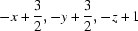
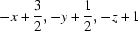
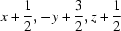
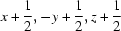
| Symmetry codes: (i) −x+3/2, −y+3/2, −z+1; (ii) −x+3/2, −y+1/2, −z+1; (iii) x+1/2, −y+3/2, z+1/2; (iv) −x+2, −y+2, −z+1; (v) x, −y+1, z+1/2; (vi) x+1/2, −y+1/2, z+1/2; (vii) −x+3/2, y+1/2, −z+1/2. |
Experimental details
| Crystal data | |
| Chemical formula | C3H8N62+·SO42− |
| Mr | 224.21 |
| Crystal system, space group | Monoclinic, C2/c |
| Temperature (K) | 293 |
| a, b, c (Å) | 18.5787 (3), 8.6272 (2), 12.7945 (4) |
| β (°) | 129.739 (1) |
| V (Å3) | 1576.94 (7) |
| Z | 8 |
| Radiation type | Mo Kα |
| µ (mm−1) | 0.42 |
| Crystal size (mm) | 0.32 × 0.27 × 0.26 |
| Data collection | |
| Diffractometer | Bruker APEX2 CCD diffractometer |
| Absorption correction | Multi-scan (APEX2; Bruker, 2005) |
| Tmin, Tmax | 0.879, 0.900 |
| No. of measured, independent and observed [I > 2σ(I)] reflections | 3793, 1794, 1672 |
| Rint | 0.013 |
| (sin θ/λ)max (Å−1) | 0.649 |
| Refinement | |
| R[F2 > 2σ(F2)], wR(F2), S | 0.031, 0.089, 1.00 |
| No. of reflections | 1794 |
| No. of parameters | 136 |
| H-atom treatment | H atoms treated by a mixture of independent and constrained refinement |
| Δρmax, Δρmin (e Å−3) | 0.48, −0.45 |
Computer programs: APEX2 (Bruker, 2005), SIR97 (Altomare et al., 1999), SHELXL97 (Sheldrick, 1997), SHELXTL (Bruker, 1997), WinGX (Farrugia, 1999).
| D—H···A | D—H | H···A | D···A | D—H···A |
| N6—H6···O2i | 0.87 (3) | 1.76 (3) | 2.622 (2) | 171 (3) |
| N5—H5···O4ii | 0.85 (3) | 1.76 (3) | 2.608 (2) | 176 (3) |
| N3—H3B···O2i | 0.86 | 2.59 | 3.244 (2) | 134.1 |
| N3—H3B···O1iii | 0.86 | 2.44 | 2.944 (2) | 117.9 |
| N3—H3A···N4iv | 0.86 | 2.14 | 3.000 (2) | 175.7 |
| N2—H2B···O3i | 0.86 | 1.97 | 2.822 (2) | 172.1 |
| N2—H2A···O3v | 0.86 | 2.02 | 2.836 (2) | 159.0 |
| N1—H1B···O2ii | 0.86 | 1.99 | 2.838 (2) | 168.6 |
| N1—H1A···O1vi | 0.86 | 2.43 | 2.992 (2) | 123.1 |
| N1—H1A···O1vii | 0.86 | 2.11 | 2.887 (2) | 150.7 |
| Symmetry codes: (i) −x+3/2, −y+3/2, −z+1; (ii) −x+3/2, −y+1/2, −z+1; (iii) x+1/2, −y+3/2, z+1/2; (iv) −x+2, −y+2, −z+1; (v) x, −y+1, z+1/2; (vi) x+1/2, −y+1/2, z+1/2; (vii) −x+3/2, y+1/2, −z+1/2. |
Acknowledgements
We thank Professor Wen-Tao Yu and Mr Jian-Dong Fan for the data collection and helpful discussions. This work was supported by the Science and Technology Research Program of the Ministry of Education, China (grant No. 305010).
References
 Altomare, A., Burla, M. C., Camalli, M., Cascarano, G. L., Giacovazzo, C., Guagliardi, A., Moliterni, A. G. G., Polidori, G. & Spagna, R. (1999). J. Appl. Cryst. 32, 115–119. Web of Science CrossRef CAS IUCr Journals Google Scholar
Bruker (1997). SHELXTL. Version 5.1. Bruker AXS Inc., Madison, Wisconsin, USA. Google Scholar
Bruker (2005). APEX2. Version 2.0-2. Bruker AXS Inc., Madison, Wisconsin, USA. Google Scholar
Dewar, M. J. S., Zoebisch, E. G., Healy, E. F. & Stewart, J. J. P. (1985). J. Am. Chem. Soc. 107, 3902–3909. Web of Science CrossRef CAS Google Scholar
Farrugia, L. J. (1999). J. Appl. Cryst. 32, 837–838. CrossRef CAS IUCr Journals Google Scholar
Janczak, J. & Perpétuo, G. J. (2001a). Acta Cryst. C57, 873–875. Web of Science CSD CrossRef CAS IUCr Journals Google Scholar
Janczak, J. & Perpétuo, G. J. (2001b). Acta Cryst. C57, 1431–1433. Web of Science CSD CrossRef CAS IUCr Journals Google Scholar
Martin, A. & Pinkerton, A. A. (1995). Acta Cryst. C51, 2174–2177. CSD CrossRef CAS Web of Science IUCr Journals Google Scholar
Sheldrick, G. M. (1997). SHELXL97. University of Göttingen, Germany. Google Scholar
This is an open-access article distributed under the terms of the Creative Commons Attribution (CC-BY) Licence, which permits unrestricted use, distribution, and reproduction in any medium, provided the original authors and source are cited.
| CRYSTALLOGRAPHIC COMMUNICATIONS |


Salts of melamine and its derivatives can develop supramolecular structures via hydrogen bonding by self assembly. Monoprotonated melaminium sulfate hydrate, (C3H7N6)2 SO4.H2O, has been structurally investigated (Janczak & Perpétuo, 2001b). We present here the solid state structure of anhydrous diprotonated melaminium salt.
The internal C—N—C angle at the protonated N atoms [C2—N6—C3 120.35 (15) ° and C2—N5—C1 120.25 (15) °] is significantly larger than the C—N—C angle at the non-protonated N atom [C1—N4—C3 116.79 (15) °]. These differences are due to the steric effect of the lone-pair electrons and are fully consistent with the valence-shell electron-pair repulsion theory (Janczak & Perpétuo, 2001a). The two shortest bonds [N4—C3 1.333 (2) Å and N4—C1 1.338 (2) Å] are those furthest from the protonated ring N atoms. The two longest bonds [N6—C3 1.367 (2) Å and N5—C1 1.373 (2) Å] are those connected to the shortest bonds. This has the effect of opening up the ring bond angles at atoms C1 and C3, thus creating the largest bond angles in the ring [N4—C3—N6 122.4 (1) ° and N4—C1—N5 122.1 (1) °]. A semi-empirical calculation, with the AM1 parameter set (Dewar et al., 1985) on the melaminium residue diprotonated at two ring N atoms, results in almost the same geometrical features as being found in the title compound. The distortion of the aromatic ring is quite similar to that reported for the melaminium diperchlorate monohydrate salt (Martin & Pinkerton, 1995), as well as for melaminium bis(4-hydroxybenzene-sulfonate) dihydrate (Janczak & Perpétuo, 2001a).
The melaminium residue is involved in eleven hydrogen bonds, two N—H···N bonds with the neighbouring melaminium residue and nine N—H···O bonds with six neighbouring SO42- anions. Two of the SO42- anions are acceptors of two and three hydrogen bonds, respectively, while the other four are acceptors of one hydrogen bond each (Fig. 2). The H atoms at the protonated N atoms of the melaminium residue are involved in almost linear N—H···O hydrogen bonds.
Each SO42- ion is involved as an acceptor in nine hydrogen bonds connecting to six melaminium residues. The O1 and O2 atoms are the most interesting ones as they all accept three hydrogen atoms each. O3 forms two hydrogen bonds with melaminium residues via the H atoms of the amino groups, and O4 forms only one hydrogen bond via H5 atom at the protonated N atom of the melaminium residue.
The melaminium residues are interconnected by two almost linear N—H···N hydrogen bonds and five N—H···O hydrogen bonds. The distance between the centroids of the aromatic rings in adjacent layers (symmetry operator 2 - x, +y, 1.5 - z) is about 3.4 Å, which is much shorter than the maximum distance for the π-π stacking interaction (3.8 Å for centroid-centroid distance), indicating strong π-π stacking interactions. The two-dimensional layers are extensively interconnected by multiple hydrongen bonds with sulfate anions and π-π stacking interactions (Fig. 3).