 | Acta Crystallographica Section E Acta Crystallographica Section E CRYSTALLOGRAPHIC COMMUNICATIONS |


 journal menu


metal-organic compounds
| CRYSTALLOGRAPHIC COMMUNICATIONS |
 access
trans-Tetraaquabis[3-(3-pyridyl)acrylato-κN]cobalt(II)

aDepartment of Chemistry, Faculty of Natural Sciences, University of St. Cyril and Methodius, SK-91701 Trnava, Slovakia, and bDepartment of Inorganic Chemistry, Slovak Technical University, Radlinského 9, SK-812 37 Bratislava, Slovakia
*Correspondence e-mail: [email protected]
The of the title compound, [Co(C8H6NO2)2(H2O)4], contains one half-molecule. The CoII atom lies on an inversion centre and is coordinated by two N atoms of the pyridine rings of 3-(3-pyridyl)acrylate anions and four O atoms of water molecules in a distorted octahedral coordination geometry. In the intermolecular O—H⋯O hydrogen bonds link the molecules, forming a three-dimensional network.
Related literature
For related literature, see: Ayyappan et al. (2001![[Ayyappan, P., Evans, O. R. & Lin, W. (2001). Inorg. Chem. 40, 4627-4632.]](../../../../../../logos/arrows/e_arr.gif "Ayyappan, P., Evans, O. R. & Lin, W. (2001). Inorg. Chem. 40, 4627-4632.") ); Kurmoo et al. (2005); Tong et al. (2003); Zhou et al. (2006); For related structures, see: Huang et al. (2005); Tang et al. (2006); Yang et al. (2006).
); Kurmoo et al. (2005); Tong et al. (2003); Zhou et al. (2006); For related structures, see: Huang et al. (2005); Tang et al. (2006); Yang et al. (2006).
![[Scheme 1]](hk2421scheme1.gif)
Experimental
Crystal data
|
Refinement
|
| |||||||||||||||||||
|
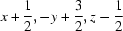 ; (iii)
 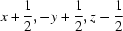 .
. Data collection: XSCANS (Siemens, 1994); cell refinement: XSCANS; data reduction: XSCANS; program(s) used to solve structure: SHELXS97 (Sheldrick, 2008); program(s) used to refine structure: SHELXL97 (Sheldrick, 2008); molecular graphics: ORTEP-3 (Farrugia, 1997); software used to prepare material for publication: enCIFer (Allen et al., 2004).
Supporting information
contains datablocks global, I. DOI: 10.1107/S1600536808002559/hk2421sup1.cif
Structure factors: contains datablock I. DOI: 10.1107/S1600536808002559/hk2421Isup2.hkl
Well shaped crystals of (I) suitable for X-ray analysis were prepared in an H-tube. In the first part of the H-tube, there was aqueous solutions of sodium salt of 3-(3-pyridyl)-acrylic acid and in the second part, there was aquous solution of Co(II) sulfate. The crystals formed after one month, they were separated and dried at room temperature (yield; 75%). The Anal. Calc.: C, 44.98; H, 6.61; N, 6.56; Co, 13.79; Found: C, 44.72; H, 6.31; N, 6.40; Co, 13.45. IR data (KBr) cm-1: 1646m ν(C?C); 1547vs νas(COO-); 1371vs,br νs(COO-); 649m δ(py); 415m χ(py). Electronic data (cm-1): 20200; 21200s h; 9100br.
H atoms were positioned geometrically with O—H = 0.82 Å (for OH2 and their displacement parameters were kept fixed as Uiso = 0.032 Å2) and C—H = 0.93 Å, for aromatic H atoms and constrained to ride on their parent atoms, with Uiso(H) = 1.2Ueq(C).
Data collection: XSCANS (Siemens, 1994); cell XSCANS (Siemens, 1994); data reduction: XSCANS (Siemens, 1994); program(s) used to solve structure: SHELXS97 (Sheldrick, 2008); program(s) used to refine structure: SHELXL97 (Sheldrick, 2008); molecular graphics: ORTEP-3 (Farrugia, 1997); software used to prepare material for publication: enCIFer (Allen et al., 2004).
![[Figure 1]](./hk2421fig1thm.gif) | Fig. 1. The molecular structure of the title molecule, with the atom-numbering scheme. Displacement ellipsoids are drawn at the 50% probability level |
![[Figure 2]](./hk2421fig2thm.gif) | Fig. 2. A packing diagram of (I). Hydrogen bonds are shown as dashed lines [symmetry codes: (i) -x, -y + 1, -z + 1; (ii) x + 1/2, -y + 3/2, z - 1/2; (iii) x + 1/2, -y + 1/2, z - 1/2]. |
| [Co(C8H6NO2)2(H2O)4] | F(000) = 442 |
| Mr = 427.27 | Dx = 1.625 Mg m−3 |
| Monoclinic, P21/n | Mo Kα radiation, λ = 0.71073 Å |
| Hall symbol: -P 2yn | Cell parameters from 25 reflections |
| a = 11.235 (1) Å | θ = 2.5–8.7° |
| b = 7.020 (1) Å | µ = 1.03 mm−1 |
| c = 12.012 (1) Å | T = 294 K |
| β = 112.81 (1)° | Block, pink |
| V = 873.29 (18) Å3 | 0.40 × 0.25 × 0.20 mm |
| Z = 2 |
| Siemens P4 diffractometer | 2255 reflections with I > 2σ(I) |
| Radiation source: fine-focus sealed tube | Rint = 0.030 |
| Graphite monochromator | θmax = 30.0°, θmin = 2.1° |
| 2θ/ω scans | h = −1→15 |
| Absorption correction: ψ scan (XEMP; Siemens, 1994) | k = −1→9 |
| Tmin = 0.672, Tmax = 0.808 | l = −16→15 |
| 3307 measured reflections | 3 standard reflections every 97 reflections |
| 2533 independent reflections | intensity decay: 2.5% |
| Refinement on F2 | Primary atom site location: structure-invariant direct methods |
| Least-squares matrix: full | Secondary atom site location: difference Fourier map |
| R[F2 > 2σ(F2)] = 0.038 | Hydrogen site location: inferred from neighbouring sites |
| wR(F2) = 0.156 | H-atom parameters constrained |
| S = 1.10 | w = 1/[σ2(Fo2) + (0.1034P)2 + 0.5011P] where P = (Fo2 + 2Fc2)/3 |
| 2533 reflections | (Δ/σ)max < 0.001 |
| 124 parameters | Δρmax = 0.65 e Å−3 |
| 0 restraints | Δρmin = −0.84 e Å−3 |
| [Co(C8H6NO2)2(H2O)4] | V = 873.29 (18) Å3 |
| Mr = 427.27 | Z = 2 |
| Monoclinic, P21/n | Mo Kα radiation |
| a = 11.235 (1) Å | µ = 1.03 mm−1 |
| b = 7.020 (1) Å | T = 294 K |
| c = 12.012 (1) Å | 0.40 × 0.25 × 0.20 mm |
| β = 112.81 (1)° |
| Siemens P4 diffractometer | 2255 reflections with I > 2σ(I) |
| Absorption correction: ψ scan (XEMP; Siemens, 1994) | Rint = 0.030 |
| Tmin = 0.672, Tmax = 0.808 | 3 standard reflections every 97 reflections |
| 3307 measured reflections | intensity decay: 2.5% |
| 2533 independent reflections |
| R[F2 > 2σ(F2)] = 0.038 | 0 restraints |
| wR(F2) = 0.156 | H-atom parameters constrained |
| S = 1.10 | Δρmax = 0.65 e Å−3 |
| 2533 reflections | Δρmin = −0.84 e Å−3 |
| 124 parameters |
Geometry. All e.s.d.'s (except the e.s.d. in the dihedral angle between two l.s. planes) are estimated using the full covariance matrix. The cell e.s.d.'s are taken into account individually in the estimation of e.s.d.'s in distances, angles and torsion angles; correlations between e.s.d.'s in cell parameters are only used when they are defined by crystal symmetry. An approximate (isotropic) treatment of cell e.s.d.'s is used for estimating e.s.d.'s involving l.s. planes. |
Refinement. Refinement of F2 against ALL reflections. The weighted R-factor wR and goodness of fit S are based on F2, conventional R-factors R are based on F, with F set to zero for negative F2. The threshold expression of F2 > σ(F2) is used only for calculating R-factors(gt) etc. and is not relevant to the choice of reflections for refinement. R-factors based on F2 are statistically about twice as large as those based on F, and R- factors based on ALL data will be even larger. |
| x | y | z | Uiso*/Ueq | ||
| Co | 0.5000 | 0.5000 | 0.5000 | 0.01873 (16) | |
| N1 | 0.44388 (17) | 0.5543 (3) | 0.65137 (17) | 0.0228 (4) | |
| O1 | −0.13338 (15) | 0.6559 (3) | 0.61120 (16) | 0.0328 (4) | |
| O2 | −0.12936 (18) | 0.5143 (2) | 0.77834 (18) | 0.0264 (4) | |
| O1W | 0.38329 (15) | 0.2573 (2) | 0.45303 (14) | 0.0257 (3) | |
| H1W | 0.3959 | 0.1739 | 0.4111 | 0.032* | |
| H2W | 0.3072 | 0.2884 | 0.4306 | 0.032* | |
| O2W | 0.33927 (15) | 0.6646 (2) | 0.39394 (15) | 0.0270 (3) | |
| H3W | 0.2800 | 0.6092 | 0.3407 | 0.032* | |
| H4W | 0.3567 | 0.7701 | 0.3751 | 0.032* | |
| C1 | 0.3185 (2) | 0.5672 (3) | 0.63318 (19) | 0.0236 (4) | |
| H1 | 0.2578 | 0.5545 | 0.5546 | 0.028* | |
| C2 | 0.27363 (19) | 0.5986 (3) | 0.72477 (19) | 0.0217 (4) | |
| C3 | 0.3653 (2) | 0.6228 (3) | 0.84170 (19) | 0.0248 (4) | |
| H3 | 0.3400 | 0.6463 | 0.9055 | 0.030* | |
| C4 | 0.4946 (2) | 0.6114 (4) | 0.86108 (19) | 0.0273 (4) | |
| H4 | 0.5574 | 0.6271 | 0.9384 | 0.033* | |
| C5 | 0.5303 (2) | 0.5765 (3) | 0.7649 (2) | 0.0243 (4) | |
| H5 | 0.6177 | 0.5681 | 0.7795 | 0.029* | |
| C6 | 0.1337 (2) | 0.6061 (3) | 0.69088 (19) | 0.0238 (4) | |
| H6 | 0.0838 | 0.6301 | 0.6100 | 0.029* | |
| C7 | 0.0699 (2) | 0.5824 (3) | 0.7628 (2) | 0.0249 (4) | |
| H7 | 0.1153 | 0.5635 | 0.8452 | 0.030* | |
| C8 | −0.07372 (19) | 0.5859 (3) | 0.71227 (19) | 0.0216 (4) |
| U11 | U22 | U33 | U12 | U13 | U23 | |
| Co | 0.0127 (2) | 0.0260 (2) | 0.0190 (2) | −0.00015 (12) | 0.00773 (16) | −0.00068 (12) |
| N1 | 0.0157 (8) | 0.0320 (9) | 0.0231 (8) | −0.0009 (7) | 0.0103 (6) | −0.0001 (7) |
| O1 | 0.0190 (7) | 0.0495 (10) | 0.0296 (8) | −0.0006 (7) | 0.0091 (6) | 0.0048 (7) |
| O2 | 0.0215 (8) | 0.0310 (9) | 0.0317 (9) | −0.0023 (6) | 0.0158 (7) | −0.0007 (6) |
| O1W | 0.0187 (7) | 0.0311 (8) | 0.0281 (8) | −0.0023 (6) | 0.0098 (6) | −0.0046 (6) |
| O2W | 0.0178 (7) | 0.0323 (8) | 0.0292 (8) | −0.0012 (6) | 0.0072 (6) | 0.0063 (6) |
| C1 | 0.0155 (8) | 0.0353 (11) | 0.0219 (9) | −0.0015 (8) | 0.0092 (7) | −0.0026 (8) |
| C2 | 0.0167 (8) | 0.0272 (9) | 0.0240 (9) | −0.0002 (7) | 0.0108 (7) | −0.0010 (7) |
| C3 | 0.0220 (9) | 0.0341 (11) | 0.0209 (9) | 0.0016 (8) | 0.0111 (8) | −0.0010 (8) |
| C4 | 0.0205 (9) | 0.0390 (11) | 0.0204 (9) | 0.0006 (8) | 0.0058 (7) | −0.0017 (8) |
| C5 | 0.0166 (9) | 0.0301 (11) | 0.0265 (10) | −0.0004 (8) | 0.0086 (8) | −0.0012 (8) |
| C6 | 0.0168 (8) | 0.0306 (10) | 0.0252 (9) | 0.0005 (7) | 0.0097 (7) | −0.0011 (8) |
| C7 | 0.0169 (9) | 0.0337 (11) | 0.0256 (9) | −0.0012 (8) | 0.0098 (7) | −0.0030 (8) |
| C8 | 0.0179 (8) | 0.0248 (9) | 0.0252 (9) | −0.0014 (7) | 0.0117 (7) | −0.0046 (7) |
| Co—O1Wi | 2.0895 (16) | C1—C2 | 1.394 (3) |
| Co—O1W | 2.0895 (16) | C1—H1 | 0.9300 |
| Co—O2Wi | 2.1061 (16) | C2—C3 | 1.393 (3) |
| Co—O2W | 2.1061 (16) | C2—C6 | 1.465 (3) |
| Co—N1i | 2.1765 (18) | C3—C4 | 1.382 (3) |
| Co—N1 | 2.1765 (18) | C3—H3 | 0.9300 |
| N1—C5 | 1.342 (3) | C4—C5 | 1.384 (3) |
| N1—C1 | 1.343 (3) | C4—H4 | 0.9300 |
| O1—C8 | 1.238 (3) | C5—H5 | 0.9300 |
| O2—C8 | 1.288 (3) | C6—C7 | 1.329 (3) |
| O1W—H1W | 0.82 | C6—H6 | 0.9300 |
| O1W—H2W | 0.82 | C7—C8 | 1.488 (3) |
| O2W—H3W | 0.82 | C7—H7 | 0.9300 |
| O2W—H4W | 0.82 | ||
| O1Wi—Co—O1W | 180.0 | N1—C1—C2 | 124.1 (2) |
| O1Wi—Co—O2Wi | 89.02 (6) | N1—C1—H1 | 118.0 |
| O1W—Co—O2Wi | 90.98 (6) | C2—C1—H1 | 118.0 |
| O1Wi—Co—O2W | 90.98 (6) | C3—C2—C1 | 117.57 (19) |
| O1W—Co—O2W | 89.02 (6) | C3—C2—C6 | 124.77 (18) |
| O2Wi—Co—O2W | 180.0 | C1—C2—C6 | 117.65 (19) |
| O1Wi—Co—N1i | 90.78 (7) | C4—C3—C2 | 118.75 (19) |
| O1W—Co—N1i | 89.22 (7) | C4—C3—H3 | 120.6 |
| O2Wi—Co—N1i | 87.20 (7) | C2—C3—H3 | 120.6 |
| O2W—Co—N1i | 92.80 (7) | C3—C4—C5 | 119.7 (2) |
| O1Wi—Co—N1 | 89.22 (7) | C3—C4—H4 | 120.1 |
| O1W—Co—N1 | 90.78 (7) | C5—C4—H4 | 120.1 |
| O2Wi—Co—N1 | 92.80 (7) | N1—C5—C4 | 122.64 (19) |
| O2W—Co—N1 | 87.20 (7) | N1—C5—H5 | 118.7 |
| N1i—Co—N1 | 180.0 | C4—C5—H5 | 118.7 |
| C5—N1—C1 | 117.26 (18) | C7—C6—C2 | 127.3 (2) |
| C5—N1—Co | 122.64 (14) | C7—C6—H6 | 116.4 |
| C1—N1—Co | 120.10 (14) | C2—C6—H6 | 116.4 |
| Co—O1W—H1W | 120.6 | C6—C7—C8 | 120.3 (2) |
| Co—O1W—H2W | 109.7 | C6—C7—H7 | 119.8 |
| H1W—O1W—H2W | 113.2 | C8—C7—H7 | 119.8 |
| Co—O2W—H3W | 117.2 | O1—C8—O2 | 123.5 (2) |
| Co—O2W—H4W | 114.9 | O1—C8—C7 | 119.73 (19) |
| H3W—O2W—H4W | 115.0 | O2—C8—C7 | 116.8 (2) |
| O1Wi—Co—N1—C5 | −54.14 (19) | C1—C2—C3—C4 | −1.1 (3) |
| O1W—Co—N1—C5 | 125.86 (19) | C6—C2—C3—C4 | 179.7 (2) |
| O2Wi—Co—N1—C5 | 34.84 (19) | C2—C3—C4—C5 | 0.0 (4) |
| O2W—Co—N1—C5 | −145.16 (19) | C1—N1—C5—C4 | 0.0 (4) |
| O1Wi—Co—N1—C1 | 125.68 (19) | Co—N1—C5—C4 | 179.86 (18) |
| O1W—Co—N1—C1 | −54.32 (19) | C3—C4—C5—N1 | 0.5 (4) |
| O2Wi—Co—N1—C1 | −145.34 (19) | C3—C2—C6—C7 | −20.7 (4) |
| O2W—Co—N1—C1 | 34.66 (19) | C1—C2—C6—C7 | 160.2 (2) |
| C5—N1—C1—C2 | −1.2 (4) | C2—C6—C7—C8 | −177.2 (2) |
| Co—N1—C1—C2 | 178.93 (18) | C6—C7—C8—O1 | −17.7 (3) |
| N1—C1—C2—C3 | 1.8 (4) | C6—C7—C8—O2 | 162.4 (2) |
| N1—C1—C2—C6 | −179.0 (2) |
| Symmetry code: (i) −x+1, −y+1, −z+1. |
| D—H···A | D—H | H···A | D···A | D—H···A |
| O2W—H3W···O2ii | 0.82 | 1.95 | 2.764 (3) | 175 |
| O2W—H4W···O2iii | 0.82 | 1.95 | 2.741 (2) | 161 |
| O1W—H2W···O1ii | 0.82 | 1.86 | 2.678 (2) | 175 |
| O1W—H1W···O2iv | 0.82 | 2.00 | 2.798 (2) | 163 |
| Symmetry codes: (ii) −x, −y+1, −z+1; (iii) x+1/2, −y+3/2, z−1/2; (iv) x+1/2, −y+1/2, z−1/2. |
Experimental details
| Crystal data | |
| Chemical formula | [Co(C8H6NO2)2(H2O)4] |
| Mr | 427.27 |
| Crystal system, space group | Monoclinic, P21/n |
| Temperature (K) | 294 |
| a, b, c (Å) | 11.235 (1), 7.020 (1), 12.012 (1) |
| β (°) | 112.81 (1) |
| V (Å3) | 873.29 (18) |
| Z | 2 |
| Radiation type | Mo Kα |
| µ (mm−1) | 1.03 |
| Crystal size (mm) | 0.40 × 0.25 × 0.20 |
| Data collection | |
| Diffractometer | Siemens P4 diffractometer |
| Absorption correction | ψ scan (XEMP; Siemens, 1994) |
| Tmin, Tmax | 0.672, 0.808 |
| No. of measured, independent and observed [I > 2σ(I)] reflections | 3307, 2533, 2255 |
| Rint | 0.030 |
| (sin θ/λ)max (Å−1) | 0.703 |
| Refinement | |
| R[F2 > 2σ(F2)], wR(F2), S | 0.038, 0.156, 1.10 |
| No. of reflections | 2533 |
| No. of parameters | 124 |
| H-atom treatment | H-atom parameters constrained |
| Δρmax, Δρmin (e Å−3) | 0.65, −0.84 |
Computer programs: XSCANS (Siemens, 1994), SHELXS97 (Sheldrick, 2008), SHELXL97 (Sheldrick, 2008), ORTEP-3 (Farrugia, 1997), enCIFer (Allen et al., 2004).
| Co—O1W | 2.0895 (16) | Co—N1 | 2.1765 (18) |
| Co—O2W | 2.1061 (16) | ||
| O1W—Co—O2W | 89.02 (6) | O2W—Co—N1 | 87.20 (7) |
| O1W—Co—N1 | 90.78 (7) |
| D—H···A | D—H | H···A | D···A | D—H···A |
| O2W—H3W···O2i | 0.82 | 1.95 | 2.764 (3) | 174.8 |
| O2W—H4W···O2ii | 0.82 | 1.95 | 2.741 (2) | 161.4 |
| O1W—H2W···O1i | 0.82 | 1.86 | 2.678 (2) | 175.2 |
| O1W—H1W···O2iii | 0.82 | 2.00 | 2.798 (2) | 162.7 |
| Symmetry codes: (i) −x, −y+1, −z+1; (ii) x+1/2, −y+3/2, z−1/2; (iii) x+1/2, −y+1/2, z−1/2. |
Acknowledgements
We thank the Scientific Grant Agency of the Ministry of Education of the Slovak Republic and the Slovak Academy of Sciences (grant Nos. 1/4454/07 and 1/0353/08).
References
 Allen, F. H., Johnson, O., Shields, G. P., Smith, B. R. & Towler, M. (2004). J. Appl. Cryst. 37, 335–338. Web of Science CrossRef CAS IUCr Journals Google Scholar
Ayyappan, P., Evans, O. R. & Lin, W. (2001). Inorg. Chem. 40, 4627–4632. Web of Science CSD CrossRef PubMed CAS Google Scholar
Farrugia, L. J. (1997). J. Appl. Cryst. 30, 565. CrossRef IUCr Journals Google Scholar
Huang, Y.-G., Zhou, Y.-F., Wu, B.-L., Han, L., Yuan, D.-Q., Lou, B.-Q. & Hong, M.-C. (2005). Chin. J. Struct. Chem. 24, 1123–1128. CAS Google Scholar
Kurmoo, M., Rstournes, C., Oka, Y., Kumagai, H. & Inoue, K. (2005). Inorg. Chem. 44, 217–224. Web of Science CSD CrossRef PubMed CAS Google Scholar
Sheldrick, G. M. (2008). Acta Cryst. A64, 112–122. Web of Science CrossRef CAS IUCr Journals Google Scholar
Siemens (1994). XSCANS and XEMP. Siemens Analytical X-ray Instruments Inc., Madison, Wisconsin, USA. Google Scholar
Tang, L., Li, D.-S., Fu, F., Li, J., Zhao, X.-Z. & Wang, J.-W. (2006). Z. Kristallogr. New Cryst. Struct. 221, 441–442. CAS Google Scholar
Tong, M.-L., Chen, X.-M. & Batten, S. R. (2003). J. Am. Chem. Soc. 125, 16170–16171. Web of Science CSD CrossRef PubMed CAS Google Scholar
Yang, E., Chen, Q.-Y. & Chen, G.-Y. (2006). Acta Cryst. E62, m1043–m1044. Web of Science CSD CrossRef IUCr Journals Google Scholar
Zhou, Q.-X., Bai, X.-J. & Chen, L.-P. (2006). Chin. J. Struct. Chem. 25, 49–52. Google Scholar
This is an open-access article distributed under the terms of the Creative Commons Attribution (CC-BY) Licence, which permits unrestricted use, distribution, and reproduction in any medium, provided the original authors and source are cited.
| CRYSTALLOGRAPHIC COMMUNICATIONS |


Several CoII coordination polymers that contain a bridging 3-(3-pyridyl) -acrylate ligands have been reported recently (Ayyappan et al., 2001; Kurmoo et al., 2005; Tong et al., 2003; Zhou et al., 2006). However, if the 3-(3-pyridyl)-acrylate anions are coordinated only as terminal ligands, the possibility of participating in a hydrogen-bonding network originates. As part of our efforts to investigate metal(II) complexes based on pyridyl- carboxylic acids, we report herein the crystal structure of the title compound, (I).
In the molecule of the title compound, (I), (Fig. 1) CoII atom lies on an inversion centre and adopts a distorted octahedral coordination geometry with two N atoms of the pyridine rings of 3-(3-pyridyl)-acrylate anions and four O atoms of water molecules (Table 1), where the two symmetry related 3-(3-pyridyl)-acrylate ligands are in trans positions.
The bond lengths and angles may be compared with the corresponding values in [Co(C8H6NO2)2(H2O)4].2H2O [(II); Huang et al., 2005]. In (II), CoII atom displays a similar distorted octahedral coordination geometry, but the existence of two more water molecules result in the formation of a different hydrogen-bonding network. On the other hand, complex (I) is isostructural with [Zn(C8H6NO2)2(H2O)4] [(III); Tang et al., 2006; Yang et al., 2006] and [Mn(C8H6NO2)2(H2O)4] [(IV); Huang et al., 2005].
In the crystal structure, intermolecular O—H···O hydrogen bonds (Table 2) link the molecules to form a three-dimensional network.