 | Acta Crystallographica Section E Acta Crystallographica Section E CRYSTALLOGRAPHIC COMMUNICATIONS |


 journal menu


metal-organic compounds
| CRYSTALLOGRAPHIC COMMUNICATIONS |
 access
Dichlorido{2-hydroxyimino-N′-[1-(2-pyridyl)ethylidene]propanohydrazide-κ3N,N′,O}zinc(II) hemihydrate

aNational Taras Shevchenko University, Department of Chemistry, Volodymyrska str. 64, 01033 Kyiv, Ukraine, and bFaculty of Chemistry, University of Wrocław, 14 F. Joliot-Curie str., 50-383 Wrocław, Poland
*Correspondence e-mail: [email protected]
The title compound, [ZnCl2(C10H12N4O2)]·0.5H2O, was readily prepared by the reaction between ZnCl2 and 2-hydroxyimino-N′-[1-(2-pyridyl)ethylidene]propanohydrazide. The Zn atom has a distorted trigonal–bipyramidal geometry with two Cl atoms and one azomethine N atom in the equatorial plane and one pyridine N atom and one amide O atom in the axial positions. In the crystal structure, complex molecules are connected in pairs by N—H⋯Cl hydrogen bonds, formed between the amide NH of one molecule and the Cl atom of a neighboring one. Molecular pairs are connected by hydrogen bonds involving the uncoordinated water molecule, which lies on a twofold axis.
Related literature
For details of the structure and biological activity of zinc(II) complexes, see: Canary et al. (1998![[Canary, J. W., Allen, C. S., Castagnetto, J. M., Chiu, Y. H., Toscano, P. J. & Wang, Y. H. (1998). Inorg. Chem. 37, 6255-6262.]](../../../../../../logos/arrows/e_arr.gif "Canary, J. W., Allen, C. S., Castagnetto, J. M., Chiu, Y. H., Toscano, P. J. & Wang, Y. H. (1998). Inorg. Chem. 37, 6255-6262.") ); Comba et al. (2002); Kasuga et al. (2003); Panosyan et al. (2003); Rodriuez-Argüelles et al. (1995); Sousa et al. (2003). For the preparation of 2-(oximato)propanehydrazide, see: Fritsky et al. (1998).
); Comba et al. (2002); Kasuga et al. (2003); Panosyan et al. (2003); Rodriuez-Argüelles et al. (1995); Sousa et al. (2003). For the preparation of 2-(oximato)propanehydrazide, see: Fritsky et al. (1998).
![[Scheme 1]](hy2108scheme1.gif)
Experimental
Crystal data
|
Refinement
|
| |||||||||||||||||||||
|
 ; (ii)
 Data collection: KM-4 CCD Software (Kuma, 1999); cell refinement: SAINT (Bruker, 1999); data reduction: SAINT; program(s) used to solve structure: SHELXS97 (Sheldrick, 1997); program(s) used to refine structure: SHELXL97 (Sheldrick, 1997); molecular graphics: ORTEP-3 for Windows (Farrugia, 1997); software used to prepare material for publication: WinGX (Farrugia, 1999).
Supporting information
contains datablocks I, global. DOI: 10.1107/S160053680706535X/hy2108sup1.cif
Structure factors: contains datablock I. DOI: 10.1107/S160053680706535X/hy2108Isup2.hkl
2-(Oximato)-N'-(1-(pyridin-2-yl)ethylidene)propanehydrazide (L) was prepared according to early reported method (Fritsky et al., 1998). 2-Acetylpyridine (1.2 ml, 0.0107 mol) was added to a stirred warm ethanol/water solution (20 ml) of 2-(oximato)propanehydrazide (1.17 g, 0.01 mol). After stirring at 333 k for 6 h, the solution was cooled and a white precipitate was formed immediately. It was filtered off, washed with water and acetone and dried under vacuum (yield 72%, 1.59 g). 1H NMR, 400.13 MHz, (DMSO-d6): 12.118 (s, 1H, N—OH), 10.242 (s, 1H, NH), 8.608 (dt, 1H, py-6, J6,5 = 4.8 Hz, J6,4 = 1.8 Hz), 8.066 (d, 1H, py-3, J3,4 = 7.8 Hz), 7.861 (td, 1H, py-4, J4,5,3 = 7.8 Hz, J4,6 = 1.8 Hz), 7.415 (ddd, 1H, py-5, J5,6 = 4.8 Hz, J5,4 = 7.8 Hz, J = 1.2 Hz), 2.376 (s, 3H, CH3(py)), 1.985(s, 3H, CH3). IR (KBr, cm-1): 1660 (COamid), 1030 (NOoxim), 3340 (NHas). Analysis calculated for C10H12N4O2: C 54.54, H 5.49, N 25.44%; found: C 54.41, H 5.62, N 25.42%.
Zinc(II) chloride (0.014 g, 0.1 mmol) in H2O (5 ml) was added to 10 ml of hot methanol solution of L (0.022 g, 0.1 mmol). The solution was left for slow evaporation at room temperature. After 5 days cubic crystals of the title compound suitable for X-ray analysis were obtained.
H atoms on C atoms were positioned geometrically and refined as riding atoms, with C—H = 0.93Å (CH) and 0.96Å (CH3), and with Uiso(H) = 1.2Ueq(C) for aromatic and Uiso(H) = 1.5Ueq(C) for methyl group. H atoms on N and O atoms were located from a difference Fourier map and were refined isotropically.
Data collection: KM-4 CCD Software (Kuma, 1999); cell SAINT (Bruker, 1999); data reduction: SAINT (Bruker, 1999); program(s) used to solve structure: SHELXS97 (Sheldrick, 1997); program(s) used to refine structure: SHELXL97 (Sheldrick, 1997); molecular graphics: ORTEP-3 for Windows (Farrugia, 1997); software used to prepare material for publication: WinGX (Farrugia, 1999).
![[Figure 1]](./hy2108fig1thm.gif) | Fig. 1. The molecular structure of the title compound. Displacement ellipsoids are shown at the 40% probability level. Water molecule is not shown. |
![[Figure 2]](./hy2108fig2thm.gif) | Fig. 2. A view of a pair of the complex molecules. Displacement ellipsoids are shown at the 40% probability level. Hydrogen bonds are indicated by dashed lines. |
![[Figure 3]](./hy2108fig3thm.gif) | Fig. 3. A packing diagram of the title compound along the b-axis direction. Hydrogen bonds are indicated by dashed lines. H atoms have been omitted for clarity. |
| [ZnCl2(C10H12N4O2)]·0.5H2O | F(000) = 1480 |
| Mr = 365.51 | Dx = 1.720 Mg m−3 |
| Monoclinic, C2/c | Mo Kα radiation, λ = 0.71073 Å |
| Hall symbol: -C 2yc | Cell parameters from 3373 reflections |
| a = 14.5666 (8) Å | θ = 3.1–28.5° |
| b = 12.9898 (8) Å | µ = 2.13 mm−1 |
| c = 15.8671 (8) Å | T = 100 K |
| β = 109.873 (5)° | Cubic, yellow |
| V = 2823.5 (3) Å3 | 0.5 × 0.1 × 0.05 mm |
| Z = 8 |
| Kum KM4 CCD area-detector diffractometer | 3373 independent reflections |
| Radiation source: fine-focus sealed tube | 3069 reflections with I > 2σ(I) |
| Graphite monochromator | Rint = 0.043 |
| ω scans | θmax = 28.5°, θmin = 3.1° |
| Absorption correction: multi-scan (PLATON; Spek, 2003) | h = −19→19 |
| Tmin = 0.774, Tmax = 0.891 | k = −16→16 |
| 17382 measured reflections | l = −20→21 |
| Refinement on F2 | Primary atom site location: structure-invariant direct methods |
| Least-squares matrix: full | Secondary atom site location: difference Fourier map |
| R[F2 > 2σ(F2)] = 0.037 | Hydrogen site location: inferred from neighbouring sites |
| wR(F2) = 0.070 | H atoms treated by a mixture of independent and constrained refinement |
| S = 1.21 | w = 1/[σ2(Fo2) + (0.0282P)2 + 3.185P] where P = (Fo2 + 2Fc2)/3 |
| 3373 reflections | (Δ/σ)max = 0.002 |
| 191 parameters | Δρmax = 0.45 e Å−3 |
| 0 restraints | Δρmin = −0.37 e Å−3 |
| [ZnCl2(C10H12N4O2)]·0.5H2O | V = 2823.5 (3) Å3 |
| Mr = 365.51 | Z = 8 |
| Monoclinic, C2/c | Mo Kα radiation |
| a = 14.5666 (8) Å | µ = 2.13 mm−1 |
| b = 12.9898 (8) Å | T = 100 K |
| c = 15.8671 (8) Å | 0.5 × 0.1 × 0.05 mm |
| β = 109.873 (5)° |
| Kum KM4 CCD area-detector diffractometer | 3373 independent reflections |
| Absorption correction: multi-scan (PLATON; Spek, 2003) | 3069 reflections with I > 2σ(I) |
| Tmin = 0.774, Tmax = 0.891 | Rint = 0.043 |
| 17382 measured reflections |
| R[F2 > 2σ(F2)] = 0.037 | 0 restraints |
| wR(F2) = 0.070 | H atoms treated by a mixture of independent and constrained refinement |
| S = 1.21 | Δρmax = 0.45 e Å−3 |
| 3373 reflections | Δρmin = −0.37 e Å−3 |
| 191 parameters |
| x | y | z | Uiso*/Ueq | ||
| C1 | 0.8446 (2) | 0.45584 (19) | 0.90460 (16) | 0.0300 (6) | |
| H1A | 0.8849 | 0.3958 | 0.9225 | 0.045* | |
| H1B | 0.8500 | 0.4827 | 0.8501 | 0.045* | |
| H1C | 0.7778 | 0.4378 | 0.8949 | 0.045* | |
| C2 | 0.87720 (17) | 0.53560 (17) | 0.97658 (14) | 0.0155 (4) | |
| C3 | 0.86291 (17) | 0.64543 (17) | 0.95017 (14) | 0.0149 (4) | |
| C4 | 0.89866 (16) | 0.89516 (17) | 1.03894 (14) | 0.0127 (4) | |
| C5 | 0.96032 (18) | 0.89213 (18) | 1.13564 (14) | 0.0187 (5) | |
| H5A | 0.9937 | 0.8272 | 1.1490 | 0.028* | |
| H5B | 0.9197 | 0.9003 | 1.1718 | 0.028* | |
| H5C | 1.0073 | 0.9469 | 1.1483 | 0.028* | |
| C6 | 0.86661 (16) | 0.99579 (17) | 0.99301 (14) | 0.0124 (4) | |
| C7 | 0.89136 (17) | 1.08943 (18) | 1.03628 (15) | 0.0163 (5) | |
| H7 | 0.9293 | 1.0921 | 1.0967 | 0.020* | |
| C8 | 0.85855 (19) | 1.17985 (18) | 0.98807 (16) | 0.0194 (5) | |
| H8 | 0.8745 | 1.2437 | 1.0157 | 0.023* | |
| C9 | 0.80194 (19) | 1.17314 (18) | 0.89857 (16) | 0.0203 (5) | |
| H9 | 0.7788 | 1.2323 | 0.8650 | 0.024* | |
| C10 | 0.78027 (17) | 1.07659 (18) | 0.85973 (15) | 0.0181 (5) | |
| H10 | 0.7424 | 1.0722 | 0.7994 | 0.022* | |
| N1 | 0.81153 (14) | 0.98950 (15) | 0.90538 (12) | 0.0140 (4) | |
| N2 | 0.86837 (14) | 0.81687 (14) | 0.98712 (12) | 0.0127 (4) | |
| N3 | 0.88998 (14) | 0.71758 (14) | 1.01651 (13) | 0.0144 (4) | |
| N4 | 0.91703 (14) | 0.51964 (14) | 1.06044 (12) | 0.0161 (4) | |
| O1 | 0.82753 (14) | 0.67055 (12) | 0.87067 (10) | 0.0213 (4) | |
| O2 | 0.92836 (13) | 0.41557 (13) | 1.08008 (11) | 0.0211 (4) | |
| Cl2 | 0.88241 (4) | 0.85938 (4) | 0.75864 (3) | 0.01726 (13) | |
| Cl3 | 0.63307 (4) | 0.81753 (5) | 0.78506 (4) | 0.01874 (13) | |
| Zn1 | 0.793127 (19) | 0.838156 (19) | 0.848619 (16) | 0.01239 (8) | |
| H1 | 0.954 (3) | 0.413 (3) | 1.139 (2) | 0.048 (10)* | |
| O1W | 0.0000 | 0.34448 (19) | 0.2500 | 0.0206 (5) | |
| H1W | 0.045 (2) | 0.308 (3) | 0.250 (2) | 0.048 (11)* | |
| H2 | 0.905 (2) | 0.699 (2) | 1.068 (2) | 0.024 (8)* |
| U11 | U22 | U33 | U12 | U13 | U23 | |
| C1 | 0.0471 (17) | 0.0123 (12) | 0.0180 (12) | −0.0014 (11) | −0.0052 (11) | −0.0005 (9) |
| C2 | 0.0178 (11) | 0.0114 (11) | 0.0162 (11) | −0.0004 (9) | 0.0045 (9) | 0.0004 (8) |
| C3 | 0.0163 (11) | 0.0135 (11) | 0.0150 (10) | −0.0008 (9) | 0.0054 (9) | −0.0011 (8) |
| C4 | 0.0134 (11) | 0.0124 (11) | 0.0129 (10) | −0.0022 (8) | 0.0054 (8) | −0.0001 (8) |
| C5 | 0.0235 (13) | 0.0145 (12) | 0.0138 (10) | −0.0020 (9) | 0.0005 (9) | 0.0002 (9) |
| C6 | 0.0122 (10) | 0.0130 (11) | 0.0135 (10) | 0.0006 (8) | 0.0063 (8) | 0.0016 (8) |
| C7 | 0.0181 (12) | 0.0163 (11) | 0.0141 (10) | −0.0019 (9) | 0.0050 (9) | −0.0016 (8) |
| C8 | 0.0256 (13) | 0.0108 (11) | 0.0220 (12) | −0.0017 (9) | 0.0086 (10) | −0.0027 (9) |
| C9 | 0.0243 (13) | 0.0140 (12) | 0.0211 (12) | 0.0019 (9) | 0.0058 (10) | 0.0033 (9) |
| C10 | 0.0196 (12) | 0.0179 (12) | 0.0152 (11) | 0.0031 (9) | 0.0039 (9) | 0.0019 (9) |
| N1 | 0.0153 (9) | 0.0132 (9) | 0.0130 (9) | −0.0003 (7) | 0.0042 (7) | −0.0008 (7) |
| N2 | 0.0150 (9) | 0.0103 (9) | 0.0130 (9) | 0.0011 (7) | 0.0051 (7) | 0.0016 (7) |
| N3 | 0.0202 (10) | 0.0115 (9) | 0.0097 (9) | −0.0001 (8) | 0.0028 (8) | 0.0021 (7) |
| N4 | 0.0208 (10) | 0.0103 (9) | 0.0169 (9) | 0.0011 (8) | 0.0062 (8) | 0.0019 (7) |
| O1 | 0.0333 (10) | 0.0136 (8) | 0.0122 (7) | 0.0026 (7) | 0.0015 (7) | 0.0002 (6) |
| O2 | 0.0322 (10) | 0.0126 (8) | 0.0164 (8) | 0.0014 (7) | 0.0054 (7) | 0.0043 (6) |
| Cl2 | 0.0152 (3) | 0.0210 (3) | 0.0172 (3) | −0.0004 (2) | 0.0076 (2) | −0.0007 (2) |
| Cl3 | 0.0154 (3) | 0.0255 (3) | 0.0158 (3) | −0.0057 (2) | 0.0059 (2) | −0.0026 (2) |
| Zn1 | 0.01436 (14) | 0.01195 (13) | 0.01015 (12) | −0.00066 (10) | 0.00323 (9) | −0.00064 (9) |
| O1W | 0.0272 (14) | 0.0137 (12) | 0.0202 (12) | 0.000 | 0.0070 (11) | 0.000 |
| C1—C2 | 1.495 (3) | C7—H7 | 0.9300 |
| C1—H1A | 0.9600 | C8—C9 | 1.381 (3) |
| C1—H1B | 0.9600 | C8—H8 | 0.9300 |
| C1—H1C | 0.9600 | C9—C10 | 1.386 (3) |
| C2—N4 | 1.275 (3) | C9—H9 | 0.9300 |
| C2—C3 | 1.482 (3) | C10—N1 | 1.337 (3) |
| C3—O1 | 1.233 (3) | C10—H10 | 0.9300 |
| C3—N3 | 1.364 (3) | Zn1—N1 | 2.1409 (19) |
| C4—N2 | 1.288 (3) | N2—N3 | 1.371 (3) |
| C4—C5 | 1.492 (3) | Zn1—N2 | 2.1142 (18) |
| C4—C6 | 1.492 (3) | N3—H2 | 0.80 (3) |
| C5—H5A | 0.9600 | N4—O2 | 1.384 (2) |
| C5—H5B | 0.9600 | Zn1—O1 | 2.2348 (16) |
| C5—H5C | 0.9600 | O2—H1 | 0.88 (3) |
| C6—N1 | 1.351 (3) | Zn1—Cl2 | 2.2513 (6) |
| C6—C7 | 1.383 (3) | Zn1—Cl3 | 2.2195 (6) |
| C7—C8 | 1.394 (3) | O1W—H1W | 0.81 (3) |
| C2—C1—H1A | 109.5 | C7—C8—H8 | 120.5 |
| C2—C1—H1B | 109.5 | C8—C9—C10 | 118.7 (2) |
| H1A—C1—H1B | 109.5 | C8—C9—H9 | 120.6 |
| C2—C1—H1C | 109.5 | C10—C9—H9 | 120.6 |
| H1A—C1—H1C | 109.5 | N1—C10—C9 | 122.7 (2) |
| H1B—C1—H1C | 109.5 | N1—C10—H10 | 118.6 |
| N4—C2—C3 | 115.0 (2) | C9—C10—H10 | 118.6 |
| N4—C2—C1 | 126.8 (2) | C10—N1—C6 | 118.69 (19) |
| C3—C2—C1 | 118.27 (19) | C10—N1—Zn1 | 125.33 (15) |
| O1—C3—N3 | 121.2 (2) | C6—N1—Zn1 | 115.73 (15) |
| O1—C3—C2 | 120.9 (2) | C4—N2—N3 | 122.44 (18) |
| N3—C3—C2 | 117.88 (19) | C4—N2—Zn1 | 120.30 (15) |
| N2—C4—C5 | 126.3 (2) | N3—N2—Zn1 | 117.03 (13) |
| N2—C4—C6 | 113.42 (18) | C3—N3—N2 | 114.28 (18) |
| C5—C4—C6 | 120.29 (19) | C3—N3—H2 | 119 (2) |
| C4—C5—H5A | 109.5 | N2—N3—H2 | 125 (2) |
| C4—C5—H5B | 109.5 | C2—N4—O2 | 111.77 (18) |
| H5A—C5—H5B | 109.5 | C3—O1—Zn1 | 114.29 (14) |
| C4—C5—H5C | 109.5 | N4—O2—H1 | 104 (2) |
| H5A—C5—H5C | 109.5 | N2—Zn1—N1 | 74.71 (7) |
| H5B—C5—H5C | 109.5 | N2—Zn1—Cl3 | 123.36 (5) |
| N1—C6—C7 | 121.8 (2) | N1—Zn1—Cl3 | 105.30 (5) |
| N1—C6—C4 | 115.30 (19) | N2—Zn1—O1 | 72.57 (6) |
| C7—C6—C4 | 122.86 (19) | N1—Zn1—O1 | 147.07 (6) |
| C6—C7—C8 | 119.1 (2) | Cl3—Zn1—O1 | 95.66 (5) |
| C6—C7—H7 | 120.5 | N2—Zn1—Cl2 | 117.91 (5) |
| C8—C7—H7 | 120.5 | N1—Zn1—Cl2 | 97.91 (5) |
| C9—C8—C7 | 119.0 (2) | Cl3—Zn1—Cl2 | 118.08 (2) |
| C9—C8—H8 | 120.5 | O1—Zn1—Cl2 | 94.10 (5) |
| N4—C2—C3—O1 | 178.0 (2) | Zn1—N2—N3—C3 | 2.7 (2) |
| C1—C2—C3—O1 | −2.0 (4) | C3—C2—N4—O2 | −179.79 (19) |
| N4—C2—C3—N3 | −2.1 (3) | C1—C2—N4—O2 | 0.2 (4) |
| C1—C2—C3—N3 | 177.9 (2) | N3—C3—O1—Zn1 | −8.3 (3) |
| N2—C4—C6—N1 | 0.0 (3) | C2—C3—O1—Zn1 | 171.56 (16) |
| C5—C4—C6—N1 | 179.6 (2) | C4—N2—Zn1—N1 | −6.55 (17) |
| N2—C4—C6—C7 | −179.8 (2) | N3—N2—Zn1—N1 | 178.85 (17) |
| C5—C4—C6—C7 | −0.1 (3) | C4—N2—Zn1—Cl3 | −105.03 (17) |
| N1—C6—C7—C8 | 0.0 (3) | N3—N2—Zn1—Cl3 | 80.36 (16) |
| C4—C6—C7—C8 | 179.7 (2) | C4—N2—Zn1—O1 | 169.73 (19) |
| C6—C7—C8—C9 | 0.3 (4) | N3—N2—Zn1—O1 | −4.88 (15) |
| C7—C8—C9—C10 | −0.4 (4) | C4—N2—Zn1—Cl2 | 84.41 (17) |
| C8—C9—C10—N1 | 0.3 (4) | N3—N2—Zn1—Cl2 | −90.20 (15) |
| C9—C10—N1—C6 | −0.1 (3) | C10—N1—Zn1—N2 | −179.8 (2) |
| C9—C10—N1—Zn1 | −173.99 (18) | C6—N1—Zn1—N2 | 6.09 (15) |
| C7—C6—N1—C10 | −0.1 (3) | C10—N1—Zn1—Cl3 | −58.74 (19) |
| C4—C6—N1—C10 | −179.9 (2) | C6—N1—Zn1—Cl3 | 127.17 (14) |
| C7—C6—N1—Zn1 | 174.42 (17) | C10—N1—Zn1—O1 | 173.63 (16) |
| C4—C6—N1—Zn1 | −5.4 (2) | C6—N1—Zn1—O1 | −0.5 (2) |
| C5—C4—N2—N3 | 0.4 (3) | C10—N1—Zn1—Cl2 | 63.31 (19) |
| C6—C4—N2—N3 | 179.97 (19) | C6—N1—Zn1—Cl2 | −110.78 (15) |
| C5—C4—N2—Zn1 | −173.95 (18) | C3—O1—Zn1—N2 | 6.96 (17) |
| C6—C4—N2—Zn1 | 5.7 (3) | C3—O1—Zn1—N1 | 13.6 (2) |
| O1—C3—N3—N2 | 4.1 (3) | C3—O1—Zn1—Cl3 | −116.27 (17) |
| C2—C3—N3—N2 | −175.80 (19) | C3—O1—Zn1—Cl2 | 124.96 (17) |
| C4—N2—N3—C3 | −171.8 (2) |
| D—H···A | D—H | H···A | D···A | D—H···A |
| N3—H2···Cl3i | 0.80 (3) | 2.59 (3) | 3.310 (2) | 150 (3) |
| O1W—H1W···Cl2ii | 0.81 (3) | 2.44 (3) | 3.182 (2) | 153 (3) |
| O2—H1···O1Wiii | 0.88 (3) | 1.89 (4) | 2.7015 (19) | 153 (3) |
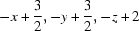
| Symmetry codes: (i) −x+3/2, −y+3/2, −z+2; (ii) −x+1, −y+1, −z+1; (iii) x+1, y, z+1. |
Experimental details
| Crystal data | |
| Chemical formula | [ZnCl2(C10H12N4O2)]·0.5H2O |
| Mr | 365.51 |
| Crystal system, space group | Monoclinic, C2/c |
| Temperature (K) | 100 |
| a, b, c (Å) | 14.5666 (8), 12.9898 (8), 15.8671 (8) |
| β (°) | 109.873 (5) |
| V (Å3) | 2823.5 (3) |
| Z | 8 |
| Radiation type | Mo Kα |
| µ (mm−1) | 2.13 |
| Crystal size (mm) | 0.5 × 0.1 × 0.05 |
| Data collection | |
| Diffractometer | Kum KM4 CCD area-detector diffractometer |
| Absorption correction | Multi-scan (PLATON; Spek, 2003) |
| Tmin, Tmax | 0.774, 0.891 |
| No. of measured, independent and observed [I > 2σ(I)] reflections | 17382, 3373, 3069 |
| Rint | 0.043 |
| (sin θ/λ)max (Å−1) | 0.671 |
| Refinement | |
| R[F2 > 2σ(F2)], wR(F2), S | 0.037, 0.070, 1.21 |
| No. of reflections | 3373 |
| No. of parameters | 191 |
| H-atom treatment | H atoms treated by a mixture of independent and constrained refinement |
| Δρmax, Δρmin (e Å−3) | 0.45, −0.37 |
Computer programs: KM-4 CCD Software (Kuma, 1999), SAINT (Bruker, 1999), SHELXS97 (Sheldrick, 1997), SHELXL97 (Sheldrick, 1997), ORTEP-3 for Windows (Farrugia, 1997), WinGX (Farrugia, 1999).
| Zn1—N1 | 2.1409 (19) | Zn1—Cl2 | 2.2513 (6) |
| Zn1—N2 | 2.1142 (18) | Zn1—Cl3 | 2.2195 (6) |
| Zn1—O1 | 2.2348 (16) | ||
| N2—Zn1—N1 | 74.71 (7) | N2—Zn1—O1 | 72.57 (6) |
| D—H···A | D—H | H···A | D···A | D—H···A |
| N3—H2···Cl3i | 0.80 (3) | 2.59 (3) | 3.310 (2) | 150 (3) |
| O1W—H1W···Cl2ii | 0.81 (3) | 2.44 (3) | 3.182 (2) | 153 (3) |
| O2—H1···O1Wiii | 0.88 (3) | 1.89 (4) | 2.7015 (19) | 153 (3) |
| Symmetry codes: (i) −x+3/2, −y+3/2, −z+2; (ii) −x+1, −y+1, −z+1; (iii) x+1, y, z+1. |
Acknowledgements
The authors are grateful to NATO for financial support (grant CBP. NUKR. CLG 982019).
References
 Bruker (1999). SAINT. Version 6.02. Bruker AXS Inc., Madison, Wisconsin, USA. Google Scholar
Canary, J. W., Allen, C. S., Castagnetto, J. M., Chiu, Y. H., Toscano, P. J. & Wang, Y. H. (1998). Inorg. Chem. 37, 6255–6262. Web of Science CSD CrossRef CAS Google Scholar
Comba, P., Kerscher, M., Merz, M., Muller, V., Pritzkow, H., Remenyi, R., Schiek, W. & Xiong, Y. (2002). Chem. Eur. J. 8, 5750–5760. CrossRef PubMed CAS Google Scholar
Farrugia, L. J. (1997). J. Appl. Cryst. 30, 565. CrossRef IUCr Journals Google Scholar
Farrugia, L. J. (1999). J. Appl. Cryst. 32, 837–838. CrossRef CAS IUCr Journals Google Scholar
Fritsky, I. O., Kozłowski, H., Sadler, P. J., Yefetova, O. P., Świątek-Kozłowska, J., Kalibabchuk, V. A. & Glowiak, T. (1998). J. Chem. Soc. Dalton Trans. pp. 3269–3274. Web of Science CSD CrossRef Google Scholar
Kasuga, N. C., Sekino, K., Ishikawa, M., Honda, A., Yokoyama, M., Nakano, S., Shimada, N., Koumo, S. & Nomiya, K. (2003). J. Inorg. Biochem. 96, 298–310. Web of Science CSD CrossRef PubMed CAS Google Scholar
Kuma (1999). KM-4 CCD Software. Version 1.61. Kuma Diffraction, Wrocław, Poland. Google Scholar
Panosyan, F. B., Lough, A. J. & Chin, J. (2003). Acta Cryst. E59, m827–m829. Web of Science CSD CrossRef IUCr Journals Google Scholar
Rodriuez-Argüelles, M. C., Ferrari, M. B., Fava, G. G., Pelizzi, C., Tarasconi, P., Albertini, R., Dall'Aglio, P. P., Lunghi, P. & Pinelli, S. (1995). J. Inorg. Biochem. 58, 157–175. PubMed Web of Science Google Scholar
Sheldrick, G. M. (1997). SHELXS97 and SHELXL97. University of Göttingen, Germany. Google Scholar
Sousa, G. F. de & Deflon, V. M. (2003). Transition Met. Chem. 28, 74–78. Web of Science CSD CrossRef Google Scholar
Spek, A. L. (2003). J. Appl. Cryst. 36, 7–13. Web of Science CrossRef CAS IUCr Journals Google Scholar
This is an open-access article distributed under the terms of the Creative Commons Attribution (CC-BY) Licence, which permits unrestricted use, distribution, and reproduction in any medium, provided the original authors and source are cited.
| CRYSTALLOGRAPHIC COMMUNICATIONS |


In the past few decades mononuclear zinc(II) complexes attract a lot of attention because of their biological and catalytical activity (Kasuga et al., 2003; Panosyan et al., 2003; Rodriuez-Argüelles et al., 1995; Sousa et al., 2003). On the other hand, many zinc mononuclear complexes containing additional vacant donor sets and chelate centers are taken as ligands for building of homo- and heteropolynuclear systems, which are widely used in bioinorganic modeling and catalysis. The properties of the obtained compounds are closely connected with their structure, so the best results one could obtain using well designed ligand systems. We report here the synthesis and structure of a zinc complex, [ZnCl2(C10H12N4O2)].0.5H2O, based on a novel polynucleative ligand 2-(oximato)-N'-(1-(pyridin-2-yl)ethylidene)propanehydrazide (L).
The title compound consists of neutral complex molecules and solvated water molecules (Fig. 1). The Zn atom has a distorted trigonal-bipyramidal geometry, defined by two Cl atoms and one azomethine N atom at the equatorial plane and a pyridine N atom and an amide O atom at the axial positions. The Zn—N, Zn—O and Zn—Cl bond lengths are comparable to previously reported zinc complexes with thiosemicarbasone and semicarbasone derivatives (Kasuga et al., 2003) and with pyridine complexed to the metal ion (Canary et al., 1998; Comba et al., 2002) (Table 1). The bite angles around the central atom deviate from an ideal square-planar configuration [e.g. N2—Zn1—O1 = 72.57 (6)°, N2—Zn1—N1 = 74.71 (7)°], that is a consequence of the formation of two almost flat five-membered chelate rings. In the crystal packing, the molecules are connected in pairs by N—H···Cl hydrogen bonds (Fig. 2), where the protonated amide group from one molecule acts as a donor and the Cl atom from the neighboring molecule as an acceptor (Table 2). The weak π-stacking interaction is observed between the pyridine ring and oximic group. The molecular pairs are connected to each other by hydrogen bonds involving the solvated water molecules, resulting in an extensive three-dimensional system (Fig. 3).