 | Acta Crystallographica Section E Acta Crystallographica Section E CRYSTALLOGRAPHIC COMMUNICATIONS |


 journal menu


metal-organic compounds
| CRYSTALLOGRAPHIC COMMUNICATIONS |
 access
Diaquabis(4-bromobenzoato-κ2O,O′)zinc(II)

aHacettepe University, Department of Physics, 06800 Beytepe, Ankara, Turkey, bSakarya University, Faculty of Arts and Science, Department of Physics, 54187 Esentepe, Adapazarı, Turkey, and cKafkas University, Department of Chemistry, 63100 Kars, Turkey
*Correspondence e-mail: [email protected]
The monomeric title ZnII complex, [Zn(C7H4BrO2)2(H2O)2], contains two 4-bromobenzoate (BB) ligands and two coordinated water molecules around a ZnII atom on a twofold rotation axis. The BB ions act as bidentate ligands, with two very dissimilar coordination distances. The sixfold coordination around the ZnII may be described as highly distorted octahedral, with the two aqua ligands arranged cis. Hydrogen bonding involving the carboxylate O atoms has an effect on the delocalization in the carboxylate groups. In the crystal structure, intermolecular O—H⋯O hydrogen bonds link the molecules into chains parallel to the c axis and stacked along the b axis.
Related literature
For general background, see: Antolini et al. (1982![[Antolini, L., Battaglia, L. P., Corradi, A. B., Marcotrigiano, G., Menabue, L., Pellacani, G. C. & Saladini, M. (1982). Inorg. Chem. 21, 1391-1395.]](../../../../../../logos/arrows/e_arr.gif "Antolini, L., Battaglia, L. P., Corradi, A. B., Marcotrigiano, G., Menabue, L., Pellacani, G. C. & Saladini, M. (1982). Inorg. Chem. 21, 1391-1395.") ); Chen & Chen (2002); Amiraslanov et al. (1979); Hauptmann et al. (2000); Shnulin et al. (1981); Antsyshkina et al. (1980); Adiwidjaja et al. (1978); Catterick et al. (1974). For related literature, see: Guseinov et al. (1984); Clegg et al. (1986a,b, 1987); Capilla & Aranda (1979); van Niekerk et al. (1953); Usubaliev et al. (1992); Musaev et al. (1983); Nadzhafov et al. (1981); Day & Selbin (1969); Amiraslanov et al. (1980); Necefoğlu et al. (2002); Hökelek et al. (2008, 2007); Hökelek & Necefoğlu (1996, 2001, 2007); Greenaway et al. (1984).
); Chen & Chen (2002); Amiraslanov et al. (1979); Hauptmann et al. (2000); Shnulin et al. (1981); Antsyshkina et al. (1980); Adiwidjaja et al. (1978); Catterick et al. (1974). For related literature, see: Guseinov et al. (1984); Clegg et al. (1986a,b, 1987); Capilla & Aranda (1979); van Niekerk et al. (1953); Usubaliev et al. (1992); Musaev et al. (1983); Nadzhafov et al. (1981); Day & Selbin (1969); Amiraslanov et al. (1980); Necefoğlu et al. (2002); Hökelek et al. (2008, 2007); Hökelek & Necefoğlu (1996, 2001, 2007); Greenaway et al. (1984).
![[Scheme 1]](bg2161scheme1.gif)
Experimental
Crystal data
|
Refinement
|
| ||||||||||
| ||||||||||||||||||||||
 .
. Data collection: CAD-4 EXPRESS (Enraf–Nonius, 1994); cell refinement: CAD-4 EXPRESS; data reduction: XCAD4 (Harms & Wocadlo, 1995); program(s) used to solve structure: SHELXS97 (Sheldrick, 2008); program(s) used to refine structure: SHELXL97 (Sheldrick, 2008); molecular graphics: ORTEP-3 for Windows (Farrugia, 1997); software used to prepare material for publication: WinGX (Farrugia, 1999).
Supporting information
contains datablocks I, global. DOI: 10.1107/S1600536808003759/bg2161sup1.cif
Structure factors: contains datablock I. DOI: 10.1107/S1600536808003759/bg2161Isup2.hkl
The title compound, (I), was prepared by the reaction of ZnSO4 (1.61 g, 10 mmol) in H2O (100 ml) and p-bromobenzoate (4.00 g, 20 mmol) in H2O (100 ml). The mixture was filtered and set aside to crystallize at ambient temperature for several days, giving colorless single crystals.
H atoms of water molecules were located in difference syntheses and refined isotropically with restrains [O—H = 0.97 (7) and 0.95 (8) Å; Uiso(H) = 0.09 (4) and 0.09 (4) Å2]. The remaining H atoms were positioned geometrically with C—H = 0.93 Å, for aromatic H atoms and constrained to ride on their parent atoms, with Uiso(H) = 1.2Ueq(C).
Data collection: CAD-4 EXPRESS (Enraf–Nonius, 1994); cell CAD-4 EXPRESS (Enraf–Nonius, 1994); data reduction: XCAD4 (Harms & Wocadlo, 1995); program(s) used to solve structure: SHELXS97 (Sheldrick, 2008); program(s) used to refine structure: SHELXL97 (Sheldrick, 2008); molecular graphics: ORTEP-3 for Windows (Farrugia, 1997); software used to prepare material for publication: WinGX (Farrugia, 1999).
![[Figure 1]](./bg2161fig1thm.gif) | Fig. 1. A drawing of the title molecule with the atom-numbering scheme. The displacement ellipsoids are drawn at the 50% probability level [symmetry code: (i) 2 - x, y, 1/2 - z]. |
| [Zn(C7H4BrO2)2(H2O)2] | F(000) = 976 |
| Mr = 501.43 | Dx = 2.099 Mg m−3 |
| Monoclinic, C2/c | Mo Kα radiation, λ = 0.71073 Å |
| Hall symbol: -C 2yc | Cell parameters from 25 reflections |
| a = 26.9067 (3) Å | θ = 6.7–10.8° |
| b = 5.0704 (4) Å | µ = 6.61 mm−1 |
| c = 12.0371 (5) Å | T = 294 K |
| β = 104.95 (2)° | Block, colourless |
| V = 1586.6 (2) Å3 | 0.25 × 0.20 × 0.15 mm |
| Z = 4 |
| Enraf–Nonius TurboCAD-4 diffractometer | 1133 reflections with I > 2σ(I) |
| Radiation source: fine-focus sealed tube | Rint = 0.031 |
| Graphite monochromator | θmax = 26.3°, θmin = 3.1° |
| non–profiled ω scans | h = −33→0 |
| Absorption correction: ψ scan (North et al., 1968) | k = −6→0 |
| Tmin = 0.214, Tmax = 0.370 | l = −14→15 |
| 1648 measured reflections | 3 standard reflections every 120 min |
| 1613 independent reflections | intensity decay: 1% |
| Refinement on F2 | Primary atom site location: structure-invariant direct methods |
| Least-squares matrix: full | Secondary atom site location: difference Fourier map |
| R[F2 > 2σ(F2)] = 0.063 | Hydrogen site location: inferred from neighbouring sites |
| wR(F2) = 0.166 | H atoms treated by a mixture of independent and constrained refinement |
| S = 1.04 | w = 1/[σ2(Fo2) + (0.1112P)2] where P = (Fo2 + 2Fc2)/3 |
| 1613 reflections | (Δ/σ)max < 0.001 |
| 113 parameters | Δρmax = 1.42 e Å−3 |
| 4 restraints | Δρmin = −1.83 e Å−3 |
| [Zn(C7H4BrO2)2(H2O)2] | V = 1586.6 (2) Å3 |
| Mr = 501.43 | Z = 4 |
| Monoclinic, C2/c | Mo Kα radiation |
| a = 26.9067 (3) Å | µ = 6.61 mm−1 |
| b = 5.0704 (4) Å | T = 294 K |
| c = 12.0371 (5) Å | 0.25 × 0.20 × 0.15 mm |
| β = 104.95 (2)° |
| Enraf–Nonius TurboCAD-4 diffractometer | 1133 reflections with I > 2σ(I) |
| Absorption correction: ψ scan (North et al., 1968) | Rint = 0.031 |
| Tmin = 0.214, Tmax = 0.370 | 3 standard reflections every 120 min |
| 1648 measured reflections | intensity decay: 1% |
| 1613 independent reflections |
| R[F2 > 2σ(F2)] = 0.063 | 4 restraints |
| wR(F2) = 0.166 | H atoms treated by a mixture of independent and constrained refinement |
| S = 1.04 | Δρmax = 1.42 e Å−3 |
| 1613 reflections | Δρmin = −1.83 e Å−3 |
| 113 parameters |
Geometry. All e.s.d.'s (except the e.s.d. in the dihedral angle between two l.s. planes) are estimated using the full covariance matrix. The cell e.s.d.'s are taken into account individually in the estimation of e.s.d.'s in distances, angles and torsion angles; correlations between e.s.d.'s in cell parameters are only used when they are defined by crystal symmetry. An approximate (isotropic) treatment of cell e.s.d.'s is used for estimating e.s.d.'s involving l.s. planes. |
Refinement. Refinement of F2 against ALL reflections. The weighted R-factor wR and goodness of fit S are based on F2, conventional R-factors R are based on F, with F set to zero for negative F2. The threshold expression of F2 > σ(F2) is used only for calculating R-factors(gt) etc. and is not relevant to the choice of reflections for refinement. R-factors based on F2 are statistically about twice as large as those based on F, and R- factors based on ALL data will be even larger. |
| x | y | z | Uiso*/Ueq | ||
| Br | 1.22102 (3) | 1.19239 (18) | 0.64660 (7) | 0.0502 (4) | |
| Zn | 1.0000 | 0.0782 (2) | 0.2500 | 0.0335 (4) | |
| O1 | 1.0587 (2) | 0.3361 (10) | 0.2873 (4) | 0.0342 (12) | |
| O2 | 1.0366 (2) | 0.2503 (10) | 0.4458 (4) | 0.0379 (12) | |
| O3 | 0.9709 (2) | −0.1998 (10) | 0.3320 (4) | 0.0404 (13) | |
| H31 | 0.960 (4) | −0.19 (2) | 0.403 (5) | 0.09 (4)* | |
| H32 | 0.953 (4) | −0.343 (15) | 0.289 (7) | 0.09 (4)* | |
| C1 | 1.0641 (3) | 0.3712 (14) | 0.3959 (6) | 0.0314 (16) | |
| C2 | 1.1029 (3) | 0.5711 (14) | 0.4540 (5) | 0.0292 (16) | |
| C3 | 1.0994 (3) | 0.6756 (16) | 0.5586 (6) | 0.0361 (17) | |
| H3 | 1.0732 | 0.6214 | 0.5909 | 0.043* | |
| C4 | 1.1352 (3) | 0.8615 (16) | 0.6150 (6) | 0.0404 (19) | |
| H4 | 1.1329 | 0.9337 | 0.6845 | 0.048* | |
| C5 | 1.1735 (3) | 0.9357 (14) | 0.5673 (6) | 0.0316 (16) | |
| C6 | 1.1776 (3) | 0.8399 (17) | 0.4632 (7) | 0.0415 (19) | |
| H6 | 1.2036 | 0.8983 | 0.4311 | 0.050* | |
| C7 | 1.1418 (3) | 0.6525 (17) | 0.4067 (6) | 0.0392 (18) | |
| H7 | 1.1442 | 0.5826 | 0.3369 | 0.047* |
| U11 | U22 | U33 | U12 | U13 | U23 | |
| Br | 0.0509 (6) | 0.0389 (5) | 0.0485 (5) | −0.0172 (4) | −0.0093 (4) | 0.0011 (4) |
| Zn | 0.0403 (7) | 0.0166 (6) | 0.0429 (7) | 0.000 | 0.0097 (5) | 0.000 |
| O1 | 0.050 (3) | 0.028 (3) | 0.021 (2) | 0.001 (2) | 0.002 (2) | −0.006 (2) |
| O2 | 0.049 (3) | 0.030 (3) | 0.031 (3) | −0.014 (2) | 0.005 (2) | 0.000 (2) |
| O3 | 0.068 (4) | 0.023 (3) | 0.030 (3) | −0.009 (3) | 0.012 (3) | −0.004 (2) |
| C1 | 0.038 (4) | 0.026 (4) | 0.027 (3) | 0.005 (3) | 0.000 (3) | −0.001 (3) |
| C2 | 0.039 (4) | 0.019 (3) | 0.023 (3) | 0.001 (3) | −0.003 (3) | −0.003 (3) |
| C3 | 0.045 (4) | 0.041 (4) | 0.026 (3) | −0.012 (4) | 0.014 (3) | −0.008 (3) |
| C4 | 0.054 (5) | 0.035 (4) | 0.030 (4) | −0.011 (4) | 0.008 (3) | −0.009 (3) |
| C5 | 0.037 (4) | 0.024 (3) | 0.025 (3) | −0.006 (3) | −0.007 (3) | 0.003 (3) |
| C6 | 0.043 (4) | 0.043 (5) | 0.040 (4) | −0.007 (4) | 0.014 (4) | 0.002 (4) |
| C7 | 0.044 (4) | 0.050 (5) | 0.023 (3) | −0.006 (4) | 0.007 (3) | −0.009 (3) |
| Br—C5 | 1.901 (7) | C1—C2 | 1.494 (10) |
| Zn—O1 | 2.010 (5) | C2—C3 | 1.392 (10) |
| Zn—O1i | 2.010 (5) | C2—C7 | 1.376 (11) |
| Zn—O2 | 2.468 (5) | C3—H3 | 0.9300 |
| Zn—O2i | 2.468 (5) | C4—C3 | 1.393 (10) |
| Zn—O3 | 1.993 (5) | C4—H4 | 0.9300 |
| Zn—O3i | 1.993 (5) | C5—C4 | 1.354 (11) |
| O1—C1 | 1.289 (8) | C5—C6 | 1.375 (11) |
| O2—C1 | 1.230 (9) | C6—H6 | 0.9300 |
| O3—H31 | 0.97 (7) | C7—C6 | 1.399 (11) |
| O3—H32 | 0.95 (8) | C7—H7 | 0.9300 |
| O1—Zn—O1i | 98.8 (3) | O2—C1—Zn | 70.5 (4) |
| O1—Zn—O2 | 57.27 (18) | O2—C1—O1 | 120.1 (7) |
| O1i—Zn—O2 | 94.62 (19) | O2—C1—C2 | 123.0 (6) |
| O1—Zn—O2i | 94.62 (19) | C2—C1—Zn | 165.9 (5) |
| O1i—Zn—O2i | 57.27 (18) | C3—C2—C1 | 118.7 (7) |
| O2—Zn—O2i | 138.6 (3) | C7—C2—C1 | 121.6 (6) |
| O3i—Zn—O1 | 100.6 (2) | C7—C2—C3 | 119.7 (7) |
| O3—Zn—O1 | 137.4 (2) | C2—C3—C4 | 120.0 (7) |
| O3i—Zn—O1i | 137.4 (2) | C2—C3—H3 | 120.0 |
| O3—Zn—O1i | 100.6 (2) | C4—C3—H3 | 120.0 |
| O3i—Zn—O2 | 127.7 (2) | C3—C4—H4 | 120.4 |
| O3—Zn—O2 | 83.58 (18) | C5—C4—C3 | 119.1 (7) |
| O3i—Zn—O2i | 83.58 (18) | C5—C4—H4 | 120.4 |
| O3—Zn—O2i | 127.7 (2) | C4—C5—Br | 117.6 (5) |
| O3i—Zn—O3 | 90.0 (3) | C4—C5—C6 | 122.5 (7) |
| C1—O1—Zn | 101.1 (5) | C6—C5—Br | 119.8 (6) |
| C1—O2—Zn | 81.5 (4) | C5—C6—C7 | 118.3 (7) |
| Zn—O3—H32 | 119 (6) | C5—C6—H6 | 120.8 |
| Zn—O3—H31 | 131 (6) | C7—C6—H6 | 120.8 |
| H32—O3—H31 | 106 (4) | C2—C7—C6 | 120.3 (7) |
| O1—C1—Zn | 49.6 (4) | C2—C7—H7 | 119.8 |
| O1—C1—C2 | 116.8 (7) | C6—C7—H7 | 119.8 |
| O1i—Zn—O1—C1 | 89.0 (4) | O1—C1—C2—C7 | −19.9 (10) |
| O2—Zn—O1—C1 | −0.8 (4) | O2—C1—C2—C7 | 162.8 (7) |
| O2i—Zn—O1—C1 | 146.6 (4) | Zn—C1—C2—C3 | 146.9 (18) |
| O3i—Zn—O1—C1 | −129.1 (4) | Zn—C1—C2—C7 | −33 (2) |
| O3—Zn—O1—C1 | −27.4 (6) | O1—C1—C2—C3 | 160.3 (7) |
| C1i—Zn—O1—C1 | 118.5 (4) | O2—C1—C2—C3 | −17.0 (11) |
| O1—Zn—O2—C1 | 0.9 (4) | C1—C2—C3—C4 | 179.7 (7) |
| O1i—Zn—O2—C1 | −96.7 (4) | C7—C2—C3—C4 | −0.1 (12) |
| O2i—Zn—O2—C1 | −53.4 (4) | C1—C2—C7—C6 | −180.0 (7) |
| O3i—Zn—O2—C1 | 78.2 (5) | C3—C2—C7—C6 | −0.2 (12) |
| O3—Zn—O2—C1 | 163.1 (5) | C5—C4—C3—C2 | −0.8 (12) |
| C1i—Zn—O2—C1 | −78.8 (6) | Br—C5—C4—C3 | 179.4 (6) |
| Zn—O1—C1—O2 | 1.6 (8) | C6—C5—C4—C3 | 1.9 (12) |
| Zn—O1—C1—C2 | −175.8 (5) | Br—C5—C6—C7 | −179.6 (6) |
| Zn—O2—C1—O1 | −1.3 (6) | C4—C5—C6—C7 | −2.1 (12) |
| Zn—O2—C1—C2 | 175.9 (7) | C2—C7—C6—C5 | 1.2 (12) |
| Symmetry code: (i) −x+2, y, −z+1/2. |
| D—H···A | D—H | H···A | D···A | D—H···A |
| O3—H31···O2ii | 0.97 (7) | 1.82 (6) | 2.746 (7) | 157 (9) |
| O3—H32···O1iii | 0.95 (8) | 1.86 (8) | 2.765 (7) | 160 (9) |
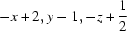
| Symmetry codes: (ii) −x+2, −y, −z+1; (iii) −x+2, y−1, −z+1/2. |
Experimental details
| Crystal data | |
| Chemical formula | [Zn(C7H4BrO2)2(H2O)2] |
| Mr | 501.43 |
| Crystal system, space group | Monoclinic, C2/c |
| Temperature (K) | 294 |
| a, b, c (Å) | 26.9067 (3), 5.0704 (4), 12.0371 (5) |
| β (°) | 104.95 (2) |
| V (Å3) | 1586.6 (2) |
| Z | 4 |
| Radiation type | Mo Kα |
| µ (mm−1) | 6.61 |
| Crystal size (mm) | 0.25 × 0.20 × 0.15 |
| Data collection | |
| Diffractometer | Enraf–Nonius TurboCAD-4 diffractometer |
| Absorption correction | ψ scan (North et al., 1968) |
| Tmin, Tmax | 0.214, 0.370 |
| No. of measured, independent and observed [I > 2σ(I)] reflections | 1648, 1613, 1133 |
| Rint | 0.031 |
| (sin θ/λ)max (Å−1) | 0.623 |
| Refinement | |
| R[F2 > 2σ(F2)], wR(F2), S | 0.063, 0.166, 1.04 |
| No. of reflections | 1613 |
| No. of parameters | 113 |
| No. of restraints | 4 |
| H-atom treatment | H atoms treated by a mixture of independent and constrained refinement |
| Δρmax, Δρmin (e Å−3) | 1.42, −1.83 |
Computer programs: CAD-4 EXPRESS (Enraf–Nonius, 1994), XCAD4 (Harms & Wocadlo, 1995), SHELXS97 (Sheldrick, 2008), SHELXL97 (Sheldrick, 2008), ORTEP-3 for Windows (Farrugia, 1997), WinGX (Farrugia, 1999).
| D—H···A | D—H | H···A | D···A | D—H···A |
| O3—H31···O2i | 0.97 (7) | 1.82 (6) | 2.746 (7) | 157 (9) |
| O3—H32···O1ii | 0.95 (8) | 1.86 (8) | 2.765 (7) | 160 (9) |
| Symmetry codes: (i) −x+2, −y, −z+1; (ii) −x+2, y−1, −z+1/2. |
Acknowledgements
The authors acknowledge the purchase of the CAD-4 diffractometer under grant DPT/TBAG1 of the Scientific and Technical Research Council of Turkey.
References
 Adiwidjaja, G., Rossmanith, E. & Küppers, H. (1978). Acta Cryst. B34, 3079–3083. CSD CrossRef CAS IUCr Journals Web of Science Google Scholar
Amiraslanov, I. R., Mamedov, Kh. S., Movsumov, E. M., Musaev, F. N. & Nadzhafov, G. N. (1979). Zh. Strukt. Khim. 20, 1075–1080. CAS Google Scholar
Amiraslanov, I. R., Nadzhafov, G. N., Usubaliev, B. T., Musaev, A. A., Movsumov, E. M. & Mamedov, Kh. S. (1980). Zh. Strukt. Khim. 21, 140–145. CAS Google Scholar
Antolini, L., Battaglia, L. P., Corradi, A. B., Marcotrigiano, G., Menabue, L., Pellacani, G. C. & Saladini, M. (1982). Inorg. Chem. 21, 1391–1395. CSD CrossRef CAS Web of Science Google Scholar
Antsyshkina, A. S., Chiragov, F. M. & Poray-Koshits, M. A. (1980). Koord. Khim. 15, 1098–1103. Google Scholar
Capilla, A. V. & Aranda, R. A. (1979). Cryst. Struct. Commun. 8, 795–798. Google Scholar
Catterick, J., Hursthouse, M. B., New, D. B. & Thorhton, P. (1974). J. Chem. Soc. Chem. Commun. pp. 843–844. CrossRef Web of Science Google Scholar
Chen, H. J. & Chen, X. M. (2002). Inorg. Chim. Acta, 329, 13–21. Web of Science CSD CrossRef CAS Google Scholar
Clegg, W., Little, I. R. & Straughan, B. P. (1986a). Acta Cryst. C42, 919–920. CSD CrossRef CAS Web of Science IUCr Journals Google Scholar
Clegg, W., Little, I. R. & Straughan, B. P. (1986b). Acta Cryst. C42, 1701–1703. CSD CrossRef CAS Web of Science IUCr Journals Google Scholar
Clegg, W., Little, I. R. & Straughan, B. P. (1987). Acta Cryst. C43, 456–457. CSD CrossRef CAS Web of Science IUCr Journals Google Scholar
Day, M. C. & Selbin, J. (1969). Theoretical Inorganic Chemistry, p. 109. New York: Van Nostrand Reinhold. Google Scholar
Enraf–Nonius (1994). CAD-4 EXPRESS. Enraf–Nonius, Delft, The Netherlands. Google Scholar
Farrugia, L. J. (1997). J. Appl. Cryst. 30, 565. CrossRef IUCr Journals Google Scholar
Farrugia, L. J. (1999). J. Appl. Cryst. 32, 837–838. CrossRef CAS IUCr Journals Google Scholar
Greenaway, F. T., Pezeshk, A., Cordes, A. W., Noble, M. C. & Sorenson, J. R. J. (1984). Inorg. Chim. Acta, 93, 67–71. CSD CrossRef CAS Web of Science Google Scholar
Guseinov, G. A., Musaev, F. N., Usubaliev, B. T., Amiraslanov, I. R. & Mamedov, Kh. S. (1984). Koord. Khim. 10, 117–122. CAS Google Scholar
Harms, K. & Wocadlo, S. (1995). XCAD4. University of Marburg, Germany. Google Scholar
Hauptmann, R., Kondo, M. & Kitagawa, S. (2000). Z. Kristallogr. New Cryst. Struct. 215, 169–172. CAS Google Scholar
Hökelek, T., Çaylak, N. & Necefoğlu, H. (2007). Acta Cryst. E63, m2561–m2562. Web of Science CSD CrossRef IUCr Journals Google Scholar
Hökelek, T., Çaylak, N. & Necefoğlu, H. (2008). Acta Cryst. E64, m460–m461. Web of Science CSD CrossRef IUCr Journals Google Scholar
Hökelek, T. & Necefoğlu, H. (1996). Acta Cryst. C52, 1128–1131. CSD CrossRef Web of Science IUCr Journals Google Scholar
Hökelek, T. & Necefoğlu, H. (2001). Anal. Sci. 17, 1241–1242. Web of Science CSD CrossRef PubMed CAS Google Scholar
Hökelek, T. & Necefoğlu, H. (2007). Acta Cryst. E63, m821–m823. Web of Science CSD CrossRef IUCr Journals Google Scholar
Musaev, F. N., Nadzhafov, G. N. & Mamedov, Kh. S. (1983). Koord. Khim. 12, 37–46. Google Scholar
Nadzhafov, G. N., Usubaliev, B. T., Amiraslanov, I. R., Movsumov, E. M. & Mamedov, Kh. S. (1981). Koord. Khim. 7, 770–775. CAS Google Scholar
Necefoğlu, H., Hökelek, T., Ersanlı, C. C. & Erdönmez, A. (2002). Acta Cryst. E58, m758–m761. Web of Science CSD CrossRef IUCr Journals Google Scholar
Niekerk, J. N. van, Schoening, F. R. L. & Talbot, J. H. (1953). Acta Cryst. 6, 720–723. CSD CrossRef IUCr Journals Google Scholar
North, A. C. T., Phillips, D. C. & Mathews, F. S. (1968). Acta Cryst. A24, 351–359. CrossRef IUCr Journals Web of Science Google Scholar
Sheldrick, G. M. (2008). Acta Cryst. A64, 112–122. Web of Science CrossRef CAS IUCr Journals Google Scholar
Shnulin, A. N., Nadzhafov, G. N., Amiraslanov, I. R., Usubaliev, B. T. & Mamedov, Kh. S. (1981). Koord. Khim. 7, 1409–1416. CAS Google Scholar
Usubaliev, B. T., Guliev, F. I., Musaev, F. N., Ganbarov, D. M., Ashurova, S. A. & Movsumov, E. M. (1992). Zh. Strukt. Khim. 33, 203–207. CAS Google Scholar
This is an open-access article distributed under the terms of the Creative Commons Attribution (CC-BY) Licence, which permits unrestricted use, distribution, and reproduction in any medium, provided the original authors and source are cited.
| CRYSTALLOGRAPHIC COMMUNICATIONS |


Transition metal complexes with biochemical molecules show interesting physical and/or chemical properties, through which they may find applications in biological systems (Antolini et al., 1982). Some benzoic acid derivatives, such as 4-aminobenzoic acid, have been extensively reported in coordination chemistry, as bifunctional organic ligands, due to the varieties of their coordination modes (Chen & Chen, 2002, Amiraslanov et al., 1979; Hauptmann et al., 2000).
The structure-function-coordination relationships of the arylcarboxylate ion in ZnII complexes of benzoic acid derivatives may also change depending on the nature and position of the substituted groups on the benzene ring, the nature of the additional ligand molecule or solvent, and the pH and temperature of synthesis, as in CoII complexes (Shnulin et al., 1981; Antsyshkina et al., 1980; Adiwidjaja et al., 1978). When pyridine and its derivatives are used instead of water molecules, the structure is completely different (Catterick et al., 1974).
The solid-state structures of anhydrous zinc(II) carboxylates include one-dimensional (Guseinov et al., 1984; Clegg et al., 1986a), two-dimensional (Clegg et al., 1986b, 1987) and three-dimensional (Capilla & Aranda, 1979) polymeric motifs of different types, while discerete monomeric complexes with octahedral or tetrahedral coordination geometry are found if water or other donor molecules are coordinated to Zn (van Niekerk et al., 1953; Usubaliev et al., 1992). In hexaaquazinc(II) bis(4-hydroxybenzoate) dihydrate, [Zn(H2O)6](4-HOC6H4COO)2.2H2O, [(II); Musaev et al., 1983], which is isostructural with the corresponding MgII, CoII, NiII and MnII compounds, the carboxylate ion lies outside the coordination sphere of the Zn atom, while [Zn(4-HOC6H4COO)2].4C5H5N [(III); Nadzhafov et al., 1981], forms a clathrate, consisting of [Zn(4-HOC6H4COO)2(C5H5N)2] units with tetrahedral coordination geometry and free pyridine molecules.
The structure determination of the title compound, (I), a zinc complex with two bromobenzoate (BB) ligands and two water molecules, was undertaken in order to determine the ligand properties of (BB) and also to compare the results obtained with those reported previously.
In the monomeric title complex, [Zn(C7H4O2Br)2(H2O)2], (I), the Zn atom lies on a on a twofold rotation axis and is surrounded by two 4-bromobenzoate (BB), acting as bidentate ligands, and two coordinated water molecules (Fig. 1).
The Zn coordination polyhedron is formed by four clear basal bonds and two close contacts of the symmetry related O2 and O2i atoms, [(i) 2 - x, y, 1/2 - z, Zn···O2 = 2.468 (5) Å, in double dashed lines in Fig. 1] occupying apical positions and completing the six-coordination; this distance is greater than the sum of the corresponding ionic radii (2.14 Å; Day & Selbin, 1969), but similar Zn···O contacts have already been reported, viz.: 2.50 (1) Å in (III), 2.494 (8) Å in [Zn(p—H2NC6H4COO)2]n.1.5nH2O [(IV); Amiraslanov et al., 1980], 2.404 (2) Å in [Zn(C6H6N2O2)2(C7H5O3)2] [(V), (Necefoğlu et al., 2002] and 2.458 (3) Å in [Zn(C7H4O2F)2(C6H6N2O)2].H2O [(VI); Hökelek et al., 2008]. The sixfold coordination around ZnII may thus be described as highly distorted octahedral (Table 1), with the two aqua ligands arranged cis.
In the binuclear complex [Zn2(C7H5O3)4(C10H14N2O)2(H2O)2] [(VII); Hökelek & Necefoğlu, 1996], the average Zn—O bond length [1.953 (2) Å] is shorter than the corresponding value in (I) [2.157 (5) Å], but Zn is four coordinate. In complexes (V), [Zn(C7H4FO2)2(DENA)2(H2O)2] [(VIII); Hökelek et al., 2007] and [Zn(C7H5O3)(OH2)3(C6H6N2O)].C7O3H5 [(IX); Hökelek & Necefoğlu, 2001), (where Zn atoms are five, six and five coordinates) the average Zn—O bond lengths are 2.107 (2) Å, 2.117 (2) Å and 2.047 (5) Å, respectively. In (I), the O1—Zn···O2 angle is 57.27 (18)°. The corresponding O—M···O (where M is a metal) angles are 58.79 (6)° in (V), 57.04 (10)° in (VI), 58.3 (3)° in (VII) and 55.2 (1)° in [Cu(Asp)2(py)2] (where Asp is acetylsalicylate and py is pyridine) [(X); Greenaway et al., 1984].
The near equality of C1—O1 [1.289 (8) Å] and C1—O2 [1.230 (9) Å] bonds in the carboxylate group indicates a delocalized bonding arrangement, rather than localized single and double bonds, as in (V) and [Mn(C9H10NO2)2(H2O)4].2H2O [(XI); Hökelek & Necefoğlu, 2007]. This may be due to the intermolecular hydrogen bonds of the carboxyl O atoms (Table 2). The Zn atom is out of the least-squares plane of the carboxyl group (O1/C1/O2) by 0.055 (1) Å. The dihedral angle between the planar carboxyl group and the benzene ring (C2–C7) is 18.62 (44)°. The corresponding value is reported as 5.54 (43)° in (XI).
The molecules of (I) are linked by intermolecular O—H···O hydrogen bonds (Table 2), forming infinite chains along the [001] direction, which are in turn stacked along the b axis.