 | Acta Crystallographica Section E Acta Crystallographica Section E CRYSTALLOGRAPHIC COMMUNICATIONS |


 journal menu


organic compounds
| CRYSTALLOGRAPHIC COMMUNICATIONS |
 access
Dichloridobis(methylamine-κN)boron(III) chloride

aMax-Planck-Institut für Festkörperforschung, Heisenbergstrasse 1, 70569 Stuttgart, Germany
*Correspondence e-mail: [email protected]
The title compound, C2H10BCl2N2+·Cl− or [BCl2(H3CNH2)2]+·Cl−, is the first crystallographically characterized di(alkylamine)–BCl2+ salt. The B atom is tetrahedrally coordinated by two Cl and two methylamine N atoms. In the the cations and anions interact via N—H⋯Cl hydrogen bonds (mean H⋯Cl = 2.40 Å), resulting in a layered structure.
Related literature
For more details of the synthesis and background, see Weinmann, Nuss et al. (2007![[Weinmann, M., Nuss, J. & Jansen, M. (2007). Acta Cryst. E63, o4235.]](../../../../../../logos/arrows/e_arr.gif "Weinmann, M., Nuss, J. & Jansen, M. (2007). Acta Cryst. E63, o4235.") ); Weinmann, Kroschel et al. (2007). For related structures, see: Nöth & Lukas (1962); Mikhailov et al. (1964); Nöth et al. (1966); Ryschkewitz & Myers (1975).
); Weinmann, Kroschel et al. (2007). For related structures, see: Nöth & Lukas (1962); Mikhailov et al. (1964); Nöth et al. (1966); Ryschkewitz & Myers (1975).
![[Scheme 1]](hb2697scheme1.gif)
Experimental
Crystal data
|
Refinement
|
|
 ; (ii)
  .
. Data collection: SMART (Bruker, 2005); cell refinement: SAINT (Bruker, 2005); data reduction: SAINT; program(s) used to solve structure: SHELXS97 (Sheldrick, 2008); program(s) used to refine structure: SHELXL97 (Sheldrick, 2008); molecular graphics: ATOMS (Dowty, 2005); software used to prepare material for publication: SHELXL97.
Supporting information
contains datablocks I, global. DOI: 10.1107/S1600536808003589/hb2697sup1.cif
Structure factors: contains datablock I. DOI: 10.1107/S1600536808003589/hb2697Isup2.hkl
[BCl2(H3CNH2)2]Cl was obtained as a side-product in amounts < 5% during the continuous synthesis of DMTA. Details of the experimental setup are found elsewhere (Weinmann, Nuss et al., 2007; Weinmann, Kroschel et al., 2007). Re-crystallization of the reaction mixture from THF/n-hexane afforded colourless needles of (I).
All H atoms were found in a difference map and their positions and Uiso values were freely refined.
Data collection: SMART (Bruker 2005); cell SAINT (Bruker 2005); data reduction: SAINT (Bruker 2005); program(s) used to solve structure: SHELXS97 (Sheldrick, 2008); program(s) used to refine structure: SHELXL97 (Sheldrick, 2008); molecular graphics: ATOMS (Dowty, 2005); software used to prepare material for publication: SHELXL97 (Sheldrick, 2008).
![[Figure 1]](./hb2697fig1thm.gif) | Fig. 1. Molecular structure of (I) with displacement ellipsoids drawn at the 50% probability level (arbitrary spheres for the H atoms). Hydrogen bonds are indicated by thin red lines. |
![[Figure 2]](./hb2697fig2thm.gif) | Fig. 2. Packing diagram of (I) with hydrogen bonds indicated by dashed lines. |
| C2H10BCl2N2+·Cl− | F(000) = 736 |
| Mr = 179.28 | Dx = 1.432 Mg m−3 |
| Orthorhombic, Pbca | Mo Kα radiation, λ = 0.71073 Å |
| Hall symbol: -P 2ac 2ab | Cell parameters from 5369 reflections |
| a = 9.9881 (11) Å | θ = 2.6–34.8° |
| b = 11.8071 (13) Å | µ = 1.01 mm−1 |
| c = 14.1039 (15) Å | T = 100 K |
| V = 1663.3 (3) Å3 | Needle, colourless |
| Z = 8 | 0.30 × 0.02 × 0.02 mm |
| Bruker SMART APEX diffractometer | 2430 independent reflections |
| Radiation source: fine-focus sealed tube | 2123 reflections with I > 2σ(I) |
| Graphite monochromator | Rint = 0.050 |
| ω scans | θmax = 30.0°, θmin = 2.9° |
| Absorption correction: multi-scan (SADABS; Bruker, 2007) | h = −14→14 |
| Tmin = 0.751, Tmax = 0.980 | k = −16→16 |
| 19044 measured reflections | l = −19→19 |
| Refinement on F2 | Primary atom site location: structure-invariant direct methods |
| Least-squares matrix: full | Secondary atom site location: difference Fourier map |
| R[F2 > 2σ(F2)] = 0.043 | Hydrogen site location: difference Fourier map |
| wR(F2) = 0.089 | All H-atom parameters refined |
| S = 1.22 | w = 1/[σ2(Fo2) + (0.036P)2 + 0.6817P] where P = (Fo2 + 2Fc2)/3 |
| 2430 reflections | (Δ/σ)max = 0.001 |
| 113 parameters | Δρmax = 0.62 e Å−3 |
| 0 restraints | Δρmin = −0.28 e Å−3 |
| C2H10BCl2N2+·Cl− | V = 1663.3 (3) Å3 |
| Mr = 179.28 | Z = 8 |
| Orthorhombic, Pbca | Mo Kα radiation |
| a = 9.9881 (11) Å | µ = 1.01 mm−1 |
| b = 11.8071 (13) Å | T = 100 K |
| c = 14.1039 (15) Å | 0.30 × 0.02 × 0.02 mm |
| Bruker SMART APEX diffractometer | 2430 independent reflections |
| Absorption correction: multi-scan (SADABS; Bruker, 2007) | 2123 reflections with I > 2σ(I) |
| Tmin = 0.751, Tmax = 0.980 | Rint = 0.050 |
| 19044 measured reflections |
| R[F2 > 2σ(F2)] = 0.043 | 0 restraints |
| wR(F2) = 0.089 | All H-atom parameters refined |
| S = 1.22 | Δρmax = 0.62 e Å−3 |
| 2430 reflections | Δρmin = −0.28 e Å−3 |
| 113 parameters |
Geometry. All e.s.d.'s (except the e.s.d. in the dihedral angle between two l.s. planes) are estimated using the full covariance matrix. The cell e.s.d.'s are taken into account individually in the estimation of e.s.d.'s in distances, angles and torsion angles; correlations between e.s.d.'s in cell parameters are only used when they are defined by crystal symmetry. An approximate (isotropic) treatment of cell e.s.d.'s is used for estimating e.s.d.'s involving l.s. planes. |
Refinement. Refinement of F2 against ALL reflections. The weighted R-factor wR and goodness of fit S are based on F2, conventional R-factors R are based on F, with F set to zero for negative F2. The threshold expression of F2 > σ(F2) is used only for calculating R-factors(gt) etc. and is not relevant to the choice of reflections for refinement. R-factors based on F2 are statistically about twice as large as those based on F, and R- factors based on ALL data will be even larger. |
| x | y | z | Uiso*/Ueq | ||
| Cl1 | 0.43797 (5) | 0.04596 (4) | 0.73581 (4) | 0.02091 (13) | |
| Cl2 | 0.54279 (5) | −0.21105 (4) | 0.55584 (3) | 0.01808 (12) | |
| Cl3 | 0.82564 (5) | −0.25006 (4) | 0.63429 (4) | 0.01710 (12) | |
| B | 0.6695 (2) | −0.16781 (17) | 0.64305 (15) | 0.0120 (4) | |
| N1 | 0.70412 (17) | −0.03969 (14) | 0.62830 (12) | 0.0136 (3) | |
| H1A | 0.630 (3) | −0.002 (2) | 0.6429 (17) | 0.021 (6)* | |
| H1B | 0.767 (3) | −0.023 (2) | 0.6669 (19) | 0.024 (7)* | |
| N2 | 0.60546 (17) | −0.18659 (14) | 0.74288 (12) | 0.0137 (3) | |
| H2A | 0.535 (3) | −0.145 (2) | 0.7468 (19) | 0.030 (7)* | |
| H2B | 0.579 (3) | −0.256 (3) | 0.744 (2) | 0.028 (7)* | |
| C3 | 0.7536 (3) | −0.01034 (19) | 0.53109 (16) | 0.0212 (4) | |
| H3A | 0.831 (3) | −0.059 (2) | 0.519 (2) | 0.032 (7)* | |
| H3B | 0.682 (3) | −0.020 (3) | 0.488 (2) | 0.040 (8)* | |
| H3C | 0.782 (3) | 0.066 (2) | 0.5310 (19) | 0.027 (7)* | |
| C4 | 0.6894 (3) | −0.1676 (2) | 0.82892 (16) | 0.0253 (5) | |
| H4A | 0.636 (3) | −0.178 (2) | 0.8830 (19) | 0.025 (7)* | |
| H4B | 0.766 (4) | −0.218 (3) | 0.831 (2) | 0.045 (9)* | |
| H4C | 0.724 (3) | −0.094 (3) | 0.825 (2) | 0.034 (8)* |
| U11 | U22 | U33 | U12 | U13 | U23 | |
| Cl1 | 0.0190 (2) | 0.0103 (2) | 0.0334 (3) | 0.00027 (17) | 0.0106 (2) | −0.00070 (18) |
| Cl2 | 0.0168 (2) | 0.0200 (2) | 0.0174 (2) | −0.00113 (18) | −0.00353 (18) | −0.00502 (18) |
| Cl3 | 0.0131 (2) | 0.0133 (2) | 0.0249 (3) | 0.00233 (17) | 0.00170 (18) | −0.00173 (18) |
| B | 0.0121 (9) | 0.0100 (9) | 0.0140 (10) | −0.0011 (7) | 0.0011 (7) | 0.0001 (7) |
| N1 | 0.0143 (8) | 0.0125 (8) | 0.0141 (8) | −0.0001 (6) | 0.0007 (6) | −0.0001 (6) |
| N2 | 0.0144 (8) | 0.0105 (7) | 0.0161 (8) | −0.0011 (6) | 0.0004 (6) | −0.0003 (6) |
| C3 | 0.0308 (12) | 0.0155 (10) | 0.0173 (10) | −0.0007 (9) | 0.0065 (9) | 0.0034 (8) |
| C4 | 0.0299 (12) | 0.0321 (13) | 0.0140 (10) | −0.0132 (10) | −0.0023 (9) | 0.0022 (9) |
| B—Cl2 | 1.837 (2) | N2—H2A | 0.86 (3) |
| B—Cl3 | 1.841 (2) | N2—H2B | 0.86 (3) |
| B—N2 | 1.562 (3) | C3—H3A | 0.98 (3) |
| B—N1 | 1.566 (3) | C3—H3B | 0.95 (3) |
| N1—C3 | 1.498 (3) | C3—H3C | 0.95 (3) |
| N1—H1A | 0.89 (3) | C4—H4A | 0.94 (3) |
| N1—H1B | 0.85 (3) | C4—H4B | 0.97 (3) |
| N2—C4 | 1.492 (3) | C4—H4C | 0.93 (3) |
| N2—B—N1 | 110.33 (15) | C4—N2—H2B | 107.4 (18) |
| N2—B—Cl2 | 106.38 (13) | B—N2—H2B | 106.0 (18) |
| N1—B—Cl2 | 109.37 (13) | H2A—N2—H2B | 107 (3) |
| N2—B—Cl3 | 109.41 (13) | N1—C3—H3A | 106.6 (16) |
| N1—B—Cl3 | 108.27 (13) | N1—C3—H3B | 108.3 (18) |
| Cl2—B—Cl3 | 113.08 (11) | H3A—C3—H3B | 114 (2) |
| C3—N1—B | 114.71 (16) | N1—C3—H3C | 108.7 (16) |
| C3—N1—H1A | 111.9 (16) | H3A—C3—H3C | 109 (2) |
| B—N1—H1A | 105.4 (17) | H3B—C3—H3C | 110 (2) |
| C3—N1—H1B | 106.6 (18) | N2—C4—H4A | 108.8 (17) |
| B—N1—H1B | 107.7 (18) | N2—C4—H4B | 112.0 (19) |
| H1A—N1—H1B | 110 (2) | H4A—C4—H4B | 110 (3) |
| C4—N2—B | 118.80 (16) | N2—C4—H4C | 107.7 (18) |
| C4—N2—H2A | 108.7 (18) | H4A—C4—H4C | 112 (2) |
| B—N2—H2A | 108.1 (18) | H4B—C4—H4C | 106 (3) |
| D—H···A | D—H | H···A | D···A | D—H···A |
| N1—H1A···Cl1 | 0.89 (3) | 2.39 (3) | 3.2232 (18) | 156 (2) |
| N1—H1B···Cl1i | 0.85 (3) | 2.34 (3) | 3.1862 (18) | 173 (2) |
| N2—H2A···Cl1 | 0.86 (3) | 2.46 (3) | 3.2168 (18) | 148 (2) |
| N2—H2B···Cl1ii | 0.86 (3) | 2.36 (3) | 3.2016 (18) | 165 (2) |
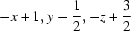
| Symmetry codes: (i) x+1/2, y, −z+3/2; (ii) −x+1, y−1/2, −z+3/2. |
Experimental details
| Crystal data | |
| Chemical formula | C2H10BCl2N2+·Cl− |
| Mr | 179.28 |
| Crystal system, space group | Orthorhombic, Pbca |
| Temperature (K) | 100 |
| a, b, c (Å) | 9.9881 (11), 11.8071 (13), 14.1039 (15) |
| V (Å3) | 1663.3 (3) |
| Z | 8 |
| Radiation type | Mo Kα |
| µ (mm−1) | 1.01 |
| Crystal size (mm) | 0.30 × 0.02 × 0.02 |
| Data collection | |
| Diffractometer | Bruker SMART APEX diffractometer |
| Absorption correction | Multi-scan (SADABS; Bruker, 2007) |
| Tmin, Tmax | 0.751, 0.980 |
| No. of measured, independent and observed [I > 2σ(I)] reflections | 19044, 2430, 2123 |
| Rint | 0.050 |
| (sin θ/λ)max (Å−1) | 0.703 |
| Refinement | |
| R[F2 > 2σ(F2)], wR(F2), S | 0.043, 0.089, 1.22 |
| No. of reflections | 2430 |
| No. of parameters | 113 |
| H-atom treatment | All H-atom parameters refined |
| Δρmax, Δρmin (e Å−3) | 0.62, −0.28 |
Computer programs: SMART (Bruker 2005), SAINT (Bruker 2005), SHELXS97 (Sheldrick, 2008), SHELXL97 (Sheldrick, 2008), ATOMS (Dowty, 2005).
| D—H···A | D—H | H···A | D···A | D—H···A |
| N1—H1A···Cl1 | 0.89 (3) | 2.39 (3) | 3.2232 (18) | 156 (2) |
| N1—H1B···Cl1i | 0.85 (3) | 2.34 (3) | 3.1862 (18) | 173 (2) |
| N2—H2A···Cl1 | 0.86 (3) | 2.46 (3) | 3.2168 (18) | 148 (2) |
| N2—H2B···Cl1ii | 0.86 (3) | 2.36 (3) | 3.2016 (18) | 165 (2) |
| Symmetry codes: (i) x+1/2, y, −z+3/2; (ii) −x+1, y−1/2, −z+3/2. |
Acknowledgements
The authors acknowledge financial support by the Max Planck Society and the German Research Foundation.
References
 Bruker (2005). SMART and SAINT. Bruker AXS Inc., Madison, Wisconsin, USA. Google Scholar
Bruker (2007). SADABS. Version 2007/4. Bruker AXS Inc., Madison, Wisconsin, USA. Google Scholar
Dowty, E. (2005). ATOMS. Version 6.3. Shape Software, Kingsport, Tennessee, USA. Google Scholar
Mikhailov, B. M., Shchegoleva, T. A. & Sheludyakov, V. D. (1964). Izv. Akad. Nauk. SSSR Ser. Khim. 12, 2165–2170. Google Scholar
Nöth, H. & Lukas, S. (1962). Chem. Ber. 95, 1505–1512. Google Scholar
Nöth, H., Schweizer, P. & Ziegelgänsberger, F. (1966). Chem. Ber. 99, 1089–1096. Google Scholar
Ryschkewitz, G. E. & Myers, W. H. (1975). Syn. React. Inorg. Met.-Org. Chem. 5, 123–134. Google Scholar
Sheldrick, G. M. (2008). Acta Cryst. A64, 112–122. Web of Science CrossRef CAS IUCr Journals Google Scholar
Weinmann, M., Kroschel, M., Jäschke, T., Nuss, J., Jansen, M., Kolios, F., Morillo, A., Tellaeche, C. & Nieken, U. (2007). J. Mater. Chem. In the press. Google Scholar
Weinmann, M., Nuss, J. & Jansen, M. (2007). Acta Cryst. E63, o4235. Web of Science CSD CrossRef IUCr Journals Google Scholar
This is an open-access article distributed under the terms of the Creative Commons Attribution (CC-BY) Licence, which permits unrestricted use, distribution, and reproduction in any medium, provided the original authors and source are cited.
| CRYSTALLOGRAPHIC COMMUNICATIONS |


Borazonium cations BCl2+ coordinated by secondary amines R2NH are very few in number whereas those coordinated by primary amines are more or less unknown. To our knowledge, there has appeared so far no publication dealing with H3CNH2-coordinated BCl2+ cations.
We recently published the continuous synthesis of Cl3Si-NCH3—BCl2 (DMTA) by a two-step gas phase synthesis. This reaction proceeds with the formation of solid by-products which are separated from the desired product by filtration. The solid mainly consists of MeNH3Cl. Moreover we observed formation of crystalline 2,4,6-trichloro-1,3,5-trimethylborazine, (CH3NBCl)3 (Weinmann, Nuss et al., 2007). Re-crystallization of the solid from THF/n-pentane now additionally afforded crystals of the title compound, (I) (Fig. 1).
The boron atom in the BCl2L2+ cation in (I) is tetrahedrally coordinated by two chlorine atoms Cl2 and Cl3 and two nitrogen atoms N1 and N2 of the methylamine ligands. The smallest angle (N2—B—Cl2) measures 106.38 (13)°, while the biggest (Cl2—B—Cl3) amounts to 113.08 (11)°. The B—Cl bond distances are 1.837 (2) and 1.841 (2) Å whereas the B—N bond lengths measure 1.566 (3) and 1.562 (3) Å. These are values typically found in tetrachloroborate (BCl4-) or tetraaminoborate (B(NR2)4-) anions, respectively.
The chloride counter anions are associated with the cations via N—H···Cl hydrogen bonds (Table 1). From Figure 2 it is evident that the anions are each connetcted to four hydrogen atoms, thereby linking three cations. Consequently all the N-bonded H atoms contribute to hydrogen-bond bridges.
A further special feature is the formation of a layered structure in (001) which results from the H-bridge formation. The layers, which are stacked in [001] are connected via less polar van-der-Vaals interactions.