 | Acta Crystallographica Section E Acta Crystallographica Section E CRYSTALLOGRAPHIC COMMUNICATIONS |


 journal menu


metal-organic compounds
| CRYSTALLOGRAPHIC COMMUNICATIONS |
 access
Dichloridobis[(S)-2-hydroxypropionamide-κ2O,O′]manganese(II)

aLaboratoire de Cristallographie et RMN Biologiques, UMR 8015 CNRS, Faculté des Sciences Pharmaceutiques et Biologiques de Paris Descartes, 4 Avenue de l'Observatoire, 75270 Paris Cedex 06, France, and bUniversité de Paris XI, Faculté des Sciences Pharmaceutiques et Biologiques, Laboratoire de Chimie Thérapeutique BioCIS, UPRES-A 8076 CNRS, 5 Rue J. B. Clément, 92296 Châtenay-Malabry Cedex, France
*Correspondence e-mail: [email protected]
In the title compound, [MnCl2(C3H7NO2)2], the MnII ion is bound to two Cl atoms and to four O atoms from two lactamide molecules which act as bidentate ligands, giving rise to a highly distorted octahedral coordination geometry. The axial positions are occupied by one Cl atom and one O (hydroxy) atom. The values of the cis bond angles at the Mn atom are in the range 72.33 (5)–100.17 (6)°. Of the two possible coordination modes (N,O- or O,O-bidentate) in metal complexes with lactamide or its derivatives described in the literature, the title compound exhibits the O,O-bidentate mode. In the crystal structure, monomeric manganese(II) complexes are linked by several N—H⋯Cl, O—H⋯Cl and O—H⋯O hydrogen bonds, generating a three-dimensional network.
Related literature
For related literature, see: Bekaert et al. (2005![[Bekaert, A., Lemoine, P., Brion, J. D. & Viossat, B. (2005). Acta Cryst. C61, m76-m77.]](../../../../../../logos/arrows/e_arr.gif "Bekaert, A., Lemoine, P., Brion, J. D. & Viossat, B. (2005). Acta Cryst. C61, m76-m77.") , 2007); Chen et al. (2006); Girma et al. (2005).
, 2007); Chen et al. (2006); Girma et al. (2005).
![[Scheme 1]](im2054scheme1.gif)
Experimental
Crystal data
|
Data collection
|
Refinement
|
|
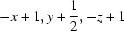 ; (iv)
 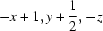 ; (vi)
  .
. Data collection: CAD-4 EXPRESS (Enraf–Nonius, 1994); cell refinement: CAD-4 EXPRESS; data reduction: XCAD4 (Harms & Wocadlo, 1995); program(s) used to solve structure: SIR92 (Altomare et al., 1994); program(s) used to refine structure: SHELXL97 (Sheldrick, 2008); molecular graphics: CAMERON (Watkin et al., 1996); software used to prepare material for publication: WinGX (Farrugia, 1999).
Supporting information
contains datablocks global, I. DOI: 10.1107/S1600536808004066/im2054sup1.cif
Structure factors: contains datablock I. DOI: 10.1107/S1600536808004066/im2054Isup2.hkl
Enantiomerically pure (S)-lactamide ((S)-2-hydroxypropionamide, 2.22 g, 25 mmol) is dissolved in 20 ml of hot ethanoic acid and manganese(II) dichloride (1.26 g, 10 mmol) is added to this solution. The solution is kept at room temperature for 72 h. Pink crystals of the title compound slowly appear in the solution, whereupon crystals suitable for X-ray diffraction were obtained.
H atoms except those bonded to methyl groups were located in a difference map and refined and a common displacement parameter. For methyl groups H atoms were positioned geometrically and refined using a riding model, with C—H = 0.96Å with Uiso(H) = 1.5 times Ueq(C).
Data collection: CAD-4 EXPRESS (Enraf–Nonius, 1994); cell CAD-4 EXPRESS (Enraf–Nonius, 1994); data reduction: XCAD4 (Harms & Wocadlo, 1995); program(s) used to solve structure: SIR92 (Altomare et al., 1994); program(s) used to refine structure: SHELXL97 (Sheldrick, 2008); molecular graphics: CAMERON (Watkin et al., 1996); software used to prepare material for publication: WinGX (Farrugia, 1999).
![[Figure 1]](./im2054fig1thm.gif) | Fig. 1. Molecular view of the complex showing the atomic numbering and some N—H···Cl, O—H···Cl and O—H···O hydrogen bonds as dotted lines. Displacement ellipsoids are displayed at the 50% probability level. Symmetry code: a: (x - 1, y, z), b: (x, y, 1 + z), c: (1 - x, 1/2 + y, 1 - z), d: (1 + x, y, z), e: (1 - x, 1/2 + y, -z), f: (-x, 1/2 + y, -z), g: (x, y, z - 1), h: (-x, y - 1/2, -z) and i: (1 - x, y - 1/2, -z). |
![[Figure 2]](./im2054fig2thm.gif) | Fig. 2. Stereoscopic view of molecular the stacking including hydrogen bonds. |
| [MnCl2(C3H7NO2)2] | F(000) = 310 |
| Mr = 304.03 | Dx = 1.674 Mg m−3 |
| Monoclinic, P21 | Mo Kα radiation, λ = 0.71073 Å |
| Hall symbol: P 2yb | Cell parameters from 25 reflections |
| a = 6.312 (2) Å | θ = 3.0–8.9° |
| b = 11.718 (3) Å | µ = 1.53 mm−1 |
| c = 8.268 (2) Å | T = 293 K |
| β = 99.47 (1)° | Parallelepiped, pink |
| V = 603.2 (3) Å3 | 0.18 × 0.16 × 0.12 mm |
| Z = 2 |
| Enraf–Nonius CAD-4 diffractometer | Rint = 0.030 |
| Radiation source: fine-focus sealed tube | θmax = 30.0°, θmin = 2.5° |
| Graphite monochromator | h = −8→8 |
| ω–2θ scans | k = 0→16 |
| 3659 measured reflections | l = −11→11 |
| 1836 independent reflections | 3 standard reflections every 60 min |
| 1803 reflections with I > 2σ(I) | intensity decay: none |
| Refinement on F2 | Primary atom site location: structure-invariant direct methods |
| Least-squares matrix: full | Secondary atom site location: difference Fourier map |
| R[F2 > 2σ(F2)] = 0.022 | Hydrogen site location: inferred from neighbouring sites |
| wR(F2) = 0.061 | H atoms treated by a mixture of independent and constrained refinement |
| S = 1.11 | w = 1/[σ2(Fo2) + (0.0412P)2] where P = (Fo2 + 2Fc2)/3 |
| 1836 reflections | (Δ/σ)max < 0.001 |
| 161 parameters | Δρmax = 0.35 e Å−3 |
| 1 restraint | Δρmin = −0.51 e Å−3 |
| [MnCl2(C3H7NO2)2] | V = 603.2 (3) Å3 |
| Mr = 304.03 | Z = 2 |
| Monoclinic, P21 | Mo Kα radiation |
| a = 6.312 (2) Å | µ = 1.53 mm−1 |
| b = 11.718 (3) Å | T = 293 K |
| c = 8.268 (2) Å | 0.18 × 0.16 × 0.12 mm |
| β = 99.47 (1)° |
| Enraf–Nonius CAD-4 diffractometer | Rint = 0.030 |
| 3659 measured reflections | 3 standard reflections every 60 min |
| 1836 independent reflections | intensity decay: none |
| 1803 reflections with I > 2σ(I) |
| R[F2 > 2σ(F2)] = 0.022 | 1 restraint |
| wR(F2) = 0.061 | H atoms treated by a mixture of independent and constrained refinement |
| S = 1.11 | Δρmax = 0.35 e Å−3 |
| 1836 reflections | Δρmin = −0.51 e Å−3 |
| 161 parameters |
Geometry. All e.s.d.'s (except the e.s.d. in the dihedral angle between two l.s. planes) are estimated using the full covariance matrix. The cell e.s.d.'s are taken into account individually in the estimation of e.s.d.'s in distances, angles and torsion angles; correlations between e.s.d.'s in cell parameters are only used when they are defined by crystal symmetry. An approximate (isotropic) treatment of cell e.s.d.'s is used for estimating e.s.d.'s involving l.s. planes. |
Refinement. Refinement of F2 against ALL reflections. The weighted R-factor wR and goodness of fit S are based on F2, conventional R-factors R are based on F, with F set to zero for negative F2. The threshold expression of F2 > σ(F2) is used only for calculating R-factors(gt) etc. and is not relevant to the choice of reflections for refinement. R-factors based on F2 are statistically about twice as large as those based on F, and R- factors based on ALL data will be even larger. |
| x | y | z | Uiso*/Ueq | ||
| Mn1 | 0.28185 (4) | 0.57573 (2) | 0.28850 (3) | 0.02305 (8) | |
| Cl1 | 0.43848 (9) | 0.40435 (4) | 0.43841 (7) | 0.03790 (12) | |
| Cl2 | 0.13344 (8) | 0.49119 (5) | 0.02244 (5) | 0.03331 (11) | |
| O1 | −0.0161 (2) | 0.56907 (16) | 0.39299 (14) | 0.0286 (3) | |
| N1 | −0.1127 (4) | 0.5206 (3) | 0.6322 (2) | 0.0513 (7) | |
| H1A | −0.228 (6) | 0.480 (3) | 0.576 (4) | 0.041 (3)* | |
| H1B | −0.079 (6) | 0.526 (3) | 0.729 (4) | 0.041 (3)* | |
| C1 | 0.0131 (3) | 0.5736 (2) | 0.54632 (19) | 0.0287 (3) | |
| O2 | 0.3440 (2) | 0.66403 (14) | 0.53298 (18) | 0.0333 (3) | |
| H2 | 0.406 (6) | 0.730 (3) | 0.563 (4) | 0.041 (3)* | |
| C2 | 0.1925 (3) | 0.6459 (2) | 0.6381 (2) | 0.0310 (4) | |
| H20 | 0.253 (5) | 0.609 (3) | 0.728 (4) | 0.041 (3)* | |
| C3 | 0.1005 (7) | 0.7558 (4) | 0.6897 (6) | 0.0699 (11) | |
| H3A | 0.2141 | 0.8023 | 0.7469 | 0.105* | |
| H3B | −0.0016 | 0.7396 | 0.7607 | 0.105* | |
| H3C | 0.0304 | 0.7958 | 0.5944 | 0.105* | |
| O6 | 0.2428 (2) | 0.74635 (14) | 0.1810 (2) | 0.0332 (3) | |
| O7 | 0.5940 (2) | 0.63077 (16) | 0.2395 (2) | 0.0414 (4) | |
| H7 | 0.726 (6) | 0.617 (3) | 0.278 (4) | 0.041 (3)* | |
| N6 | 0.3807 (4) | 0.89164 (17) | 0.0554 (3) | 0.0392 (4) | |
| H6A | 0.483 (6) | 0.919 (4) | 0.025 (4) | 0.041 (3)* | |
| H6B | 0.255 (6) | 0.924 (4) | 0.036 (4) | 0.041 (3)* | |
| C6 | 0.3966 (3) | 0.79133 (17) | 0.1305 (2) | 0.0277 (3) | |
| C7 | 0.6136 (3) | 0.73241 (18) | 0.1480 (2) | 0.0297 (4) | |
| H70 | 0.715 (6) | 0.786 (4) | 0.211 (4) | 0.041 (3)* | |
| C8 | 0.6730 (4) | 0.7018 (2) | −0.0168 (3) | 0.0399 (5) | |
| H8A | 0.8105 | 0.6647 | −0.0006 | 0.060* | |
| H8B | 0.6795 | 0.7700 | −0.0802 | 0.060* | |
| H8C | 0.5665 | 0.6513 | −0.0741 | 0.060* |
| U11 | U22 | U33 | U12 | U13 | U23 | |
| Mn1 | 0.02205 (12) | 0.02285 (12) | 0.02441 (12) | 0.00065 (10) | 0.00426 (8) | 0.00154 (9) |
| Cl1 | 0.0368 (2) | 0.0242 (2) | 0.0493 (3) | 0.00502 (18) | −0.0032 (2) | 0.00568 (18) |
| Cl2 | 0.0347 (2) | 0.0378 (2) | 0.02582 (17) | 0.00258 (19) | 0.00027 (15) | −0.00370 (18) |
| O1 | 0.0222 (5) | 0.0419 (7) | 0.0209 (5) | −0.0006 (6) | 0.0014 (4) | 0.0020 (6) |
| N1 | 0.0488 (11) | 0.0796 (18) | 0.0257 (7) | −0.0334 (12) | 0.0060 (7) | 0.0035 (9) |
| C1 | 0.0253 (7) | 0.0362 (9) | 0.0238 (7) | −0.0043 (9) | 0.0018 (6) | 0.0018 (8) |
| O2 | 0.0348 (7) | 0.0298 (7) | 0.0379 (7) | −0.0101 (6) | 0.0134 (6) | −0.0101 (6) |
| C2 | 0.0313 (8) | 0.0385 (9) | 0.0225 (6) | −0.0089 (8) | 0.0026 (6) | −0.0010 (7) |
| C3 | 0.070 (2) | 0.0620 (19) | 0.089 (2) | −0.0148 (18) | 0.046 (2) | −0.0384 (19) |
| O6 | 0.0284 (6) | 0.0280 (6) | 0.0442 (7) | 0.0033 (6) | 0.0094 (6) | 0.0096 (6) |
| O7 | 0.0202 (6) | 0.0455 (9) | 0.0578 (9) | 0.0047 (6) | 0.0043 (6) | 0.0309 (8) |
| N6 | 0.0410 (10) | 0.0281 (8) | 0.0509 (10) | 0.0063 (8) | 0.0147 (8) | 0.0128 (8) |
| C6 | 0.0295 (8) | 0.0233 (8) | 0.0299 (7) | 0.0013 (6) | 0.0041 (7) | 0.0022 (6) |
| C7 | 0.0240 (7) | 0.0279 (9) | 0.0363 (8) | −0.0020 (7) | 0.0020 (7) | 0.0081 (7) |
| C8 | 0.0421 (11) | 0.0343 (10) | 0.0466 (11) | 0.0121 (9) | 0.0172 (9) | 0.0065 (9) |
| Mn1—O7 | 2.1739 (16) | C3—H3A | 0.9600 |
| Mn1—O6 | 2.1853 (17) | C3—H3B | 0.9600 |
| Mn1—O1 | 2.1964 (14) | C3—H3C | 0.9600 |
| Mn1—O2 | 2.2471 (15) | O6—C6 | 1.236 (3) |
| Mn1—Cl2 | 2.4535 (7) | O7—C7 | 1.427 (2) |
| Mn1—Cl1 | 2.4786 (7) | O7—H7 | 0.86 (4) |
| O1—C1 | 1.252 (2) | N6—C6 | 1.326 (3) |
| N1—C1 | 1.307 (3) | N6—H6A | 0.80 (4) |
| N1—H1A | 0.92 (4) | N6—H6B | 0.87 (4) |
| N1—H1B | 0.80 (3) | C6—C7 | 1.519 (3) |
| C1—C2 | 1.515 (3) | C7—C8 | 1.514 (3) |
| O2—C2 | 1.410 (2) | C7—H70 | 0.98 (4) |
| O2—H2 | 0.89 (4) | C8—H8A | 0.9600 |
| C2—C3 | 1.503 (4) | C8—H8B | 0.9600 |
| C2—H20 | 0.89 (3) | C8—H8C | 0.9600 |
| O7—Mn1—O6 | 72.40 (6) | C1—C2—H20 | 109 (2) |
| O7—Mn1—O1 | 160.90 (7) | C2—C3—H3A | 109.5 |
| O6—Mn1—O1 | 98.39 (6) | C2—C3—H3B | 109.5 |
| O7—Mn1—O2 | 90.10 (7) | H3A—C3—H3B | 109.5 |
| O6—Mn1—O2 | 86.32 (7) | C2—C3—H3C | 109.5 |
| O1—Mn1—O2 | 72.33 (5) | H3A—C3—H3C | 109.5 |
| O7—Mn1—Cl2 | 100.17 (6) | H3B—C3—H3C | 109.5 |
| O6—Mn1—Cl2 | 90.23 (5) | C6—O6—Mn1 | 119.04 (14) |
| O1—Mn1—Cl2 | 96.49 (4) | C7—O7—Mn1 | 120.43 (12) |
| O2—Mn1—Cl2 | 167.63 (4) | C7—O7—H7 | 101 (2) |
| O7—Mn1—Cl1 | 91.97 (5) | Mn1—O7—H7 | 137 (2) |
| O6—Mn1—Cl1 | 162.47 (5) | C6—N6—H6A | 120 (3) |
| O1—Mn1—Cl1 | 94.10 (5) | C6—N6—H6B | 118 (3) |
| O2—Mn1—Cl1 | 85.82 (5) | H6A—N6—H6B | 122 (4) |
| Cl2—Mn1—Cl1 | 100.56 (3) | O6—C6—N6 | 122.2 (2) |
| C1—O1—Mn1 | 113.83 (11) | O6—C6—C7 | 121.32 (18) |
| C1—N1—H1A | 118 (2) | N6—C6—C7 | 116.43 (19) |
| C1—N1—H1B | 115 (3) | O7—C7—C8 | 109.57 (18) |
| H1A—N1—H1B | 127 (3) | O7—C7—C6 | 105.93 (15) |
| O1—C1—N1 | 121.9 (2) | C8—C7—C6 | 112.02 (17) |
| O1—C1—C2 | 120.30 (17) | O7—C7—H70 | 111 (2) |
| N1—C1—C2 | 117.71 (16) | C8—C7—H70 | 113.3 (18) |
| C2—O2—Mn1 | 116.74 (12) | C6—C7—H70 | 105 (2) |
| C2—O2—H2 | 106 (2) | C7—C8—H8A | 109.5 |
| Mn1—O2—H2 | 131 (2) | C7—C8—H8B | 109.5 |
| O2—C2—C3 | 112.3 (2) | H8A—C8—H8B | 109.5 |
| O2—C2—C1 | 107.58 (15) | C7—C8—H8C | 109.5 |
| C3—C2—C1 | 109.2 (2) | H8A—C8—H8C | 109.5 |
| O2—C2—H20 | 110 (2) | H8B—C8—H8C | 109.5 |
| C3—C2—H20 | 108 (2) |
| D—H···A | D—H | H···A | D···A | D—H···A |
| N1—H1A···Cl1i | 0.92 (4) | 2.40 (4) | 3.310 (2) | 170 (3) |
| N1—H1B···Cl2ii | 0.80 (3) | 2.60 (4) | 3.360 (2) | 159 (3) |
| O2—H2···Cl1iii | 0.89 (4) | 2.26 (4) | 3.1250 (17) | 164 (3) |
| O7—H7···O1iv | 0.86 (4) | 1.83 (4) | 2.676 (2) | 167 (3) |
| N6—H6A···Cl2v | 0.80 (4) | 2.65 (4) | 3.439 (2) | 168 (3) |
| N6—H6B···Cl2vi | 0.87 (4) | 2.54 (4) | 3.409 (3) | 172 (4) |
| Symmetry codes: (i) x−1, y, z; (ii) x, y, z+1; (iii) −x+1, y+1/2, −z+1; (iv) x+1, y, z; (v) −x+1, y+1/2, −z; (vi) −x, y+1/2, −z. |
Experimental details
| Crystal data | |
| Chemical formula | [MnCl2(C3H7NO2)2] |
| Mr | 304.03 |
| Crystal system, space group | Monoclinic, P21 |
| Temperature (K) | 293 |
| a, b, c (Å) | 6.312 (2), 11.718 (3), 8.268 (2) |
| β (°) | 99.47 (1) |
| V (Å3) | 603.2 (3) |
| Z | 2 |
| Radiation type | Mo Kα |
| µ (mm−1) | 1.53 |
| Crystal size (mm) | 0.18 × 0.16 × 0.12 |
| Data collection | |
| Diffractometer | Enraf–Nonius CAD-4 diffractometer |
| Absorption correction | – |
| No. of measured, independent and observed [I > 2σ(I)] reflections | 3659, 1836, 1803 |
| Rint | 0.030 |
| (sin θ/λ)max (Å−1) | 0.703 |
| Refinement | |
| R[F2 > 2σ(F2)], wR(F2), S | 0.022, 0.061, 1.11 |
| No. of reflections | 1836 |
| No. of parameters | 161 |
| No. of restraints | 1 |
| H-atom treatment | H atoms treated by a mixture of independent and constrained refinement |
| Δρmax, Δρmin (e Å−3) | 0.35, −0.51 |
Computer programs: CAD-4 EXPRESS (Enraf–Nonius, 1994), XCAD4 (Harms & Wocadlo, 1995), SIR92 (Altomare et al., 1994), SHELXL97 (Sheldrick, 2008), CAMERON (Watkin et al., 1996), WinGX (Farrugia, 1999).
| D—H···A | D—H | H···A | D···A | D—H···A |
| N1—H1A···Cl1i | 0.92 (4) | 2.40 (4) | 3.310 (2) | 170 (3) |
| N1—H1B···Cl2ii | 0.80 (3) | 2.60 (4) | 3.360 (2) | 159 (3) |
| O2—H2···Cl1iii | 0.89 (4) | 2.26 (4) | 3.1250 (17) | 164 (3) |
| O7—H7···O1iv | 0.86 (4) | 1.83 (4) | 2.676 (2) | 167 (3) |
| N6—H6A···Cl2v | 0.80 (4) | 2.65 (4) | 3.439 (2) | 168 (3) |
| N6—H6B···Cl2vi | 0.87 (4) | 2.54 (4) | 3.409 (3) | 172 (4) |
| Symmetry codes: (i) x−1, y, z; (ii) x, y, z+1; (iii) −x+1, y+1/2, −z+1; (iv) x+1, y, z; (v) −x+1, y+1/2, −z; (vi) −x, y+1/2, −z. |
References
 Altomare, A., Cascarano, G., Giacovazzo, C., Guagliardi, A., Burla, M. C., Polidori, G. & Camalli, M. (1994). J. Appl. Cryst. 27, 435. CrossRef Web of Science IUCr Journals Google Scholar
Bekaert, A., Lemoine, P., Brion, J. D. & Viossat, B. (2005). Acta Cryst. C61, m76–m77. Web of Science CSD CrossRef CAS IUCr Journals Google Scholar
Bekaert, A., Lemoine, P., Brion, J. D. & Viossat, B. (2007). Acta Cryst. E63, o3187–o3189. Web of Science CSD CrossRef IUCr Journals Google Scholar
Chen, L., Wang, X.-W., Chen, F.-P., Chen, Y. & Chen, J.-Z. (2006). Acta Cryst. E62, m1743–m1745. Web of Science CSD CrossRef IUCr Journals Google Scholar
Enraf–Nonius (1994). CAD-4 EXPRESS. Version 5.1. Enraf–Nonius, Delft, The Netherlands. Google Scholar
Farrugia, L. J. (1999). J. Appl. Cryst. 32, 837–838. CrossRef CAS IUCr Journals Google Scholar
Girma, K. B., Lorentz, V., Blaurock, S. & Edelmann, F. T. (2005). Z. Anorg. Allg. Chem. 631, 2763–2769. Web of Science CSD CrossRef CAS Google Scholar
Harms, K. & Wocadlo, S. (1995). XCAD4. University of Marburg, Germany. Google Scholar
Sheldrick, G. M. (2008). Acta Cryst. A64, 112–122. Web of Science CrossRef CAS IUCr Journals Google Scholar
Watkin, D. J., Prout, C. K. & Pearce, L. J. (1996). CAMERON. Chemical Crystallography Laboratory, University of Oxford, England. Google Scholar
This is an open-access article distributed under the terms of the Creative Commons Attribution (CC-BY) Licence, which permits unrestricted use, distribution, and reproduction in any medium, provided the original authors and source are cited.
| CRYSTALLOGRAPHIC COMMUNICATIONS |


Metal-containing proteins have been studied in relation to severe diseases. Alzheimer's and mad cow diseases imply metal-protein interactions and metalloproteases are implied in cancer dispersion and angiotensin converting enzyme (ACE) in blood pressure control. For these reasons, amide-metal complexes have attracted much interest (lactamide = 2-hydroxypropionamide). Recently, we have been engaged in the synthesis and structural characterization of the cationic complexes [Zn(lactamide)3]2+ (Bekaert et al., 2005) and [B(lactamide)2]+ (Bekaert et al., 2007). Moreover, manganese is known to participate in a variety of biological reactions. We therefore studied and now report a new dichloromanganese(II) complex with lactamide ligands. Compound (1) (Fig. 1) contains one monomeric octahedral manganese complex, [Mn(C3H7NO2)Cl2]. Manganese is surrounded by two bidentate lactamide ligands each coordinating via the carbonyl O atom O1 (or O6) and the hydroxy atom O2 (or O7) and two Cl ligands. The complex exhibits a highly distorted octahedral geometry around the MnII ion with the apical positions occupied by O2 and Cl2 aoms (O2—Mn—Cl2: 167.63 (4) °). The Mn atom lies 0.270 (1) Å out of the basal plane (Cl1/O1/O2/O6). The degree of deviation from an ideal octahedron is appreciable, with the cis angles of the octahedron ranging from 72.33 (5) to 100.17 (6) °. The two equatorial Mn—O bond lengths for oxygen amide atoms are 2.196 (1) and 2.185 (2) Å for O1 and O6, respectively, being close to those reported for [Mn(O-acrylamide)4Cl2] with a similar coordination of MnII [2.186 (1) Å] (Girma et al., 2005). Among the Mn—O (hydroxy) distances the equatorial Mn—O7 [2.174 (2) Å], is close to precedent values but very different from the axial Mn—O2 bond length [2.247 (2) Å]. The Mn—Cl bond distances [2.4535 (7) and 2.4786 (7) Å] are in good agreement with those found in similar octahedral MnII complexes like e.g. in [chloridobis(1,10- phenanthroline)(trichloroacetato)manganese(II)] [2.4374 (2) Å] (Chen et al., 2006). Among the two possible coordination modes (N,O or O,O) in metal complexes with lactamide or its derivatives described in the literature, the title compound presents the O,O mode as in the before cited [Zn(lactamide)3]2+ and [B(lactamide)2]+ complexes. The packing is charaterized by numerous interactions that can be considered as hydrogen bonds since they correspond to H–A contacts significantly shorter than the sum of the van der Waals radii (Table 1). In particular, [Mn(lactamide)2Cl2] complexes are connected by N—H···Cl, N—H···O and O—H···O hydrogen bonds, generating a three dimensional network (Figures 1 and 2).