 | Acta Crystallographica Section E Acta Crystallographica Section E CRYSTALLOGRAPHIC COMMUNICATIONS |


 journal menu


organic compounds
| CRYSTALLOGRAPHIC COMMUNICATIONS |
 access
3-Benzyl-5-bromopyrazin-2(1H)-one

aMolecular Design & Synthesis, Department of Chemistry, Katholieke Universiteit Leuven, Celestijnenlaan 200F, B-3001 Leuven, Belgium, and bDepartment of Chemistry, University of Stellenbosch, Private Bag X1, Matieland, South Africa
*Correspondence e-mail: [email protected]
In the title compound, C11H9BrN2O, the molecules are linked into R22(8) dimers by paired N—H⋯O hydrogen bonds and these dimers are further stacked into columns along the c axis by π–π interactions between pyrazinone rings [centroid–centroid distance = 3.544 Å; the dihedral angle between the planes of these rings is 7.51 (16)°]. The title compound is a precursor for agents with potential use as pharmaceuticals.
Related literature
For related literature, see: Betancur et al. (1997![[Betancur, C., Azzi, M. & Rostène, W. (1997). Trends Pharmacol. Sci. 18, 372-386.]](../../../../../../logos/arrows/e_arr.gif "Betancur, C., Azzi, M. & Rostène, W. (1997). Trends Pharmacol. Sci. 18, 372-386.") ); Harrison et al. (1994); Rombouts et al. (2001, 2003); Snider et al. (1991).
); Harrison et al. (1994); Rombouts et al. (2001, 2003); Snider et al. (1991).
![[Scheme 1]](kp2155scheme1.gif)
Experimental
Crystal data
|
Refinement
|
| |||||||||||||||||
 .
. Data collection: SMART (Bruker, 2001); cell refinement: SAINT (Bruker, 2002); data reduction: SAINT; program(s) used to solve structure: SHELXS97 (Sheldrick, 2008); program(s) used to refine structure: SHELXL97 (Sheldrick, 2008); molecular graphics: X-SEED (Barbour, 2001; Atwood & Barbour, 2003); software used to prepare material for publication: X-SEED;.
Supporting information
contains datablocks I, global. DOI: 10.1107/S1600536808003073/kp2155sup1.cif
Structure factors: contains datablock I. DOI: 10.1107/S1600536808003073/kp2155Isup2.hkl
105 mg (0.6 mmol) N-bromosuccinimide was added to an ice-cooled solution (273 K) of 100 mg (0.5 mmol) 3-benzyl-2(1H)-pyrazinone in anhydrous DMF and the mixture was stirred for 2 h at 273 K under inert atmosphere. After extraction with dichloromethane (3x), the organic layer was washed with water, dried over magnesium sulfate and concentrated in vacuo. The crude residue was purified by HPLC (column: Bio-Sil D90–10/250x10mm; Ref 614–0183; eluens: DCM/EtOAc 85:15; flow rate: 3 mL/min) to afford the desired product in 74% yield. IR (KBr, cm-1): 1640.9 (C=O), 1583.4 (C=N); 1H-NMR (300 MHz, CDCl3): 7.5–7.1 (m, 7H, NH + ArH), 4.1 (s, 2H, CH2); 13C-NMR (75 MHz, CDCl3): 136.3 (CO), 129.4–129.3–128.8–128.5–127.8–126.8 (9ArC), 39.3 (CH2); m/z (E.I., %): 264 (M+, 81), 263 (M+ - H, 62), 206 (C8H15OBr, 100), 185 (C4H3ON2Br, 74); HRMS (E.I.): exact mass calcd for C11H9N2OBr: 263.98982; found: 263.99082.
H atoms were positioned geometrically (C—H = 0.95 and 0.99 Å; N—H = 0.99 Å) and constrained to ride on their parent atoms; Uiso(H) values were fixed at 1.2 times Ueq(C).
Data collection: SMART (Bruker, 2001); cell SAINT (Bruker, 2002); data reduction: SAINT (Bruker, 2002); program(s) used to solve structure: SHELXS97 (Sheldrick, 2008); program(s) used to refine structure: SHELXL97 (Sheldrick, 2008); molecular graphics: X-SEED (Barbour, 2001; Atwood & Barbour, 2003); software used to prepare material for publication: X-SEED (Barbour, 2001; Atwood & Barbour, 2003).
![[Figure 1]](./kp2155fig1thm.gif) | Fig. 1. The molecular structure of (I) with the atom-numbering scheme. Displacement ellipsoids are drawn at the 50% probability level. H atoms are shown as spheres of arbitrary radii. |
![[Figure 2]](./kp2155fig2thm.gif) | Fig. 2. Hydrogen-bonded dimer. Hydrogen bonds are shown as dashed lines. The unlabeled molecule is related to the labeled one by the symmetry operation 3/2 - x, 3/2 - y, z. |
![[Figure 3]](./kp2155fig3thm.gif) | Fig. 3. Capped-stick representation showing the π-π stacking geometry of (I) (dashed orange lines). |
![[Figure 4]](./kp2155fig4thm.gif) | Fig. 4. The packing of (I) viewed down [001]. |
| C11H9BrN2O | Dx = 1.711 Mg m−3 |
| Mr = 265.11 | Melting point: 428 K |
| Orthorhombic, Pccn | Mo Kα radiation, λ = 0.71073 Å |
| Hall symbol: -P 2ab 2ac | Cell parameters from 862 reflections |
| a = 12.0408 (16) Å | θ = 3.0–18.1° |
| b = 24.273 (3) Å | µ = 3.97 mm−1 |
| c = 7.0428 (10) Å | T = 100 K |
| V = 2058.4 (5) Å3 | Block, pale yellow |
| Z = 8 | 0.28 × 0.16 × 0.14 mm |
| F(000) = 1056 |
| Bruker APEX CCD area-detector diffractometer | 1825 independent reflections |
| Radiation source: fine-focus sealed tube | 1242 reflections with I > 2σ(I) |
| Graphite monochromator | Rint = 0.097 |
| ω scans | θmax = 25.0°, θmin = 1.7° |
| Absorption correction: multi-scan (SADABS; Sheldrick, 1997) | h = −14→14 |
| Tmin = 0.383, Tmax = 0.576 | k = −28→28 |
| 9901 measured reflections | l = −8→6 |
| Refinement on F2 | Primary atom site location: structure-invariant direct methods |
| Least-squares matrix: full | Secondary atom site location: difference Fourier map |
| R[F2 > 2σ(F2)] = 0.051 | Hydrogen site location: inferred from neighbouring sites |
| wR(F2) = 0.120 | H-atom parameters constrained |
| S = 1.00 | w = 1/[σ2(Fo2) + (0.0603P)2] where P = (Fo2 + 2Fc2)/3 |
| 1825 reflections | (Δ/σ)max = 0.001 |
| 136 parameters | Δρmax = 0.71 e Å−3 |
| 0 restraints | Δρmin = −0.55 e Å−3 |
| C11H9BrN2O | V = 2058.4 (5) Å3 |
| Mr = 265.11 | Z = 8 |
| Orthorhombic, Pccn | Mo Kα radiation |
| a = 12.0408 (16) Å | µ = 3.97 mm−1 |
| b = 24.273 (3) Å | T = 100 K |
| c = 7.0428 (10) Å | 0.28 × 0.16 × 0.14 mm |
| Bruker APEX CCD area-detector diffractometer | 1825 independent reflections |
| Absorption correction: multi-scan (SADABS; Sheldrick, 1997) | 1242 reflections with I > 2σ(I) |
| Tmin = 0.383, Tmax = 0.576 | Rint = 0.097 |
| 9901 measured reflections |
| R[F2 > 2σ(F2)] = 0.051 | 0 restraints |
| wR(F2) = 0.120 | H-atom parameters constrained |
| S = 1.00 | Δρmax = 0.71 e Å−3 |
| 1825 reflections | Δρmin = −0.55 e Å−3 |
| 136 parameters |
Geometry. All e.s.d.'s (except the e.s.d. in the dihedral angle between two l.s. planes) are estimated using the full covariance matrix. The cell e.s.d.'s are taken into account individually in the estimation of e.s.d.'s in distances, angles and torsion angles; correlations between e.s.d.'s in cell parameters are only used when they are defined by crystal symmetry. An approximate (isotropic) treatment of cell e.s.d.'s is used for estimating e.s.d.'s involving l.s. planes. |
Refinement. Refinement of F2 against ALL reflections. The weighted R-factor wR and goodness of fit S are based on F2, conventional R-factors R are based on F, with F set to zero for negative F2. The threshold expression of F2 > σ(F2) is used only for calculating R-factors(gt) etc. and is not relevant to the choice of reflections for refinement. R-factors based on F2 are statistically about twice as large as those based on F, and R- factors based on ALL data will be even larger. |
| x | y | z | Uiso*/Ueq | ||
| C1 | 0.7911 (5) | 0.5858 (2) | 0.1629 (8) | 0.0200 (13) | |
| C2 | 0.8466 (4) | 0.6322 (2) | 0.1986 (9) | 0.0224 (13) | |
| H2 | 0.9253 | 0.6335 | 0.1908 | 0.027* | |
| N3 | 0.7866 (3) | 0.67783 (18) | 0.2467 (6) | 0.0203 (11) | |
| H3 | 0.8225 | 0.7086 | 0.2708 | 0.024* | |
| C4 | 0.6734 (5) | 0.6778 (2) | 0.2591 (8) | 0.0210 (13) | |
| C5 | 0.6231 (4) | 0.6248 (2) | 0.2201 (7) | 0.0210 (12) | |
| N6 | 0.6796 (4) | 0.58141 (18) | 0.1693 (7) | 0.0224 (11) | |
| Br7 | 0.86975 (5) | 0.52084 (2) | 0.10346 (9) | 0.0303 (2) | |
| O8 | 0.6208 (3) | 0.71960 (14) | 0.3066 (6) | 0.0260 (9) | |
| C9 | 0.4979 (4) | 0.6209 (2) | 0.2288 (8) | 0.0248 (14) | |
| H9A | 0.4697 | 0.6479 | 0.3223 | 0.030* | |
| H9B | 0.4768 | 0.5836 | 0.2734 | 0.030* | |
| C10 | 0.4439 (4) | 0.6316 (2) | 0.0387 (8) | 0.0207 (13) | |
| C11 | 0.4358 (4) | 0.6843 (2) | −0.0314 (8) | 0.0217 (13) | |
| H11 | 0.4676 | 0.7141 | 0.0374 | 0.026* | |
| C12 | 0.3819 (4) | 0.6943 (2) | −0.2013 (9) | 0.0299 (14) | |
| H12 | 0.3773 | 0.7309 | −0.2487 | 0.036* | |
| C13 | 0.3350 (5) | 0.6521 (3) | −0.3016 (10) | 0.0344 (16) | |
| H13 | 0.2966 | 0.6594 | −0.4168 | 0.041* | |
| C14 | 0.3437 (4) | 0.5990 (3) | −0.2346 (9) | 0.0314 (16) | |
| H14 | 0.3126 | 0.5694 | −0.3052 | 0.038* | |
| C15 | 0.3968 (4) | 0.5887 (2) | −0.0673 (9) | 0.0268 (15) | |
| H15 | 0.4020 | 0.5519 | −0.0220 | 0.032* |
| U11 | U22 | U33 | U12 | U13 | U23 | |
| C1 | 0.027 (3) | 0.017 (3) | 0.015 (3) | 0.004 (2) | −0.002 (2) | −0.002 (2) |
| C2 | 0.021 (3) | 0.024 (3) | 0.022 (3) | 0.003 (3) | −0.002 (3) | 0.001 (3) |
| N3 | 0.016 (2) | 0.016 (2) | 0.028 (3) | −0.001 (2) | −0.003 (2) | 0.004 (2) |
| C4 | 0.023 (3) | 0.022 (3) | 0.018 (3) | −0.004 (3) | −0.002 (2) | 0.004 (3) |
| C5 | 0.021 (3) | 0.031 (3) | 0.011 (3) | 0.001 (3) | −0.001 (3) | 0.008 (2) |
| N6 | 0.025 (3) | 0.021 (3) | 0.021 (3) | −0.004 (2) | −0.003 (2) | 0.004 (2) |
| Br7 | 0.0358 (4) | 0.0211 (3) | 0.0341 (4) | 0.0062 (3) | 0.0004 (3) | −0.0002 (3) |
| O8 | 0.022 (2) | 0.024 (2) | 0.033 (2) | −0.0024 (18) | 0.0019 (19) | −0.0004 (19) |
| C9 | 0.022 (3) | 0.031 (3) | 0.021 (3) | −0.003 (3) | 0.000 (3) | 0.007 (3) |
| C10 | 0.013 (3) | 0.026 (3) | 0.023 (3) | −0.001 (2) | 0.011 (2) | −0.003 (3) |
| C11 | 0.013 (3) | 0.025 (3) | 0.027 (3) | −0.002 (2) | 0.012 (3) | −0.003 (3) |
| C12 | 0.017 (3) | 0.036 (3) | 0.037 (4) | 0.004 (3) | 0.001 (3) | 0.009 (3) |
| C13 | 0.016 (3) | 0.069 (5) | 0.018 (3) | −0.006 (3) | −0.002 (3) | 0.006 (4) |
| C14 | 0.014 (3) | 0.043 (4) | 0.037 (4) | −0.004 (3) | 0.006 (3) | −0.007 (3) |
| C15 | 0.019 (3) | 0.024 (3) | 0.037 (4) | 0.004 (3) | 0.009 (3) | −0.002 (3) |
| C1—C2 | 1.334 (7) | C9—H9B | 0.9900 |
| C1—N6 | 1.347 (7) | C10—C11 | 1.375 (7) |
| C1—Br7 | 1.886 (5) | C10—C15 | 1.401 (8) |
| C2—N3 | 1.365 (6) | C11—C12 | 1.383 (8) |
| C2—H2 | 0.9500 | C11—H11 | 0.9500 |
| N3—C4 | 1.366 (6) | C12—C13 | 1.366 (8) |
| N3—H3 | 0.8800 | C12—H12 | 0.9500 |
| C4—O8 | 1.243 (6) | C13—C14 | 1.378 (9) |
| C4—C5 | 1.447 (8) | C13—H13 | 0.9500 |
| C5—N6 | 1.305 (7) | C14—C15 | 1.364 (9) |
| C5—C9 | 1.512 (7) | C14—H14 | 0.9500 |
| C9—C10 | 1.512 (8) | C15—H15 | 0.9500 |
| C9—H9A | 0.9900 | ||
| C2—C1—N6 | 124.0 (5) | C10—C9—H9B | 109.1 |
| C2—C1—Br7 | 119.7 (4) | H9A—C9—H9B | 107.8 |
| N6—C1—Br7 | 116.2 (4) | C11—C10—C15 | 118.2 (6) |
| C1—C2—N3 | 117.8 (5) | C11—C10—C9 | 120.5 (5) |
| C1—C2—H2 | 121.1 | C15—C10—C9 | 121.2 (5) |
| N3—C2—H2 | 121.1 | C10—C11—C12 | 120.5 (6) |
| C2—N3—C4 | 122.9 (5) | C10—C11—H11 | 119.8 |
| C2—N3—H3 | 118.6 | C12—C11—H11 | 119.8 |
| C4—N3—H3 | 118.6 | C13—C12—C11 | 120.7 (6) |
| O8—C4—N3 | 121.7 (5) | C13—C12—H12 | 119.7 |
| O8—C4—C5 | 124.3 (5) | C11—C12—H12 | 119.7 |
| N3—C4—C5 | 114.0 (5) | C12—C13—C14 | 119.5 (6) |
| N6—C5—C4 | 123.4 (5) | C12—C13—H13 | 120.2 |
| N6—C5—C9 | 118.7 (5) | C14—C13—H13 | 120.2 |
| C4—C5—C9 | 117.8 (5) | C15—C14—C13 | 120.2 (6) |
| C5—N6—C1 | 117.7 (5) | C15—C14—H14 | 119.9 |
| C5—C9—C10 | 112.5 (4) | C13—C14—H14 | 119.9 |
| C5—C9—H9A | 109.1 | C14—C15—C10 | 120.9 (6) |
| C10—C9—H9A | 109.1 | C14—C15—H15 | 119.6 |
| C5—C9—H9B | 109.1 | C10—C15—H15 | 119.6 |
| N6—C1—C2—N3 | 0.8 (9) | N6—C5—C9—C10 | −85.6 (6) |
| Br7—C1—C2—N3 | −178.0 (4) | C4—C5—C9—C10 | 91.2 (6) |
| C1—C2—N3—C4 | −0.2 (8) | C5—C9—C10—C11 | −75.6 (6) |
| C2—N3—C4—O8 | 178.7 (5) | C5—C9—C10—C15 | 107.0 (6) |
| C2—N3—C4—C5 | 1.1 (7) | C15—C10—C11—C12 | 0.5 (8) |
| O8—C4—C5—N6 | 179.6 (5) | C9—C10—C11—C12 | −177.0 (5) |
| N3—C4—C5—N6 | −2.9 (8) | C10—C11—C12—C13 | 0.5 (8) |
| O8—C4—C5—C9 | 3.0 (8) | C11—C12—C13—C14 | −1.4 (9) |
| N3—C4—C5—C9 | −179.5 (5) | C12—C13—C14—C15 | 1.3 (9) |
| C4—C5—N6—C1 | 3.6 (8) | C13—C14—C15—C10 | −0.4 (8) |
| C9—C5—N6—C1 | −179.8 (5) | C11—C10—C15—C14 | −0.5 (8) |
| C2—C1—N6—C5 | −2.5 (9) | C9—C10—C15—C14 | 177.0 (5) |
| Br7—C1—N6—C5 | 176.4 (4) |
| D—H···A | D—H | H···A | D···A | D—H···A |
| N3—H3···O8i | 0.88 | 1.88 | 2.760 (5) | 171 |
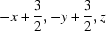
| Symmetry code: (i) −x+3/2, −y+3/2, z. |
Experimental details
| Crystal data | |
| Chemical formula | C11H9BrN2O |
| Mr | 265.11 |
| Crystal system, space group | Orthorhombic, Pccn |
| Temperature (K) | 100 |
| a, b, c (Å) | 12.0408 (16), 24.273 (3), 7.0428 (10) |
| V (Å3) | 2058.4 (5) |
| Z | 8 |
| Radiation type | Mo Kα |
| µ (mm−1) | 3.97 |
| Crystal size (mm) | 0.28 × 0.16 × 0.14 |
| Data collection | |
| Diffractometer | Bruker APEX CCD area-detector diffractometer |
| Absorption correction | Multi-scan (SADABS; Sheldrick, 1997) |
| Tmin, Tmax | 0.383, 0.576 |
| No. of measured, independent and observed [I > 2σ(I)] reflections | 9901, 1825, 1242 |
| Rint | 0.097 |
| (sin θ/λ)max (Å−1) | 0.595 |
| Refinement | |
| R[F2 > 2σ(F2)], wR(F2), S | 0.051, 0.120, 1.00 |
| No. of reflections | 1825 |
| No. of parameters | 136 |
| H-atom treatment | H-atom parameters constrained |
| Δρmax, Δρmin (e Å−3) | 0.71, −0.55 |
Computer programs: SMART (Bruker, 2001), SAINT (Bruker, 2002), SHELXS97 (Sheldrick, 2008), SHELXL97 (Sheldrick, 2008), X-SEED (Barbour, 2001; Atwood & Barbour, 2003).
| D—H···A | D—H | H···A | D···A | D—H···A |
| N3—H3···O8i | 0.88 | 1.88 | 2.760 (5) | 171 |
| Symmetry code: (i) −x+3/2, −y+3/2, z. |
Acknowledgements
The authors thank the University of Stellenbosch for financial support. JA (Postdoctoral Fellow of the FWO Flanders) thanks the FWO for the fellowship received.
References
 Atwood, J. L. & Barbour, L. J. (2003). Cryst. Growth Des. 3, 3–8. Web of Science CrossRef CAS Google Scholar
Barbour, L. J. (2001). J. Supramol. Chem. 1, 189–191. CrossRef CAS Google Scholar
Betancur, C., Azzi, M. & Rostène, W. (1997). Trends Pharmacol. Sci. 18, 372–386. CrossRef CAS PubMed Web of Science Google Scholar
Bruker (2001). SMART. Bruker AXS Inc., Madison, Wisconsin, USA. Google Scholar
Bruker (2002). SAINT. Bruker AXS Inc., Madison, Wisconsin, USA. Google Scholar
Harrison, T., Williams, B. J. & Swain, C. J. (1994). Bioorg. Med. Chem. Lett. 4, 2733–2734. CrossRef CAS Web of Science Google Scholar
Rombouts, F. J. R., De Borggraeve, W. M., Toppet, S. M., Compernolle, F. & Hoornaert, G. J. (2001). Tetrahedron Lett. 42, 7397–7399. Web of Science CrossRef CAS Google Scholar
Rombouts, F. J. R., Van den Bossche, J., Toppet, S. M., Compernolle, F. & Hoornaert, G. J. (2003). Tetrahedron, 59, 4721–4731. Web of Science CrossRef CAS Google Scholar
Sheldrick, G. M. (1997). SADABS. University of Göttingen, Germany. Google Scholar
Sheldrick, G. M. (2008). Acta Cryst. A64, 112–122. Web of Science CrossRef CAS IUCr Journals Google Scholar
Snider, R. M., Constantine, J. W., Lowe, J. A. III, Longo, K. P., Lebel, W. S., Woody, H. A., Drozda, S. E., Desai, M. C., Vinick, F. J., Spencer, R. W. & Hess, H.-J. (1991). Science, 251, 435–437. CrossRef PubMed CAS Web of Science Google Scholar
This is an open-access article distributed under the terms of the Creative Commons Attribution (CC-BY) Licence, which permits unrestricted use, distribution, and reproduction in any medium, provided the original authors and source are cited.
| CRYSTALLOGRAPHIC COMMUNICATIONS |


During the early nineties Pfizer (Snider et al., 1991) and Merck (Harrison et al., 1994) optimized a type of compounds (Betancur et al., 1997) that may be of therapeutic use in the treatment of chronic pain, inflammation, depression, emesis, and asthma. (I) can be converted into similar agents with potential biological activity (Rombouts et al., 2001; Rombouts et al., 2003). The molecular structure is given in Fig. 1. The dihedral angle between the planes of the benzene ring (C10—C15) and the pyrazinone ring (C1—N6) is 67.1 (2)°. The r.m.s deviation from the mean plane for the C10—C15 benzene ring is 0.004 Å [maximum deviation = 0.007 (4) Å for atom C13]. For the pyrazinone ring the corresponding value is 0.009 Å [maximum deviation = 0.015 (4) Å for atom C5]. In the crystal packing around a twofold axes hydrogen-bonded dimers are formed through N3—H···O8ihydrogen bond [symmetry code: (i) 3/2 - x, 3/2 - y, z; distance of 2.760 (5) Å (Table 1, Fig. 2). These dimers are stacked into columns by π-π interactions between pyrazinone rings along the c axis [centroid···centroid distances = 3.544 Å; symmetry codes: (ii) 3/2 - x, y, 1/2 + z and (iii) 3/2 - x, y, -1/2 + z] (Fig. 3). There are no direction-specific interactions between stacked columns (Fig. 4).