 | Acta Crystallographica Section E Acta Crystallographica Section E CRYSTALLOGRAPHIC COMMUNICATIONS |


 journal menu


inorganic compounds
| CRYSTALLOGRAPHIC COMMUNICATIONS |
 access
The Na0.39(NH4)1.61SO4·Te(OH)6

aLaboratoire de Chimie Inorganique, Faculté des Sciences de Sfax, 3018 Sfax, Tunisia, and bLaboratoire Léon Brillouin, CE Saclay, Bâtiment 563, 91191 Gif-sur-Yvette Cedex, France
*Correspondence e-mail: [email protected]
The title compound, sodium ammonium sulfate–telluric acid (1/1), Na0.39(NH4)1.61SO4·Te(OH)6, is isostructural with other solid solutions in the series M1−x(NH4)xSO4·Te(OH)6, where ammonium is partially replaced with an alkali metal (M = K, Rb or Cs). The structure is composed of planes of Te(OH)6 octahedra alternating with planes of SO4 tetrahedra. The Na+/NH4+ cations are statistically distributed over the same position and are located between the planes. The structure is stabilized by O—H⋯O and N—H⋯O hydrogen bonds between the telluric acid adducts and the O atoms of sulfate groups, and between the ammonium cations and O atoms, respectively. Both Te atoms lie on centres of symmetry.
Related literature
For the sodium end-member of the series Na1−x(NH4)xSO4·Te(OH)6, see: Zilber et al. (1980![[Zilber, R., Tordjman, I. & Guitel, J. C. (1980). Acta Cryst. B36, 2741-2743.]](../../../../../../logos/arrows/e_arr.gif "Zilber, R., Tordjman, I. & Guitel, J. C. (1980). Acta Cryst. B36, 2741-2743.") ). For the ammonium end-member of the same series, see: Zilber et al. (1981). For other solid solutions in the system M1−x(NH4)xSO4·Te(OH)6, where ammonium is partially replaced by an alkali metal, see: Dammak et al. (2005) for M = Cs; Ktari et al. (2002) for M = Rb; and Ktari et al. (2004) for M = K. For related literature, see: Prince (1982); Watkin (1994).
). For the ammonium end-member of the same series, see: Zilber et al. (1981). For other solid solutions in the system M1−x(NH4)xSO4·Te(OH)6, where ammonium is partially replaced by an alkali metal, see: Dammak et al. (2005) for M = Cs; Ktari et al. (2002) for M = Rb; and Ktari et al. (2004) for M = K. For related literature, see: Prince (1982); Watkin (1994).
Experimental
Crystal data
|
Refinement
|
|
 ; (ii)
  ; (iv)
  ; (v)
; (v) 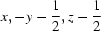 ; (vi)
  ; (ix)
|
 ; (xiii)
  ; (xiv)
 Data collection: COLLECT (Nonius, 2001); cell refinement: DENZO/SCALEPACK (Otwinowski & Minor, 1997); data reduction: DENZO/SCALEPACK; program(s) used to solve structure: SHELXS86 (Sheldrick, 2008); program(s) used to refine structure: CRYSTALS (Betteridge et al., 2003); molecular graphics: DIAMOND (Brandenburg & Berndt, 1999); software used to prepare material for publication: CRYSTALS.
Supporting information
contains datablocks I, global. DOI: 10.1107/S1600536808003425/wm2171sup1.cif
Structure factors: contains datablock I. DOI: 10.1107/S1600536808003425/wm2171Isup2.hkl
Transparent, colorless single crystals of the title compound were grown from an aqueous solution consisting of a stoichiometric mixture (ratio 1:1.5:0.5) of H6TeO6 (Aldrich, 99%) (NH4)2SO4 (Aldrich, 99.99%) and Na2SO4 (Aldrich, 99%) after evaporation at room temperature.
H atoms of the Te(OH)6 group were located in an electron density difference map and were refined with O—H distance restraints of 0.95 (2) Å and a common Uiso parameter. H atoms of the ammonium groups could not be located and were excluded from the For the of the occupation factors for N and Na atoms, their sums were restrained to be equal to 1. The highest peak in the final Fourier map is located 0.044 Å from Te2 and the deepest hole 0.43 Å from the same atom.
Data collection: COLLECT (Nonius, 2001); cell DENZO/SCALEPACK (Otwinowski & Minor, 1997); data reduction: DENZO/SCALEPACK (Otwinowski & Minor, 1997); program(s) used to solve structure: SHELXS86 (Sheldrick, 2008); program(s) used to refine structure: CRYSTALS (Betteridge et al., 2003); molecular graphics: DIAMOND (Brandenburg & Berndt, 1999); software used to prepare material for publication: CRYSTALS (Betteridge et al., 2003).
![[Figure 1]](./wm2171fig1thm.gif) | Fig. 1. Projection of the crystal structure of the title compound on the ab plane. |
![[Figure 2]](./wm2171fig2thm.gif) | Fig. 2. A part of the structure of Na0.39(NH4)1.61SO4.Te(OH)6, with displacement ellipsoids drawn at the 50% probability level. [Symmetry codes:(a) -x + 1,-y, -z; (b) -x, -y + 1, -z] |
![[Figure 3]](./wm2171fig3thm.gif) | Fig. 3. Crystal structure of Na0.39(NH4)1.61SO4.Te(OH)6 showing hydrogen bonds with dashed lines. |
| Na0.39(NH4)1.61SO4·Te(OH)6 | F(000) = 678.224 |
| Mr = 357.22 | Dx = 2.418 Mg m−3 |
| Monoclinic, P21/c | Mo Kα radiation, λ = 0.71073 Å |
| Hall symbol: -P 2ybc | Cell parameters from 919 reflections |
| a = 13.690 (1) Å | θ = 2.7–30.1° |
| b = 6.592 (1) Å | µ = 3.30 mm−1 |
| c = 11.345 (1) Å | T = 298 K |
| β = 106.58 (1)° | Parallelepiped, colourless |
| V = 981.26 (19) Å3 | 0.15 × 0.14 × 0.10 mm |
| Z = 4 |
| Nonius KappaCCD diffractometer | 638 reflections with I > 3σ(I) |
| Graphite monochromator | Rint = 0.000 |
| ϕ scans | θmax = 30.2°, θmin = 1.6° |
| Absorption correction: multi-scan (MULABS in PLATON; Spek, 2007) | h = −16→14 |
| Tmin = 0.615, Tmax = 0.719 | k = −7→7 |
| 919 measured reflections | l = −5→5 |
| 849 independent reflections |
| Refinement on F | Primary atom site location: structure-invariant direct methods |
| Least-squares matrix: full | Secondary atom site location: difference Fourier map |
| R[F2 > 2σ(F2)] = 0.032 | Hydrogen site location: inferred from neighbouring sites |
| wR(F2) = 0.043 | H-atom parameters constrained |
| S = 0.93 | Chebychev polynomial, (Watkin, 1994, Prince, 1982) [weight] = 1.0/[A0*T0(x) + A1*T1(x) ··· + An-1]*Tn-1(x)] where Ai are the Chebychev coefficients listed below and x = F /Fmax Method = Robust Weighting (Prince, 1982); W = [weight] * [1-(deltaF/6*sigmaF)2]2 Ai are: 0.527 0.367 0.302 |
| 638 reflections | (Δ/σ)max = 0.000105 |
| 104 parameters | Δρmax = 0.51 e Å−3 |
| 1 restraint | Δρmin = −1.15 e Å−3 |
| Na0.39(NH4)1.61SO4·Te(OH)6 | V = 981.26 (19) Å3 |
| Mr = 357.22 | Z = 4 |
| Monoclinic, P21/c | Mo Kα radiation |
| a = 13.690 (1) Å | µ = 3.30 mm−1 |
| b = 6.592 (1) Å | T = 298 K |
| c = 11.345 (1) Å | 0.15 × 0.14 × 0.10 mm |
| β = 106.58 (1)° |
| Nonius KappaCCD diffractometer | 849 independent reflections |
| Absorption correction: multi-scan (MULABS in PLATON; Spek, 2007) | 638 reflections with I > 3σ(I) |
| Tmin = 0.615, Tmax = 0.719 | Rint = 0.000 |
| 919 measured reflections |
| R[F2 > 2σ(F2)] = 0.032 | 1 restraint |
| wR(F2) = 0.043 | H-atom parameters constrained |
| S = 0.93 | Δρmax = 0.51 e Å−3 |
| 638 reflections | Δρmin = −1.15 e Å−3 |
| 104 parameters |
| x | y | z | Uiso*/Ueq | Occ. (<1) | |
| Te1 | 0.5000 | 0.5000 | 0.0000 | 0.0099 | |
| Te2 | 0.0000 | 1.0000 | 0.0000 | 0.0106 | |
| S1 | −0.24900 (9) | −0.49139 (17) | −0.2352 (2) | 0.0124 | |
| Na1 | −0.1448 (2) | 0.0149 (2) | −0.3454 (2) | 0.0181 | 0.2590 |
| N1 | −0.1448 (2) | 0.0149 (2) | −0.3454 (2) | 0.0181 | 0.7410 |
| Na2 | −0.3539 (2) | 0.0047 (2) | −0.0920 (2) | 0.0229 | 0.1300 |
| N2 | −0.3539 (2) | 0.0047 (2) | −0.0920 (2) | 0.0229 | 0.8700 |
| O1 | 0.5309 (3) | 0.5871 (6) | −0.1453 (6) | 0.0241 | |
| O2 | 0.4606 (3) | 0.2370 (5) | −0.0661 (5) | 0.0232 | |
| O3 | 0.3647 (2) | 0.6044 (5) | −0.0656 (5) | 0.0174 | |
| O4 | −0.1350 (2) | 1.0859 (5) | −0.0867 (5) | 0.0188 | |
| O5 | 0.0167 (2) | 1.2375 (5) | 0.1011 (5) | 0.0150 | |
| O6 | 0.0519 (2) | 1.1390 (5) | −0.1165 (6) | 0.0174 | |
| O7 | −0.1698 (3) | −0.5105 (5) | −0.1149 (6) | 0.0221 | |
| O8 | −0.3350 (2) | −0.6287 (5) | −0.2355 (5) | 0.0160 | |
| O9 | −0.2843 (2) | −0.2792 (5) | −0.2508 (5) | 0.0202 | |
| O10 | −0.2079 (3) | −0.5499 (6) | −0.3357 (6) | 0.0213 | |
| H1 | 0.5496 | 0.4942 | −0.1631 | 0.0500* | |
| H2 | 0.4006 | 0.2489 | −0.1288 | 0.0500* | |
| H3 | 0.3748 | 0.7041 | −0.1257 | 0.0500* | |
| H4 | −0.1328 | 1.2273 | −0.0942 | 0.0500* | |
| H5 | −0.0379 | 1.3302 | 0.0591 | 0.0500* | |
| H6 | 0.1037 | 1.0563 | −0.1347 | 0.0500* |
| U11 | U22 | U33 | U12 | U13 | U23 | |
| Te1 | 0.00995 (8) | 0.00995 (8) | 0.00995 (8) | 0.00017 (8) | 0.00296 (8) | 0.00017 (8) |
| Te2 | 0.01064 (8) | 0.01064 (8) | 0.01064 (8) | 0.00017 (8) | 0.00316 (8) | 0.00017 (8) |
| S1 | 0.0128 (9) | 0.0116 (8) | 0.013 (3) | 0.0000 (4) | 0.0042 (12) | 0.0010 (8) |
| Na1 | 0.0213 (2) | 0.0181 (2) | 0.0197 (2) | 0.0029 (2) | 0.0133 (2) | 0.0000 (2) |
| N1 | 0.0213 (2) | 0.0181 (2) | 0.0197 (2) | 0.0029 (2) | 0.0133 (2) | 0.0000 (2) |
| Na2 | 0.0233 (2) | 0.0199 (2) | 0.0285 (2) | −0.0014 (2) | 0.0122 (2) | 0.0024 (2) |
| N2 | 0.0233 (2) | 0.0199 (2) | 0.0285 (2) | −0.0014 (2) | 0.0122 (2) | 0.0024 (2) |
| O1 | 0.0316 (18) | 0.030 (2) | 0.016 (2) | 0.0127 (15) | 0.015 (2) | 0.009 (2) |
| O2 | 0.0272 (16) | 0.0145 (12) | 0.020 (4) | 0.0006 (12) | −0.006 (2) | −0.0080 (17) |
| O3 | 0.0103 (11) | 0.0209 (16) | 0.021 (4) | 0.0017 (11) | 0.0045 (16) | 0.003 (2) |
| O4 | 0.0143 (11) | 0.0161 (16) | 0.023 (4) | 0.0017 (11) | 0.0005 (15) | 0.0052 (19) |
| O5 | 0.0194 (15) | 0.0176 (14) | 0.008 (3) | 0.0032 (12) | 0.0042 (19) | −0.0027 (16) |
| O6 | 0.0234 (16) | 0.0191 (15) | 0.014 (3) | 0.0045 (13) | 0.0119 (19) | 0.0034 (17) |
| O7 | 0.0190 (18) | 0.0192 (18) | 0.022 (4) | −0.0001 (12) | −0.004 (2) | 0.002 (2) |
| O8 | 0.0157 (15) | 0.0212 (16) | 0.013 (5) | −0.0030 (12) | 0.006 (2) | 0.002 (2) |
| O9 | 0.0167 (16) | 0.0146 (13) | 0.026 (5) | 0.0022 (12) | 0.001 (2) | 0.001 (2) |
| O10 | 0.0189 (18) | 0.0247 (16) | 0.026 (4) | −0.0032 (14) | 0.015 (2) | −0.005 (2) |
| Te1—H1i | 2.146 | O4—H4 | 0.937 |
| Te1—O3i | 1.916 (3) | O5—H5 | 0.978 |
| Te1—O2i | 1.905 (4) | O6—H6 | 0.963 |
| Te1—O1i | 1.903 (6) | Na1—O6iii | 2.873 (4) |
| Te1—O1 | 1.903 (6) | Na1—O4iv | 2.937 (6) |
| Te1—O2 | 1.905 (4) | Na1—O5v | 2.947 (4) |
| Te1—O3 | 1.916 (3) | Na1—O3vi | 2.950 (4) |
| Te1—H1 | 2.146 | Na1—O7vii | 2.978 (7) |
| Te2—O5ii | 1.915 (4) | Na1—O10viii | 3.008 (4) |
| Te2—O4ii | 1.914 (3) | Na1—O9 | 3.120 (4) |
| Te2—O6ii | 1.904 (5) | Na1—O6iv | 3.267 (6) |
| Te2—O4 | 1.914 (3) | Na1—O5ix | 3.278 (5) |
| Te2—O5 | 1.915 (4) | Na2—O9 | 2.938 (5) |
| Te2—O6 | 1.904 (5) | Na2—O8viii | 2.966 (4) |
| S1—O7 | 1.486 (6) | Na2—O4iv | 3.029 (4) |
| S1—O8 | 1.485 (3) | Na2—O10x | 3.037 (7) |
| S1—O9 | 1.474 (3) | Na2—O2xi | 3.050 (4) |
| S1—O10 | 1.460 (6) | Na2—O2xii | 3.063 (5) |
| O1—H1 | 0.715 | Na2—O1xiii | 3.144 (5) |
| O2—H2 | 0.924 | Na2—O3ix | 3.164 (5) |
| O3—H3 | 0.985 | Na2—O1vi | 3.305 (6) |
| O3i—Te1—O2i | 92.32 (15) | O4ii—Te2—O6ii | 89.85 (18) |
| O3i—Te1—O1i | 89.1 (2) | O5ii—Te2—O4 | 90.07 (16) |
| O2i—Te1—O1i | 92.4 (2) | O4ii—Te2—O4 | 179.994 |
| O3i—Te1—O1 | 90.9 (2) | O6ii—Te2—O4 | 90.15 (18) |
| O2i—Te1—O1 | 87.6 (2) | O5ii—Te2—O5 | 179.994 |
| O1i—Te1—O1 | 179.994 | O4ii—Te2—O5 | 90.07 (16) |
| H1i—Te1—O2 | 103.413 | O6ii—Te2—O5 | 88.98 (19) |
| O3i—Te1—O2 | 87.68 (15) | O4—Te2—O5 | 89.93 (16) |
| O2i—Te1—O2 | 179.994 | O5ii—Te2—O6 | 88.98 (19) |
| O1i—Te1—O2 | 87.6 (2) | O4ii—Te2—O6 | 90.15 (18) |
| O1—Te1—O2 | 92.4 (2) | O6ii—Te2—O6 | 179.994 |
| H1i—Te1—O3 | 79.615 | O4—Te2—O6 | 89.85 (18) |
| O3i—Te1—O3 | 179.994 | O5—Te2—O6 | 91.02 (19) |
| O2i—Te1—O3 | 87.68 (15) | O7—S1—O8 | 108.7 (3) |
| O1i—Te1—O3 | 90.9 (2) | O7—S1—O9 | 108.6 (3) |
| O1—Te1—O3 | 89.1 (2) | O8—S1—O9 | 110.21 (19) |
| O2—Te1—O3 | 92.32 (15) | O7—S1—O10 | 110.6 (3) |
| O5ii—Te2—O4ii | 89.93 (16) | O8—S1—O10 | 108.6 (3) |
| O5ii—Te2—O6ii | 91.02 (19) | O9—S1—O10 | 110.1 (3) |
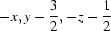
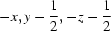
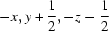
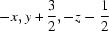
| Symmetry codes: (i) −x+1, −y+1, −z; (ii) −x, −y+2, −z; (iii) −x, y−3/2, −z−1/2; (iv) x, y−1, z; (v) x, −y+3/2, z−1/2; (vi) −x, y−1/2, −z−1/2; (vii) x, −y−1/2, z−1/2; (viii) x, y+1, z; (ix) −x, −y+1, −z; (x) x, −y−1/2, z+1/2; (xi) x−1, y, z; (xii) −x, −y, −z; (xiii) x−1, y−1, z. |
| D—H···A | D—H | H···A | D···A | D—H···A |
| O2—H2···O9xiv | 0.924 (4) | 1.787 (4) | 2.700 (6) | 169.2 (2) |
| O3—H3···O8xv | 0.985 (5) | 1.871 (5) | 2.799 (7) | 155.7 (2) |
| O4—H4···O7xvi | 0.937 (3) | 1.798 (3) | 2.706 (7) | 162.4 (2) |
| O6—H6···O10xv | 0.963 (4) | 1.706 (4) | 2.658 (6) | 169.5 (3) |
| N1···O6iii | 2.873 (4) | |||
| N1···O4iv | 2.937 (6) | |||
| N1···O5v | 2.947 (4) | |||
| N1···O3vi | 2.950 (4) | |||
| N1···O7vii | 2.978 (7) | |||
| N1···O10viii | 3.008 (4) | |||
| N2···O9 | 2.938 (5) | |||
| N2···O8viii | 2.966 (4) | |||
| N2···O4iv | 3.029 (4) | |||
| N2···O10x | 3.037 (7) | |||
| N2···O2xi | 3.050 (4) | |||
| N2···O2xii | 3.063 (5) |
| Symmetry codes: (iii) −x, y−3/2, −z−1/2; (iv) x, y−1, z; (v) x, −y+3/2, z−1/2; (vi) −x, y−1/2, −z−1/2; (vii) x, −y−1/2, z−1/2; (viii) x, y+1, z; (x) x, −y−1/2, z+1/2; (xi) x−1, y, z; (xii) −x, −y, −z; (xiv) −x, y+1/2, −z−1/2; (xv) −x, y+3/2, −z−1/2; (xvi) x, y+2, z. |
Experimental details
| Crystal data | |
| Chemical formula | Na0.39(NH4)1.61SO4·Te(OH)6 |
| Mr | 357.22 |
| Crystal system, space group | Monoclinic, P21/c |
| Temperature (K) | 298 |
| a, b, c (Å) | 13.690 (1), 6.592 (1), 11.345 (1) |
| β (°) | 106.58 (1) |
| V (Å3) | 981.26 (19) |
| Z | 4 |
| Radiation type | Mo Kα |
| µ (mm−1) | 3.30 |
| Crystal size (mm) | 0.15 × 0.14 × 0.10 |
| Data collection | |
| Diffractometer | Nonius KappaCCD diffractometer |
| Absorption correction | Multi-scan (MULABS in PLATON; Spek, 2007) |
| Tmin, Tmax | 0.615, 0.719 |
| No. of measured, independent and observed [I > 3σ(I)] reflections | 919, 849, 638 |
| Rint | 0.000 |
| (sin θ/λ)max (Å−1) | 0.707 |
| Refinement | |
| R[F2 > 2σ(F2)], wR(F2), S | 0.032, 0.043, 0.93 |
| No. of reflections | 638 |
| No. of parameters | 104 |
| No. of restraints | 1 |
| H-atom treatment | H-atom parameters constrained |
| Δρmax, Δρmin (e Å−3) | 0.51, −1.15 |
Computer programs: COLLECT (Nonius, 2001), DENZO/SCALEPACK (Otwinowski & Minor, 1997), SHELXS86 (Sheldrick, 2008), CRYSTALS (Betteridge et al., 2003), DIAMOND (Brandenburg & Berndt, 1999).
| Te1—O1 | 1.903 (6) | Na1—O7v | 2.978 (7) |
| Te1—O2 | 1.905 (4) | Na1—O10vi | 3.008 (4) |
| Te1—O3 | 1.916 (3) | Na1—O9 | 3.120 (4) |
| Te2—O4 | 1.914 (3) | Na1—O6ii | 3.267 (6) |
| Te2—O5 | 1.915 (4) | Na1—O5vii | 3.278 (5) |
| Te2—O6 | 1.904 (5) | Na2—O9 | 2.938 (5) |
| S1—O7 | 1.486 (6) | Na2—O8vi | 2.966 (4) |
| S1—O8 | 1.485 (3) | Na2—O4ii | 3.029 (4) |
| S1—O9 | 1.474 (3) | Na2—O10viii | 3.037 (7) |
| S1—O10 | 1.460 (6) | Na2—O2ix | 3.050 (4) |
| Na1—O6i | 2.873 (4) | Na2—O2x | 3.063 (5) |
| Na1—O4ii | 2.937 (6) | Na2—O1xi | 3.144 (5) |
| Na1—O5iii | 2.947 (4) | Na2—O3vii | 3.164 (5) |
| Na1—O3iv | 2.950 (4) | Na2—O1iv | 3.305 (6) |
| Symmetry codes: (i) −x, y−3/2, −z−1/2; (ii) x, y−1, z; (iii) x, −y+3/2, z−1/2; (iv) −x, y−1/2, −z−1/2; (v) x, −y−1/2, z−1/2; (vi) x, y+1, z; (vii) −x, −y+1, −z; (viii) x, −y−1/2, z+1/2; (ix) x−1, y, z; (x) −x, −y, −z; (xi) x−1, y−1, z. |
| D—H···A | D—H | H···A | D···A | D—H···A |
| O2—H2···O9xii | 0.924 (4) | 1.787 (4) | 2.700 (6) | 169.2 (2) |
| O3—H3···O8xiii | 0.985 (5) | 1.871 (5) | 2.799 (7) | 155.7 (2) |
| O4—H4···O7xiv | 0.937 (3) | 1.798 (3) | 2.706 (7) | 162.4 (2) |
| O6—H6···O10xiii | 0.963 (4) | 1.706 (4) | 2.658 (6) | 169.5 (3) |
| N1···O6i | . | . | 2.873 (4) | . |
| N1···O4ii | . | . | 2.937 (6) | . |
| N1···O5iii | . | . | 2.947 (4) | . |
| N1···O3iv | . | . | 2.950 (4) | . |
| N1···O7v | . | . | 2.978 (7) | . |
| N1···O10vi | . | . | 3.008 (4) | . |
| N2···O9 | . | . | 2.938 (5) | . |
| N2···O8vi | . | . | 2.966 (4) | . |
| N2···O4ii | . | . | 3.029 (4) | . |
| N2···O10viii | . | . | 3.037 (7) | . |
| N2···O2ix | . | . | 3.050 (4) | . |
| N2···O2x | . | . | 3.063 (5) | . |
| Symmetry codes: (i) −x, y−3/2, −z−1/2; (ii) x, y−1, z; (iii) x, −y+3/2, z−1/2; (iv) −x, y−1/2, −z−1/2; (v) x, −y−1/2, z−1/2; (vi) x, y+1, z; (viii) x, −y−1/2, z+1/2; (ix) x−1, y, z; (x) −x, −y, −z; (xii) −x, y+1/2, −z−1/2; (xiii) −x, y+3/2, −z−1/2; (xiv) x, y+2, z. |
Acknowledgements
This project was supported by the French Ministry of Research and New Technologies and the French/Tunisian Twin Committee for University Collaboration.
References
 Betteridge, P. W., Carruthers, J. R., Cooper, R. I., Prout, K. & Watkin, D. J. (2003). J. Appl. Cryst. 36, 1487. Web of Science CrossRef IUCr Journals Google Scholar
Brandenburg, K. & Berndt, M. (1999). DIAMOND. Version 2.1b. Crystal Impact GbR, Bonn, Germany. Google Scholar
Dammak, M., Ktari, L., Cousson, A. & Mhiri, T. (2005). J. Solid State Chem. 178, 2109–2116. Web of Science CrossRef CAS Google Scholar
Ktari, L., Dammak, M., Hadrich, A., Cousson, A., Nierlich, M., Romain, F. & Mhiri, T. (2004). Solid State Sci. 6, 1393–1401. Web of Science CrossRef CAS Google Scholar
Ktari, L., Dammak, M., Mhiri, T. & Kolsi, A. W. (2002). Phys. Chem. News, 8, 1–8. CAS Google Scholar
Nonius (2001). COLLECT. Nonius BV, Delft, The Netherlands. Google Scholar
Otwinowski, Z. & Minor, W. (1997). Methods in Enzymology, Vol. 276, Macromolecular Crystallography, Part A, edited by C. W. Carter Jr & R. M. Sweet, pp. 307–326. New York: Academic Press. Google Scholar
Prince, E. (1982). Mathematical Techniques in Crystallography and Materials Science. New York: Springer-Verlag. Google Scholar
Sheldrick, G. M. (2008). Acta Cryst. A64, 112–122. Web of Science CrossRef CAS IUCr Journals Google Scholar
Spek, A. L. (2007). PLATON. Utrecht University, The Netherlands. Google Scholar
Watkin, D. (1994). Acta Cryst. A50, 411–437. CrossRef CAS Web of Science IUCr Journals Google Scholar
Zilber, R., Durif, A. & Averbuch-Pouchot, M. T. (1981). Acta Cryst. B37, 650–652. CrossRef CAS Web of Science IUCr Journals Google Scholar
Zilber, R., Tordjman, I. & Guitel, J. C. (1980). Acta Cryst. B36, 2741–2743. CrossRef CAS IUCr Journals Web of Science Google Scholar
This is an open-access article distributed under the terms of the Creative Commons Attribution (CC-BY) Licence, which permits unrestricted use, distribution, and reproduction in any medium, provided the original authors and source are cited.
| CRYSTALLOGRAPHIC COMMUNICATIONS |


The studies of a partial cationic substitution on symmetry and physical properties of solid solutions in the series M1 - x(NH4)xSO4.Te(OH)6 (M = K, Rb and Cs) have been reported in previous communications, viz. for K0.84(NH4)1.16SO4.Te(OH)6 (Ktari et al.., 2004), Rb1.12(NH4)0.88SO4.Te(OH)6 (Ktari et al.., 2002), and Cs0.86(NH4)1.14SO4.Te(OH)6 (Dammak et al.., 2005). To continue these studies, we have now investigated the solid solution Na0.39(NH4)1.61SO4.Te(OH)6. This compound is isostructural with the aforementioned phases.
Fig. 1 shows a projection of the structure on the ab plane. The structure can be regarded as being built up of planes of Te(OH)6 octahedra (at x = 0 and 1/2) alternating with planes of SO4 tetrahedra (at x ≈ 1/4). The statistically disordered Na+/NH4+ cations are intercalated between these planes. Both Te atoms are situated on inversion centres and exhibit similar Te(OH)6 octahedra, with Te—O distances and O—Te—O angles ranging from 1.903 (6) to 1.916 (3) Å, and from 87.6 (2) to 92.4 (2)°, respectively (Fig. 2). In the sodium end-member Na2SO4.Te(OH)6 (Zilber et al., 1980), the Te—O distances range from 1.879 (4) to 1.932 (3) Å, whereas in the ammonium end-member (NH4)2SO4.Te(OH)6 (Zilber et al., 1981) they vary from 1.874 (3) to 1.944 (3) Å. The SO4 tetrahedra in the title compound are quite regular with S—O distances between 1.460 (6) and 1.486 (6)Å and O—S—O angles between 108.6 (3) and 110.6 (3)°. In the sodium end-member, the S—O distances are nearly the same (1.461 (5) to 1.497 (5) Å), whilst in the ammonium end-member they spread between 1.373 (11) and 1.565 (8) Å. In the mixed solution the Na/N atoms are 9-coordinate with (Na/N)—O bonds ranging from 2.873 (4) to 3.278 (5)Å for Na1/N1 and from 2.938 (5) to 3.305 (6)Å for Na2/N2. Thereby every cation is coordinated by three oxygen atoms belonging to SO4 tetrahedra and by six oxygen atoms belonging to Te(OH)6 octahedra. The structure of the title compound is stabilized via medium-strong O—H···O hydrogen bonds between the Te(OH)6 octahedra and SO4 tetrahedra (Fig. 3), and between N—H···O hydrogen bonds between the ammonium cations and various oxygen atoms in the structure (see hydrogen bonding Table).