 | Acta Crystallographica Section E Acta Crystallographica Section E CRYSTALLOGRAPHIC COMMUNICATIONS |


 journal menu


organic compounds
| CRYSTALLOGRAPHIC COMMUNICATIONS |
 access
2-Hydroxyimino-1-phenylethanone thiosemicarbazone monohydrate

aAdnan Menderes University, Department of Chemistry, 09010 Aydın, Turkey, bAtatürk University, Department of Chemistry, 22240 Erzurum, Turkey, and cHacettepe University, Department of Physics, 06800 Beytepe, Ankara, Turkey
*Correspondence e-mail: [email protected]
In the title thiosemicarbazone derivative, C9H10N4OS·H2O, intramolecular N—H⋯N hydrogen bonds result in the formation of two nearly coplanar five- and six-membered rings, which are also almost coplanar with the adjacent phenyl ring. The oxime group has an E configuration and is involved in intermolecular O—H⋯O hydrogen bonding as a donor. In the intramolecular O—H⋯S and N—H⋯N and intermolecular O—H⋯O and N—H⋯S hydrogen bonds generate edge-fused R22(8) and R41(11) ring motifs. The hydrogen-bonded motifs are linked to each other to form a three-dimensional supramolecular network.
Related literature
For general backgroud, see: Lukevics et al. (1995![[Lukevics, E., Jansone, D., Rubina, K., Abele, E., Germane, S., Leite, L., Shymaska, M. & Popelis, J. (1995). Eur. J. Med. Chem. 30, 983-986.]](../../../../../../logos/arrows/e_arr.gif "Lukevics, E., Jansone, D., Rubina, K., Abele, E., Germane, S., Leite, L., Shymaska, M. & Popelis, J. (1995). Eur. J. Med. Chem. 30, 983-986.") ); Liberta & West (1992); Hagenbach & Gysin (1952); Jones et al. (1965); Brockman & Thomson (1956); Klayman et al. (1979); Petering & van Giesen (1966); Sevagapandian et al. (2000); Forman (1964); Holan et al. (1984); Balsamo et al. (1990); Marsman et al. (1999); Karle et al. (1996); Etter et al. (1990); Chertanova et al. (1994); Bernstein et al. (1995). For related structures, see: Sarıkavaklı et al. (2007); Özel Güven et al. (2007); Hökelek, Batı et al. (2001); Hökelek, Zülfikaroğlu & Batı (2001); Büyükgüngör et al. (2003); Hökelek et al. (2004a,b); Hökelek et al. (2004). For the synthesis, see: El-Shazly et al. (2005). For bond-length data, see: Allen et al. (1987).
); Liberta & West (1992); Hagenbach & Gysin (1952); Jones et al. (1965); Brockman & Thomson (1956); Klayman et al. (1979); Petering & van Giesen (1966); Sevagapandian et al. (2000); Forman (1964); Holan et al. (1984); Balsamo et al. (1990); Marsman et al. (1999); Karle et al. (1996); Etter et al. (1990); Chertanova et al. (1994); Bernstein et al. (1995). For related structures, see: Sarıkavaklı et al. (2007); Özel Güven et al. (2007); Hökelek, Batı et al. (2001); Hökelek, Zülfikaroğlu & Batı (2001); Büyükgüngör et al. (2003); Hökelek et al. (2004a,b); Hökelek et al. (2004). For the synthesis, see: El-Shazly et al. (2005). For bond-length data, see: Allen et al. (1987).
![[Scheme 1]](xu2403scheme1.gif)
Experimental
Crystal data
|
Refinement
|
|
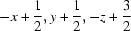 ; (ii)
 Data collection: CrystalClear (Rigaku/MSC, 2005); cell refinement: CrystalClear; data reduction: CrystalClear; program(s) used to solve structure: SHELXS97 (Sheldrick, 2008); program(s) used to refine structure: SHELXL97 (Sheldrick, 2008); molecular graphics: ORTEP-3 for Windows (Farrugia, 1997) and PLATON (Spek, 2003); software used to prepare material for publication: WinGX (Farrugia, 1999).
Supporting information
contains datablocks I, global. DOI: 10.1107/S1600536808004947/xu2403sup1.cif
Structure factors: contains datablock I. DOI: 10.1107/S1600536808004947/xu2403Isup2.hkl
The title compound was prepared according to the literature method (El-Shazly et al., 2005). 2-Isonitrosoacetophenone (149 mg, 1 mmol) was reacted with thiosemicarbazide (91 mg, 1 mmol) in ethanol-water mixture (1:1) by refluxing for 24 h. Then, a few drops of glacial acetic acid were added. The formed precipitate was filtered and recrystallized from ethanol to obtain yellow crystals (yield: 155 mg, 70%).
H atoms were located in difference syntheses and refined isotropically [O—H = 0.903 (18)–0.940 (17) Å; Uiso(H) = 0.100 (10)–0.133 (14) Å2, N—H = 0.915 (17)–0.930 (17) Å; Uiso(H) = 0.077 (8)–0.084 (9) Å2 and C—H = 0.92 (3)–0.97 (3) Å; Uiso(H) = 0.071 (8)–0.092 (9) Å2]. The restrains on the O—H (for OH) and N—H (for NH and NH2) bonds and O—H bond lengths and H—O—H bond angle of water molecule were applied.
Data collection: CrystalClear (Rigaku/MSC, 2005); cell CrystalClear (Rigaku/MSC, 2005); data reduction: CrystalClear (Rigaku/MSC, 2005); program(s) used to solve structure: SHELXS97 (Sheldrick, 2008); program(s) used to refine structure: SHELXL97 (Sheldrick, 2008); molecular graphics: ORTEP-3 for Windows (Farrugia, 1997) and PLATON (Spek, 2003); software used to prepare material for publication: WinGX (Farrugia, 1999).
![[Figure 1]](./xu2403fig1thm.gif) | Fig. 1. The molecular structure of the title molecule with the atom-numbering scheme. Displacement ellipsoids are drawn at the 50% probability level. |
![[Figure 2]](./xu2403fig2thm.gif) | Fig. 2. A part of the crystal structure of (I), showing the formation of R22(8) and R41(11) ring motifs. Hydrogen bonds are shown as dashed lines. |
![[Figure 3]](./xu2403fig3thm.gif) | Fig. 3. A partial packing diagram of (I). Hydrogen bonds are shown as dashed lines. |
| C9H10N4OS·H2O | F(000) = 1008 |
| Mr = 240.29 | Dx = 1.357 Mg m−3 |
| Monoclinic, C2/c | Melting point: 443 K |
| Hall symbol: -C 2yc | Mo Kα radiation, λ = 0.71073 Å |
| a = 28.5615 (3) Å | Cell parameters from 2893 reflections |
| b = 4.6805 (3) Å | θ = 2.3–30.5° |
| c = 22.0977 (4) Å | µ = 0.27 mm−1 |
| β = 127.24 (2)° | T = 294 K |
| V = 2351.8 (6) Å3 | Prism, yellow |
| Z = 8 | 0.30 × 0.20 × 0.15 mm |
| Rigaku R-AXIS RAPID-S diffractometer | 3607 independent reflections |
| Radiation source: fine-focus sealed tube | 2146 reflections with I > 2σ(I) |
| Graphite monochromator | Rint = 0.090 |
| ω scans | θmax = 30.5°, θmin = 2.3° |
| Absorption correction: multi-scan (Blessing, 1995) | h = −40→40 |
| Tmin = 0.940, Tmax = 0.960 | k = −6→5 |
| 31269 measured reflections | l = −31→31 |
| Refinement on F2 | Primary atom site location: structure-invariant direct methods |
| Least-squares matrix: full | Secondary atom site location: difference Fourier map |
| R[F2 > 2σ(F2)] = 0.062 | Hydrogen site location: inferred from neighbouring sites |
| wR(F2) = 0.154 | H atoms treated by a mixture of independent and constrained refinement |
| S = 1.04 | w = 1/[σ2(Fo2) + (0.0474P)2 + 0.9027P] where P = (Fo2 + 2Fc2)/3 |
| 3607 reflections | (Δ/σ)max < 0.001 |
| 193 parameters | Δρmax = 0.14 e Å−3 |
| 8 restraints | Δρmin = −0.31 e Å−3 |
| C9H10N4OS·H2O | V = 2351.8 (6) Å3 |
| Mr = 240.29 | Z = 8 |
| Monoclinic, C2/c | Mo Kα radiation |
| a = 28.5615 (3) Å | µ = 0.27 mm−1 |
| b = 4.6805 (3) Å | T = 294 K |
| c = 22.0977 (4) Å | 0.30 × 0.20 × 0.15 mm |
| β = 127.24 (2)° |
| Rigaku R-AXIS RAPID-S diffractometer | 3607 independent reflections |
| Absorption correction: multi-scan (Blessing, 1995) | 2146 reflections with I > 2σ(I) |
| Tmin = 0.940, Tmax = 0.960 | Rint = 0.090 |
| 31269 measured reflections |
| R[F2 > 2σ(F2)] = 0.062 | 8 restraints |
| wR(F2) = 0.154 | H atoms treated by a mixture of independent and constrained refinement |
| S = 1.04 | Δρmax = 0.14 e Å−3 |
| 3607 reflections | Δρmin = −0.31 e Å−3 |
| 193 parameters |
Geometry. All e.s.d.'s (except the e.s.d. in the dihedral angle between two l.s. planes) are estimated using the full covariance matrix. The cell e.s.d.'s are taken into account individually in the estimation of e.s.d.'s in distances, angles and torsion angles; correlations between e.s.d.'s in cell parameters are only used when they are defined by crystal symmetry. An approximate (isotropic) treatment of cell e.s.d.'s is used for estimating e.s.d.'s involving l.s. planes. |
Refinement. Refinement of F2 against ALL reflections. The weighted R-factor wR and goodness of fit S are based on F2, conventional R-factors R are based on F, with F set to zero for negative F2. The threshold expression of F2 > σ(F2) is used only for calculating R-factors(gt) etc. and is not relevant to the choice of reflections for refinement. R-factors based on F2 are statistically about twice as large as those based on F, and R- factors based on ALL data will be even larger. |
| x | y | z | Uiso*/Ueq | ||
| S1 | 0.08587 (3) | 0.69943 (16) | 0.58554 (3) | 0.0693 (2) | |
| O1 | 0.24428 (8) | 0.9359 (4) | 0.88734 (10) | 0.0740 (5) | |
| H1A | 0.2527 (12) | 1.022 (6) | 0.8584 (15) | 0.100 (10)* | |
| O2 | 0.22848 (8) | 0.6577 (4) | 0.70204 (11) | 0.0720 (5) | |
| H21 | 0.1878 (8) | 0.692 (7) | 0.6673 (16) | 0.133 (14)* | |
| H22 | 0.2445 (13) | 0.817 (5) | 0.7313 (16) | 0.113 (12)* | |
| N1 | 0.19953 (8) | 0.7460 (4) | 0.83853 (10) | 0.0576 (5) | |
| N2 | 0.09978 (8) | 0.3607 (4) | 0.75639 (10) | 0.0577 (5) | |
| N3 | 0.10929 (9) | 0.5206 (5) | 0.71329 (10) | 0.0619 (5) | |
| H3A | 0.1412 (9) | 0.641 (5) | 0.7347 (14) | 0.077 (8)* | |
| N4 | 0.02448 (9) | 0.3422 (5) | 0.60650 (11) | 0.0654 (6) | |
| H41 | −0.0011 (10) | 0.316 (5) | 0.5550 (10) | 0.076 (8)* | |
| H42 | 0.0210 (12) | 0.238 (5) | 0.6394 (14) | 0.084 (9)* | |
| C1 | 0.07415 (11) | 0.0295 (6) | 0.83508 (14) | 0.0644 (6) | |
| H1 | 0.0517 (11) | 0.012 (5) | 0.7826 (15) | 0.074 (8)* | |
| C2 | 0.06113 (12) | −0.1405 (6) | 0.87378 (17) | 0.0721 (7) | |
| H2 | 0.0280 (11) | −0.257 (5) | 0.8455 (15) | 0.071 (8)* | |
| C3 | 0.09577 (13) | −0.1362 (6) | 0.95201 (17) | 0.0724 (7) | |
| H3 | 0.0859 (12) | −0.245 (6) | 0.9780 (16) | 0.083 (9)* | |
| C4 | 0.14393 (14) | 0.0388 (6) | 0.99041 (16) | 0.0742 (7) | |
| H4 | 0.1666 (12) | 0.036 (6) | 1.0426 (16) | 0.092 (9)* | |
| C5 | 0.15737 (13) | 0.2112 (6) | 0.95211 (14) | 0.0639 (6) | |
| H5 | 0.1913 (13) | 0.330 (6) | 0.9810 (17) | 0.089 (9)* | |
| C6 | 0.12248 (9) | 0.2111 (5) | 0.87338 (12) | 0.0521 (5) | |
| C7 | 0.13487 (9) | 0.3927 (5) | 0.82959 (11) | 0.0516 (5) | |
| C8 | 0.18351 (10) | 0.5985 (5) | 0.87101 (13) | 0.0580 (6) | |
| H8 | 0.2005 (11) | 0.621 (5) | 0.9241 (15) | 0.080 (8)* | |
| C9 | 0.07134 (10) | 0.5057 (5) | 0.63645 (11) | 0.0556 (5) |
| U11 | U22 | U33 | U12 | U13 | U23 | |
| S1 | 0.0632 (4) | 0.0943 (5) | 0.0452 (3) | −0.0096 (3) | 0.0301 (3) | 0.0036 (3) |
| O1 | 0.0703 (11) | 0.0827 (12) | 0.0573 (10) | −0.0268 (9) | 0.0324 (9) | −0.0116 (9) |
| O2 | 0.0630 (11) | 0.0814 (13) | 0.0698 (12) | 0.0040 (10) | 0.0393 (10) | −0.0022 (10) |
| N1 | 0.0518 (10) | 0.0649 (12) | 0.0491 (10) | −0.0074 (9) | 0.0269 (9) | −0.0074 (8) |
| N2 | 0.0588 (11) | 0.0704 (12) | 0.0439 (10) | −0.0070 (9) | 0.0311 (9) | −0.0025 (8) |
| N3 | 0.0611 (12) | 0.0780 (14) | 0.0419 (9) | −0.0147 (10) | 0.0287 (9) | −0.0037 (9) |
| N4 | 0.0628 (12) | 0.0832 (15) | 0.0449 (11) | −0.0118 (11) | 0.0299 (10) | −0.0060 (10) |
| C1 | 0.0567 (13) | 0.0777 (17) | 0.0544 (14) | −0.0031 (12) | 0.0313 (12) | 0.0037 (12) |
| C2 | 0.0633 (15) | 0.0771 (18) | 0.0776 (18) | −0.0037 (14) | 0.0436 (15) | 0.0078 (14) |
| C3 | 0.0841 (19) | 0.0761 (18) | 0.0785 (19) | 0.0119 (15) | 0.0603 (17) | 0.0164 (14) |
| C4 | 0.093 (2) | 0.0816 (18) | 0.0567 (15) | 0.0102 (16) | 0.0496 (15) | 0.0081 (14) |
| C5 | 0.0737 (16) | 0.0693 (15) | 0.0500 (13) | −0.0021 (13) | 0.0381 (12) | −0.0023 (11) |
| C6 | 0.0534 (12) | 0.0566 (12) | 0.0491 (11) | 0.0061 (10) | 0.0325 (10) | 0.0012 (9) |
| C7 | 0.0503 (11) | 0.0596 (13) | 0.0429 (11) | 0.0026 (10) | 0.0272 (9) | −0.0009 (9) |
| C8 | 0.0563 (13) | 0.0668 (14) | 0.0435 (11) | −0.0018 (11) | 0.0263 (10) | −0.0028 (10) |
| C9 | 0.0549 (12) | 0.0657 (14) | 0.0438 (11) | −0.0008 (11) | 0.0286 (10) | −0.0044 (10) |
| S1—C9 | 1.681 (2) | C2—H2 | 0.93 (3) |
| O1—H1A | 0.903 (18) | C3—C2 | 1.378 (4) |
| O2—H21 | 0.940 (17) | C3—C4 | 1.368 (4) |
| O2—H22 | 0.907 (18) | C3—H3 | 0.93 (3) |
| N1—O1 | 1.385 (2) | C4—H4 | 0.92 (3) |
| N1—C8 | 1.264 (3) | C5—C4 | 1.381 (4) |
| N2—N3 | 1.362 (3) | C5—H5 | 0.95 (3) |
| N2—C7 | 1.297 (3) | C6—C1 | 1.389 (3) |
| N3—H3A | 0.923 (17) | C6—C5 | 1.386 (3) |
| N4—C9 | 1.320 (3) | C6—C7 | 1.483 (3) |
| N4—H41 | 0.915 (17) | C7—C8 | 1.469 (3) |
| N4—H42 | 0.930 (17) | C8—H8 | 0.97 (3) |
| C1—C2 | 1.374 (3) | C9—N3 | 1.355 (3) |
| C1—H1 | 0.93 (2) | ||
| N1—O1—H1A | 104.6 (19) | C3—C4—C5 | 121.2 (3) |
| H21—O2—H22 | 106 (3) | C3—C4—H4 | 116.6 (19) |
| C8—N1—O1 | 112.88 (19) | C5—C4—H4 | 122.2 (19) |
| C7—N2—N3 | 118.58 (19) | C4—C5—C6 | 120.9 (3) |
| C9—N3—N2 | 120.1 (2) | C4—C5—H5 | 118.5 (18) |
| C9—N3—H3A | 117.9 (16) | C6—C5—H5 | 120.6 (18) |
| N2—N3—H3A | 122.0 (17) | C1—C6—C7 | 119.6 (2) |
| C9—N4—H41 | 120.3 (17) | C5—C6—C1 | 117.3 (2) |
| C9—N4—H42 | 117.9 (17) | C5—C6—C7 | 123.0 (2) |
| H41—N4—H42 | 121 (2) | N2—C7—C8 | 125.4 (2) |
| C2—C1—C6 | 121.2 (2) | N2—C7—C6 | 116.00 (19) |
| C2—C1—H1 | 118.9 (16) | C8—C7—C6 | 118.60 (18) |
| C6—C1—H1 | 119.7 (16) | N1—C8—C7 | 122.4 (2) |
| C1—C2—C3 | 120.9 (3) | N1—C8—H8 | 122.8 (16) |
| C1—C2—H2 | 118.0 (16) | C7—C8—H8 | 114.7 (16) |
| C3—C2—H2 | 121.1 (16) | N4—C9—N3 | 117.2 (2) |
| C4—C3—C2 | 118.4 (3) | N4—C9—S1 | 124.28 (17) |
| C4—C3—H3 | 120.7 (18) | N3—C9—S1 | 118.46 (18) |
| C2—C3—H3 | 120.8 (18) | ||
| O1—N1—C8—C7 | 177.1 (2) | C1—C6—C5—C4 | −0.6 (4) |
| C7—N2—N3—C9 | −175.9 (2) | C7—C6—C5—C4 | 179.8 (2) |
| N3—N2—C7—C8 | 2.8 (3) | C5—C6—C7—N2 | 177.2 (2) |
| N3—N2—C7—C6 | −179.56 (19) | C1—C6—C7—N2 | −2.4 (3) |
| C6—C1—C2—C3 | −0.1 (4) | C5—C6—C7—C8 | −5.0 (3) |
| C4—C3—C2—C1 | −0.8 (4) | C1—C6—C7—C8 | 175.4 (2) |
| C2—C3—C4—C5 | 1.0 (4) | N2—C7—C8—N1 | −7.6 (4) |
| C6—C5—C4—C3 | −0.3 (4) | C6—C7—C8—N1 | 174.8 (2) |
| C5—C6—C1—C2 | 0.8 (4) | S1—C9—N3—N2 | −178.23 (16) |
| C7—C6—C1—C2 | −179.6 (2) | N4—C9—N3—N2 | 3.0 (3) |
| D—H···A | D—H | H···A | D···A | D—H···A |
| O1—H1A···O2i | 0.90 (3) | 1.83 (3) | 2.728 (3) | 174 (3) |
| O2—H21···S1 | 0.94 (3) | 2.32 (3) | 3.250 (3) | 171 (3) |
| O2—H22···O2i | 0.91 (3) | 1.98 (3) | 2.886 (3) | 172 (4) |
| N3—H3A···N1 | 0.92 (3) | 1.91 (2) | 2.604 (3) | 130 (2) |
| N4—H41···S1ii | 0.92 (2) | 2.53 (2) | 3.434 (2) | 169 (3) |
| N4—H42···N2 | 0.93 (3) | 2.24 (3) | 2.643 (3) | 105 (2) |
| Symmetry codes: (i) −x+1/2, y+1/2, −z+3/2; (ii) −x, −y+1, −z+1. |
Experimental details
| Crystal data | |
| Chemical formula | C9H10N4OS·H2O |
| Mr | 240.29 |
| Crystal system, space group | Monoclinic, C2/c |
| Temperature (K) | 294 |
| a, b, c (Å) | 28.5615 (3), 4.6805 (3), 22.0977 (4) |
| β (°) | 127.24 (2) |
| V (Å3) | 2351.8 (6) |
| Z | 8 |
| Radiation type | Mo Kα |
| µ (mm−1) | 0.27 |
| Crystal size (mm) | 0.30 × 0.20 × 0.15 |
| Data collection | |
| Diffractometer | Rigaku R-AXIS RAPID-S diffractometer |
| Absorption correction | Multi-scan (Blessing, 1995) |
| Tmin, Tmax | 0.940, 0.960 |
| No. of measured, independent and observed [I > 2σ(I)] reflections | 31269, 3607, 2146 |
| Rint | 0.090 |
| (sin θ/λ)max (Å−1) | 0.715 |
| Refinement | |
| R[F2 > 2σ(F2)], wR(F2), S | 0.062, 0.154, 1.04 |
| No. of reflections | 3607 |
| No. of parameters | 193 |
| No. of restraints | 8 |
| H-atom treatment | H atoms treated by a mixture of independent and constrained refinement |
| Δρmax, Δρmin (e Å−3) | 0.14, −0.31 |
Computer programs: CrystalClear (Rigaku/MSC, 2005), SHELXS97 (Sheldrick, 2008), SHELXL97 (Sheldrick, 2008), ORTEP-3 for Windows (Farrugia, 1997) and PLATON (Spek, 2003), WinGX (Farrugia, 1999).
| D—H···A | D—H | H···A | D···A | D—H···A |
| O1—H1A···O2i | 0.90 (3) | 1.83 (3) | 2.728 (3) | 174 (3) |
| O2—H21···S1 | 0.94 (3) | 2.32 (3) | 3.250 (3) | 171 (3) |
| O2—H22···O2i | 0.91 (3) | 1.98 (3) | 2.886 (3) | 172 (4) |
| N3—H3A···N1 | 0.92 (3) | 1.91 (2) | 2.604 (3) | 130 (2) |
| N4—H41···S1ii | 0.92 (2) | 2.53 (2) | 3.434 (2) | 169 (3) |
| N4—H42···N2 | 0.93 (3) | 2.24 (3) | 2.643 (3) | 105 (2) |
| Symmetry codes: (i) −x+1/2, y+1/2, −z+3/2; (ii) −x, −y+1, −z+1. |
| Bond/Angle | (I) | (II) | (III) | (IV) | (V) | (VI) | (VII) |
| N1-O1 | 1.385 (2) | 1.403 (2) | 1.423 (3) | 1.417 (1) | 1.429 (4) | 1.424 (2) | 1.416 (3) |
| 1.396 (2) | 1.396 (3) | 1.397 (3) | |||||
| N1-C8 | 1.264 (3) | 1.281 (2) | 1.290 (3) | 1.290 (1) | 1.241 (6) | 1.289 (2) | 1.282 (3) |
| 1.281 (2) | 1.282 (3) | 1.289 (3) | |||||
| C7-C8 | 1.469 (3) | 1.477 (3) | 1.489 (3) | 1.510 (1) | 1.551 (7) | 1.513 (2) | 1.501 (4) |
| 1.473 (3) | 1.502 (4) | ||||||
| C7-C8-N1 | 122.4 (2) | 115.2 (2) | 116.6 (2) | 114.3 (1) | 118.3 (5) | 113.2 (1) | 114.4 (2) |
| 115.0 (2) | 115.0 (2) | 113.4 (2) | |||||
| C8-N1-O1 | 112.9 (2) | 112.4 (1) | 109.4 (2) | 110.7 (1) | 112.2 (4) | 110.6 (1) | 110.7 (2) |
| 112.2 (1) | 111.5 (2) | 111.1 (2) |
| Notes: (II): 2,3-dimethylquinoxaline-dimethylglyoxime (1/1) (Hökelek, Batı et al., 2001), (III): 1-(2,6-dimethylphenylamino)propane-1,2-dione dioxime (Hökelek, Zülfikaroğlu & Batı, 2001), (IV): N-hydroxy-2-oxo-2,N'-diphenylacetamidine (Büyükgüngör et al., 2003), (V): N-(3,4-dichlorophenyl)-N'-hydroxy-2-oxo-2-phenylacetamidine (Hökelek et al., 2004), (VI): N-hydroxy-N'-(1-naphthyl)-2-phenylacetamidin-2-one (Hökelek et al., 2004a), (VII): N-(3-chloro-4-methylphenyl)-N'-hydroxy-2-oxo-2-phenylacetamidine-2,3- dimethylquinoxaline-dimethyl-glyoxime (1/1) (Hökelek et al., 2004b). |
Acknowledgements
The authors are indebted to the Department of Chemistry, Atatürk University, Erzurum, Turkey, for the use of the X-ray diffractometer purchased under grant No. 2003/219 of the University Research Fund.
References
 Allen, F. H., Kennard, O., Watson, D. G., Brammer, L., Orpen, A. G. & Taylor, R. (1987). J. Chem. Soc. Perkin Trans. 2, pp. S1–19. CrossRef Web of Science Google Scholar
Balsamo, A., Macchia, B., Martinelli, A., Orlandini, E., Rossello, A., Macchia, F., Bocelli, G. & Domiano, P. (1990). Eur. J. Med. Chem. 25, 227–233. CrossRef CAS Web of Science Google Scholar
Bernstein, J., Davis, R. E., Shimoni, L. & Chang, N.-L. (1995). Angew. Chem. Int. Ed. Engl. 34, 1555–1573. CrossRef CAS Web of Science Google Scholar
Blessing, R. H. (1995). Acta Cryst. A51, 33–38. CrossRef CAS Web of Science IUCr Journals Google Scholar
Brockman, R. W. & Thomson, J. R. (1956). Cancer Res. 16, 167–170. PubMed CAS Web of Science Google Scholar
Büyükgüngör, O., Hökelek, T., Taş, M. & Batı, H. (2003). Acta Cryst. E59, o883–o885. Web of Science CSD CrossRef IUCr Journals Google Scholar
Chertanova, L., Pascard, C. & Sheremetev, A. (1994). Acta Cryst. B50, 708–716. CSD CrossRef CAS Web of Science IUCr Journals Google Scholar
El-Shazly, R. M., Al-Hazmi, G. A. A., Ghazy, S. E., El-Shahawi, M. S. & El-Asmy, A. A. (2005). Spectrochim. Acta, A61, 243–252. Google Scholar
Etter, M. C., MacDonald, J. C. & Bernstein, J. (1990). Acta Cryst. B46, 256–262. CrossRef CAS Web of Science IUCr Journals Google Scholar
Farrugia, L. J. (1997). J. Appl. Cryst. 30, 565. CrossRef IUCr Journals Google Scholar
Farrugia, L. J. (1999). J. Appl. Cryst. 32, 837–838. CrossRef CAS IUCr Journals Google Scholar
Forman, S. E. (1964). J. Org. Chem. 29, 3323–3327. CrossRef CAS Web of Science Google Scholar
Hagenbach, R. E. & Gysin, H. (1952). Experientia, 8, 184–185. CrossRef PubMed CAS Web of Science Google Scholar
Hökelek, T., Batı, H., Bekdemir, Y. & Kütük, H. (2001). Acta Cryst. E57, o663–o665. Web of Science CSD CrossRef IUCr Journals Google Scholar
Hökelek, T., Büyükgüngör, O., Taş, M. & Batı, H. (2004a). Acta Cryst. E60, o109–o111. Web of Science CSD CrossRef IUCr Journals Google Scholar
Hökelek, T., Büyükgüngör, O., Taş, M. & Batı, H. (2004b). Acta Cryst. E60, o406–o408. Web of Science CSD CrossRef IUCr Journals Google Scholar
Hökelek, T., Taş, M. & Batı, H. (2004). Cryst. Res. Technol. 39, 363–367. Web of Science CSD CrossRef Google Scholar
Hökelek, T., Zülfikaroğlu, A. & Batı, H. (2001). Acta Cryst. E57, o1247–o1249. Web of Science CSD CrossRef IUCr Journals Google Scholar
Holan, G., Johnson, W. M. P., Rihs, K. & Virgona, C. T. (1984). Pestic. Sci. 15, 361–368. CrossRef CAS Web of Science Google Scholar
Jones, D. H., Slack, R., Squires, S. & Woolridge, K. R. H. (1965). J. Med. Chem. 8, 676–680. CrossRef CAS Web of Science Google Scholar
Karle, I. L., Ranganathan, D. & Haridas, V. (1996). J. Am. Chem. Soc. 118, 7128–7133. CSD CrossRef CAS Web of Science Google Scholar
Klayman, D. L., Bartoserich, J. F., Griffin, T. S., Manson, C. J. & Scovill, J. P. (1979). J. Med. Chem. 22, 885–893. Google Scholar
Liberta, A. E. & West, D. X. (1992). Biometals, 5, 121–125. CrossRef PubMed CAS Web of Science Google Scholar
Lukevics, E., Jansone, D., Rubina, K., Abele, E., Germane, S., Leite, L., Shymaska, M. & Popelis, J. (1995). Eur. J. Med. Chem. 30, 983–986. CrossRef CAS Web of Science Google Scholar
Marsman, A. W., Leussing, E. D., Zwikker, J. W. & Jenneskens, L. W. (1999). Chem. Mater. 11, 1484–1491. Web of Science CSD CrossRef CAS Google Scholar
Özel Güven, Ö., Erdoğan, T., Çaylak, N. & Hökelek, T. (2007). Acta Cryst. E63, o3463–o3464. Web of Science CSD CrossRef IUCr Journals Google Scholar
Petering, H. G. & van Giesen, G. J. (1966). The Biochemistry of Copper, pp. 197–208. New York: Harriman. Google Scholar
Rigaku/MSC (2005). CrystalClear. Rigaku/MSC, The Woodlands, Texas, USA. Google Scholar
Sarıkavaklı, N., Şahin, E. & Hökelek, T. (2007). Acta Cryst. E63, o3601. Web of Science CSD CrossRef IUCr Journals Google Scholar
Sevagapandian, S., Rjagopal, G., Nehru, K. & Athappan, P. (2000). Transition Met. Chem. 25, 388–393. Web of Science CrossRef CAS Google Scholar
Sheldrick, G. M. (2008). Acta Cryst. A64, 112–122. Web of Science CrossRef CAS IUCr Journals Google Scholar
Spek, A. L. (2003). J. Appl. Cryst. 36, 7–13. Web of Science CrossRef CAS IUCr Journals Google Scholar
This is an open-access article distributed under the terms of the Creative Commons Attribution (CC-BY) Licence, which permits unrestricted use, distribution, and reproduction in any medium, provided the original authors and source are cited.
| CRYSTALLOGRAPHIC COMMUNICATIONS |


Thiosemicarbazones are derivatives of carbonyl compounds and they have a wide range of biological activities, depending on the parent aldehyde or ketone (Lukevics et al., 1995; Liberta & West, 1992). Some of the thiosemicarbazone derivatives have antitumour (Hagenbach & Gysin, 1952), antiviral (Jones et al., 1965), antileukaemic (Brockman & Thomson, 1956) and antimalarial (Klayman et al., 1979) activities. Thus, some of them have been used as drugs and have the ability to form complexes (Petering & van Giesen, 1966).
Oxime and dioxime derivatives are very important compounds in the chemical industry and medicine (Sevagapandian et al., 2000). They have a broad pharmacological activity spectrum, encompassing antibacterial, antidepressant and antifungal activities (Forman, 1964; Holan et al., 1984; Balsamo et al., 1990). The oxime (–C=N—OH) moiety is potentially ambidentate, with possibilities of coordination through nitrogen and/or oxygen atoms. It is a functional group that has not been extensively explored in crystal engineering. In the solid state, oximes are usually associated via O—H···N hydrogen bonds of length 2.8 Å.
Oxime groups possess stronger hydrogen-bonding capabilities than alcohols, phenols, and carboxylic acids (Marsman et al., 1999), in which intermolecular hydrogen bonding combines moderate strength and directionality (Karle et al., 1996) in linking molecules to form supramolecular structures; this has received considerable attention with respect to directional noncovalent intermolecular interactions (Etter et al., 1990).
The structures of some oxime and dioxime derivatives have been determined in our laboratory, including those of 2,3-dimethylquinoxaline-dimethyl-glyoxime (1/1), [(II) Hökelek, Batı et al., 2001], 1-(2,6-dimethylphenylamino)- propane-1,2-dione dioxime, [(III) (Hökelek, Zülfikaroğlu & Batı, 2001), N-hydroxy-2-oxo-2,N'-diphenylacetamidine, [(IV) (Büyükgüngör et al., 2003], N-(3,4-dichlorophenyl)-N'-hydroxy-2-oxo-2-phenylacetamidine, [(V) Hökelek et al., 2004], N-hydroxy-N'-(1-naphthyl)-2-phenylacetamidin-2-one [(VI) Hökelek et al., 2004a], N-(3-chloro-4-methylphenyl)-N'-hydroxy-2 -oxo-2-phenylacetamidine [(VII) Hökelek et al., 2004b], 2-(1H-benzimidazol -1-yl)-1-phenylethanone oxime [(VIII) Özel Güven et al., 2007] and (1Z,2E)-1-(3,5-dimethyl-1H-pyrazole-1-yl)ethane-1,2-dione dioxime [(IX) Sarıkavaklı et al., 2007]. The structure determination of the title compound, (I), a thiosemicarbazone derivative with one 2-hydroxyimino -1-phenyl-ethanone, one thiosemicarbazone moieties and one uncoordinated water molecule, was carried out in order to investigate the strength of the hydrogen bonding capability of the oxime and thiosemicarbazone groups and to compare the geometry of the oxime moiety with the previously reported ones.
In the molecule of the title compound, (I), (Fig. 1) the bond lengths (Allen et al., 1987) and angles are generally within normal ranges. Ring A (C1—C6) is, of course, planar. The intramolecular N—H···N hydrogen bonds (Table 1) result in the formation of two more planar five- and six-membered rings B (C9/N2—N4/H42) and C (C7/C8/N1—N3/H3A). The rings A, B and C are also nearly coplanar with dihedral angles of A/B = 3.47 (10)°, A/C = 2.84 (10) and B/C = 5.94 (10)°.
Some significant changes in the geometry of the oxime moiety are evident when the bond lengths and angles are compared with the corresponding values in compounds (II)-(VII) (Table 2). The oxime moiety has an E configuration [C7—C8—N1—O1 177.1 (2)°; Chertanova et al., 1994]. In this configuration, the oxime groups are involved as donors in O—H···O intermolecular hydrogen bondings (Table 1).
In the crystal structure, intramolecular O—H···S and N—H···N and intermolecular O—H···O and N—H···S hydrogen bonds (Table 1) generate edge-fused R22(8) and R41(11) ring motifs (Fig. 2) (Bernstein et al., 1995). The hydrogen bonded motifs are linked to each other to form a three dimensional network (Fig. 3). The intra- and intermolecular hydrogen bonds seem to be effective in the stabilization of the crystal structure.