 | Acta Crystallographica Section E Acta Crystallographica Section E CRYSTALLOGRAPHIC COMMUNICATIONS |


 journal menu


organic compounds
| CRYSTALLOGRAPHIC COMMUNICATIONS |
 access
1-Methyl-1-propylpyrrolidinium chloride

aSchool of Chemistry, Monash University, Wellington Road, Clayton, Victoria 3800, Australia
*Correspondence e-mail: [email protected]
The aymmetric unit of the title compound, C8H18N+·Cl−, consists of one crystallographically independent 1-methyl-1-propylpyrrolidinium cation and one chloride anion, both of which lie in general positions. Minor hydrogen-bonded C—H⋯Cl interactions occur. However, no classical hydrogen bonding is observed.
Related literature
For bond-length data, see: Allen et al. (1987![[Allen, F. H., Kennard, O., Watson, D. G., Brammer, L., Orpen, A. G. & Taylor, R. (1987). J. Chem. Soc. Perkin Trans. 2, pp. S1-S19.]](../../../../../../logos/arrows/e_arr.gif "Allen, F. H., Kennard, O., Watson, D. G., Brammer, L., Orpen, A. G. & Taylor, R. (1987). J. Chem. Soc. Perkin Trans. 2, pp. S1-S19.") ). For comparative thermal and crystallographic analysis of four crystallized N-alkyl-N-methylpyrrolidinium and piperidinium bis(trifluoromethanesulfonyl)imide salts and an insight into why these salts form room-temperature ionic liquids, see: Henderson et al. (2006). For the synthesis and analysis of N-butyl-N-methyl pyrrolidinium chloride, an analogue of the title compound, see: Lancaster et al. (2002). For the first synthesis and analysis of the new pyrrolidinium family of molten salts, see: MacFarlane et al. (1999). For the quantitative comparison of intermolecular interactions using Hirshfeld surfaces, see: McKinnon et al. (2007). For the first synthesis and analysis of 1-alkyl-2-methyl pyrrolidinium ionic liquids involving the bis(trifluoromethanesulfonyl)imide anion, see: Sun et al. (2003).
). For comparative thermal and crystallographic analysis of four crystallized N-alkyl-N-methylpyrrolidinium and piperidinium bis(trifluoromethanesulfonyl)imide salts and an insight into why these salts form room-temperature ionic liquids, see: Henderson et al. (2006). For the synthesis and analysis of N-butyl-N-methyl pyrrolidinium chloride, an analogue of the title compound, see: Lancaster et al. (2002). For the first synthesis and analysis of the new pyrrolidinium family of molten salts, see: MacFarlane et al. (1999). For the quantitative comparison of intermolecular interactions using Hirshfeld surfaces, see: McKinnon et al. (2007). For the first synthesis and analysis of 1-alkyl-2-methyl pyrrolidinium ionic liquids involving the bis(trifluoromethanesulfonyl)imide anion, see: Sun et al. (2003).
![[Scheme 1]](zl2101scheme1.gif)
Experimental
Crystal data
|
Refinement
|
|
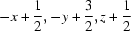 ; (ii)
 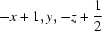 ; (iii)
  .
. Data collection: APEX2 (Bruker, 2005); cell refinement: APEX2; data reduction: APEX2; program(s) used to solve structure: SHELXS97 (Sheldrick, 2008); program(s) used to refine structure: SHELXL97 (Sheldrick, 2008); molecular graphics: POV-RAY (Persistence of Vision, 2003); software used to prepare material for publication: SHELXL97.
Supporting information
contains datablocks I, global. DOI: 10.1107/S1600536808005229/zl2101sup1.cif
Structure factors: contains datablock I. DOI: 10.1107/S1600536808005229/zl2101Isup2.hkl
The compound was synthesized following the procedure of Lancaster et al. (2002) for the analogous N-butyl-N-methyl pyrrolidinium chloride species: 1-methyl-1-propylpyrrolidinium chloride was synthesized by heating a solution of chloropropane (28 ml, 0.315 moles) and methyl pyrrolidine (20 ml, 0.287 moles) in 2-propanol at 323 K under nitrogen for 48 h. The resultant white solid was recrystallized from 2-propanol at 273 K. Crystals resulted after 2 days. Crystals were coated with Paratone N oil (Exxon Chemical Co., TX, USA) immediately after isolation and cooled in a stream of nitrogen vapour on the diffractometer. Melting point: 323.5 K.
All H atoms were initially located in a difference Fourier map. Thereafter, all H atoms were placed in geometrically fixed idealized positions and constrained to ride on their parent atoms with C—H distances in the range 0.95–1.00 Å and Uiso(H) = 1.2Ueq(C).
Data collection: APEX2 (Bruker, 2005); cell APEX2 (Bruker, 2005); data reduction: APEX2 (Bruker, 2005); program(s) used to solve structure: SHELXS97 (Sheldrick, 2008); program(s) used to refine structure: SHELXL97 (Sheldrick, 2008); molecular graphics: POV-RAY (Persistence of Vision, 2003); software used to prepare material for publication: SHELXL97 (Sheldrick, 2008).
![[Figure 1]](./zl2101fig1thm.gif) | Fig. 1. Diagram of the unique component of (I) shown with 50% thermal ellipsoids and hydrogen atoms as spheres of arbitrary size. |
![[Figure 2]](./zl2101fig2thm.gif) | Fig. 2. Extended packing diagram of the unit-cell contents of (I) as viewed down the b axis. |
| C8H18N+·Cl− | Dx = 1.130 Mg m−3 |
| Mr = 163.68 | Melting point: 323.5 K |
| Orthorhombic, Pbcn | Mo Kα radiation, λ = 0.71073 Å |
| Hall symbol: -P 2n 2ab | Cell parameters from 4825 reflections |
| a = 14.5863 (5) Å | θ = 2.8–26.4° |
| b = 13.2196 (4) Å | µ = 0.33 mm−1 |
| c = 9.9779 (3) Å | T = 123 K |
| V = 1923.99 (11) Å3 | Cubic, colourless |
| Z = 8 | 0.30 × 0.30 × 0.30 mm |
| F(000) = 720 |
| Bruker X8 APEX KappaCCD diffractometer | 1982 independent reflections |
| Radiation source: fine-focus sealed tube | 1800 reflections with I > 2σ(I) |
| Graphite monochromator | Rint = 0.030 |
| 0.5° frames in ϕ and ω scans | θmax = 26.4°, θmin = 2.1° |
| Absorption correction: multi-scan (SADABS; Bruker, 2005) | h = −18→18 |
| Tmin = 0.907, Tmax = 0.907 | k = −15→16 |
| 11550 measured reflections | l = −11→12 |
| Refinement on F2 | Primary atom site location: structure-invariant direct methods |
| Least-squares matrix: full | Secondary atom site location: difference Fourier map |
| R[F2 > 2σ(F2)] = 0.031 | Hydrogen site location: inferred from neighbouring sites |
| wR(F2) = 0.079 | H-atom parameters constrained |
| S = 1.04 | w = 1/[σ2(Fo2) + (0.0361P)2 + 0.834P] where P = (Fo2 + 2Fc2)/3 |
| 1982 reflections | (Δ/σ)max = 0.001 |
| 93 parameters | Δρmax = 0.25 e Å−3 |
| 0 restraints | Δρmin = −0.20 e Å−3 |
| C8H18N+·Cl− | V = 1923.99 (11) Å3 |
| Mr = 163.68 | Z = 8 |
| Orthorhombic, Pbcn | Mo Kα radiation |
| a = 14.5863 (5) Å | µ = 0.33 mm−1 |
| b = 13.2196 (4) Å | T = 123 K |
| c = 9.9779 (3) Å | 0.30 × 0.30 × 0.30 mm |
| Bruker X8 APEX KappaCCD diffractometer | 1982 independent reflections |
| Absorption correction: multi-scan (SADABS; Bruker, 2005) | 1800 reflections with I > 2σ(I) |
| Tmin = 0.907, Tmax = 0.907 | Rint = 0.030 |
| 11550 measured reflections |
| R[F2 > 2σ(F2)] = 0.031 | 0 restraints |
| wR(F2) = 0.079 | H-atom parameters constrained |
| S = 1.04 | Δρmax = 0.25 e Å−3 |
| 1982 reflections | Δρmin = −0.20 e Å−3 |
| 93 parameters |
Geometry. All e.s.d.'s (except the e.s.d. in the dihedral angle between two l.s. planes) are estimated using the full covariance matrix. The cell e.s.d.'s are taken into account individually in the estimation of e.s.d.'s in distances, angles and torsion angles; correlations between e.s.d.'s in cell parameters are only used when they are defined by crystal symmetry. An approximate (isotropic) treatment of cell e.s.d.'s is used for estimating e.s.d.'s involving l.s. planes. |
Refinement. Refinement of F2 against ALL reflections. The weighted R-factor wR and goodness of fit S are based on F2, conventional R-factors R are based on F, with F set to zero for negative F2. The threshold expression of F2 > σ(F2) is used only for calculating R-factors(gt) etc. and is not relevant to the choice of reflections for refinement. R-factors based on F2 are statistically about twice as large as those based on F, and R- factors based on ALL data will be even larger. |
| x | y | z | Uiso*/Ueq | ||
| Cl1 | 0.36024 (2) | 0.82436 (2) | 0.05218 (3) | 0.02423 (12) | |
| N1 | 0.32912 (7) | 0.86923 (8) | 0.43497 (10) | 0.0179 (2) | |
| C1 | 0.35707 (9) | 0.75928 (10) | 0.41992 (14) | 0.0241 (3) | |
| H1A | 0.3939 | 0.7496 | 0.3376 | 0.029* | |
| H1B | 0.3023 | 0.7152 | 0.4152 | 0.029* | |
| C2 | 0.41390 (11) | 0.73488 (12) | 0.54424 (15) | 0.0323 (3) | |
| H2A | 0.4793 | 0.7268 | 0.5202 | 0.039* | |
| H2B | 0.3922 | 0.6714 | 0.5863 | 0.039* | |
| C3 | 0.40131 (10) | 0.82444 (12) | 0.64053 (15) | 0.0309 (3) | |
| H3A | 0.3884 | 0.8004 | 0.7326 | 0.037* | |
| H3B | 0.4569 | 0.8674 | 0.6423 | 0.037* | |
| C4 | 0.32014 (9) | 0.88251 (11) | 0.58455 (13) | 0.0242 (3) | |
| H4A | 0.2616 | 0.8540 | 0.6174 | 0.029* | |
| H4B | 0.3234 | 0.9549 | 0.6097 | 0.029* | |
| C5 | 0.40372 (8) | 0.93610 (10) | 0.38042 (13) | 0.0209 (3) | |
| H5A | 0.4045 | 0.9315 | 0.2824 | 0.031* | |
| H5B | 0.4631 | 0.9141 | 0.4161 | 0.031* | |
| H5C | 0.3922 | 1.0063 | 0.4072 | 0.031* | |
| C6 | 0.23958 (8) | 0.88722 (10) | 0.36358 (13) | 0.0198 (3) | |
| H6A | 0.1941 | 0.8374 | 0.3962 | 0.024* | |
| H6B | 0.2487 | 0.8750 | 0.2666 | 0.024* | |
| C7 | 0.20062 (9) | 0.99281 (11) | 0.38223 (14) | 0.0254 (3) | |
| H7A | 0.1931 | 1.0073 | 0.4789 | 0.031* | |
| H7B | 0.2433 | 1.0434 | 0.3442 | 0.031* | |
| C8 | 0.10858 (10) | 0.99984 (12) | 0.31221 (18) | 0.0372 (4) | |
| H8A | 0.1173 | 0.9926 | 0.2153 | 0.056* | |
| H8B | 0.0806 | 1.0657 | 0.3313 | 0.056* | |
| H8C | 0.0683 | 0.9458 | 0.3447 | 0.056* |
| U11 | U22 | U33 | U12 | U13 | U23 | |
| Cl1 | 0.02343 (18) | 0.02619 (19) | 0.02308 (18) | −0.00399 (13) | −0.00151 (13) | −0.00178 (12) |
| N1 | 0.0162 (5) | 0.0191 (5) | 0.0185 (5) | −0.0015 (4) | −0.0013 (4) | 0.0004 (4) |
| C1 | 0.0246 (7) | 0.0178 (6) | 0.0299 (7) | 0.0005 (5) | −0.0008 (6) | 0.0012 (5) |
| C2 | 0.0282 (7) | 0.0287 (8) | 0.0401 (9) | 0.0006 (6) | −0.0051 (6) | 0.0123 (6) |
| C3 | 0.0273 (7) | 0.0406 (9) | 0.0247 (7) | −0.0068 (6) | −0.0067 (6) | 0.0100 (6) |
| C4 | 0.0232 (6) | 0.0322 (8) | 0.0172 (6) | −0.0044 (6) | −0.0004 (5) | −0.0005 (5) |
| C5 | 0.0163 (6) | 0.0223 (7) | 0.0241 (6) | −0.0031 (5) | 0.0008 (5) | 0.0023 (5) |
| C6 | 0.0157 (6) | 0.0231 (6) | 0.0206 (6) | −0.0019 (5) | −0.0035 (5) | −0.0014 (5) |
| C7 | 0.0208 (6) | 0.0257 (7) | 0.0298 (7) | 0.0018 (5) | −0.0037 (6) | −0.0049 (6) |
| C8 | 0.0258 (7) | 0.0314 (8) | 0.0543 (10) | 0.0050 (6) | −0.0138 (7) | −0.0065 (7) |
| N1—C5 | 1.5038 (16) | C4—H4B | 0.9900 |
| N1—C6 | 1.5066 (16) | C5—H5A | 0.9800 |
| N1—C4 | 1.5085 (16) | C5—H5B | 0.9800 |
| N1—C1 | 1.5171 (17) | C5—H5C | 0.9800 |
| C1—C2 | 1.526 (2) | C6—C7 | 1.5185 (18) |
| C1—H1A | 0.9900 | C6—H6A | 0.9900 |
| C1—H1B | 0.9900 | C6—H6B | 0.9900 |
| C2—C3 | 1.536 (2) | C7—C8 | 1.5163 (19) |
| C2—H2A | 0.9900 | C7—H7A | 0.9900 |
| C2—H2B | 0.9900 | C7—H7B | 0.9900 |
| C3—C4 | 1.518 (2) | C8—H8A | 0.9800 |
| C3—H3A | 0.9900 | C8—H8B | 0.9800 |
| C3—H3B | 0.9900 | C8—H8C | 0.9800 |
| C4—H4A | 0.9900 | ||
| C5—N1—C6 | 111.31 (10) | N1—C4—H4B | 111.0 |
| C5—N1—C4 | 110.64 (10) | C3—C4—H4B | 111.0 |
| C6—N1—C4 | 111.98 (10) | H4A—C4—H4B | 109.0 |
| C5—N1—C1 | 109.44 (10) | N1—C5—H5A | 109.5 |
| C6—N1—C1 | 109.72 (10) | N1—C5—H5B | 109.5 |
| C4—N1—C1 | 103.46 (10) | H5A—C5—H5B | 109.5 |
| N1—C1—C2 | 105.54 (11) | N1—C5—H5C | 109.5 |
| N1—C1—H1A | 110.6 | H5A—C5—H5C | 109.5 |
| C2—C1—H1A | 110.6 | H5B—C5—H5C | 109.5 |
| N1—C1—H1B | 110.6 | N1—C6—C7 | 114.30 (10) |
| C2—C1—H1B | 110.6 | N1—C6—H6A | 108.7 |
| H1A—C1—H1B | 108.8 | C7—C6—H6A | 108.7 |
| C1—C2—C3 | 106.30 (12) | N1—C6—H6B | 108.7 |
| C1—C2—H2A | 110.5 | C7—C6—H6B | 108.7 |
| C3—C2—H2A | 110.5 | H6A—C6—H6B | 107.6 |
| C1—C2—H2B | 110.5 | C8—C7—C6 | 109.34 (11) |
| C3—C2—H2B | 110.5 | C8—C7—H7A | 109.8 |
| H2A—C2—H2B | 108.7 | C6—C7—H7A | 109.8 |
| C4—C3—C2 | 104.66 (11) | C8—C7—H7B | 109.8 |
| C4—C3—H3A | 110.8 | C6—C7—H7B | 109.8 |
| C2—C3—H3A | 110.8 | H7A—C7—H7B | 108.3 |
| C4—C3—H3B | 110.8 | C7—C8—H8A | 109.5 |
| C2—C3—H3B | 110.8 | C7—C8—H8B | 109.5 |
| H3A—C3—H3B | 108.9 | H8A—C8—H8B | 109.5 |
| N1—C4—C3 | 103.74 (11) | C7—C8—H8C | 109.5 |
| N1—C4—H4A | 111.0 | H8A—C8—H8C | 109.5 |
| C3—C4—H4A | 111.0 | H8B—C8—H8C | 109.5 |
| C5—N1—C1—C2 | 85.97 (12) | C1—N1—C4—C3 | 40.98 (12) |
| C6—N1—C1—C2 | −151.63 (11) | C2—C3—C4—N1 | −33.99 (14) |
| C4—N1—C1—C2 | −31.99 (13) | C5—N1—C6—C7 | −63.82 (14) |
| N1—C1—C2—C3 | 10.96 (15) | C4—N1—C6—C7 | 60.62 (14) |
| C1—C2—C3—C4 | 14.09 (15) | C1—N1—C6—C7 | 174.90 (11) |
| C5—N1—C4—C3 | −76.14 (13) | N1—C6—C7—C8 | −177.02 (12) |
| C6—N1—C4—C3 | 159.05 (10) |
| D—H···A | D—H | H···A | D···A | D—H···A |
| C1—H1B···Cl1i | 0.99 | 2.79 | 3.607 (1) | 141 |
| C2—H2A···Cl1ii | 0.99 | 2.77 | 3.630 (2) | 146 |
| C5—H5A···Cl1 | 0.98 | 2.77 | 3.648 (1) | 149 |
| C5—H5C···Cl1iii | 0.98 | 2.71 | 3.656 (1) | 163 |
| C6—H6A···Cl1i | 0.99 | 2.76 | 3.672 (1) | 153 |
| C6—H6B···Cl1 | 0.99 | 2.77 | 3.666 (1) | 151 |
| Symmetry codes: (i) −x+1/2, −y+3/2, z+1/2; (ii) −x+1, y, −z+1/2; (iii) x, −y+2, z+1/2. |
Experimental details
| Crystal data | |
| Chemical formula | C8H18N+·Cl− |
| Mr | 163.68 |
| Crystal system, space group | Orthorhombic, Pbcn |
| Temperature (K) | 123 |
| a, b, c (Å) | 14.5863 (5), 13.2196 (4), 9.9779 (3) |
| V (Å3) | 1923.99 (11) |
| Z | 8 |
| Radiation type | Mo Kα |
| µ (mm−1) | 0.33 |
| Crystal size (mm) | 0.30 × 0.30 × 0.30 |
| Data collection | |
| Diffractometer | Bruker X8 APEX KappaCCD diffractometer |
| Absorption correction | Multi-scan (SADABS; Bruker, 2005) |
| Tmin, Tmax | 0.907, 0.907 |
| No. of measured, independent and observed [I > 2σ(I)] reflections | 11550, 1982, 1800 |
| Rint | 0.030 |
| (sin θ/λ)max (Å−1) | 0.626 |
| Refinement | |
| R[F2 > 2σ(F2)], wR(F2), S | 0.031, 0.079, 1.04 |
| No. of reflections | 1982 |
| No. of parameters | 93 |
| H-atom treatment | H-atom parameters constrained |
| Δρmax, Δρmin (e Å−3) | 0.25, −0.20 |
Computer programs: APEX2 (Bruker, 2005), SHELXS97 (Sheldrick, 2008), SHELXL97 (Sheldrick, 2008), POV-RAY (Persistence of Vision, 2003).
| D—H···A | D—H | H···A | D···A | D—H···A |
| C1—H1B···Cl1i | 0.99 | 2.79 | 3.607 (1) | 141 |
| C2—H2A···Cl1ii | 0.99 | 2.77 | 3.630 (2) | 146 |
| C5—H5A···Cl1 | 0.98 | 2.77 | 3.648 (1) | 149 |
| C5—H5C···Cl1iii | 0.98 | 2.71 | 3.656 (1) | 163 |
| C6—H6A···Cl1i | 0.99 | 2.76 | 3.672 (1) | 153 |
| C6—H6B···Cl1 | 0.99 | 2.77 | 3.666 (1) | 151 |
| Symmetry codes: (i) −x+1/2, −y+3/2, z+1/2; (ii) −x+1, y, −z+1/2; (iii) x, −y+2, z+1/2. |
Acknowledgements
PMD is grateful to Monash University for the Monash Graduate Scholarship and Monash International Postgraduate Research Scholarship. The Australian Research Council is thanked for a QEII fellowship for JMP.
References
 Allen, F. H., Kennard, O., Watson, D. G., Brammer, L., Orpen, A. G. & Taylor, R. (1987). J. Chem. Soc. Perkin Trans. 2, pp. S1–S19. CrossRef Web of Science Google Scholar
Bruker (2005). APEX2. Bruker AXS Inc., Madison, Wisconsin, USA. Google Scholar
Henderson, W. A., Young, V. G., Pearson, W., Passerini, S., De Long, H. C. & Trulove, P. C. (2006). J. Phys. Condens. Matter, 18, 10377–10390. Web of Science CSD CrossRef CAS Google Scholar
Lancaster, N. L., Salter, P. A., Welton, T. & Young, G. B. (2002). J. Org. Chem. 67, 8855–8861. Web of Science CrossRef PubMed CAS Google Scholar
MacFarlane, D. R., Meakin, P., Sun, J., Amini, N. & Forsyth, M. (1999). J. Phys. Chem. B, 103, 4164–4170. Web of Science CrossRef CAS Google Scholar
McKinnon, J. J., Jayatilaka, D. & Spackman, M. A. (2007). Chem. Commun. pp. 3814–3816. Web of Science CrossRef Google Scholar
Persistence of Vision (2003). Persistence of Vision Raytracer POV-RAY. Persistence of Vision Raytracer Pty Ltd, Victoria, Australia. URL: http://www.povray.org/download/ . Google Scholar
Sheldrick, G. M. (2008). Acta Cryst. A64, 112–122. Web of Science CrossRef CAS IUCr Journals Google Scholar
Sun, J., Forsyth, M. & MacFarlane, D. R. (2003). Electrochim. Acta, 48, 1707–1717. Web of Science CrossRef CAS Google Scholar
This is an open-access article distributed under the terms of the Creative Commons Attribution (CC-BY) Licence, which permits unrestricted use, distribution, and reproduction in any medium, provided the original authors and source are cited.
| CRYSTALLOGRAPHIC COMMUNICATIONS |


The title compound, (I), is commonly used as a precursor in ionic liquid synthesis (MacFarlane et al., 1999, Sun et al., 2003). Pyrrolidinium-based ionic liquids have been a subject of intense investigation recently (Henderson et al., 2006), whereby with understanding of the fundamental molecular-level interactions, a desired product with predicted physico-chemical properites could be designed. Additionally, a particular emphasis has been placed on whether hydrogen bonding occurs between the cation and a potential electron-pair donor (hydrogen bond acceptor) and its influence on the ionic liquids' overall properties. This paper briefly reports the structural determination and analysis of 1-methyl-1-propyl pyrrolidinium chloride (Figure 1).
The bond distances and angles of the pyrrolidinium cation are all within normal ranges (as is tabulated in Allen et al., 1987), with the propyl substituent adopting the energetically preferred anti conformation (torsional angle N1—C6—C7—C8: -177.0 (2) °) and the ring adopting the energetically preferred envelope (Cs) conformation. The extended structure packs in layers of groups of anions and cations (Figure 2) which are interconnected by an extended network of weak hydrogen bonds (C—H···Cl interactions), where each cation is hydrogen bonded to four anions and each anion is weakly hydrogen bonded to four cations [C1—H1B···Cl1i [3.607 (2) Å], C2—H2A···Cl1ii [3.630 (2) Å], C5— H5A ··· Cl1 [3.648 (1) Å], C5—H5C···Cl1iii [3.656 (1) Å], C6—H6A···Cl1i [3.672 (2) Å] and C6— H6B···Cl1 [3.666 (1) Å] (symmetry operators: i=1/2 - x,3/2 - y,1/2 + z; ii=1 - x,y,1/2 - z; iii=x,2 - y,1/2 + z) -see Table 1]. Analysis of the salts' Hirshfeld surface, reveals that the short range inter-cationic H—H intermolecular contact contribution to the Hirshfeld surface area predominates (McKinnon et al., 2007).