 | Acta Crystallographica Section E Acta Crystallographica Section E CRYSTALLOGRAPHIC COMMUNICATIONS |


 journal menu


organic compounds
| CRYSTALLOGRAPHIC COMMUNICATIONS |
 access
(E)-2-(2-Fluorobenzylidene)butanoic acid

aDepartment of Chemistry, Quaid-i-Azam University, Islamabad 45320, Pakistan, bDepartment of Physics, University of Sargodha, Sagrodha, Pakistan, and cDepartment of Chemistry, Government College University, Lahore, Pakistan
*Correspondence e-mail: [email protected]
In the of the title compound, C11H11FO2, the methine CH forms an intramolecular hydrogen bond with the carboxyl O atom. The molecules form dimers through hydrogen bonding between carboxyl groups. These dimers are linked to each other by C—H⋯O contacts between the benzene and carbonyl groups of adjoining molecules. In addition, there are weak intermolecular C—H⋯F contacts.
Related literature
For related literature, see: Burns & Hagaman (1993![[Burns, J. H. & Hagaman, E. W. (1993). Acta Cryst. C49, 1393-1396.]](../../../../../../logos/arrows/e_arr.gif "Burns, J. H. & Hagaman, E. W. (1993). Acta Cryst. C49, 1393-1396.") ); Burt (2004); Forgó et al. (2005); Hertog et al. (1995); Muhammad et al. (2007). For details of the Cambridge Structural Database, see: Allen (2002).
); Burt (2004); Forgó et al. (2005); Hertog et al. (1995); Muhammad et al. (2007). For details of the Cambridge Structural Database, see: Allen (2002).
![[Scheme 1]](bv2091scheme1.gif)
Experimental
Crystal data
|
Refinement
|
|
 ; (iii)
  .
. Data collection: APEX2 (Bruker, 2007); cell refinement: APEX2; data reduction: SAINT (Bruker, 2007); program(s) used to solve structure: SHELXS97 (Sheldrick, 2008); program(s) used to refine structure: SHELXL97 (Sheldrick, 2008); molecular graphics: ORTEP-3 for Windows (Farrugia, 1997) and PLATON (Spek, 2003); software used to prepare material for publication: WinGX (Farrugia, 1999) and PLATON.
Supporting information
contains datablocks global, I. DOI: 10.1107/S1600536808007149/bv2091sup1.cif
Structure factors: contains datablock I. DOI: 10.1107/S1600536808007149/bv2091Isup2.hkl
Compound (I) was synthesized as reported earlier (Niaz, et al., 2007). A mixture of 2-fluorobenzaldehyde (1.05 ml, 10 mmol), ethylmalonic acid (2.64 g, 20 mmol) and piperidine (1.98 ml, 20 mmol) in a pyridine (12.5 ml) solution was heated on a steam-bath for 24 h. The reaction mixture was cooled and added to a mixture of 25 ml of concentrated HCl and 50 g of ice. The precipitate formed in the acidified mixture was filtered off and washed with ice-cold water. The product was recrystallized from ethanol. The yield was 65%, m.p. 94 °C.
Data collection: APEX2 (Bruker, 2007); cell APEX2 (Bruker, 2007); data reduction: SAINT (Bruker, 2007); program(s) used to solve structure: SHELXS97 (Sheldrick, 2008); program(s) used to refine structure: SHELXL97 (Sheldrick, 2008); molecular graphics: ORTEP-3 for Windows (Farrugia, 1997) and PLATON (Spek, 2003); software used to prepare material for publication: WinGX (Farrugia, 1999) and PLATON (Spek, 2003).
![[Figure 1]](./bv2091fig1thm.gif) | Fig. 1. ORTEP drawing of the title compound, C11H11F1O2 with the atom numbering scheme. The thermal ellipsoids are drawn at the 50% probability level. H-atoms are shown by small circles of arbitrary radii. |
![[Figure 2]](./bv2091fig2thm.gif) | Fig. 2. The packing figure (PLATON: Spek, 2003) which shows the dimeric nature of the compound owing to inter molecular hydrogen bonding and also showing a link between dimers. |
| C11H11FO2 | F(000) = 408 |
| Mr = 194.20 | Dx = 1.287 Mg m−3 |
| Monoclinic, P21/c | Mo Kα radiation radiation, λ = 0.71073 Å |
| Hall symbol: -P 2ybc | Cell parameters from 2981 reflections |
| a = 4.1895 (4) Å | θ = 2.3–30.6° |
| b = 17.4362 (19) Å | µ = 0.10 mm−1 |
| c = 13.8134 (15) Å | T = 296 K |
| β = 96.719 (3)° | Prismatic, colourless |
| V = 1002.12 (18) Å3 | 0.25 × 0.18 × 0.12 mm |
| Z = 4 |
| Bruker KappaAPEXII CCD diffractometer | 2981 independent reflections |
| Radiation source: fine-focus sealed tube | 1704 reflections with I > 2σ(I) |
| Graphite monochromator | Rint = 0.026 |
| Detector resolution: 7.2 pixels mm-1 | θmax = 30.6°, θmin = 2.3° |
| ω scans | h = −5→6 |
| Absorption correction: multi-scan (SADABS; Bruker, 2005) | k = −24→23 |
| Tmin = 0.935, Tmax = 0.958 | l = −19→19 |
| 8632 measured reflections |
| Refinement on F2 | Primary atom site location: structure-invariant direct methods |
| Least-squares matrix: full | Secondary atom site location: difference Fourier map |
| R[F2 > 2σ(F2)] = 0.050 | Hydrogen site location: inferred from neighbouring sites |
| wR(F2) = 0.164 | H atoms treated by a mixture of independent and constrained refinement |
| S = 1.04 | w = 1/[σ2(Fo2) + (0.0731P)2 + 0.1527P] where P = (Fo2 + 2Fc2)/3 |
| 2981 reflections | (Δ/σ)max < 0.001 |
| 131 parameters | Δρmax = 0.41 e Å−3 |
| 0 restraints | Δρmin = −0.22 e Å−3 |
| C11H11FO2 | V = 1002.12 (18) Å3 |
| Mr = 194.20 | Z = 4 |
| Monoclinic, P21/c | Mo Kα radiation |
| a = 4.1895 (4) Å | µ = 0.10 mm−1 |
| b = 17.4362 (19) Å | T = 296 K |
| c = 13.8134 (15) Å | 0.25 × 0.18 × 0.12 mm |
| β = 96.719 (3)° |
| Bruker KappaAPEXII CCD diffractometer | 2981 independent reflections |
| Absorption correction: multi-scan (SADABS; Bruker, 2005) | 1704 reflections with I > 2σ(I) |
| Tmin = 0.935, Tmax = 0.958 | Rint = 0.026 |
| 8632 measured reflections |
| R[F2 > 2σ(F2)] = 0.050 | 0 restraints |
| wR(F2) = 0.164 | H atoms treated by a mixture of independent and constrained refinement |
| S = 1.04 | Δρmax = 0.41 e Å−3 |
| 2981 reflections | Δρmin = −0.22 e Å−3 |
| 131 parameters |
Geometry. All e.s.d.'s (except the e.s.d. in the dihedral angle between two l.s. planes) are estimated using the full covariance matrix. The cell e.s.d.'s are taken into account individually in the estimation of e.s.d.'s in distances, angles and torsion angles; correlations between e.s.d.'s in cell parameters are only used when they are defined by crystal symmetry. An approximate (isotropic) treatment of cell e.s.d.'s is used for estimating e.s.d.'s involving l.s. planes. |
Refinement. Refinement of F2 against ALL reflections. The weighted R-factor wR and goodness of fit S are based on F2, conventional R-factors R are based on F, with F set to zero for negative F2. The threshold expression of F2 > σ(F2) is used only for calculating R-factors(gt) etc. and is not relevant to the choice of reflections for refinement. R-factors based on F2 are statistically about twice as large as those based on F, and R- factors based on ALL data will be even larger. |
| x | y | z | Uiso*/Ueq | ||
| F1 | 0.5705 (5) | 0.28288 (7) | 0.22076 (10) | 0.1113 (6) | |
| O1 | 1.0669 (3) | 0.08331 (7) | 0.07503 (9) | 0.0575 (4) | |
| H1 | 1.104 (5) | 0.0617 (11) | 0.0126 (15) | 0.069* | |
| O2 | 0.8191 (3) | −0.02692 (7) | 0.09434 (9) | 0.0609 (4) | |
| C1 | 0.8986 (4) | 0.03770 (8) | 0.12367 (11) | 0.0406 (4) | |
| C2 | 0.8045 (3) | 0.06721 (8) | 0.21699 (11) | 0.0394 (4) | |
| C3 | 0.8530 (4) | 0.14131 (9) | 0.23791 (12) | 0.0443 (4) | |
| H3 | 0.9555 | 0.1699 | 0.1938 | 0.053* | |
| C4 | 0.7616 (4) | 0.18258 (9) | 0.32326 (11) | 0.0449 (4) | |
| C5 | 0.6226 (5) | 0.25413 (10) | 0.31195 (13) | 0.0593 (5) | |
| C6 | 0.5260 (6) | 0.29671 (11) | 0.38672 (16) | 0.0705 (6) | |
| H6 | 0.4286 | 0.3443 | 0.3749 | 0.085* | |
| C7 | 0.5763 (6) | 0.26755 (11) | 0.47922 (15) | 0.0659 (6) | |
| H7 | 0.5120 | 0.2953 | 0.5311 | 0.079* | |
| C8 | 0.7214 (5) | 0.19750 (12) | 0.49543 (14) | 0.0691 (6) | |
| H8 | 0.7586 | 0.1781 | 0.5585 | 0.083* | |
| C9 | 0.8126 (5) | 0.15554 (11) | 0.41831 (13) | 0.0601 (5) | |
| H9 | 0.9105 | 0.1081 | 0.4304 | 0.072* | |
| C10 | 0.6348 (4) | 0.01081 (9) | 0.27580 (12) | 0.0458 (4) | |
| H10A | 0.4779 | −0.0170 | 0.2319 | 0.055* | |
| H10B | 0.5185 | 0.0392 | 0.3209 | 0.055* | |
| C11 | 0.8524 (5) | −0.04706 (11) | 0.33354 (14) | 0.0614 (5) | |
| H11A | 0.7248 | −0.0808 | 0.3682 | 0.092* | |
| H11B | 1.0041 | −0.0205 | 0.3791 | 0.092* | |
| H11C | 0.9657 | −0.0764 | 0.2897 | 0.092* |
| U11 | U22 | U33 | U12 | U13 | U23 | |
| F1 | 0.2170 (19) | 0.0646 (8) | 0.0569 (8) | 0.0505 (10) | 0.0350 (9) | 0.0161 (6) |
| O1 | 0.0854 (9) | 0.0450 (7) | 0.0468 (7) | −0.0124 (6) | 0.0275 (6) | −0.0072 (5) |
| O2 | 0.0912 (10) | 0.0434 (7) | 0.0528 (7) | −0.0149 (6) | 0.0288 (7) | −0.0118 (5) |
| C1 | 0.0485 (8) | 0.0360 (8) | 0.0382 (8) | 0.0015 (6) | 0.0091 (7) | 0.0007 (6) |
| C2 | 0.0426 (8) | 0.0401 (8) | 0.0357 (7) | 0.0046 (6) | 0.0061 (6) | 0.0003 (6) |
| C3 | 0.0549 (9) | 0.0404 (8) | 0.0382 (8) | 0.0029 (6) | 0.0085 (7) | −0.0005 (6) |
| C4 | 0.0575 (10) | 0.0386 (8) | 0.0393 (8) | 0.0012 (7) | 0.0088 (7) | −0.0041 (6) |
| C5 | 0.0947 (14) | 0.0413 (9) | 0.0438 (10) | 0.0086 (9) | 0.0156 (9) | 0.0029 (7) |
| C6 | 0.1047 (17) | 0.0438 (10) | 0.0653 (13) | 0.0165 (10) | 0.0194 (12) | −0.0084 (9) |
| C7 | 0.0898 (15) | 0.0588 (12) | 0.0521 (11) | 0.0015 (10) | 0.0203 (10) | −0.0183 (9) |
| C8 | 0.0999 (16) | 0.0685 (13) | 0.0391 (9) | 0.0122 (11) | 0.0095 (10) | −0.0042 (9) |
| C9 | 0.0866 (14) | 0.0525 (10) | 0.0406 (9) | 0.0170 (9) | 0.0047 (9) | −0.0027 (8) |
| C10 | 0.0478 (9) | 0.0460 (9) | 0.0456 (9) | −0.0026 (7) | 0.0136 (7) | −0.0018 (7) |
| C11 | 0.0694 (12) | 0.0513 (10) | 0.0654 (12) | −0.0014 (8) | 0.0163 (10) | 0.0179 (9) |
| F1—C5 | 1.350 (2) | C6—H6 | 0.9300 |
| O1—C1 | 1.3006 (18) | C7—C8 | 1.371 (3) |
| O1—H1 | 0.97 (2) | C7—H7 | 0.9300 |
| O2—C1 | 1.2301 (18) | C8—C9 | 1.383 (2) |
| C1—C2 | 1.483 (2) | C8—H8 | 0.9300 |
| C2—C3 | 1.334 (2) | C9—H9 | 0.9300 |
| C2—C10 | 1.506 (2) | C10—C11 | 1.521 (2) |
| C3—C4 | 1.470 (2) | C10—H10A | 0.9700 |
| C3—H3 | 0.9300 | C10—H10B | 0.9700 |
| C4—C5 | 1.378 (2) | C11—H11A | 0.9600 |
| C4—C9 | 1.388 (2) | C11—H11B | 0.9600 |
| C5—C6 | 1.371 (3) | C11—H11C | 0.9600 |
| C6—C7 | 1.368 (3) | ||
| C1—O1—H1 | 112.0 (12) | C6—C7—H7 | 120.0 |
| O2—C1—O1 | 122.15 (14) | C8—C7—H7 | 120.0 |
| O2—C1—C2 | 120.97 (14) | C7—C8—C9 | 120.19 (18) |
| O1—C1—C2 | 116.88 (13) | C7—C8—H8 | 119.9 |
| C3—C2—C1 | 118.35 (14) | C9—C8—H8 | 119.9 |
| C3—C2—C10 | 125.80 (14) | C8—C9—C4 | 121.56 (17) |
| C1—C2—C10 | 115.63 (13) | C8—C9—H9 | 119.2 |
| C2—C3—C4 | 126.91 (15) | C4—C9—H9 | 119.2 |
| C2—C3—H3 | 116.5 | C2—C10—C11 | 115.09 (14) |
| C4—C3—H3 | 116.5 | C2—C10—H10A | 108.5 |
| C5—C4—C9 | 115.53 (15) | C11—C10—H10A | 108.5 |
| C5—C4—C3 | 119.92 (15) | C2—C10—H10B | 108.5 |
| C9—C4—C3 | 124.53 (14) | C11—C10—H10B | 108.5 |
| F1—C5—C6 | 118.18 (17) | H10A—C10—H10B | 107.5 |
| F1—C5—C4 | 117.52 (16) | C10—C11—H11A | 109.5 |
| C6—C5—C4 | 124.27 (18) | C10—C11—H11B | 109.5 |
| C7—C6—C5 | 118.38 (18) | H11A—C11—H11B | 109.5 |
| C7—C6—H6 | 120.8 | C10—C11—H11C | 109.5 |
| C5—C6—H6 | 120.8 | H11A—C11—H11C | 109.5 |
| C6—C7—C8 | 120.03 (18) | H11B—C11—H11C | 109.5 |
| O2—C1—C2—C3 | −169.70 (16) | C3—C4—C5—C6 | 179.3 (2) |
| O1—C1—C2—C3 | 10.1 (2) | F1—C5—C6—C7 | 179.6 (2) |
| O2—C1—C2—C10 | 5.2 (2) | C4—C5—C6—C7 | 1.5 (4) |
| O1—C1—C2—C10 | −174.93 (14) | C5—C6—C7—C8 | 0.3 (4) |
| C1—C2—C3—C4 | 176.46 (15) | C6—C7—C8—C9 | −1.0 (4) |
| C10—C2—C3—C4 | 2.1 (3) | C7—C8—C9—C4 | 0.1 (3) |
| C2—C3—C4—C5 | −136.30 (19) | C5—C4—C9—C8 | 1.5 (3) |
| C2—C3—C4—C9 | 45.5 (3) | C3—C4—C9—C8 | 179.80 (19) |
| C9—C4—C5—F1 | 179.57 (19) | C3—C2—C10—C11 | −106.93 (19) |
| C3—C4—C5—F1 | 1.2 (3) | C1—C2—C10—C11 | 78.57 (19) |
| C9—C4—C5—C6 | −2.4 (3) |
| D—H···A | D—H | H···A | D···A | D—H···A |
| O1—H1···O2i | 0.97 (2) | 1.66 (2) | 2.6325 (18) | 177.7 (12) |
| C3—H3···O1 | 0.93 | 2.32 | 2.713 (2) | 105 |
| C6—H6···O2ii | 0.93 | 2.53 | 3.421 (2) | 160 |
| C8—H8···F1iii | 0.93 | 2.55 | 3.266 (2) | 134 (1) |
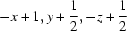
| Symmetry codes: (i) −x+2, −y, −z; (ii) −x+1, y+1/2, −z+1/2; (iii) x, −y+1/2, z+1/2. |
Experimental details
| Crystal data | |
| Chemical formula | C11H11FO2 |
| Mr | 194.20 |
| Crystal system, space group | Monoclinic, P21/c |
| Temperature (K) | 296 |
| a, b, c (Å) | 4.1895 (4), 17.4362 (19), 13.8134 (15) |
| β (°) | 96.719 (3) |
| V (Å3) | 1002.12 (18) |
| Z | 4 |
| Radiation type | Mo Kα |
| µ (mm−1) | 0.10 |
| Crystal size (mm) | 0.25 × 0.18 × 0.12 |
| Data collection | |
| Diffractometer | Bruker KappaAPEXII CCD diffractometer |
| Absorption correction | Multi-scan (SADABS; Bruker, 2005) |
| Tmin, Tmax | 0.935, 0.958 |
| No. of measured, independent and observed [I > 2σ(I)] reflections | 8632, 2981, 1704 |
| Rint | 0.026 |
| (sin θ/λ)max (Å−1) | 0.717 |
| Refinement | |
| R[F2 > 2σ(F2)], wR(F2), S | 0.050, 0.164, 1.04 |
| No. of reflections | 2981 |
| No. of parameters | 131 |
| H-atom treatment | H atoms treated by a mixture of independent and constrained refinement |
| Δρmax, Δρmin (e Å−3) | 0.41, −0.22 |
Computer programs: APEX2 (Bruker, 2007), SAINT (Bruker, 2007), SHELXS97 (Sheldrick, 2008), SHELXL97 (Sheldrick, 2008), ORTEP-3 for Windows (Farrugia, 1997) and PLATON (Spek, 2003), WinGX (Farrugia, 1999) and PLATON (Spek, 2003).
| D—H···A | D—H | H···A | D···A | D—H···A |
| O1—H1···O2i | 0.97 (2) | 1.66 (2) | 2.6325 (18) | 177.7 (12) |
| C3—H3···O1 | 0.93 | 2.32 | 2.713 (2) | 105 |
| C6—H6···O2ii | 0.93 | 2.53 | 3.421 (2) | 160 |
| C8—H8···F1iii | 0.93 | 2.55 | 3.266 (2) | 133.67 (12) |
| Symmetry codes: (i) −x+2, −y, −z; (ii) −x+1, y+1/2, −z+1/2; (iii) x, −y+1/2, z+1/2. |
Acknowledgements
The authors acknowledge the Higher Education Commision, Islamabad, Pakistan, for funding the purchase of the diffractometer and Bana International, Karachi, Pakistan, for technical support.
References
 Allen, F. H. (2002). Acta Cryst. B58, 380–388. Web of Science CrossRef CAS IUCr Journals Google Scholar
Bruker (2005). SADABS. Bruker AXS Inc. Madison, Wisconsin, USA. Google Scholar
Bruker (2007). APEX2 and SAINT. Bruker AXS Inc. Madison, Wisconsin, USA. Google Scholar
Burns, J. H. & Hagaman, E. W. (1993). Acta Cryst. C49, 1393–1396. CSD CrossRef CAS Web of Science IUCr Journals Google Scholar
Burt, S. (2004). Int. J. Food Microbiol. 94, 223–253. Web of Science CrossRef PubMed CAS Google Scholar
Farrugia, L. J. (1997). J. Appl. Cryst. 30, 565. CrossRef IUCr Journals Google Scholar
Farrugia, L. J. (1999). J. Appl. Cryst. 32, 837–838. CrossRef CAS IUCr Journals Google Scholar
Forgó, P., Felföldi, K. & Pálinkó, I. (2005). J. Mol. Struct. 744–747, 273–276. Google Scholar
Hertog, M. G., Kromhout, D., Aravanis, C., Blackburn, H., Buzina, R., Fidanza, F., Giampaoli, S., Jansen, A., Menotti, A. & Nedeljkovic, S. (1995). Arch. Intern. Med. 155, 381–386. CrossRef CAS PubMed Web of Science Google Scholar
Muhammad, N., Zia-ur-Rehman., Ali, S. & Meetsma, A. (2007). Acta Cryst. E63, o2174–o2175. Web of Science CSD CrossRef IUCr Journals Google Scholar
Sheldrick, G. M. (2008). Acta Cryst. A64, 112–122. Web of Science CrossRef CAS IUCr Journals Google Scholar
Spek, A. L. (2003). J. Appl. Cryst. 36, 7–13. Web of Science CrossRef CAS IUCr Journals Google Scholar
This is an open-access article distributed under the terms of the Creative Commons Attribution (CC-BY) Licence, which permits unrestricted use, distribution, and reproduction in any medium, provided the original authors and source are cited.
| CRYSTALLOGRAPHIC COMMUNICATIONS |


Cinnamic acid derivatives are well known for their antibacterial, antifungal antiparasitic (Burt, 2004), and antitumor activity (Hertog et al., 1995). They are also used in the shikmic acid metabolic pathways of higher plants (Forgó et al., 2005).
In the structure of the title compound (I), there are two C-atoms between the carboxylate and 2-fluorophenyl C-atoms. A search of CCDC (Allen, 2002) shows that a structure of 2-amino-2-(2-fluorophenyl)acetic acid (Burns et al., 1993) has been published in which there is only a single C-atom between carboxylate and phenyl ring. Moreover, there is no structure of this kind with a different position for the F-atom.
The C1=O2 bond distance [1.2301 (18) Å], is significantly shorter than the C1—O1 distance [1.3006 (18) Å]. The C1—O1 bond lengthened due to the formation of intramolecular and intermolecular H-bonds. The value of C2=C3 is 1.334 (2) Å. The phenyl ring bond distances are in the normal range but the C4—C5—C6 bond angle is 124.27 (18)°, due to the influence of the F substituent attached to C5. The dihedral angle between the planes formed by (O1, C1, and O2) and (C2, C10, and C11) is 80.97 (18)°, and the dihedral angles between these planes and the phenyl ring are 52.88 (10)° and 67.17 (15)° respectively. The molecules are stabilized by intramolecular and intermolecular H-bonds. The title compound forms dimers through H-bonding, O1—H1···O2i [symmetry code i = -x + 2, -y, -z] as shown in Fig 2. These dimers are linked to each other through a C6—H6···O2ii interaction [symmetry code ii = -x + 1, y + 1/2, -z + 1/2]. Details of the H-bonding are given in Table 1. In addition there is a weak C8—H8···F1iii intermolecular interaction [symmetry code iii = x, 1/2 - y, 1/2 + z] with a distance 3.2658 (25) Å between C8 and F1iii.