Experimental
Data collection
Bruker SMART 1000 CCD area-detector diffractometer Absorption correction: multi-scan (SADABS; Sheldrick, 2004![[Sheldrick, G. M. (2004). SADABS. University of Göttingen, Germany.]](../../../../../../logos/arrows/e_arr.gif "Sheldrick, G. M. (2004). SADABS. University of Göttingen, Germany.") ) Tmin = 0.838, Tmax = 0.914 ) Tmin = 0.838, Tmax = 0.914 4297 measured reflections 1552 independent reflections 1252 reflections with I > 2σ(I) Rint = 0.025
|
| Mn1—O3 | 2.0670 (18) | | Mn1—O1 | 2.0738 (16) | | Mn1—N1 | 2.1246 (19) | | | O3—Mn1—O1i | 90.24 (7) | | O3—Mn1—O1 | 89.76 (7) | | O3—Mn1—N1i | 91.51 (8) | | O1—Mn1—N1i | 101.65 (7) | | O3—Mn1—N1 | 88.49 (8) | | O1—Mn1—N1 | 78.35 (7) | Symmetry code: (i) -x, -y+1, -z.
| |
| D—H⋯A | D—H | H⋯A | D⋯A | D—H⋯A | | O3—H3B⋯O4ii | 0.85 | 1.79 | 2.639 (3) | 176 | | O3—H3A⋯O2iii | 0.85 | 1.87 | 2.715 (2) | 171 | | O4—H4A⋯O2iv | 0.85 | 1.98 | 2.806 (3) | 164 | | O4—H4B⋯N2 | 0.85 | 2.03 | 2.865 (3) | 170 | Symmetry codes: (ii) x-1, y, z-1; (iii) -x+1, -y+1, -z; (iv) 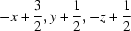 . .
| |
Data collection: SMART (Bruker, 2001); cell refinement: SMART; data reduction: SAINT (Bruker, 2001); program(s) used to solve structure: SHELXS97 (Sheldrick, 2008); program(s) used to refine structure: SHELXL97 (Sheldrick, 2008); molecular graphics: SHELXTL (Sheldrick, 2008); software used to prepare material for publication: SHELXTL.
Supporting information
A mixture of manganese(II) chloride tetrahydrate, (0.4 mmol, 79.2 mg), pyrazine-2,3-dicarboxylic acid (0.8 mmol, 134.5 mg), and H2O (1.0 mol, 18.0 ml) in the molar ratio of 1: 2: 2500 was sealed in a 40 ml stainless steel reactor with Teflon liner and directly heated to 160 °C, kept at 160 °C for 72 h, and then directly cooled to the room temperature. Light-yellow block-shaped crystals of the title complex were collected by filtration and washed with ethanol (2×5 ml) for the structural analysis.
All H atoms were initially located in difference Fourier maps and were treated isotropically in the riding-model approximation with C—H = 0.93 Å, O—H = 0.85 Å, Uiso(H) = 1.5Ueq(O), and Uiso(H) = 1.2Ueq(C).
Data collection: SMART (Bruker, 2001); cell refinement: SMART (Bruker, 2001); data reduction: SAINT (Bruker, 2001); program(s) used to solve structure: SHELXS97 (Sheldrick, 2008); program(s) used to refine structure: SHELXL97 (Sheldrick, 2008); molecular graphics: SHELXTL (Sheldrick, 2008); software used to prepare material for publication: SHELXTL (Sheldrick, 2008).
Diaquabis(pyrazine-2-carboxylato-
κ2N1,
O)manganese(II) dihydrate
top Crystal data top | [Mn(C5H3N2O2)2(H2O)2]·2H2O | F(000) = 382 |
| Mr = 373.19 | Dx = 1.633 Mg m−3 |
| Monoclinic, P21/n | Mo Kα radiation, λ = 0.71073 Å |
| Hall symbol: -P 2yn | Cell parameters from 931 reflections |
| a = 7.233 (2) Å | θ = 3.0–26.4° |
| b = 13.003 (4) Å | µ = 0.91 mm−1 |
| c = 8.257 (3) Å | T = 293 K |
| β = 102.207 (5)° | Block, light-yellow |
| V = 759.1 (4) Å3 | 0.20 × 0.10 × 0.10 mm |
| Z = 2 | |
Data collection top Bruker SMART 1000 CCD area-detector
diffractometer | 1552 independent reflections |
| Radiation source: fine-focus sealed tube | 1252 reflections with I > 2σ(I) |
| Graphite monochromator | Rint = 0.025 |
| ϕ and ω scans | θmax = 26.4°, θmin = 3.0° |
Absorption correction: multi-scan
(SADABS; Sheldrick, 2004) | h = −7→9 |
| Tmin = 0.838, Tmax = 0.914 | k = −16→15 |
| 4297 measured reflections | l = −10→9 |
Refinement top | Refinement on F2 | Primary atom site location: structure-invariant direct methods |
| Least-squares matrix: full | Secondary atom site location: difference Fourier map |
| R[F2 > 2σ(F2)] = 0.032 | Hydrogen site location: inferred from neighbouring sites |
| wR(F2) = 0.081 | H-atom parameters constrained |
| S = 1.08 | w = 1/[σ2(Fo2) + (0.0336P)2 + 0.3749P]
where P = (Fo2 + 2Fc2)/3 |
| 1552 reflections | (Δ/σ)max < 0.001 |
| 106 parameters | Δρmax = 0.33 e Å−3 |
| 0 restraints | Δρmin = −0.23 e Å−3 |
Crystal data top | [Mn(C5H3N2O2)2(H2O)2]·2H2O | V = 759.1 (4) Å3 |
| Mr = 373.19 | Z = 2 |
| Monoclinic, P21/n | Mo Kα radiation |
| a = 7.233 (2) Å | µ = 0.91 mm−1 |
| b = 13.003 (4) Å | T = 293 K |
| c = 8.257 (3) Å | 0.20 × 0.10 × 0.10 mm |
| β = 102.207 (5)° | |
Data collection top Bruker SMART 1000 CCD area-detector
diffractometer | 1552 independent reflections |
Absorption correction: multi-scan
(SADABS; Sheldrick, 2004) | 1252 reflections with I > 2σ(I) |
| Tmin = 0.838, Tmax = 0.914 | Rint = 0.025 |
| 4297 measured reflections | |
Refinement top | R[F2 > 2σ(F2)] = 0.032 | 0 restraints |
| wR(F2) = 0.081 | H-atom parameters constrained |
| S = 1.08 | Δρmax = 0.33 e Å−3 |
| 1552 reflections | Δρmin = −0.23 e Å−3 |
| 106 parameters | |
Fractional atomic coordinates and isotropic or equivalent isotropic displacement parameters (Å2) top| | x | y | z | Uiso*/Ueq | |
| Mn1 | 0.0000 | 0.5000 | 0.0000 | 0.02497 (15) | |
| C2 | 0.3799 (3) | 0.50843 (18) | 0.2061 (3) | 0.0321 (5) | |
| O1 | 0.2234 (2) | 0.40214 (13) | −0.0110 (2) | 0.0374 (4) | |
| N1 | 0.2126 (3) | 0.55522 (15) | 0.1991 (2) | 0.0344 (5) | |
| C1 | 0.3768 (3) | 0.41836 (17) | 0.0906 (3) | 0.0316 (5) | |
| C5 | 0.2082 (4) | 0.6331 (2) | 0.3022 (3) | 0.0449 (6) | |
| H5 | 0.0940 | 0.6661 | 0.3015 | 0.054* | |
| O2 | 0.5231 (2) | 0.36634 (14) | 0.1034 (2) | 0.0461 (5) | |
| N2 | 0.5373 (3) | 0.62300 (17) | 0.4146 (3) | 0.0457 (5) | |
| C3 | 0.5411 (3) | 0.5443 (2) | 0.3121 (3) | 0.0388 (6) | |
| H3 | 0.6561 | 0.5123 | 0.3119 | 0.047* | |
| C4 | 0.3699 (4) | 0.6661 (2) | 0.4106 (3) | 0.0495 (7) | |
| H4 | 0.3612 | 0.7200 | 0.4827 | 0.059* | |
| O3 | 0.0978 (2) | 0.60221 (15) | −0.1543 (2) | 0.0554 (5) | |
| H3A | 0.2145 | 0.6136 | −0.1497 | 0.083* | |
| H3B | 0.0328 | 0.6326 | −0.2386 | 0.083* | |
| O4 | 0.9068 (3) | 0.69223 (17) | 0.5751 (3) | 0.0703 (7) | |
| H4B | 0.7931 | 0.6798 | 0.5266 | 0.105* | |
| H4A | 0.9341 | 0.7505 | 0.5398 | 0.105* | |
Atomic displacement parameters (Å2) top| | U11 | U22 | U33 | U12 | U13 | U23 |
| Mn1 | 0.0141 (2) | 0.0262 (2) | 0.0330 (3) | 0.00080 (19) | 0.00120 (16) | 0.0019 (2) |
| C2 | 0.0266 (10) | 0.0339 (12) | 0.0354 (12) | −0.0008 (10) | 0.0058 (9) | 0.0064 (10) |
| O1 | 0.0273 (8) | 0.0382 (10) | 0.0439 (10) | −0.0004 (7) | 0.0009 (7) | −0.0047 (8) |
| N1 | 0.0285 (10) | 0.0322 (11) | 0.0419 (11) | 0.0015 (8) | 0.0061 (8) | 0.0012 (9) |
| C1 | 0.0253 (11) | 0.0315 (12) | 0.0388 (13) | −0.0017 (9) | 0.0081 (9) | 0.0025 (10) |
| C5 | 0.0421 (15) | 0.0396 (15) | 0.0527 (16) | 0.0052 (11) | 0.0098 (12) | −0.0058 (12) |
| O2 | 0.0262 (9) | 0.0475 (11) | 0.0635 (12) | 0.0075 (8) | 0.0071 (8) | −0.0069 (9) |
| N2 | 0.0465 (13) | 0.0424 (13) | 0.0438 (13) | −0.0070 (10) | −0.0005 (10) | −0.0009 (10) |
| C3 | 0.0305 (12) | 0.0406 (13) | 0.0429 (14) | −0.0025 (10) | 0.0022 (10) | 0.0032 (12) |
| C4 | 0.0584 (17) | 0.0384 (15) | 0.0495 (16) | −0.0011 (13) | 0.0066 (13) | −0.0080 (12) |
| O3 | 0.0276 (9) | 0.0690 (14) | 0.0664 (13) | −0.0023 (8) | 0.0024 (9) | 0.0293 (11) |
| O4 | 0.0569 (13) | 0.0736 (16) | 0.0679 (14) | −0.0166 (11) | −0.0148 (11) | 0.0273 (12) |
Geometric parameters (Å, º) top | Mn1—O3 | 2.0670 (18) | C1—O2 | 1.242 (3) |
| Mn1—O3i | 2.0670 (18) | C5—C4 | 1.382 (4) |
| Mn1—O1i | 2.0738 (16) | C5—H5 | 0.9300 |
| Mn1—O1 | 2.0738 (16) | N2—C4 | 1.328 (4) |
| Mn1—N1i | 2.1246 (19) | N2—C3 | 1.332 (3) |
| Mn1—N1 | 2.1246 (19) | C3—H3 | 0.9300 |
| C2—N1 | 1.345 (3) | C4—H4 | 0.9300 |
| C2—C3 | 1.383 (3) | O3—H3A | 0.8500 |
| C2—C1 | 1.507 (3) | O3—H3B | 0.8500 |
| O1—C1 | 1.259 (3) | O4—H4B | 0.8500 |
| N1—C5 | 1.328 (3) | O4—H4A | 0.8501 |
| | | |
| O3—Mn1—O3i | 180.0 | C5—N1—Mn1 | 129.97 (17) |
| O3—Mn1—O1i | 90.24 (7) | C2—N1—Mn1 | 112.20 (15) |
| O3i—Mn1—O1i | 89.76 (7) | O2—C1—O1 | 125.5 (2) |
| O3—Mn1—O1 | 89.76 (7) | O2—C1—C2 | 118.1 (2) |
| O3i—Mn1—O1 | 90.24 (7) | O1—C1—C2 | 116.42 (19) |
| O1i—Mn1—O1 | 180.0 | N1—C5—C4 | 121.3 (2) |
| O3—Mn1—N1i | 91.51 (8) | N1—C5—H5 | 119.3 |
| O3i—Mn1—N1i | 88.49 (8) | C4—C5—H5 | 119.3 |
| O1i—Mn1—N1i | 78.35 (7) | C4—N2—C3 | 116.7 (2) |
| O1—Mn1—N1i | 101.65 (7) | N2—C3—C2 | 122.2 (2) |
| O3—Mn1—N1 | 88.49 (8) | N2—C3—H3 | 118.9 |
| O3i—Mn1—N1 | 91.51 (8) | C2—C3—H3 | 118.9 |
| O1i—Mn1—N1 | 101.65 (7) | N2—C4—C5 | 121.9 (3) |
| O1—Mn1—N1 | 78.35 (7) | N2—C4—H4 | 119.1 |
| N1i—Mn1—N1 | 180.00 (8) | C5—C4—H4 | 119.1 |
| N1—C2—C3 | 120.4 (2) | Mn1—O3—H3A | 123.4 |
| N1—C2—C1 | 115.55 (19) | Mn1—O3—H3B | 126.9 |
| C3—C2—C1 | 124.1 (2) | H3A—O3—H3B | 109.2 |
| C1—O1—Mn1 | 116.93 (15) | H4B—O4—H4A | 106.2 |
| C5—N1—C2 | 117.5 (2) | | |
| Symmetry code: (i) −x, −y+1, −z. |
Hydrogen-bond geometry (Å, º) top | D—H···A | D—H | H···A | D···A | D—H···A |
| O3—H3B···O4ii | 0.85 | 1.79 | 2.639 (3) | 176 |
| O3—H3A···O2iii | 0.85 | 1.87 | 2.715 (2) | 171 |
| O4—H4A···O2iv | 0.85 | 1.98 | 2.806 (3) | 164 |
| O4—H4B···N2 | 0.85 | 2.03 | 2.865 (3) | 170 |
| Symmetry codes: (ii) x−1, y, z−1; (iii) −x+1, −y+1, −z; (iv) −x+3/2, y+1/2, −z+1/2. |
Experimental details
| Crystal data |
| Chemical formula | [Mn(C5H3N2O2)2(H2O)2]·2H2O |
| Mr | 373.19 |
| Crystal system, space group | Monoclinic, P21/n |
| Temperature (K) | 293 |
| a, b, c (Å) | 7.233 (2), 13.003 (4), 8.257 (3) |
| β (°) | 102.207 (5) |
| V (Å3) | 759.1 (4) |
| Z | 2 |
| Radiation type | Mo Kα |
| µ (mm−1) | 0.91 |
| Crystal size (mm) | 0.20 × 0.10 × 0.10 |
| |
| Data collection |
| Diffractometer | Bruker SMART 1000 CCD area-detector
diffractometer |
| Absorption correction | Multi-scan
(SADABS; Sheldrick, 2004) |
| Tmin, Tmax | 0.838, 0.914 |
No. of measured, independent and
observed [I > 2σ(I)] reflections | 4297, 1552, 1252 |
| Rint | 0.025 |
| (sin θ/λ)max (Å−1) | 0.626 |
| |
| Refinement |
| R[F2 > 2σ(F2)], wR(F2), S | 0.032, 0.081, 1.08 |
| No. of reflections | 1552 |
| No. of parameters | 106 |
| H-atom treatment | H-atom parameters constrained |
| Δρmax, Δρmin (e Å−3) | 0.33, −0.23 |
Selected geometric parameters (Å, º) top| Mn1—O3 | 2.0670 (18) | O1—C1 | 1.259 (3) |
| Mn1—O1 | 2.0738 (16) | C1—O2 | 1.242 (3) |
| Mn1—N1 | 2.1246 (19) | | |
| | | |
| O3—Mn1—O1i | 90.24 (7) | O1—Mn1—N1i | 101.65 (7) |
| O3—Mn1—O1 | 89.76 (7) | O3—Mn1—N1 | 88.49 (8) |
| O3—Mn1—N1i | 91.51 (8) | O1—Mn1—N1 | 78.35 (7) |
| Symmetry code: (i) −x, −y+1, −z. |
Hydrogen-bond geometry (Å, º) top | D—H···A | D—H | H···A | D···A | D—H···A |
| O3—H3B···O4ii | 0.85 | 1.79 | 2.639 (3) | 175.8 |
| O3—H3A···O2iii | 0.85 | 1.87 | 2.715 (2) | 170.9 |
| O4—H4A···O2iv | 0.85 | 1.98 | 2.806 (3) | 163.8 |
| O4—H4B···N2 | 0.85 | 2.03 | 2.865 (3) | 169.5 |
| Symmetry codes: (ii) x−1, y, z−1; (iii) −x+1, −y+1, −z; (iv) −x+3/2, y+1/2, −z+1/2. |
Acknowledgements
The authors acknowledge financial support from the National Natural Science Foundation of China (grant No. 50590402).
References
 Bruker (2001). SMART and SAINT. Bruker AXS Inc., Madison, Wisconsin, USA. Google Scholar
Ciurtin, D. M., Smith, M. D. & zur Loye, H. C. (2002). Solid State Sci. 4, 461–465. Web of Science CSD CrossRef CAS Google Scholar
Dong, Y.-B., Smith, M. D. & zur Loye, H. C. (2000). Solid State Sci. 2, 861–870. Web of Science CSD CrossRef CAS Google Scholar
Klein, C. L., Majeste, R. J., Trefonas, L. M. & O'Connor, C. J. (1982). Inorg. Chem. 21, 1891–1897. CSD CrossRef CAS Web of Science Google Scholar
O'Connor, C. J. & Sinn, E. (1981). Inorg. Chem. 20, 545–551. CSD CrossRef CAS Web of Science Google Scholar
Ptasiewicz-Bak, H., Leciejewicz, J. & Zachara, J. (1995). J. Coord. Chem. 36, 317–326. CrossRef CAS Web of Science Google Scholar
Sheldrick, G. M. (2004). SADABS. University of Göttingen, Germany. Google Scholar
Sheldrick, G. M. (2008). Acta Cryst. A64, 112–122. Web of Science CrossRef CAS IUCr Journals Google Scholar
This is an open-access article distributed under the terms of the Creative Commons Attribution (CC-BY) Licence, which permits unrestricted use, distribution, and reproduction in any medium, provided the original authors and source are cited.
 | CRYSTALLOGRAPHIC
COMMUNICATIONS |
ISSN: 2056-9890
Open

access


 journal menu



![[Scheme 1]](cs2069scheme1.gif)
![[Figure 1]](./cs2069fig1thm.gif)
![[Figure 2]](./cs2069fig2thm.gif)


In the past decades, self-assembly processes involving metal ions and organic ligands directed by either metal coordination or hydrogen bonds have received a great deal of attention in the field of supramolecular chemistry and crystal engineering. Pyrazine carboxylic acids, containing O– or N– donors, are excellent bridging ligands when coordinated to transition metals and have been extensively studied as active ligands in the course of electron-transfer and magnetochemistry research (Klein et al., 1982; O'Connor et al., 1981). The cobalt(II), nickel(II), copper(II), zinc(II) and manganese(II) complexes of the 2-pyrazinecarboxylic acid ligand have been reported (Ciurtin et al., 2002; Dong et al., 2000; Ptasiewicz-Bak et al., 1995). Ptasiewicz-Bak et al. reported an orthorhombic manganese(II) dipyrazinate dihydrate complex (space group Fdd2), in which the coordination polyhedron around the MnII atom is a distorted octahedron with cis positioned water molecules. The title complex is another monomeric complex of MnII with the 2-pyrazinecarboxylic acid ligand, which is isostructrual to the cobalt(II) complex (Ptasiewicz-Bak et al., 1995).
The MnII atom sits on an inversion center and the coordination geometry for the MnII atom (Fig. 1) is distorted octahedral (Table 1). Each MnII atom is axially coordinated by water molecules and consists of an equatorial plane of two oxygen donors and two nitrogen donors from two chelating 2-pyrazinecarboxylato group. As a consequence of the reaction the carboxylic groups of the starting diacid in position 3 are decarboxylated while the coordinated carboxylic groups in 2-position are kept and are deprotonated. The title molecules are connected by the O—H···N and O—H···O hydrogen-bonding interactions (Fig. 2); see Table 2 for the geometric parameters describing these interactions.