 | Acta Crystallographica Section E Acta Crystallographica Section E CRYSTALLOGRAPHIC COMMUNICATIONS |


 journal menu


organic compounds
| CRYSTALLOGRAPHIC COMMUNICATIONS |
 access
Ethyl 2-(5-phenyl-1,3,4-oxadiazol-2-ylsulfanyl)acetate

aDepartment of Chemistry, Quaid-i-Azam University, Islamabad 45320, Pakistan, and bDepartment of Chemistry, The University of Calgary, 2500 University Drive NW, Calgary, Alberta, Canada T2N 1N4
*Correspondence e-mail: [email protected]
The title molecule, C12H12N2O3S, is composed of two individually planar units, viz. 5-phenyl-1,3,4-oxadiazol-2-yl-sulfanyl and ethyl acetate, which are oriented at almost right angles [80.07 (8)°] with respect to each other. The structure is stabilized by weak intermolecular C—H⋯O and C—H⋯N hydrogen bonds. The phenyl and oxadiazole rings show π–π stacking interactions [centroid–centroid distance = 3.846 (2) Å] and there is also a short π-interaction between the carbonyl O atom and the oxadiazole ring [the distance from this O atom to the centroid of the oxadiazole ring is 3.156 (2) Å].
Related literature
For related literature, see: Cao et al. (2002![[Cao, S., Qian, X., Song, G. & Huang, Q. C. (2002). J. Fluorine Chem. 117, 63-66.]](../../../../../../logos/arrows/e_arr.gif "Cao, S., Qian, X., Song, G. & Huang, Q. C. (2002). J. Fluorine Chem. 117, 63-66.") ); Iqbal et al. (2007); Kadi et al. (2007); Mir & Siddiqui (1970); Zareef et al. (2006, 2007).
); Iqbal et al. (2007); Kadi et al. (2007); Mir & Siddiqui (1970); Zareef et al. (2006, 2007).
![[Scheme 1]](fb2092scheme1.gif)
Experimental
Crystal data
|
Refinement
|
| ||||||||||||||||||||||
 .
. Data collection: COLLECT (Hooft, 1998); cell refinement: DENZO (Otwinowski & Minor, 1997); data reduction: SCALEPACK (Otwinowski & Minor, 1997); program(s) used to solve structure: SAPI91 (Fan, 1991); program(s) used to refine structure: SHELXL97 (Sheldrick, 2008); molecular graphics: ORTEP-3 for Windows (Farrugia, 1997); software used to prepare material for publication: SHELXL97.
Supporting information
contains datablocks global, I. DOI: 10.1107/S1600536808007125/fb2092sup1.cif
Structure factors: contains datablock I. DOI: 10.1107/S1600536808007125/fb2092Isup2.hkl
The title compound was prepared according to the procedure reported in the literature (Zareef et al., 2006; Mir & Siddiqui, 1970). To a solution of benzoic acid hydrazide (50 mmol) in ethanol (150 ml) was added carbon disulfide (55 mmol), followed by the addition of KOH (50 mmol) dissolved in 25 ml of water. The reaction mixture was stirred and subjected to reflux for 19 h. After reaction completion, excess ethanol was distilled off. The crude solid obtained was dissolved in water (50 ml) and acidified with 4 N HCl to pH 2–3. The product was filtered, washed with water and recrystallized from aqueous ethanol (20–30%). The resulting 5-phenyl-2-mercapto-1,3,4-oxadiazole (20 mmol) was dissolved in saturated aqueous sodium hydrogencarbonate solution while stirring. The required ethylbromoacetate (20 mmol) in absolute ethanol (10 ml) was added and the reaction mixture was stirred for 7 h at 325–335 K. After reaction completion, the resulting solid was filtered off, washed with water and recrystallized from aqueous ethanol (60%) (Yield = 75%; m.p. = 344–345 K). Prismatic crystals suitable for crystallographic study were grown from ethanol solution by slow evaporation at room temperature.
Though all the H atoms could be distinguished in the difference Fouries map the H-atoms were situated at the geometrically idealized positions and refined in riding-model approximation with the following constraints: aryl, methylene and methyl C—H distances were set to 0.95, 0.99 and 0.98 Å, respectively; in all these instances Uiso(H) = 1.2 Ueq(C).
Data collection: COLLECT (Hooft, 1998); cell DENZO (Otwinowski & Minor, 1997); data reduction: SCALEPACK (Otwinowski & Minor, 1997); program(s) used to solve structure: SAPI91 (Fan, 1991); program(s) used to refine structure: SHELXL97 (Sheldrick, 2008); molecular graphics: ORTEP-3 for Windows (Farrugia, 1997); software used to prepare material for publication: SHELXL97 (Sheldrick, 2008).
![[Figure 1]](./fb2092fig1thm.gif) | Fig. 1. ORTEP-3 (Farrugia, 1997) drawing of the title molecule with displacement ellipsoids plotted at 50% probability level. |
| C12H12N2O3S | F(000) = 552 |
| Mr = 264.30 | Dx = 1.419 Mg m−3 |
| Monoclinic, P21/c | Melting point = 344–345 K |
| Hall symbol: -P 2ybc | Mo Kα radiation, λ = 0.71073 Å |
| a = 8.777 (3) Å | Cell parameters from 5263 reflections |
| b = 11.008 (5) Å | θ = 3.7–27.5° |
| c = 13.177 (6) Å | µ = 0.26 mm−1 |
| β = 103.59 (3)° | T = 173 K |
| V = 1237.5 (9) Å3 | Prism, colourless |
| Z = 4 | 0.16 × 0.10 × 0.08 mm |
| Nonius KappaCCD diffractometer | 2820 independent reflections |
| Radiation source: fine-focus sealed tube | 1943 reflections with I > 2σ(I) |
| Graphite monochromator | Rint = 0.046 |
| ω and ϕ scans | θmax = 27.5°, θmin = 3.7° |
| Absorption correction: multi-scan (SORTAV; Blessing, 1997) | h = −11→11 |
| Tmin = 0.959, Tmax = 0.979 | k = −13→14 |
| 5263 measured reflections | l = −17→17 |
| Refinement on F2 | Secondary atom site location: difference Fourier map |
| Least-squares matrix: full | Hydrogen site location: difference Fourier map |
| R[F2 > 2σ(F2)] = 0.045 | H-atom parameters constrained |
| wR(F2) = 0.117 | w = 1/[σ2(Fo2) + (0.058P)2 + 0.1P] where P = (Fo2 + 2Fc2)/3 |
| S = 1.02 | (Δ/σ)max = 0.001 |
| 2820 reflections | Δρmax = 0.25 e Å−3 |
| 165 parameters | Δρmin = −0.27 e Å−3 |
| 0 restraints | Extinction correction: SHELXL97 (Sheldrick, 2008), Fc*=kFc[1+0.001xFc2λ3/sin(2θ)]-1/4 |
| 47 constraints | Extinction coefficient: 0.021 (3) |
| Primary atom site location: structure-invariant direct methods |
| C12H12N2O3S | V = 1237.5 (9) Å3 |
| Mr = 264.30 | Z = 4 |
| Monoclinic, P21/c | Mo Kα radiation |
| a = 8.777 (3) Å | µ = 0.26 mm−1 |
| b = 11.008 (5) Å | T = 173 K |
| c = 13.177 (6) Å | 0.16 × 0.10 × 0.08 mm |
| β = 103.59 (3)° |
| Nonius KappaCCD diffractometer | 2820 independent reflections |
| Absorption correction: multi-scan (SORTAV; Blessing, 1997) | 1943 reflections with I > 2σ(I) |
| Tmin = 0.959, Tmax = 0.979 | Rint = 0.046 |
| 5263 measured reflections |
| R[F2 > 2σ(F2)] = 0.045 | 0 restraints |
| wR(F2) = 0.117 | H-atom parameters constrained |
| S = 1.02 | Δρmax = 0.25 e Å−3 |
| 2820 reflections | Δρmin = −0.27 e Å−3 |
| 165 parameters |
Geometry. All e.s.d.'s (except the e.s.d. in the dihedral angle between two l.s. planes) are estimated using the full covariance matrix. The cell e.s.d.'s are taken into account individually in the estimation of e.s.d.'s in distances, angles and torsion angles; correlations between e.s.d.'s in cell parameters are only used when they are defined by crystal symmetry. An approximate (isotropic) treatment of cell e.s.d.'s is used for estimating e.s.d.'s involving l.s. planes. |
| x | y | z | Uiso*/Ueq | ||
| S1 | 0.76489 (6) | 0.36024 (5) | 0.69782 (4) | 0.0336 (2) | |
| O1 | 0.67313 (14) | 0.20172 (11) | 0.54296 (10) | 0.0264 (3) | |
| O2 | 0.86894 (16) | 0.19182 (14) | 0.88791 (12) | 0.0412 (4) | |
| O3 | 1.12555 (15) | 0.22664 (13) | 0.90282 (11) | 0.0354 (4) | |
| N1 | 0.87361 (18) | 0.07562 (15) | 0.55872 (13) | 0.0307 (4) | |
| N2 | 0.91309 (18) | 0.16477 (15) | 0.63754 (13) | 0.0319 (4) | |
| C1 | 0.6404 (2) | 0.03494 (16) | 0.41660 (14) | 0.0245 (4) | |
| C2 | 0.7088 (2) | −0.06503 (17) | 0.37915 (15) | 0.0283 (5) | |
| H2 | 0.8131 | −0.0882 | 0.4116 | 0.034* | |
| C3 | 0.6246 (2) | −0.13002 (18) | 0.29499 (16) | 0.0339 (5) | |
| H3 | 0.6717 | −0.1972 | 0.2690 | 0.041* | |
| C4 | 0.4712 (2) | −0.09762 (19) | 0.24806 (16) | 0.0335 (5) | |
| H4 | 0.4130 | −0.1429 | 0.1905 | 0.040* | |
| C5 | 0.4040 (2) | 0.0005 (2) | 0.28557 (16) | 0.0342 (5) | |
| H5 | 0.2991 | 0.0225 | 0.2534 | 0.041* | |
| C6 | 0.4870 (2) | 0.06791 (19) | 0.36949 (15) | 0.0291 (5) | |
| H6 | 0.4397 | 0.1357 | 0.3945 | 0.035* | |
| C7 | 0.7333 (2) | 0.10069 (16) | 0.50595 (15) | 0.0245 (4) | |
| C8 | 0.7925 (2) | 0.23515 (17) | 0.62486 (15) | 0.0266 (4) | |
| C9 | 0.9529 (2) | 0.35400 (18) | 0.78938 (17) | 0.0337 (5) | |
| H9A | 1.0358 | 0.3499 | 0.7498 | 0.040* | |
| H9B | 0.9684 | 0.4302 | 0.8304 | 0.040* | |
| C10 | 0.9730 (2) | 0.24772 (19) | 0.86414 (16) | 0.0311 (5) | |
| C11 | 1.1623 (2) | 0.1290 (2) | 0.97896 (17) | 0.0392 (6) | |
| H11A | 1.1105 | 0.0528 | 0.9492 | 0.047* | |
| H11B | 1.1252 | 0.1498 | 1.0422 | 0.047* | |
| C12 | 1.3366 (2) | 0.1135 (2) | 1.00597 (17) | 0.0421 (6) | |
| H12A | 1.3655 | 0.0466 | 1.0558 | 0.051* | |
| H12B | 1.3864 | 0.1887 | 1.0373 | 0.051* | |
| H12C | 1.3722 | 0.0952 | 0.9425 | 0.051* |
| U11 | U22 | U33 | U12 | U13 | U23 | |
| S1 | 0.0300 (3) | 0.0316 (3) | 0.0369 (3) | 0.0048 (2) | 0.0031 (2) | −0.0069 (2) |
| O1 | 0.0232 (7) | 0.0275 (7) | 0.0273 (7) | 0.0048 (6) | 0.0037 (5) | −0.0008 (6) |
| O2 | 0.0280 (7) | 0.0554 (10) | 0.0392 (9) | −0.0054 (7) | 0.0056 (7) | −0.0009 (8) |
| O3 | 0.0235 (7) | 0.0397 (8) | 0.0407 (9) | 0.0003 (6) | 0.0026 (6) | 0.0013 (7) |
| N1 | 0.0292 (8) | 0.0333 (10) | 0.0278 (9) | 0.0061 (7) | 0.0031 (7) | −0.0055 (8) |
| N2 | 0.0279 (9) | 0.0354 (10) | 0.0308 (10) | 0.0070 (8) | 0.0038 (7) | −0.0050 (8) |
| C1 | 0.0265 (9) | 0.0261 (10) | 0.0219 (10) | −0.0015 (8) | 0.0074 (8) | 0.0045 (8) |
| C2 | 0.0275 (10) | 0.0286 (10) | 0.0288 (11) | 0.0000 (9) | 0.0066 (8) | 0.0020 (9) |
| C3 | 0.0403 (12) | 0.0296 (11) | 0.0327 (12) | −0.0022 (10) | 0.0103 (9) | −0.0023 (9) |
| C4 | 0.0349 (11) | 0.0373 (12) | 0.0278 (11) | −0.0128 (10) | 0.0061 (9) | −0.0010 (9) |
| C5 | 0.0250 (10) | 0.0473 (13) | 0.0286 (11) | −0.0036 (10) | 0.0031 (9) | 0.0057 (10) |
| C6 | 0.0265 (10) | 0.0354 (11) | 0.0264 (11) | 0.0028 (9) | 0.0085 (8) | 0.0044 (9) |
| C7 | 0.0241 (9) | 0.0235 (10) | 0.0278 (10) | 0.0056 (8) | 0.0101 (8) | 0.0034 (8) |
| C8 | 0.0243 (9) | 0.0283 (10) | 0.0267 (10) | 0.0011 (9) | 0.0050 (8) | 0.0005 (8) |
| C9 | 0.0269 (10) | 0.0336 (11) | 0.0382 (12) | −0.0033 (9) | 0.0027 (9) | −0.0088 (9) |
| C10 | 0.0241 (10) | 0.0381 (12) | 0.0300 (11) | −0.0027 (9) | 0.0040 (8) | −0.0111 (9) |
| C11 | 0.0353 (11) | 0.0437 (14) | 0.0387 (13) | 0.0012 (10) | 0.0089 (10) | 0.0031 (10) |
| C12 | 0.0356 (12) | 0.0534 (15) | 0.0360 (13) | 0.0066 (11) | 0.0056 (10) | 0.0033 (11) |
| S1—C8 | 1.729 (2) | C3—H3 | 0.9500 |
| S1—C9 | 1.802 (2) | C4—C5 | 1.377 (3) |
| O1—C8 | 1.366 (2) | C4—H4 | 0.9500 |
| O1—C7 | 1.369 (2) | C5—C6 | 1.387 (3) |
| O2—C10 | 1.202 (2) | C5—H5 | 0.9500 |
| O3—C10 | 1.336 (2) | C6—H6 | 0.9500 |
| O3—C11 | 1.454 (3) | C9—C10 | 1.513 (3) |
| N1—C7 | 1.294 (2) | C9—H9A | 0.9900 |
| N1—N2 | 1.412 (2) | C9—H9B | 0.9900 |
| N2—C8 | 1.291 (2) | C11—C12 | 1.497 (3) |
| C1—C6 | 1.392 (2) | C11—H11A | 0.9900 |
| C1—C2 | 1.398 (3) | C11—H11B | 0.9900 |
| C1—C7 | 1.457 (3) | C12—H12A | 0.9800 |
| C2—C3 | 1.379 (3) | C12—H12B | 0.9800 |
| C2—H2 | 0.9500 | C12—H12C | 0.9800 |
| C3—C4 | 1.390 (3) | ||
| C8—S1—C9 | 96.66 (9) | O1—C7—C1 | 120.13 (15) |
| C8—O1—C7 | 102.24 (13) | N2—C8—O1 | 113.20 (17) |
| C10—O3—C11 | 115.56 (16) | N2—C8—S1 | 128.61 (15) |
| C7—N1—N2 | 106.58 (15) | O1—C8—S1 | 118.18 (13) |
| C8—N2—N1 | 105.66 (15) | C10—C9—S1 | 114.43 (14) |
| C6—C1—C2 | 119.91 (17) | C10—C9—H9A | 108.7 |
| C6—C1—C7 | 121.99 (18) | S1—C9—H9A | 108.7 |
| C2—C1—C7 | 118.10 (16) | C10—C9—H9B | 108.7 |
| C3—C2—C1 | 119.90 (18) | S1—C9—H9B | 108.7 |
| C3—C2—H2 | 120.0 | H9A—C9—H9B | 107.6 |
| C1—C2—H2 | 120.0 | O2—C10—O3 | 124.49 (19) |
| C2—C3—C4 | 120.3 (2) | O2—C10—C9 | 125.87 (18) |
| C2—C3—H3 | 119.8 | O3—C10—C9 | 109.62 (17) |
| C4—C3—H3 | 119.8 | O3—C11—C12 | 107.26 (18) |
| C5—C4—C3 | 119.56 (18) | O3—C11—H11A | 110.3 |
| C5—C4—H4 | 120.2 | C12—C11—H11A | 110.3 |
| C3—C4—H4 | 120.2 | O3—C11—H11B | 110.3 |
| C4—C5—C6 | 121.14 (18) | C12—C11—H11B | 110.3 |
| C4—C5—H5 | 119.4 | H11A—C11—H11B | 108.5 |
| C6—C5—H5 | 119.4 | C11—C12—H12A | 109.5 |
| C5—C6—C1 | 119.2 (2) | C11—C12—H12B | 109.5 |
| C5—C6—H6 | 120.4 | H12A—C12—H12B | 109.5 |
| C1—C6—H6 | 120.4 | C11—C12—H12C | 109.5 |
| N1—C7—O1 | 112.32 (16) | H12A—C12—H12C | 109.5 |
| N1—C7—C1 | 127.55 (18) | H12B—C12—H12C | 109.5 |
| C7—N1—N2—C8 | 0.1 (2) | C6—C1—C7—O1 | −3.2 (3) |
| C6—C1—C2—C3 | 0.6 (3) | C2—C1—C7—O1 | 177.68 (16) |
| C7—C1—C2—C3 | 179.73 (18) | N1—N2—C8—O1 | −0.3 (2) |
| C1—C2—C3—C4 | −0.9 (3) | N1—N2—C8—S1 | 178.66 (15) |
| C2—C3—C4—C5 | 0.5 (3) | C7—O1—C8—N2 | 0.4 (2) |
| C3—C4—C5—C6 | 0.1 (3) | C7—O1—C8—S1 | −178.68 (14) |
| C4—C5—C6—C1 | −0.3 (3) | C9—S1—C8—N2 | 0.1 (2) |
| C2—C1—C6—C5 | 0.0 (3) | C9—S1—C8—O1 | 179.01 (15) |
| C7—C1—C6—C5 | −179.09 (18) | C8—S1—C9—C10 | −69.82 (17) |
| N2—N1—C7—O1 | 0.2 (2) | C11—O3—C10—O2 | −0.3 (3) |
| N2—N1—C7—C1 | −179.84 (18) | C11—O3—C10—C9 | 177.96 (16) |
| C8—O1—C7—N1 | −0.4 (2) | S1—C9—C10—O2 | −22.7 (3) |
| C8—O1—C7—C1 | 179.66 (16) | S1—C9—C10—O3 | 159.06 (14) |
| C6—C1—C7—N1 | 176.80 (19) | C10—O3—C11—C12 | 175.61 (18) |
| C2—C1—C7—N1 | −2.3 (3) |
| D—H···A | D—H | H···A | D···A | D—H···A |
| C4—H4···O2i | 0.95 | 2.51 | 3.268 (3) | 137 |
| C9—H9B···N1ii | 0.99 | 2.38 | 3.293 (3) | 153 |
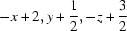
| Symmetry codes: (i) −x+1, −y, −z+1; (ii) −x+2, y+1/2, −z+3/2. |
Experimental details
| Crystal data | |
| Chemical formula | C12H12N2O3S |
| Mr | 264.30 |
| Crystal system, space group | Monoclinic, P21/c |
| Temperature (K) | 173 |
| a, b, c (Å) | 8.777 (3), 11.008 (5), 13.177 (6) |
| β (°) | 103.59 (3) |
| V (Å3) | 1237.5 (9) |
| Z | 4 |
| Radiation type | Mo Kα |
| µ (mm−1) | 0.26 |
| Crystal size (mm) | 0.16 × 0.10 × 0.08 |
| Data collection | |
| Diffractometer | Nonius KappaCCD diffractometer |
| Absorption correction | Multi-scan (SORTAV; Blessing, 1997) |
| Tmin, Tmax | 0.959, 0.979 |
| No. of measured, independent and observed [I > 2σ(I)] reflections | 5263, 2820, 1943 |
| Rint | 0.046 |
| (sin θ/λ)max (Å−1) | 0.650 |
| Refinement | |
| R[F2 > 2σ(F2)], wR(F2), S | 0.045, 0.117, 1.02 |
| No. of reflections | 2820 |
| No. of parameters | 165 |
| H-atom treatment | H-atom parameters constrained |
| Δρmax, Δρmin (e Å−3) | 0.25, −0.27 |
Computer programs: COLLECT (Hooft, 1998), DENZO (Otwinowski & Minor, 1997), SCALEPACK (Otwinowski & Minor, 1997), SAPI91 (Fan, 1991), SHELXL97 (Sheldrick, 2008), ORTEP-3 for Windows (Farrugia, 1997).
| D—H···A | D—H | H···A | D···A | D—H···A |
| C4—H4···O2i | 0.95 | 2.51 | 3.268 (3) | 137 |
| C9—H9B···N1ii | 0.99 | 2.38 | 3.293 (3) | 153 |
| Symmetry codes: (i) −x+1, −y, −z+1; (ii) −x+2, y+1/2, −z+3/2. |
References
 Blessing, R. H. (1997). J. Appl. Cryst. 30, 421–426. CrossRef CAS Web of Science IUCr Journals Google Scholar
Cao, S., Qian, X., Song, G. & Huang, Q. C. (2002). J. Fluorine Chem. 117, 63–66. Web of Science CrossRef CAS Google Scholar
Fan, H.-F. (1991). SAPI91. Rigaku Corporation, Tokyo, Japan. Google Scholar
Farrugia, L. J. (1997). J. Appl. Cryst. 30, 565. CrossRef IUCr Journals Google Scholar
Hooft, R. (1998). COLLECT. Nonius B V, Delft, The Netherlands. Google Scholar
Iqbal, R., Aziz, S., Ahmed, M. N., Qadeer, G. & Wong, W.-Y. (2007). Acta Cryst. E63, o1021–o1022. Web of Science CSD CrossRef IUCr Journals Google Scholar
Kadi, A. A., El-Brollosy, N. R., Al-Deeb, O. A., Habib, E. E., Ibrahim, T. M. & El-Emam, A. A. (2007). Eur. J. Med. Chem. 42, 235–242. Web of Science CrossRef PubMed CAS Google Scholar
Mir, I. & Siddiqui, M. T. (1970). Tetrahedron, 26, 5235–5238. CrossRef CAS PubMed Google Scholar
Otwinowski, Z. & Minor, W. (1997). Methods in Enzymology, Vol. 276, Macromolecular Crystallography, Part A, edited by C. W. Carter Jr. and R. M. Sweet, pp. 307–326. New York: Academic Press. Google Scholar
Sheldrick, G. M. (2008). Acta Cryst. A64, 112–122. Web of Science CrossRef CAS IUCr Journals Google Scholar
Zareef, M., Innocenti, A., Iqbal, R., Zaidi, J. H., Arfan, M., Scozzafava, A. & Supuran, C. T. J. (2006). Enzym. Inhib. Med. Chem. 21, 351–359. Web of Science CrossRef CAS Google Scholar
Zareef, M., Iqbal, R., Al-Masoudi, N. A., Zaidi, J. H., Arfan, M. & Shahzad, S. A. (2007). Phosphorus Sulfur Silicon Relat. Elem. 182, 281–298. Web of Science CrossRef CAS Google Scholar
This is an open-access article distributed under the terms of the Creative Commons Attribution (CC-BY) Licence, which permits unrestricted use, distribution, and reproduction in any medium, provided the original authors and source are cited.
| CRYSTALLOGRAPHIC COMMUNICATIONS |


Substituted-1,3,4-oxadiazole derivatives are of significant interest due to their chemotherapeutic effects (Kadi et al., 2007; Zareef et al., 2006; Zareef et al., 2007; Cao et al., 2002). Based on the known structures of the 2,5-disubstituted-1,3,4-oxadiazoles with diverse biological activities and their derivatives, we have designed and synthesized several new derivatives of 1,3,4-oxadiazole (Zareef et al., 2007). In this paper, we report the structure of one of these compounds.
The structure of the title compound (Fig. 1) is composed of two essentially planar moieties, C1—C8/N1/N2/O1/S1 and C9—C12/O2/O3 the least-square planes of which are inclined at 80.07 (8)°; the maximum deviations from the respective least square planes are: O1 = 0.037 (2) and C11 = 0.048 (2) Å. The structure is stabilized by two intermolecular interactions C4—H4···O2 and C9—H9B···N1 (Table 1). The shortest distance between the centroids of the phenyl and the oxadiazole rings of the adjacent molecules is 3.846 (2) Å which indicates the existence of π-π stacking interactions. In addition, there is a π-interaction between the carbonyl O-atom and the oxadiazole ring. (The distance from this O atom to the centroid of the oxadiazole ring is 3.156 (2) Å). The bond distances and angles in the title compound are in agreement with the corresponding ones reported in the similar structure of Ethyl 2-({5-[2-(benzoylamino)phenyl]-1,3,4-oxadiazol-2-yl}sulfanyl)acetate (Iqbal et al., 2007).