 | Acta Crystallographica Section E Acta Crystallographica Section E CRYSTALLOGRAPHIC COMMUNICATIONS |


 journal menu


organic compounds
| CRYSTALLOGRAPHIC COMMUNICATIONS |
 access
2,3,4-Tribromothiophene

aDepartment of Chemistry, University of Otago, PO Box 56, Dunedin, New Zealand
*Correspondence e-mail: [email protected]
In the title compound, C4HBr3S, there are two essentially planar molecules in the asymmetric unit. In the crystal structure, bifurcated C—H⋯Br hydrogen bonds link the molecules into chains. Weak Br⋯Br interactions [Br⋯Br = 3.634 (4)–3.691 (4) Å] then lead to undulating sheets in the bc plane.
Related literature
For related polybromothiophene structures, see: Helmholdt et al. (2007![[Helmholdt, R. B., Sonneveld, E. J., Velde, C. M. L. V., Blockhuys, F., Lenstra, A. T. H., Geise, H. J. & Peschar, R. (2007). Acta Cryst. B63, 783-790.]](../../../../../../logos/arrows/e_arr.gif "Helmholdt, R. B., Sonneveld, E. J., Velde, C. M. L. V., Blockhuys, F., Lenstra, A. T. H., Geise, H. J. & Peschar, R. (2007). Acta Cryst. B63, 783-790.") ); Murakami et al. (2002); Xie et al. (1997, 1998). For information on halogen⋯halogen contacts, see: Pedireddi et al. (1994). For details of the Cambridge Structural Database, see: Allen (2002).
); Murakami et al. (2002); Xie et al. (1997, 1998). For information on halogen⋯halogen contacts, see: Pedireddi et al. (1994). For details of the Cambridge Structural Database, see: Allen (2002).
![[Scheme 1]](hb2706scheme1.gif)
Experimental
Crystal data
|
|
 ; (ii)
  .
. Data collection: APEX2 (Bruker 2006); cell refinement: APEX2 and SAINT (Bruker 2006); data reduction: SAINT; program(s) used to solve structure: SHELXS97 (Sheldrick, 2008) and TITAN (Hunter & Simpson, 1999); program(s) used to refine structure: SHELXL97 (Sheldrick, 2008) and TITAN; molecular graphics: ORTEP-3 (Farrugia, 1997) and Mercury (Macrae et al., 2006); software used to prepare material for publication: SHELXL97, enCIFer (Allen et al., 2004) and PLATON (Spek, 2003).
Supporting information
contains datablocks I, global. DOI: 10.1107/S1600536808006600/hb2706sup1.cif
Structure factors: contains datablock I. DOI: 10.1107/S1600536808006600/hb2706Isup2.hkl
2,3,4-Tribromothiophene, prepared by the method of Xie et al. (1998), was dissolved in methanol. Colourless plates of (I) were grown by slow diffusion of water into the solution.
The crystals were small and very weakly diffracting and little data were obtainable beyond θ = 23°. This clearly contributes to the relatively high factor and poor precision of the data in this determination. The C-bound H atoms were placed geometrically (C—H = 0.95 Å) and refined as riding with Uiso(H) = 1.2Ueq(C). A number of high peaks were found in the final difference map in the vicinity of the Br atoms in both molecules. The deepest hole is 0.98Å from Br3B.
Data collection: APEX2 (Bruker 2006); cell APEX2 (Bruker 2006) and SAINT (Bruker 2006); data reduction: SAINT (Bruker 2006); program(s) used to solve structure: SHELXS97 (Sheldrick, 2008) and TITAN (Hunter & Simpson, 1999); program(s) used to refine structure: SHELXL97 (Sheldrick, 2008) and TITAN (Hunter & Simpson, 1999); molecular graphics: ORTEP-3 (Farrugia, 1997) and Mercury (Macrae et al., 2006); software used to prepare material for publication: SHELXL97 (Sheldrick, 2008), enCIFer (Allen et al., 2004) and PLATON (Spek, 2003).
![[Figure 1]](./hb2706fig1thm.gif) | Fig. 1. The asymmetric unit of (I), with 50% displacement ellipsoids for the non-hydrogen atoms. |
![[Figure 2]](./hb2706fig2thm.gif) | Fig. 2. Crystal packing of (I) with C—H···Br hydrogen bonds and Br···Br interactions drawn as dashed lines. |
| C4HBr3S | F(000) = 1168 |
| Mr = 320.84 | Dx = 2.987 Mg m−3 |
| Orthorhombic, Pna21 | Mo Kα radiation, λ = 0.71073 Å |
| Hall symbol: P 2c -2n | Cell parameters from 1448 reflections |
| a = 12.4529 (11) Å | θ = 3.4–21.9° |
| b = 3.9724 (4) Å | µ = 17.14 mm−1 |
| c = 28.846 (3) Å | T = 91 K |
| V = 1426.9 (2) Å3 | Plate, colourless |
| Z = 8 | 0.17 × 0.06 × 0.02 mm |
| Bruker APEXII CCD area-detector diffractometer | 2163 independent reflections |
| Radiation source: fine-focus sealed tube | 1852 reflections with I > 2σ(I) |
| Graphite monochromator | Rint = 0.092 |
| ω scans | θmax = 23.7°, θmin = 1.4° |
| Absorption correction: multi-scan (SADABS; Bruker, 2006) | h = −14→14 |
| Tmin = 0.434, Tmax = 0.710 | k = −4→4 |
| 12082 measured reflections | l = −32→32 |
| Refinement on F2 | Secondary atom site location: difference Fourier map |
| Least-squares matrix: full | Hydrogen site location: inferred from neighbouring sites |
| R[F2 > 2σ(F2)] = 0.061 | H-atom parameters constrained |
| wR(F2) = 0.172 | w = 1/[σ2(Fo2) + (0.1079P)2 + 95.665P] where P = (Fo2 + 2Fc2)/3 |
| S = 0.86 | (Δ/σ)max = 0.001 |
| 2163 reflections | Δρmax = 3.39 e Å−3 |
| 109 parameters | Δρmin = −1.30 e Å−3 |
| 1 restraint | Absolute structure: Flack (1983), 1050 Friedel pairs |
| Primary atom site location: structure-invariant direct methods | Absolute structure parameter: 0.11 (6) |
| C4HBr3S | V = 1426.9 (2) Å3 |
| Mr = 320.84 | Z = 8 |
| Orthorhombic, Pna21 | Mo Kα radiation |
| a = 12.4529 (11) Å | µ = 17.14 mm−1 |
| b = 3.9724 (4) Å | T = 91 K |
| c = 28.846 (3) Å | 0.17 × 0.06 × 0.02 mm |
| Bruker APEXII CCD area-detector diffractometer | 2163 independent reflections |
| Absorption correction: multi-scan (SADABS; Bruker, 2006) | 1852 reflections with I > 2σ(I) |
| Tmin = 0.434, Tmax = 0.710 | Rint = 0.092 |
| 12082 measured reflections | θmax = 23.7° |
| R[F2 > 2σ(F2)] = 0.061 | H-atom parameters constrained |
| wR(F2) = 0.172 | w = 1/[σ2(Fo2) + (0.1079P)2 + 95.665P] where P = (Fo2 + 2Fc2)/3 |
| S = 0.86 | Δρmax = 3.39 e Å−3 |
| 2163 reflections | Δρmin = −1.30 e Å−3 |
| 109 parameters | Absolute structure: Flack (1983), 1050 Friedel pairs |
| 1 restraint | Absolute structure parameter: 0.11 (6) |
Experimental. As the crystals were small and very weakly diffracting, data were collected using 55 sec exposures per frame. |
Geometry. All e.s.d.'s (except the e.s.d. in the dihedral angle between two l.s. planes) are estimated using the full covariance matrix. The cell e.s.d.'s are taken into account individually in the estimation of e.s.d.'s in distances, angles and torsion angles; correlations between e.s.d.'s in cell parameters are only used when they are defined by crystal symmetry. An approximate (isotropic) treatment of cell e.s.d.'s is used for estimating e.s.d.'s involving l.s. planes. |
Refinement. Refinement of F2 against ALL reflections. The weighted R-factor wR and goodness of fit S are based on F2, conventional R-factors R are based on F, with F set to zero for negative F2. The threshold expression of F2 > σ(F2) is used only for calculating R-factors(gt) etc. and is not relevant to the choice of reflections for refinement. R-factors based on F2 are statistically about twice as large as those based on F, and R- factors based on ALL data will be even larger. |
| x | y | z | Uiso*/Ueq | ||
| S1A | 0.6553 (5) | 0.6506 (19) | 0.2528 (2) | 0.0307 (15) | |
| C1A | 0.723 (2) | 0.726 (7) | 0.2042 (10) | 0.0307 (15) | |
| H1A | 0.7916 | 0.8311 | 0.2015 | 0.037* | |
| C2A | 0.6527 (19) | 0.592 (6) | 0.1649 (8) | 0.0229 (6) | |
| Br2A | 0.69172 (17) | 0.6009 (6) | 0.10260 (10) | 0.0229 (6) | |
| C3A | 0.5527 (17) | 0.441 (7) | 0.1819 (9) | 0.021 (5) | |
| Br3A | 0.44805 (17) | 0.2573 (6) | 0.14378 (10) | 0.0183 (7) | |
| C4A | 0.5485 (18) | 0.455 (6) | 0.2298 (8) | 0.0197 (6) | |
| Br4A | 0.43447 (16) | 0.3131 (7) | 0.26658 (9) | 0.0197 (6) | |
| S1B | 0.6092 (5) | 0.3531 (17) | 0.3764 (2) | 0.0268 (14) | |
| C1B | 0.542 (2) | 0.270 (6) | 0.4273 (10) | 0.0268 (14) | |
| H1B | 0.4743 | 0.1617 | 0.4311 | 0.032* | |
| C2B | 0.6136 (18) | 0.407 (7) | 0.4637 (8) | 0.0227 (6) | |
| Br2B | 0.57498 (17) | 0.4088 (6) | 0.52692 (10) | 0.0227 (6) | |
| C3B | 0.7118 (17) | 0.544 (6) | 0.4479 (8) | 0.016 (5) | |
| Br3B | 0.82097 (17) | 0.7329 (6) | 0.48587 (10) | 0.0193 (7) | |
| C4B | 0.7212 (17) | 0.523 (6) | 0.4001 (8) | 0.0206 (6) | |
| Br4B | 0.83237 (18) | 0.6820 (7) | 0.36312 (9) | 0.0206 (6) |
| U11 | U22 | U33 | U12 | U13 | U23 | |
| S1A | 0.017 (3) | 0.039 (4) | 0.037 (4) | 0.000 (3) | −0.004 (3) | 0.002 (3) |
| C1A | 0.017 (3) | 0.039 (4) | 0.037 (4) | 0.000 (3) | −0.004 (3) | 0.002 (3) |
| C2A | 0.0147 (12) | 0.0294 (16) | 0.0246 (13) | −0.0022 (10) | 0.0041 (10) | 0.0019 (12) |
| Br2A | 0.0147 (12) | 0.0294 (16) | 0.0246 (13) | −0.0022 (10) | 0.0041 (10) | 0.0019 (12) |
| C3A | 0.005 (10) | 0.035 (14) | 0.024 (13) | 0.008 (10) | −0.002 (9) | −0.006 (12) |
| Br3A | 0.0104 (11) | 0.0209 (16) | 0.0237 (16) | −0.0040 (9) | −0.0040 (10) | −0.0015 (9) |
| C4A | 0.0138 (12) | 0.0212 (11) | 0.0243 (14) | −0.0028 (9) | 0.0055 (9) | −0.0012 (14) |
| Br4A | 0.0138 (12) | 0.0212 (11) | 0.0243 (14) | −0.0028 (9) | 0.0055 (9) | −0.0012 (14) |
| S1B | 0.023 (3) | 0.023 (3) | 0.034 (4) | 0.004 (3) | 0.001 (3) | −0.005 (3) |
| C1B | 0.023 (3) | 0.023 (3) | 0.034 (4) | 0.004 (3) | 0.001 (3) | −0.005 (3) |
| C2B | 0.0142 (11) | 0.0305 (15) | 0.0235 (13) | −0.0007 (10) | 0.0037 (10) | 0.0040 (12) |
| Br2B | 0.0142 (11) | 0.0305 (15) | 0.0235 (13) | −0.0007 (10) | 0.0037 (10) | 0.0040 (12) |
| C3B | 0.016 (11) | 0.015 (11) | 0.017 (12) | 0.000 (9) | 0.000 (9) | 0.002 (10) |
| Br3B | 0.0090 (11) | 0.0200 (16) | 0.0290 (17) | 0.0022 (10) | −0.0020 (10) | −0.0028 (10) |
| C4B | 0.0125 (11) | 0.0198 (10) | 0.0295 (15) | 0.0030 (10) | 0.0056 (10) | 0.0023 (14) |
| Br4B | 0.0125 (11) | 0.0198 (10) | 0.0295 (15) | 0.0030 (10) | 0.0056 (10) | 0.0023 (14) |
| S1A—C4A | 1.68 (2) | S1B—C4B | 1.69 (2) |
| S1A—C1A | 1.66 (3) | S1B—C1B | 1.72 (3) |
| C1A—C2A | 1.53 (4) | C1B—C2B | 1.48 (4) |
| C1A—H1A | 0.9500 | C1B—H1B | 0.9500 |
| C2A—C3A | 1.47 (3) | C2B—C3B | 1.41 (3) |
| C2A—Br2A | 1.86 (2) | C2B—Br2B | 1.89 (2) |
| C3A—C4A | 1.38 (3) | C3B—C4B | 1.39 (3) |
| C3A—Br3A | 1.86 (2) | C3B—Br3B | 1.90 (2) |
| C4A—Br4A | 1.86 (2) | C4B—Br4B | 1.86 (2) |
| C4A—S1A—C1A | 98.9 (13) | C4B—S1B—C1B | 97.7 (12) |
| C2A—C1A—S1A | 105.5 (17) | C2B—C1B—S1B | 103.8 (17) |
| C2A—C1A—H1A | 127.2 | C2B—C1B—H1B | 128.1 |
| S1A—C1A—H1A | 127.2 | S1B—C1B—H1B | 128.1 |
| C3A—C2A—C1A | 112 (2) | C3B—C2B—C1B | 116 (2) |
| C3A—C2A—Br2A | 123.5 (18) | C3B—C2B—Br2B | 122.1 (17) |
| C1A—C2A—Br2A | 123.9 (18) | C1B—C2B—Br2B | 122.1 (18) |
| C4A—C3A—C2A | 110 (2) | C4B—C3B—C2B | 112 (2) |
| C4A—C3A—Br3A | 125.6 (19) | C4B—C3B—Br3B | 122.4 (17) |
| C2A—C3A—Br3A | 124.0 (19) | C2B—C3B—Br3B | 125.8 (17) |
| C3A—C4A—S1A | 112.5 (18) | C3B—C4B—S1B | 110.9 (17) |
| C3A—C4A—Br4A | 125.9 (18) | C3B—C4B—Br4B | 127.9 (18) |
| S1A—C4A—Br4A | 121.4 (14) | S1B—C4B—Br4B | 121.1 (14) |
| D—H···A | D—H | H···A | D···A | D—H···A |
| C1A—H1A···Br3Ai | 0.95 | 3.04 | 3.89 (3) | 149 |
| C1A—H1A···Br4Ai | 0.95 | 2.96 | 3.68 (3) | 134 |
| C1B—H1B···Br3Bii | 0.95 | 2.93 | 3.79 (3) | 151 |
| C1B—H1B···Br4Bii | 0.95 | 2.97 | 3.66 (2) | 131 |
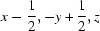
| Symmetry codes: (i) x+1/2, −y+3/2, z; (ii) x−1/2, −y+1/2, z. |
Experimental details
| Crystal data | |
| Chemical formula | C4HBr3S |
| Mr | 320.84 |
| Crystal system, space group | Orthorhombic, Pna21 |
| Temperature (K) | 91 |
| a, b, c (Å) | 12.4529 (11), 3.9724 (4), 28.846 (3) |
| V (Å3) | 1426.9 (2) |
| Z | 8 |
| Radiation type | Mo Kα |
| µ (mm−1) | 17.14 |
| Crystal size (mm) | 0.17 × 0.06 × 0.02 |
| Data collection | |
| Diffractometer | Bruker APEXII CCD area-detector diffractometer |
| Absorption correction | Multi-scan (SADABS; Bruker, 2006) |
| Tmin, Tmax | 0.434, 0.710 |
| No. of measured, independent and observed [I > 2σ(I)] reflections | 12082, 2163, 1852 |
| Rint | 0.092 |
| θmax (°) | 23.7 |
| (sin θ/λ)max (Å−1) | 0.566 |
| Refinement | |
| R[F2 > 2σ(F2)], wR(F2), S | 0.061, 0.172, 0.86 |
| No. of reflections | 2163 |
| No. of parameters | 109 |
| No. of restraints | 1 |
| H-atom treatment | H-atom parameters constrained |
| w = 1/[σ2(Fo2) + (0.1079P)2 + 95.665P] where P = (Fo2 + 2Fc2)/3 | |
| Δρmax, Δρmin (e Å−3) | 3.39, −1.30 |
| Absolute structure | Flack (1983), 1050 Friedel pairs |
| Absolute structure parameter | 0.11 (6) |
Computer programs: , APEX2 (Bruker 2006) and SAINT (Bruker 2006), SAINT (Bruker 2006), SHELXS97 (Sheldrick, 2008) and TITAN (Hunter & Simpson, 1999), SHELXL97 (Sheldrick, 2008) and TITAN (Hunter & Simpson, 1999), ORTEP-3 (Farrugia, 1997) and Mercury (Macrae et al., 2006), SHELXL97 (Sheldrick, 2008), enCIFer (Allen et al., 2004) and PLATON (Spek, 2003).
| D—H···A | D—H | H···A | D···A | D—H···A |
| C1A—H1A···Br3Ai | 0.95 | 3.04 | 3.89 (3) | 149 |
| C1A—H1A···Br4Ai | 0.95 | 2.96 | 3.68 (3) | 134 |
| C1B—H1B···Br3Bii | 0.95 | 2.93 | 3.79 (3) | 151 |
| C1B—H1B···Br4Bii | 0.95 | 2.97 | 3.66 (2) | 131 |
| Symmetry codes: (i) x+1/2, −y+3/2, z; (ii) x−1/2, −y+1/2, z. |
Acknowledgements
This work was supported by grant No UOO-X0404 from the New Economy Research Fund of the New Zealand Foundation for Research Science and Technology. We also thank the University of Otago for the purchase of the diffractometer.
References
 Allen, F. H. (2002). Acta Cryst. B58, 380–388. Web of Science CrossRef CAS IUCr Journals Google Scholar
Allen, F. H., Johnson, O., Shields, G. P., Smith, B. R. & Towler, M. (2004). J. Appl. Cryst. 37, 335–338. Web of Science CrossRef CAS IUCr Journals Google Scholar
Bruker (2006). APEX2, SAINT and SADABS. Bruker AXS Inc., Madison, Wisconsin, USA. Google Scholar
Farrugia, L. J. (1997). J. Appl. Cryst. 30, 565. CrossRef IUCr Journals Google Scholar
Flack, H. D. (1983). Acta Cryst. A39, 876–881. CrossRef CAS Web of Science IUCr Journals Google Scholar
Helmholdt, R. B., Sonneveld, E. J., Velde, C. M. L. V., Blockhuys, F., Lenstra, A. T. H., Geise, H. J. & Peschar, R. (2007). Acta Cryst. B63, 783–790. Web of Science CSD CrossRef IUCr Journals Google Scholar
Hunter, K. A. & Simpson, J. (1999). TITAN2000. University of Otago, New Zealand. Google Scholar
Macrae, C. F., Edgington, P. R., McCabe, P., Pidcock, E., Shields, G. P., Taylor, R., Towler, M. & van de Streek, J. (2006). J. Appl. Cryst. 39, 453–457. Web of Science CrossRef CAS IUCr Journals Google Scholar
Murakami, F., Sasaki, S. & Yoshifuji, M. (2002). Angew. Chem. Int. Ed. 41, 2574–2576. CrossRef CAS Google Scholar
Pedireddi, V. R., Shekhar Reddy, D., Satish Goud, B., Craig, D. C., Rae, A. D. & Desiraju, G. R. (1994). J. Chem. Soc. Perkin Trans. 2, pp. 2353–2359. CSD CrossRef Google Scholar
Sheldrick, G. M. (2008). Acta Cryst. A64, 112–122. Web of Science CrossRef CAS IUCr Journals Google Scholar
Spek, A. L. (2003). J. Appl. Cryst. 36, 7–13. Web of Science CrossRef CAS IUCr Journals Google Scholar
Xie, Y., Ng, S.-C., Wu, B.-M., Xue, F., Mak, T. C. W. & Hor, T. S. A. (1997). J. Organomet. Chem. 531, 175–181. CSD CrossRef CAS Web of Science Google Scholar
Xie, Y., Wu, B.-M., Xue, F., Ng, S.-C., Mak, T. C. W. & Hor, T. S. A. (1998). Organometallics, 17, 3988–3995. Web of Science CSD CrossRef CAS Google Scholar
This is an open-access article distributed under the terms of the Creative Commons Attribution (CC-BY) Licence, which permits unrestricted use, distribution, and reproduction in any medium, provided the original authors and source are cited.
| CRYSTALLOGRAPHIC COMMUNICATIONS |


Brominated thiophenes are very important intermediates in the construction of thiophene oligomers and polymers for use in optoelectronics. In some cases, it is important to have one or two α-positions free for further oxidative coupling. The 2,3,4-tribromo derivative is not easy to access, as the 2- and 5-positions are normally substituted first, and so it is normally synthesized via debromination from tetrabromothiophene (Xie et al., 1998).
The asymmetric unit of the title compound, (I), C8H2Br6S2, consists of two discrete tribromothiophene molecules A & B (Fig. 1). Each molecule is essentially planar with r.m.s. deviations from the mean planes through all non-hydrogen atoms of 0.0194 and 0.0286 Å for A and B respectively. The dihedral angle between the A and B ring planes is 0.9 (4)° but they are well separated with a centroid to centroid distance of 6.3 Å.
In the crystal of (I) bifurcated C—H···Br hydrogen bonds (Table 1) form chains of like molecules that pack in an obverse fashion along a. The structure is further stabilized by an extensive network of weak Br···Br interactions with Br···Br distances in the range 3.634 (4)Å (Br3A···Br2Bi, i = 1 - x, 1 - y, -1/2 + z; θ1 = 156.7° and θ2 = 117.5°) (Pedireddi et al., 1994) to 3.691 (4)Å (Br3A···Br2Aii ii = -1/2 + x, 1/2 - y, z; θ1 = 161.8° and θ2 = 84.7°). These contacts link the chains of molecules into undulating sheets in the bc plane (Fig. 2).