 | Acta Crystallographica Section E Acta Crystallographica Section E CRYSTALLOGRAPHIC COMMUNICATIONS |


 journal menu


metal-organic compounds
| CRYSTALLOGRAPHIC COMMUNICATIONS |
 access
Diaqua[5-(2-pyridyl)tetrazolato-κ2N1,N5]manganese(II)

aOrdered Matter Science Research Centre, College of Chemistry and Chemical Engineering, Southeast University, Nanjing 210096, People's Republic of China
*Correspondence e-mail: [email protected]
The title compound, [Mn(C6H4N5)2(H2O)2], was synthesized by the hydrothermal reaction of Mn(NO3)2 with picolinonitrile in the presence of NaN3. The Mn atom lies on an inversion centre. The distorted octahedral Mn environment contains two planar trans-related N,N′-chelating 5-(2-pyridyl)tetrazolate ligands in the equatorial plane and two axial water molecules. O—H⋯N hydrogen bonds generate an infinite three-dimensional network.
Related literature
For the chemisty of tetrazole, see: Arp et al. (2000![[Arp, H. P. H., Decken, A., Passmore, J. & Wood, D. J. (2000). Inorg. Chem. 39, 1840-1848.]](../../../../../../logos/arrows/e_arr.gif "Arp, H. P. H., Decken, A., Passmore, J. & Wood, D. J. (2000). Inorg. Chem. 39, 1840-1848.") ); Dunica et al. (1991); Wang et al. (2005); Wittenberger & Donner (1993).
); Dunica et al. (1991); Wang et al. (2005); Wittenberger & Donner (1993).
![[Scheme 1]](dn2338scheme1.gif)
Experimental
Crystal data
|
Refinement
|
| ||||||||||||||||||||||
 .
. Data collection: CrystalClear (Rigaku, 2005); cell refinement: CrystalClear; data reduction: CrystalClear; program(s) used to solve structure: SHELXS97 (Sheldrick, 2008); program(s) used to refine structure: SHELXL97 (Sheldrick, 2008); molecular graphics: ORTEPIII (Burnett & Johnson, 1996), ORTEP3 (Farrugia, 1997) and SHELXTL (Sheldrick, 2008); software used to prepare material for publication: SHELXL97.
Supporting information
contains datablocks I, global. DOI: 10.1107/S1600536808010106/dn2338sup1.cif
Structure factors: contains datablock I. DOI: 10.1107/S1600536808010106/dn2338Isup2.hkl
A mixture of picolinonitrile (0.2 mmol), NaN3 (0.4 mmol), Mn(NO3)2(0.15 mmol) ethanol (1 ml) and a few drops of water sealed in a glass tube was maintained at 120 °C. Yellow block crystals suitable for X-ray analysis were obtained after 3 days.
All H atoms attached to C atoms were fixed geometrically and treated as riding with C—H = 0.93 Å and Uiso(H) = 1.2Ueq(C). H atoms of water molecule were located in difference Fourier maps and included in the subsequent using restraints (O-H= 0.85 (1)Å and H···H= 1.49 (2)Å) with Uiso(H) = 1.5Ueq(O). In the last stage of they were treated as riding on the O atom.
Data collection: CrystalClear (Rigaku, 2005); cell CrystalClear (Rigaku, 2005); data reduction: CrystalClear (Rigaku, 2005); program(s) used to solve structure: SHELXS97 (Sheldrick, 2008); program(s) used to refine structure: SHELXL97 (Sheldrick, 2008); molecular graphics: ORTEPIII (Burnett & Johnson, 1996), ORTEP-32 (Farrugia, 1998) and SHELXTL (Sheldrick, 2008); software used to prepare material for publication: SHELXL97 (Sheldrick, 2008).
![[Figure 1]](./dn2338fig1thm.gif) | Fig. 1. Molecular view of the title compound with the atomic numbering scheme. Displacement ellipsoids are drawn at the 50% probability level. H atoms have been omitted for clarity. [Symmetry code : (i) 1-x, 1-y, 1-z] |
![[Figure 2]](./dn2338fig2thm.gif) | Fig. 2. The crystal packing of the title compound viewed along the a axis showing the three dimensionnal hydrogen bondings network (dashed line). Hydrogen atoms not involved in hydrogen bonding have been omitted for clarity. |
| [Mn(C6H4N5)2(H2O)2] | F(000) = 390 |
| Mr = 383.26 | Dx = 1.671 Mg m−3 |
| Monoclinic, P21/n | Mo Kα radiation, λ = 0.71073 Å |
| Hall symbol: -P 2yn | Cell parameters from 2090 reflections |
| a = 6.185 (3) Å | θ = 3.8–27.5° |
| b = 12.110 (7) Å | µ = 0.90 mm−1 |
| c = 10.615 (5) Å | T = 293 K |
| β = 106.597 (12)° | Block, yellow |
| V = 761.9 (7) Å3 | 0.5 × 0.5 × 0.4 mm |
| Z = 2 |
| Rigaku Mercury2 (2x2 bin mode) diffractometer | 1803 independent reflections |
| Radiation source: fine-focus sealed tube | 1660 reflections with I > 2σ(I) |
| Graphite monochromator | Rint = 0.021 |
| Detector resolution: 13.6612 pixels mm-1 | θmax = 27.9°, θmin = 2.6° |
| ω scans | h = −8→8 |
| Absorption correction: multi-scan (CrystalClear; Rigaku, 2005) | k = −15→15 |
| Tmin = 0.638, Tmax = 0.695 | l = −13→13 |
| 7656 measured reflections |
| Refinement on F2 | Primary atom site location: structure-invariant direct methods |
| Least-squares matrix: full | Secondary atom site location: difference Fourier map |
| R[F2 > 2σ(F2)] = 0.028 | Hydrogen site location: inferred from neighbouring sites |
| wR(F2) = 0.071 | H-atom parameters constrained |
| S = 1.11 | w = 1/[σ2(Fo2) + (0.0346P)2 + 0.2477P] where P = (Fo2 + 2Fc2)/3 |
| 1803 reflections | (Δ/σ)max = 0.001 |
| 115 parameters | Δρmax = 0.26 e Å−3 |
| 0 restraints | Δρmin = −0.30 e Å−3 |
| [Mn(C6H4N5)2(H2O)2] | V = 761.9 (7) Å3 |
| Mr = 383.26 | Z = 2 |
| Monoclinic, P21/n | Mo Kα radiation |
| a = 6.185 (3) Å | µ = 0.90 mm−1 |
| b = 12.110 (7) Å | T = 293 K |
| c = 10.615 (5) Å | 0.5 × 0.5 × 0.4 mm |
| β = 106.597 (12)° |
| Rigaku Mercury2 (2x2 bin mode) diffractometer | 1803 independent reflections |
| Absorption correction: multi-scan (CrystalClear; Rigaku, 2005) | 1660 reflections with I > 2σ(I) |
| Tmin = 0.638, Tmax = 0.695 | Rint = 0.021 |
| 7656 measured reflections |
| R[F2 > 2σ(F2)] = 0.028 | 0 restraints |
| wR(F2) = 0.071 | H-atom parameters constrained |
| S = 1.11 | Δρmax = 0.26 e Å−3 |
| 1803 reflections | Δρmin = −0.30 e Å−3 |
| 115 parameters |
Geometry. All esds (except the esd in the dihedral angle between two l.s. planes) are estimated using the full covariance matrix. The cell esds are taken into account individually in the estimation of esds in distances, angles and torsion angles; correlations between esds in cell parameters are only used when they are defined by crystal symmetry. An approximate (isotropic) treatment of cell esds is used for estimating esds involving l.s. planes. |
Refinement. Refinement of F2 against ALL reflections. The weighted R-factor wR and goodness of fit S are based on F2, conventional R-factors R are based on F, with F set to zero for negative F2. The threshold expression of F2 > σ(F2) is used only for calculating R-factors(gt) etc. and is not relevant to the choice of reflections for refinement. R-factors based on F2 are statistically about twice as large as those based on F, and R- factors based on ALL data will be even larger. |
| x | y | z | Uiso*/Ueq | ||
| C1 | 0.2334 (2) | 0.69220 (11) | 0.35475 (13) | 0.0241 (3) | |
| C2 | 0.4533 (2) | 0.74376 (11) | 0.41494 (13) | 0.0244 (3) | |
| C3 | 0.4930 (3) | 0.85522 (12) | 0.40133 (15) | 0.0344 (3) | |
| H3 | 0.3799 | 0.9008 | 0.3511 | 0.041* | |
| C4 | 0.7043 (3) | 0.89713 (13) | 0.46408 (17) | 0.0412 (4) | |
| H4 | 0.7349 | 0.9717 | 0.4569 | 0.049* | |
| C5 | 0.8696 (3) | 0.82755 (14) | 0.53750 (16) | 0.0393 (4) | |
| H5 | 1.0121 | 0.8544 | 0.5814 | 0.047* | |
| C6 | 0.8179 (2) | 0.71703 (13) | 0.54410 (15) | 0.0325 (3) | |
| H6 | 0.9299 | 0.6698 | 0.5921 | 0.039* | |
| Mn1 | 0.5000 | 0.5000 | 0.5000 | 0.02576 (11) | |
| N1 | 0.61452 (19) | 0.67490 (9) | 0.48475 (11) | 0.0255 (2) | |
| N2 | 0.19348 (18) | 0.58625 (9) | 0.37478 (12) | 0.0275 (2) | |
| N3 | −0.0219 (2) | 0.56898 (11) | 0.30475 (13) | 0.0338 (3) | |
| N4 | −0.1061 (2) | 0.66105 (11) | 0.24559 (13) | 0.0368 (3) | |
| N5 | 0.0515 (2) | 0.74084 (10) | 0.27584 (12) | 0.0318 (3) | |
| O1W | 0.58488 (19) | 0.45145 (9) | 0.32058 (11) | 0.0393 (3) | |
| H1W | 0.5510 | 0.3858 | 0.2905 | 0.059* | |
| H2W | 0.7096 | 0.4775 | 0.3151 | 0.059* |
| U11 | U22 | U33 | U12 | U13 | U23 | |
| C1 | 0.0229 (6) | 0.0215 (6) | 0.0268 (6) | 0.0016 (5) | 0.0055 (5) | 0.0021 (5) |
| C2 | 0.0237 (6) | 0.0221 (6) | 0.0267 (6) | −0.0007 (5) | 0.0059 (5) | 0.0014 (5) |
| C3 | 0.0350 (7) | 0.0238 (7) | 0.0409 (8) | −0.0016 (6) | 0.0050 (6) | 0.0051 (6) |
| C4 | 0.0445 (9) | 0.0267 (7) | 0.0491 (9) | −0.0124 (6) | 0.0082 (7) | 0.0013 (6) |
| C5 | 0.0299 (7) | 0.0422 (9) | 0.0407 (8) | −0.0135 (6) | 0.0019 (6) | −0.0014 (7) |
| C6 | 0.0243 (6) | 0.0366 (8) | 0.0327 (7) | −0.0011 (6) | 0.0020 (5) | 0.0024 (6) |
| Mn1 | 0.02613 (16) | 0.01760 (16) | 0.03133 (17) | 0.00182 (10) | 0.00463 (12) | 0.00246 (10) |
| N1 | 0.0235 (5) | 0.0237 (5) | 0.0277 (5) | 0.0000 (4) | 0.0047 (4) | 0.0021 (4) |
| N2 | 0.0222 (5) | 0.0227 (6) | 0.0342 (6) | −0.0018 (4) | 0.0026 (5) | 0.0001 (4) |
| N3 | 0.0239 (6) | 0.0332 (7) | 0.0400 (7) | −0.0042 (5) | 0.0023 (5) | −0.0009 (5) |
| N4 | 0.0246 (6) | 0.0402 (7) | 0.0407 (7) | −0.0016 (5) | 0.0012 (5) | 0.0044 (6) |
| N5 | 0.0240 (6) | 0.0316 (6) | 0.0363 (6) | 0.0023 (5) | 0.0029 (5) | 0.0075 (5) |
| O1W | 0.0422 (6) | 0.0340 (6) | 0.0472 (6) | −0.0123 (5) | 0.0213 (5) | −0.0121 (5) |
| C1—N5 | 1.3325 (17) | C6—H6 | 0.9300 |
| C1—N2 | 1.3350 (18) | Mn1—O1Wi | 2.1954 (14) |
| C1—C2 | 1.4670 (19) | Mn1—O1W | 2.1954 (14) |
| C2—N1 | 1.3478 (17) | Mn1—N2i | 2.2388 (14) |
| C2—C3 | 1.387 (2) | Mn1—N2 | 2.2388 (14) |
| C3—C4 | 1.383 (2) | Mn1—N1i | 2.2538 (16) |
| C3—H3 | 0.9300 | Mn1—N1 | 2.2538 (16) |
| C4—C5 | 1.381 (2) | N2—N3 | 1.3438 (17) |
| C4—H4 | 0.9300 | N3—N4 | 1.3122 (19) |
| C5—C6 | 1.382 (2) | N4—N5 | 1.3449 (18) |
| C5—H5 | 0.9300 | O1W—H1W | 0.8597 |
| C6—N1 | 1.3367 (18) | O1W—H2W | 0.8507 |
| N5—C1—N2 | 111.33 (12) | N2i—Mn1—N2 | 180.0 |
| N5—C1—C2 | 126.65 (12) | O1Wi—Mn1—N1i | 91.80 (5) |
| N2—C1—C2 | 122.03 (11) | O1W—Mn1—N1i | 88.20 (5) |
| N1—C2—C3 | 122.30 (13) | N2i—Mn1—N1i | 75.47 (5) |
| N1—C2—C1 | 115.11 (12) | N2—Mn1—N1i | 104.53 (5) |
| C3—C2—C1 | 122.59 (12) | O1Wi—Mn1—N1 | 88.20 (5) |
| C4—C3—C2 | 118.56 (14) | O1W—Mn1—N1 | 91.80 (5) |
| C4—C3—H3 | 120.7 | N2i—Mn1—N1 | 104.53 (5) |
| C2—C3—H3 | 120.7 | N2—Mn1—N1 | 75.47 (5) |
| C5—C4—C3 | 119.57 (14) | N1i—Mn1—N1 | 180.0 |
| C5—C4—H4 | 120.2 | C6—N1—C2 | 118.14 (12) |
| C3—C4—H4 | 120.2 | C6—N1—Mn1 | 126.70 (10) |
| C4—C5—C6 | 118.32 (14) | C2—N1—Mn1 | 115.00 (9) |
| C4—C5—H5 | 120.8 | C1—N2—N3 | 105.11 (11) |
| C6—C5—H5 | 120.8 | C1—N2—Mn1 | 112.29 (9) |
| N1—C6—C5 | 123.09 (14) | N3—N2—Mn1 | 142.51 (9) |
| N1—C6—H6 | 118.5 | N4—N3—N2 | 109.13 (12) |
| C5—C6—H6 | 118.5 | N3—N4—N5 | 109.55 (12) |
| O1Wi—Mn1—O1W | 180.0 | C1—N5—N4 | 104.88 (12) |
| O1Wi—Mn1—N2i | 88.95 (5) | Mn1—O1W—H1W | 118.4 |
| O1W—Mn1—N2i | 91.05 (5) | Mn1—O1W—H2W | 114.0 |
| O1Wi—Mn1—N2 | 91.05 (5) | H1W—O1W—H2W | 116.5 |
| O1W—Mn1—N2 | 88.95 (5) |
| Symmetry code: (i) −x+1, −y+1, −z+1. |
| D—H···A | D—H | H···A | D···A | D—H···A |
| O1W—H2W···N3ii | 0.85 | 2.03 | 2.864 (2) | 169 |
| O1W—H1W···N5iii | 0.86 | 1.93 | 2.788 (2) | 175 |
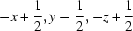
| Symmetry codes: (ii) x+1, y, z; (iii) −x+1/2, y−1/2, −z+1/2. |
Experimental details
| Crystal data | |
| Chemical formula | [Mn(C6H4N5)2(H2O)2] |
| Mr | 383.26 |
| Crystal system, space group | Monoclinic, P21/n |
| Temperature (K) | 293 |
| a, b, c (Å) | 6.185 (3), 12.110 (7), 10.615 (5) |
| β (°) | 106.597 (12) |
| V (Å3) | 761.9 (7) |
| Z | 2 |
| Radiation type | Mo Kα |
| µ (mm−1) | 0.90 |
| Crystal size (mm) | 0.5 × 0.5 × 0.4 |
| Data collection | |
| Diffractometer | Rigaku Mercury2 (2x2 bin mode) diffractometer |
| Absorption correction | Multi-scan (CrystalClear; Rigaku, 2005) |
| Tmin, Tmax | 0.638, 0.695 |
| No. of measured, independent and observed [I > 2σ(I)] reflections | 7656, 1803, 1660 |
| Rint | 0.021 |
| (sin θ/λ)max (Å−1) | 0.658 |
| Refinement | |
| R[F2 > 2σ(F2)], wR(F2), S | 0.028, 0.071, 1.11 |
| No. of reflections | 1803 |
| No. of parameters | 115 |
| H-atom treatment | H-atom parameters constrained |
| Δρmax, Δρmin (e Å−3) | 0.26, −0.30 |
Computer programs: CrystalClear (Rigaku, 2005), SHELXS97 (Sheldrick, 2008), SHELXL97 (Sheldrick, 2008), ORTEPIII (Burnett & Johnson, 1996), ORTEP-32 (Farrugia, 1998) and SHELXTL (Sheldrick, 2008).
| D—H···A | D—H | H···A | D···A | D—H···A |
| O1W—H2W···N3i | 0.85 | 2.03 | 2.864 (2) | 168.5 |
| O1W—H1W···N5ii | 0.86 | 1.93 | 2.788 (2) | 175.0 |
| Symmetry codes: (i) x+1, y, z; (ii) −x+1/2, y−1/2, −z+1/2. |
Acknowledgements
This work was supported by a Start-up Grant from Southeast University to Professor Ren-Gen Xiong.
References
 Arp, H. P. H., Decken, A., Passmore, J. & Wood, D. J. (2000). Inorg. Chem. 39, 1840–1848. Web of Science CSD CrossRef PubMed CAS Google Scholar
Burnett, M. N. & Johnson, C. K. (1996). ORTEPIII. Report ORNL-6895. Oak Ridge National Laboratory, Tennessee, USA. Google Scholar
Dunica, J. V., Pierce, M. E. & Santella, J. B. III (1991). J. Org. Chem. 56, 2395–2400. Google Scholar
Farrugia, L. J. (1997). J. Appl. Cryst. 30, 565. CrossRef IUCr Journals Google Scholar
Rigaku (2005). CrystalClear. Rigaku Corporation, Tokyo, Japan. Google Scholar
Sheldrick, G. M. (2008). Acta Cryst. A64, 112–122. Web of Science CrossRef CAS IUCr Journals Google Scholar
Wang, X.-S., Tang, Y.-Z., Huang, X.-F., Qu, Z.-R., Che, C.-M., Chan, C. W. H. & Xiong, R.-G. (2005). Inorg. Chem. 44, 5278–5285. Web of Science CSD CrossRef PubMed CAS Google Scholar
Wittenberger, S. J. & Donner, B. G. (1993). J. Org. Chem. 58, 4139–4141. CrossRef CAS Web of Science Google Scholar
This is an open-access article distributed under the terms of the Creative Commons Attribution (CC-BY) Licence, which permits unrestricted use, distribution, and reproduction in any medium, provided the original authors and source are cited.
| CRYSTALLOGRAPHIC COMMUNICATIONS |


The tetrazole functional group has found a wide range of applications in coordination chemistry as ligands, in medicinal chemistry as a metabolically stable surrogate for a carboxylic acid group, and in materials science as high density energy materials(Wang et al., 2005; Dunica et al., 1991; Wittenberger & Donner, 1993). We report here the crystal structure of the title compound, 5-(2-pyridyl)tetrazolate-Manganese(II) dihydrate.
The Mn atom lies on an inversion centre. The distorted octahedral Mn environment contains two planar trans-related N,N-chelating 5-(2-pyridyl)tetrazolate ligands in the equatorial plane and two water molecules ligands. The pyridine and tetrazole rings are nearly coplanar and are twisted from each other by a dihedral angle of only 4.02 (0.09) °(Fig.1). The bond distances and bond angles of the tetrazole rings are in the usual ranges (Wang et al., 2005; Arp et al., 2000).
The O atoms from water molecules are involved in intermolecular hydrogen bonds building up an infinite three-dimensional network(Table 1, Fig. 2).