 | Acta Crystallographica Section E Acta Crystallographica Section E CRYSTALLOGRAPHIC COMMUNICATIONS |


 journal menu


organic compounds
| CRYSTALLOGRAPHIC COMMUNICATIONS |
 access
Methyl 4-(trimethylsilylethynyl)benzoate

aDepartment of Chemistry and Polymer Science, University of Stellenbosch, Private Bag X1, Matieland, 7602, South Africa
*Correspondence e-mail: [email protected]
The title compound, C13H16O2Si, was synthesized as a precursor for ethynylarene derivatives and crystallized from hexane. In the crystal structure, molecules are linked by weak C—H⋯O hydrogen bonds to form chains that pack in layers in a herringbone fashion.
Related literature
For related literature, see: Eddaoudi et al. (2001![[Eddaoudi, M., Moler, D. B., Li, H., Chen, B., Reineke, T. M., O'Keeffe, M. & Yaghi, O. M. (2001). Acc. Chem. Res. 34, 319-330.]](../../../../../../logos/arrows/e_arr.gif "Eddaoudi, M., Moler, D. B., Li, H., Chen, B., Reineke, T. M., O'Keeffe, M. & Yaghi, O. M. (2001). Acc. Chem. Res. 34, 319-330.") ); Dybtsev et al. (2004); Kesanli et al. (2005); Zhao et al. (2004); Allen et al. (1987); Fasina et al. (2005).
); Dybtsev et al. (2004); Kesanli et al. (2005); Zhao et al. (2004); Allen et al. (1987); Fasina et al. (2005).
![[Scheme 1]](ez2120scheme1.gif)
Experimental
Crystal data
|
| ||||||||||||||||||||||
 ; (ii)
  .
. Data collection: SMART (Bruker, 2002); cell refinement: SAINT (Bruker, 2003); data reduction: SAINT; program(s) used to solve structure: SHELXS97 (Sheldrick, 2008); program(s) used to refine structure: SHELXL97 (Sheldrick, 2008); molecular graphics: X-SEED (Barbour, 2001; Atwood & Barbour, 2003); software used to prepare material for publication: publCIF (Westrip, 2008).
Supporting information
contains datablocks I, New_Global_Publ_Block. DOI: 10.1107/S1600536808008192/ez2120sup1.cif
Structure factors: contains datablock I. DOI: 10.1107/S1600536808008192/ez2120Isup2.hkl
The title compound (I), was synthesized from trimethylsilylacetylene and 4-iodo(methylbenzoate) using a Sonogashira cross-coupling-type reaction as detailed in (Fasina et al., 2005). Recrystallization from hexane afforded crystals of the title compound.
1H and 13C NMR spectra were recorded as an additional method of characterization, 1H NMR (CDCl3, 400 MHz): δ = 0.22 (9H, s, SiCH3), 3.89 (3H, s, CO2CH3), 7.49–7.53 (2H, m, ArH), 7.95–7.99 (2H, m, ArH); 13C-NMR (CDCl3, 75.5 MHz): δ = -0.44 (SiCH3), 52.063 (OCH3), 97.738 (CC), 104.16 (CC), 127.952 (ArH), 129.53 (ArH), 129.896 (ArH), 132.029 (ArH), 166.761 (CO)
Hydrogen atoms were refined in calculated positions, using a riding model (C–H = 0.98–0.99 Å, Uiso(H) = 1.5Ueq(C) for methyl C or 1.2Ueq(C) or the remaining C atoms).
Data collection: SMART (Bruker, 2002); cell SAINT (Bruker, 2003); data reduction: SAINT (Bruker, 2003); program(s) used to solve structure: SHELXS97 (Sheldrick, 2008); program(s) used to refine structure: SHELXL97 (Sheldrick, 2008); molecular graphics: X-SEED (Barbour, 2001; Atwood & Barbour, 2003); software used to prepare material for publication: publCIF (Westrip, 2008).
![[Figure 1]](./ez2120fig1thm.gif) | Fig. 1. The molecular structure of the title compound showing the atom-labelling scheme. Displacement ellipsoids are shown at the 50% probability level. |
![[Figure 2]](./ez2120fig2thm.gif) | Fig. 2. Herring-bone arrangement of the molecules, viewed down the c axis. |
![[Figure 3]](./ez2120fig3thm.gif) | Fig. 3. C—H···O hydrogen bonds formed between a methyl hydrogen of the trimethylsilyl group and a neighbouring carbonyl oxygen atom. Hydrogen bonds are shown as dashed lines. |
| C13H16O2Si | F(000) = 496 |
| Mr = 232.35 | Dx = 1.184 Mg m−3 |
| Orthorhombic, P212121 | Mo Kα radiation, λ = 0.71073 Å |
| Hall symbol: P2ac2ab | Cell parameters from 1456 reflections |
| a = 6.1983 (11) Å | θ = 2.8–23.3° |
| b = 7.1194 (12) Å | µ = 0.16 mm−1 |
| c = 29.530 (5) Å | T = 100 K |
| V = 1303.1 (4) Å3 | Plate, colourless |
| Z = 4 | 0.25 × 0.24 × 0.08 mm |
| Bruker APEX CCD area-detector diffractometer | 3050 independent reflections |
| Radiation source: fine-focus sealed tube | 2643 reflections with I > 2σ(I) |
| Graphite monochromator | Rint = 0.054 |
| /w scans | θmax = 28.3°, θmin = 2.8° |
| Absorption correction: multi-scan (SADABS; Bruker, 2002) | h = −7→8 |
| Tmin = 0.960, Tmax = 0.987 | k = −8→9 |
| 8160 measured reflections | l = −37→32 |
| Refinement on F2 | Secondary atom site location: difference Fourier map |
| Least-squares matrix: full | Hydrogen site location: inferred from neighbouring sites |
| R[F2 > 2σ(F2)] = 0.058 | H-atom parameters constrained |
| wR(F2) = 0.114 | w = 1/[σ2(Fo2) + (0.0431P)2 + 0.2577P] where P = (Fo2 + 2Fc2)/3 |
| S = 1.10 | (Δ/σ)max < 0.001 |
| 3050 reflections | Δρmax = 0.37 e Å−3 |
| 149 parameters | Δρmin = −0.30 e Å−3 |
| 0 restraints | Absolute structure: Flack (1983), 1136 Friedel pairs |
| Primary atom site location: structure-invariant direct methods | Absolute structure parameter: −0.01 (19) |
| C13H16O2Si | V = 1303.1 (4) Å3 |
| Mr = 232.35 | Z = 4 |
| Orthorhombic, P212121 | Mo Kα radiation |
| a = 6.1983 (11) Å | µ = 0.16 mm−1 |
| b = 7.1194 (12) Å | T = 100 K |
| c = 29.530 (5) Å | 0.25 × 0.24 × 0.08 mm |
| Bruker APEX CCD area-detector diffractometer | 3050 independent reflections |
| Absorption correction: multi-scan (SADABS; Bruker, 2002) | 2643 reflections with I > 2σ(I) |
| Tmin = 0.960, Tmax = 0.987 | Rint = 0.054 |
| 8160 measured reflections |
| R[F2 > 2σ(F2)] = 0.058 | H-atom parameters constrained |
| wR(F2) = 0.114 | Δρmax = 0.37 e Å−3 |
| S = 1.10 | Δρmin = −0.30 e Å−3 |
| 3050 reflections | Absolute structure: Flack (1983), 1136 Friedel pairs |
| 149 parameters | Absolute structure parameter: −0.01 (19) |
| 0 restraints |
Geometry. All e.s.d.'s (except the e.s.d. in the dihedral angle between two l.s. planes) are estimated using the full covariance matrix. The cell e.s.d.'s are taken into account individually in the estimation of e.s.d.'s in distances, angles and torsion angles; correlations between e.s.d.'s in cell parameters are only used when they are defined by crystal symmetry. An approximate (isotropic) treatment of cell e.s.d.'s is used for estimating e.s.d.'s involving l.s. planes. |
Refinement. Refinement of F2 against ALL reflections. The weighted R-factor wR and goodness of fit S are based on F2, conventional R-factors R are based on F, with F set to zero for negative F2. The threshold expression of F2 > σ(F2) is used only for calculating R-factors(gt) etc. and is not relevant to the choice of reflections for refinement. R-factors based on F2 are statistically about twice as large as those based on F, and R- factors based on ALL data will be even larger. |
| x | y | z | Uiso*/Ueq | ||
| Si1 | 0.68188 (11) | 0.55394 (11) | 0.42983 (2) | 0.01481 (17) | |
| O1 | 0.1541 (3) | 0.5852 (3) | 0.12946 (6) | 0.0236 (5) | |
| O2 | −0.1514 (3) | 0.4974 (3) | 0.16417 (6) | 0.0182 (4) | |
| C1 | 0.1563 (4) | 0.5421 (4) | 0.20957 (8) | 0.0138 (5) | |
| C2 | 0.3623 (4) | 0.6175 (4) | 0.21449 (9) | 0.0138 (5) | |
| H2 | 0.4368 | 0.6646 | 0.1888 | 0.017* | |
| C3 | 0.4582 (4) | 0.6241 (4) | 0.25659 (9) | 0.0146 (5) | |
| H3 | 0.5981 | 0.6770 | 0.2598 | 0.017* | |
| C4 | 0.3507 (4) | 0.5533 (4) | 0.29466 (8) | 0.0133 (5) | |
| C5 | 0.1428 (4) | 0.4787 (4) | 0.28942 (8) | 0.0137 (5) | |
| H5 | 0.0673 | 0.4322 | 0.3151 | 0.016* | |
| C6 | 0.0467 (4) | 0.4724 (3) | 0.24702 (8) | 0.0138 (5) | |
| H6 | −0.0936 | 0.4206 | 0.2436 | 0.017* | |
| C7 | 0.0588 (4) | 0.5439 (4) | 0.16347 (8) | 0.0145 (5) | |
| C8 | −0.2620 (4) | 0.5084 (4) | 0.12112 (9) | 0.0220 (7) | |
| H8A | −0.2696 | 0.6397 | 0.1113 | 0.033* | |
| H8B | −0.4084 | 0.4581 | 0.1244 | 0.033* | |
| H8C | −0.1831 | 0.4347 | 0.0985 | 0.033* | |
| C9 | 0.4551 (4) | 0.5535 (4) | 0.33826 (8) | 0.0149 (5) | |
| C10 | 0.5448 (4) | 0.5509 (4) | 0.37428 (8) | 0.0169 (5) | |
| C11 | 0.9744 (4) | 0.5113 (5) | 0.42078 (10) | 0.0299 (8) | |
| H11A | 0.9953 | 0.3856 | 0.4080 | 0.045* | |
| H11B | 1.0505 | 0.5202 | 0.4498 | 0.045* | |
| H11C | 1.0318 | 0.6055 | 0.3998 | 0.045* | |
| C12 | 0.6371 (5) | 0.7888 (4) | 0.45560 (9) | 0.0219 (6) | |
| H12A | 0.6989 | 0.8858 | 0.4360 | 0.033* | |
| H12B | 0.7068 | 0.7937 | 0.4854 | 0.033* | |
| H12C | 0.4819 | 0.8108 | 0.4591 | 0.033* | |
| C13 | 0.5661 (5) | 0.3652 (4) | 0.46578 (10) | 0.0272 (7) | |
| H13A | 0.4092 | 0.3806 | 0.4676 | 0.041* | |
| H13B | 0.6281 | 0.3728 | 0.4962 | 0.041* | |
| H13C | 0.5999 | 0.2426 | 0.4525 | 0.041* |
| U11 | U22 | U33 | U12 | U13 | U23 | |
| Si1 | 0.0106 (3) | 0.0178 (4) | 0.0160 (3) | 0.0025 (3) | −0.0022 (3) | −0.0019 (3) |
| O1 | 0.0155 (9) | 0.0366 (12) | 0.0188 (10) | −0.0016 (10) | 0.0001 (8) | 0.0049 (9) |
| O2 | 0.0108 (9) | 0.0249 (11) | 0.0189 (9) | −0.0047 (8) | −0.0051 (7) | 0.0009 (7) |
| C1 | 0.0119 (11) | 0.0130 (13) | 0.0166 (12) | 0.0010 (12) | −0.0024 (9) | −0.0018 (11) |
| C2 | 0.0115 (12) | 0.0129 (13) | 0.0171 (14) | 0.0011 (10) | 0.0019 (10) | 0.0008 (10) |
| C3 | 0.0085 (12) | 0.0145 (13) | 0.0208 (14) | −0.0016 (10) | −0.0010 (10) | −0.0032 (11) |
| C4 | 0.0119 (11) | 0.0115 (12) | 0.0164 (12) | 0.0039 (12) | −0.0024 (9) | −0.0016 (11) |
| C5 | 0.0127 (12) | 0.0123 (13) | 0.0162 (12) | −0.0025 (11) | 0.0024 (9) | 0.0015 (10) |
| C6 | 0.0115 (12) | 0.0086 (13) | 0.0213 (13) | 0.0009 (10) | 0.0001 (10) | −0.0019 (11) |
| C7 | 0.0124 (11) | 0.0110 (12) | 0.0199 (13) | 0.0007 (11) | −0.0024 (10) | 0.0001 (12) |
| C8 | 0.0181 (14) | 0.0266 (17) | 0.0212 (14) | −0.0029 (11) | −0.0079 (11) | −0.0028 (12) |
| C9 | 0.0134 (11) | 0.0112 (12) | 0.0202 (13) | −0.0005 (12) | −0.0010 (10) | −0.0013 (12) |
| C10 | 0.0122 (12) | 0.0167 (14) | 0.0218 (14) | −0.0009 (12) | 0.0016 (10) | −0.0021 (12) |
| C11 | 0.0186 (14) | 0.0392 (19) | 0.0320 (18) | 0.0086 (13) | −0.0050 (12) | −0.0188 (14) |
| C12 | 0.0231 (16) | 0.0255 (16) | 0.0171 (15) | 0.0053 (12) | −0.0037 (12) | −0.0011 (12) |
| C13 | 0.0223 (16) | 0.0280 (17) | 0.0313 (18) | 0.0039 (13) | −0.0063 (13) | 0.0061 (14) |
| Si1—C10 | 1.848 (3) | C5—H5 | 0.9500 |
| Si1—C13 | 1.857 (3) | C6—H6 | 0.9500 |
| Si1—C11 | 1.858 (3) | C8—H8A | 0.9800 |
| Si1—C12 | 1.858 (3) | C8—H8B | 0.9800 |
| O1—C7 | 1.202 (3) | C8—H8C | 0.9800 |
| O2—C7 | 1.344 (3) | C9—C10 | 1.200 (3) |
| O2—C8 | 1.447 (3) | C9—C4 | 1.441 (3) |
| C1—C6 | 1.390 (3) | C11—H11A | 0.9800 |
| C1—C2 | 1.392 (3) | C11—H11B | 0.9800 |
| C1—C7 | 1.490 (3) | C11—H11C | 0.9800 |
| C2—H2 | 0.9500 | C12—H12A | 0.9800 |
| C3—C2 | 1.379 (4) | C12—H12B | 0.9800 |
| C3—H3 | 0.9500 | C12—H12C | 0.9800 |
| C4—C3 | 1.401 (3) | C13—H13A | 0.9800 |
| C4—C5 | 1.403 (3) | C13—H13B | 0.9800 |
| C5—C6 | 1.387 (3) | C13—H13C | 0.9800 |
| C10—Si1—C13 | 108.75 (14) | O1—C7—O2 | 123.3 (2) |
| C10—Si1—C11 | 108.62 (12) | O1—C7—C1 | 124.5 (2) |
| C13—Si1—C11 | 109.95 (15) | O2—C7—C1 | 112.2 (2) |
| C10—Si1—C12 | 107.78 (13) | Si1—C11—H11A | 109.5 |
| C13—Si1—C12 | 111.06 (14) | Si1—C11—H11B | 109.5 |
| C11—Si1—C12 | 110.61 (14) | H11A—C11—H11B | 109.5 |
| C7—O2—C8 | 115.63 (19) | Si1—C11—H11C | 109.5 |
| C10—C9—C4 | 178.7 (3) | H11A—C11—H11C | 109.5 |
| C3—C4—C5 | 119.0 (2) | H11B—C11—H11C | 109.5 |
| C3—C4—C9 | 120.2 (2) | O2—C8—H8A | 109.5 |
| C5—C4—C9 | 120.8 (2) | O2—C8—H8B | 109.5 |
| C6—C1—C2 | 120.2 (2) | H8A—C8—H8B | 109.5 |
| C6—C1—C7 | 122.1 (2) | O2—C8—H8C | 109.5 |
| C2—C1—C7 | 117.7 (2) | H8A—C8—H8C | 109.5 |
| C2—C3—C4 | 120.4 (2) | H8B—C8—H8C | 109.5 |
| C2—C3—H3 | 119.8 | Si1—C12—H12A | 109.5 |
| C4—C3—H3 | 119.8 | Si1—C12—H12B | 109.5 |
| C3—C2—C1 | 120.2 (2) | H12A—C12—H12B | 109.5 |
| C3—C2—H2 | 119.9 | Si1—C12—H12C | 109.5 |
| C1—C2—H2 | 119.9 | H12A—C12—H12C | 109.5 |
| C9—C10—Si1 | 178.4 (3) | H12B—C12—H12C | 109.5 |
| C6—C5—C4 | 120.4 (2) | Si1—C13—H13A | 109.5 |
| C6—C5—H5 | 119.8 | Si1—C13—H13B | 109.5 |
| C4—C5—H5 | 119.8 | H13A—C13—H13B | 109.5 |
| C5—C6—C1 | 119.8 (2) | Si1—C13—H13C | 109.5 |
| C5—C6—H6 | 120.1 | H13A—C13—H13C | 109.5 |
| C1—C6—H6 | 120.1 | H13B—C13—H13C | 109.5 |
| C5—C4—C3—C2 | −1.1 (4) | C2—C1—C6—C5 | 0.2 (4) |
| C9—C4—C3—C2 | 177.5 (2) | C7—C1—C6—C5 | −178.3 (2) |
| C4—C3—C2—C1 | 0.7 (4) | C8—O2—C7—O1 | −2.8 (4) |
| C6—C1—C2—C3 | −0.2 (4) | C8—O2—C7—C1 | 175.9 (2) |
| C7—C1—C2—C3 | 178.3 (2) | C6—C1—C7—O1 | −172.3 (3) |
| C3—C4—C5—C6 | 1.1 (4) | C2—C1—C7—O1 | 9.2 (4) |
| C9—C4—C5—C6 | −177.5 (2) | C6—C1—C7—O2 | 9.0 (4) |
| C4—C5—C6—C1 | −0.6 (4) | C2—C1—C7—O2 | −169.5 (2) |
| D—H···A | D—H | H···A | D···A | D—H···A |
| C11—H11A···O1i | 0.98 | 2.58 | 3.470 (4) | 151 |
| C12—H12A···O1ii | 0.98 | 2.57 | 3.527 (3) | 167 |
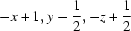
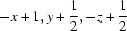
| Symmetry codes: (i) −x+1, y−1/2, −z+1/2; (ii) −x+1, y+1/2, −z+1/2. |
Experimental details
| Crystal data | |
| Chemical formula | C13H16O2Si |
| Mr | 232.35 |
| Crystal system, space group | Orthorhombic, P212121 |
| Temperature (K) | 100 |
| a, b, c (Å) | 6.1983 (11), 7.1194 (12), 29.530 (5) |
| V (Å3) | 1303.1 (4) |
| Z | 4 |
| Radiation type | Mo Kα |
| µ (mm−1) | 0.16 |
| Crystal size (mm) | 0.25 × 0.24 × 0.08 |
| Data collection | |
| Diffractometer | Bruker APEX CCD area-detector diffractometer |
| Absorption correction | Multi-scan (SADABS; Bruker, 2002) |
| Tmin, Tmax | 0.960, 0.987 |
| No. of measured, independent and observed [I > 2σ(I)] reflections | 8160, 3050, 2643 |
| Rint | 0.054 |
| (sin θ/λ)max (Å−1) | 0.666 |
| Refinement | |
| R[F2 > 2σ(F2)], wR(F2), S | 0.058, 0.114, 1.10 |
| No. of reflections | 3050 |
| No. of parameters | 149 |
| H-atom treatment | H-atom parameters constrained |
| Δρmax, Δρmin (e Å−3) | 0.37, −0.30 |
| Absolute structure | Flack (1983), 1136 Friedel pairs |
| Absolute structure parameter | −0.01 (19) |
Computer programs: SMART (Bruker, 2002), SAINT (Bruker, 2003), SHELXS97 (Sheldrick, 2008), SHELXL97 (Sheldrick, 2008), X-SEED (Barbour, 2001; Atwood & Barbour, 2003), publCIF (Westrip, 2008).
| D—H···A | D—H | H···A | D···A | D—H···A |
| C11—H11A···O1i | 0.98 | 2.58 | 3.470 (4) | 151 |
| C12—H12A···O1ii | 0.98 | 2.57 | 3.527 (3) | 167 |
| Symmetry codes: (i) −x+1, y−1/2, −z+1/2; (ii) −x+1, y+1/2, −z+1/2. |
Acknowledgements
The authors acknowledge SASOL for funding.
References
 Allen, F. H., Kennard, O., Watson, D. G., Brammer, L., Orpen, A. G. & Taylor, R. (1987). J. Chem. Soc. Perkin Trans. 2, pp. S1–19. CrossRef Web of Science Google Scholar
Atwood, J. L. & Barbour, L. J. (2003). Cryst. Growth Des. 3, 3–8. Web of Science CrossRef CAS Google Scholar
Barbour, L. J. (2001). J. Supramol. Chem. 1, 189–191. CrossRef CAS Google Scholar
Bruker (2002). SMART and SADABS. Bruker AXS Inc., Madison, Wisconsin, USA. Google Scholar
Bruker (2003). SAINT. Bruker AXS Inc., Madison, Wisconsin, USA. Google Scholar
Dybtsev, D. N., Chun, H. & Kim, K. (2004). Angew. Chem. Int. Ed. 43, 5033–5036. Web of Science CSD CrossRef CAS Google Scholar
Eddaoudi, M., Moler, D. B., Li, H., Chen, B., Reineke, T. M., O'Keeffe, M. & Yaghi, O. M. (2001). Acc. Chem. Res. 34, 319–330. Web of Science CrossRef PubMed CAS Google Scholar
Fasina, T. M., Collings, J. C., Burke, J. M., Batsanov, A. S., Ward, R. M., Albesa-Jové, D., Porrès, L., Beeby, A., Howard, J. A. K., Scott, A. J., Clegg, W., Watt, S. W., Viney, C. & Marder, T. B. (2005). J. Mater. Chem. 15, 690–697. Web of Science CSD CrossRef CAS Google Scholar
Flack, H. D. (1983). Acta Cryst. A39, 876–881. CrossRef CAS Web of Science IUCr Journals Google Scholar
Kesanli, B., Cui, Y., Smith, M. R., Bittner, E. W., Bockrath, B. L. & Lin, W. (2005). Angew. Chem. Int. Ed. 44, 72–75. Web of Science CSD CrossRef CAS Google Scholar
Sheldrick, G. M. (2008). Acta Cryst. A64, 112–122. Web of Science CrossRef CAS IUCr Journals Google Scholar
Westrip, S. P. (2008). publCIF. In preparation. Google Scholar
Zhao, X., Xiao, B., Fletcher, A. J., Thomas, K. M., Bradshaw, D. & Rosseinsky, M. J. (2004). Science, 306, 1012–1015. Web of Science CSD CrossRef PubMed CAS Google Scholar
This is an open-access article distributed under the terms of the Creative Commons Attribution (CC-BY) Licence, which permits unrestricted use, distribution, and reproduction in any medium, provided the original authors and source are cited.
| CRYSTALLOGRAPHIC COMMUNICATIONS |


The title compound was isolated as a precursor in the synthesis of a series of ethynylarene-based ligands with terminal carboxylate groups. Interest in these kinds of ligands can be attributed to their ability to incorporate metal ions into M—O—C clusters, leading to novel metal-organic frameworks (MOFs), a category of compounds gaining increasing interest due to their potential applications for gas storage and separation and catalysis (Eddaoudi et al., 2001; Dybtsev et al., 2004; Kesanli et al., 2005; Zhao et al., 2004). The structure of the title compound (I) is shown in Fig. 1. Molecules of (I) pack in layers parallel to the (010) plane forming herring-bone motifs (Fig. 2). Analysis of the crystal packing shows that the molecules are arranged in alternating directions in the layer, due to the bulky trimethylsilyl groups facilitating the close packing of the molecules with the adjacent layer along the c axis. The methyl hydrogen atoms of the trimethysilyl group form C—H···O hydrogen bonds with the carbonyl oxygen atom on the adjacent molecule (Fig. 3).
The acetylenic bond distance [C9—C10 1.200 (3) Å] corresponds with the average value detailed in Allen et al. (1987) for Csp≡ Csp–Csp2 (Ar).