 | Acta Crystallographica Section E Acta Crystallographica Section E CRYSTALLOGRAPHIC COMMUNICATIONS |


 journal menu


organic compounds
| CRYSTALLOGRAPHIC COMMUNICATIONS |
 access
4-Acetyl-2,3,4,5-tetrahydro-1H-1,4-benzodiazepine

aShanghai Institute of Materia Medica, Chinese Academy of Sciences, Shanghai, 201203, People's Republic of China
*Correspondence e-mail: [email protected]
The title compound, C11H14N2O·H2O, crystallizes with one formula unit in the asymmetric unit. The seven-membered ring has a chair conformation with the C=O group turned away from the benzene ring. N—H⋯O and O—H⋯O hydrogen bonds are present in the crystal structure.
Related literature
For related literature, see: Allen et al. (1987![[Allen, F. H., Kennard, O., Watson, D. G., Brammer, L., Orpen, A. G. & Taylor, R. (1987). J. Chem. Soc. Perkin Trans. 2, pp. S1-19.]](../../../../../../logos/arrows/e_arr.gif "Allen, F. H., Kennard, O., Watson, D. G., Brammer, L., Orpen, A. G. & Taylor, R. (1987). J. Chem. Soc. Perkin Trans. 2, pp. S1-19.") ); Ding et al. (1999); Grunewald et al. (1996); Kim (1976).
); Ding et al. (1999); Grunewald et al. (1996); Kim (1976).
![[Scheme 1]](om2218scheme1.gif)
Experimental
Crystal data
|
Data collection
|
Refinement
|
| |||||||||||||||||
 ; (ii)
  .
. Data collection: APEX2 (Bruker, 2000); cell refinement: SAINT (Bruker, 2000); data reduction: SAINT; program(s) used to solve structure: SHELXS97 (Sheldrick, 2008); program(s) used to refine structure: SHELXL97 (Sheldrick, 2008); molecular graphics: SHELXTL (Sheldrick, 2008); software used to prepare material for publication: SHELXTL.
Supporting information
contains datablocks I, New_Global_Publ_Block. DOI: 10.1107/S1600536808007927/om2218sup1.cif
Structure factors: contains datablock I. DOI: 10.1107/S1600536808007927/om2218Isup2.hkl
Acetyl chloride (6 ml) was added dropwise to CH2Cl2 solution (80 ml) containing 2,3,4,5-tetrahydro-1H-1,4-benzodiazepine (14.8 g, 0.1 mol) at ice-water bath. After addition, the reaction temperature was raised to room temperature. The resulting mixture was crashed to ice-water bath after stirring for 5 hrs. The organic layer was separated and dried over MgSO4. After filtration, the filtrate was evaporated to give an oil which can be crystallized from acetone to give title compound in 96% yield. Single crystals suitable for X-ray analysis (m.p. 358 K) were obtained by slow evaporation of a ethyl acetate/n-hexane/H2O solution at 298 K.
The water H atoms and imine H atom were located from Fourier difference maps and refined subject to an O—H restraint of 0.85Å and N—H 0.88 Å. Other H atoms were introduced at calculated positions (C—H = 0.93–0.97 Å) and refined using a riding model. The isotropic displacement parameters of all H atoms were set to 1.2 times Ueq of the parent atoms.
Data collection: SMART (Bruker, 2000); cell SMART (Bruker, 2000); data reduction: SAINT (Bruker, 2000); program(s) used to solve structure: SHELXS97 (Sheldrick, 2008); program(s) used to refine structure: SHELXL97 (Sheldrick, 2008); molecular graphics: SHELXTL (Sheldrick, 2008); software used to prepare material for publication: SHELXTL (Sheldrick, 2008).
![[Figure 1]](./om2218fig1thm.gif) | Fig. 1. View of the molecule of (I) showing the atom-labelling scheme. Displacement ellipsoids are drawn at the 30% probability level and H atoms are shown as small spheres of arbitrary radii. |
![[Figure 2]](./om2218fig2thm.gif) | Fig. 2. The crystal packing of (I), viewed along the c-axis. Hydrogen bonds are shown as dashed lines. |
| C11H14N2O·H2O | Melting point: 358 K |
| Mr = 208.26 | Mo Kα radiation, λ = 0.71073 Å |
| Tetragonal, P43 | Cell parameters from 3047 reflections |
| a = 10.8251 (8) Å | θ = 2.7–26.0° |
| c = 9.4569 (14) Å | µ = 0.09 mm−1 |
| V = 1108.2 (2) Å3 | T = 296 K |
| Z = 4 | Block, colourless |
| F(000) = 448 | 0.20 × 0.20 × 0.15 mm |
| Dx = 1.248 Mg m−3 |
| Bruker SMART CCD diffractometer | 972 reflections with I > 2σ(I) |
| Radiation source: fine-focus sealed tube | Rint = 0.016 |
| Graphite monochromator | θmax = 25.0°, θmin = 2.7° |
| phi and ω scans | h = −12→8 |
| 5758 measured reflections | k = −12→12 |
| 1043 independent reflections | l = −9→11 |
| Refinement on F2 | Secondary atom site location: difference Fourier map |
| Least-squares matrix: full | Hydrogen site location: inferred from neighbouring sites |
| R[F2 > 2σ(F2)] = 0.035 | H atoms treated by a mixture of independent and constrained refinement |
| wR(F2) = 0.098 | w = 1/[σ2(Fo2) + (0.0638P)2 + 0.1073P] where P = (Fo2 + 2Fc2)/3 |
| S = 1.07 | (Δ/σ)max < 0.001 |
| 1043 reflections | Δρmax = 0.21 e Å−3 |
| 140 parameters | Δρmin = −0.20 e Å−3 |
| 1 restraint | Absolute structure: Flack (1983) |
| Primary atom site location: structure-invariant direct methods | Absolute structure parameter: −10 (10) |
| C11H14N2O·H2O | Z = 4 |
| Mr = 208.26 | Mo Kα radiation |
| Tetragonal, P43 | µ = 0.09 mm−1 |
| a = 10.8251 (8) Å | T = 296 K |
| c = 9.4569 (14) Å | 0.20 × 0.20 × 0.15 mm |
| V = 1108.2 (2) Å3 |
| Bruker SMART CCD diffractometer | 972 reflections with I > 2σ(I) |
| 5758 measured reflections | Rint = 0.016 |
| 1043 independent reflections |
| R[F2 > 2σ(F2)] = 0.035 | H atoms treated by a mixture of independent and constrained refinement |
| wR(F2) = 0.098 | Δρmax = 0.21 e Å−3 |
| S = 1.07 | Δρmin = −0.20 e Å−3 |
| 1043 reflections | Absolute structure: Flack (1983) |
| 140 parameters | Absolute structure parameter: −10 (10) |
| 1 restraint |
Geometry. All e.s.d.'s (except the e.s.d. in the dihedral angle between two l.s. planes) are estimated using the full covariance matrix. The cell e.s.d.'s are taken into account individually in the estimation of e.s.d.'s in distances, angles and torsion angles; correlations between e.s.d.'s in cell parameters are only used when they are defined by crystal symmetry. An approximate (isotropic) treatment of cell e.s.d.'s is used for estimating e.s.d.'s involving l.s. planes. |
Refinement. Refinement of F2 against ALL reflections. The weighted R-factor wR and goodness of fit S are based on F2, conventional R-factors R are based on F, with F set to zero for negative F2. The threshold expression of F2 > σ(F2) is used only for calculating R-factors(gt) etc. and is not relevant to the choice of reflections for refinement. R-factors based on F2 are statistically about twice as large as those based on F, and R- factors based on ALL data will be even larger. |
| x | y | z | Uiso*/Ueq | ||
| O1W | 0.40813 (19) | 0.43417 (18) | 0.4076 (2) | 0.0676 (6) | |
| H1A | 0.4427 | 0.3641 | 0.3986 | 0.081* | |
| H1B | 0.3401 | 0.4358 | 0.4525 | 0.081* | |
| C1 | 0.6424 (2) | 0.9826 (2) | 0.3856 (3) | 0.0460 (5) | |
| C2 | 0.7330 (3) | 1.0679 (2) | 0.4220 (3) | 0.0580 (7) | |
| H2 | 0.7462 | 1.1362 | 0.3642 | 0.070* | |
| C3 | 0.8037 (3) | 1.0533 (3) | 0.5422 (3) | 0.0701 (8) | |
| H3 | 0.8639 | 1.1112 | 0.5653 | 0.084* | |
| C4 | 0.7843 (3) | 0.9525 (3) | 0.6272 (3) | 0.0735 (9) | |
| H4 | 0.8310 | 0.9425 | 0.7090 | 0.088* | |
| C5 | 0.6966 (3) | 0.8663 (3) | 0.5923 (3) | 0.0638 (8) | |
| H5 | 0.6853 | 0.7980 | 0.6505 | 0.077* | |
| C6 | 0.6240 (2) | 0.8789 (2) | 0.4716 (3) | 0.0490 (6) | |
| C7 | 0.5295 (3) | 0.7284 (2) | 0.3073 (4) | 0.0613 (7) | |
| H7A | 0.4792 | 0.6547 | 0.3164 | 0.074* | |
| H7B | 0.6133 | 0.7023 | 0.2867 | 0.074* | |
| C8 | 0.4817 (2) | 0.8038 (3) | 0.1833 (3) | 0.0604 (7) | |
| H8A | 0.4760 | 0.7516 | 0.1002 | 0.072* | |
| H8B | 0.3996 | 0.8343 | 0.2047 | 0.072* | |
| C9 | 0.5604 (2) | 1.0065 (2) | 0.2601 (3) | 0.0514 (6) | |
| H9A | 0.4761 | 1.0164 | 0.2928 | 0.062* | |
| H9B | 0.5853 | 1.0835 | 0.2160 | 0.062* | |
| C10 | 0.6485 (2) | 0.8995 (2) | 0.0517 (3) | 0.0513 (6) | |
| C11 | 0.7359 (3) | 1.0053 (3) | 0.0322 (3) | 0.0689 (8) | |
| H11A | 0.7950 | 0.9850 | −0.0398 | 0.103* | |
| H11B | 0.7783 | 1.0213 | 0.1195 | 0.103* | |
| H11C | 0.6906 | 1.0776 | 0.0044 | 0.103* | |
| N1 | 0.5291 (2) | 0.7936 (2) | 0.4415 (3) | 0.0596 (6) | |
| N2 | 0.56359 (19) | 0.90814 (18) | 0.1536 (2) | 0.0500 (5) | |
| O1 | 0.6565 (2) | 0.80907 (18) | −0.0269 (2) | 0.0685 (6) | |
| H1 | 0.519 (3) | 0.747 (4) | 0.517 (5) | 0.082* |
| U11 | U22 | U33 | U12 | U13 | U23 | |
| O1W | 0.0770 (13) | 0.0662 (11) | 0.0596 (12) | 0.0001 (9) | −0.0051 (10) | 0.0138 (10) |
| C1 | 0.0511 (12) | 0.0457 (12) | 0.0412 (12) | 0.0081 (10) | 0.0042 (10) | −0.0016 (10) |
| C2 | 0.0669 (16) | 0.0523 (13) | 0.0547 (16) | 0.0004 (12) | 0.0037 (13) | −0.0129 (12) |
| C3 | 0.0711 (18) | 0.0773 (19) | 0.0620 (19) | 0.0076 (15) | −0.0121 (15) | −0.0284 (16) |
| C4 | 0.0722 (19) | 0.101 (2) | 0.0476 (16) | 0.0341 (18) | −0.0147 (14) | −0.0216 (17) |
| C5 | 0.0764 (18) | 0.0692 (17) | 0.0457 (15) | 0.0306 (15) | 0.0060 (14) | 0.0082 (13) |
| C6 | 0.0502 (13) | 0.0513 (13) | 0.0455 (13) | 0.0126 (10) | 0.0072 (11) | 0.0053 (11) |
| C7 | 0.0599 (15) | 0.0437 (13) | 0.080 (2) | −0.0070 (11) | 0.0064 (14) | 0.0074 (14) |
| C8 | 0.0514 (13) | 0.0617 (15) | 0.0682 (19) | −0.0105 (11) | −0.0053 (13) | −0.0020 (14) |
| C9 | 0.0596 (14) | 0.0441 (12) | 0.0507 (15) | 0.0070 (11) | −0.0044 (12) | 0.0048 (11) |
| C10 | 0.0640 (15) | 0.0508 (13) | 0.0392 (12) | −0.0015 (11) | −0.0085 (12) | 0.0050 (11) |
| C11 | 0.087 (2) | 0.0663 (17) | 0.0529 (17) | −0.0163 (15) | 0.0089 (15) | 0.0064 (14) |
| N1 | 0.0602 (13) | 0.0577 (13) | 0.0610 (15) | 0.0020 (10) | 0.0131 (12) | 0.0183 (12) |
| N2 | 0.0582 (12) | 0.0469 (11) | 0.0449 (11) | −0.0001 (9) | −0.0078 (10) | 0.0040 (9) |
| O1 | 0.0907 (14) | 0.0624 (11) | 0.0525 (11) | −0.0061 (10) | 0.0010 (11) | −0.0097 (10) |
| O1W—H1A | 0.8500 | C7—H7A | 0.9700 |
| O1W—H1B | 0.8499 | C7—H7B | 0.9700 |
| C1—C2 | 1.390 (4) | C8—N2 | 1.463 (3) |
| C1—C6 | 1.401 (4) | C8—H8A | 0.9700 |
| C1—C9 | 1.505 (3) | C8—H8B | 0.9700 |
| C2—C3 | 1.379 (4) | C9—N2 | 1.466 (3) |
| C2—H2 | 0.9300 | C9—H9A | 0.9700 |
| C3—C4 | 1.372 (5) | C9—H9B | 0.9700 |
| C3—H3 | 0.9300 | C10—O1 | 1.233 (3) |
| C4—C5 | 1.372 (5) | C10—N2 | 1.334 (3) |
| C4—H4 | 0.9300 | C10—C11 | 1.497 (4) |
| C5—C6 | 1.392 (4) | C11—H11A | 0.9600 |
| C5—H5 | 0.9300 | C11—H11B | 0.9600 |
| C6—N1 | 1.411 (4) | C11—H11C | 0.9600 |
| C7—N1 | 1.452 (4) | N1—H1 | 0.88 (4) |
| C7—C8 | 1.519 (4) | ||
| H1A—O1W—H1B | 116.8 | N2—C8—H8A | 109.5 |
| C2—C1—C6 | 119.3 (3) | C7—C8—H8A | 109.5 |
| C2—C1—C9 | 119.9 (2) | N2—C8—H8B | 109.5 |
| C6—C1—C9 | 120.8 (2) | C7—C8—H8B | 109.5 |
| C3—C2—C1 | 121.3 (3) | H8A—C8—H8B | 108.0 |
| C3—C2—H2 | 119.4 | N2—C9—C1 | 113.81 (19) |
| C1—C2—H2 | 119.4 | N2—C9—H9A | 108.8 |
| C4—C3—C2 | 119.3 (3) | C1—C9—H9A | 108.8 |
| C4—C3—H3 | 120.3 | N2—C9—H9B | 108.8 |
| C2—C3—H3 | 120.3 | C1—C9—H9B | 108.8 |
| C5—C4—C3 | 120.4 (3) | H9A—C9—H9B | 107.7 |
| C5—C4—H4 | 119.8 | O1—C10—N2 | 122.7 (2) |
| C3—C4—H4 | 119.8 | O1—C10—C11 | 119.2 (3) |
| C4—C5—C6 | 121.4 (3) | N2—C10—C11 | 118.1 (2) |
| C4—C5—H5 | 119.3 | C10—C11—H11A | 109.5 |
| C6—C5—H5 | 119.3 | C10—C11—H11B | 109.5 |
| C5—C6—C1 | 118.3 (3) | H11A—C11—H11B | 109.5 |
| C5—C6—N1 | 120.8 (2) | C10—C11—H11C | 109.5 |
| C1—C6—N1 | 120.7 (2) | H11A—C11—H11C | 109.5 |
| N1—C7—C8 | 114.4 (2) | H11B—C11—H11C | 109.5 |
| N1—C7—H7A | 108.7 | C6—N1—C7 | 119.5 (2) |
| C8—C7—H7A | 108.7 | C6—N1—H1 | 107 (3) |
| N1—C7—H7B | 108.7 | C7—N1—H1 | 116 (3) |
| C8—C7—H7B | 108.7 | C10—N2—C8 | 120.1 (2) |
| H7A—C7—H7B | 107.6 | C10—N2—C9 | 124.3 (2) |
| N2—C8—C7 | 110.9 (2) | C8—N2—C9 | 114.5 (2) |
| C6—C1—C2—C3 | −1.0 (4) | C6—C1—C9—N2 | −60.6 (3) |
| C9—C1—C2—C3 | 175.2 (2) | C5—C6—N1—C7 | −123.7 (3) |
| C1—C2—C3—C4 | 0.1 (4) | C1—C6—N1—C7 | 60.3 (3) |
| C2—C3—C4—C5 | 0.7 (4) | C8—C7—N1—C6 | −79.0 (3) |
| C3—C4—C5—C6 | −0.8 (4) | O1—C10—N2—C8 | 5.0 (4) |
| C4—C5—C6—C1 | −0.1 (4) | C11—C10—N2—C8 | −175.7 (3) |
| C4—C5—C6—N1 | −176.2 (3) | O1—C10—N2—C9 | 172.1 (2) |
| C2—C1—C6—C5 | 0.9 (3) | C11—C10—N2—C9 | −8.6 (4) |
| C9—C1—C6—C5 | −175.3 (2) | C7—C8—N2—C10 | 97.6 (3) |
| C2—C1—C6—N1 | 177.0 (2) | C7—C8—N2—C9 | −70.8 (3) |
| C9—C1—C6—N1 | 0.8 (3) | C1—C9—N2—C10 | −84.2 (3) |
| N1—C7—C8—N2 | 65.5 (3) | C1—C9—N2—C8 | 83.6 (3) |
| C2—C1—C9—N2 | 123.2 (3) |
| D—H···A | D—H | H···A | D···A | D—H···A |
| N1—H1···O1Wi | 0.88 (5) | 2.33 (4) | 3.163 (3) | 158 (4) |
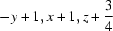
| Symmetry code: (i) y, −x+1, z+1/4. |
Experimental details
| Crystal data | |
| Chemical formula | C11H14N2O·H2O |
| Mr | 208.26 |
| Crystal system, space group | Tetragonal, P43 |
| Temperature (K) | 296 |
| a, c (Å) | 10.8251 (8), 9.4569 (14) |
| V (Å3) | 1108.2 (2) |
| Z | 4 |
| Radiation type | Mo Kα |
| µ (mm−1) | 0.09 |
| Crystal size (mm) | 0.20 × 0.20 × 0.15 |
| Data collection | |
| Diffractometer | Bruker SMART CCD diffractometer |
| Absorption correction | – |
| No. of measured, independent and observed [I > 2σ(I)] reflections | 5758, 1043, 972 |
| Rint | 0.016 |
| (sin θ/λ)max (Å−1) | 0.595 |
| Refinement | |
| R[F2 > 2σ(F2)], wR(F2), S | 0.035, 0.098, 1.07 |
| No. of reflections | 1043 |
| No. of parameters | 140 |
| No. of restraints | 1 |
| H-atom treatment | H atoms treated by a mixture of independent and constrained refinement |
| Δρmax, Δρmin (e Å−3) | 0.21, −0.20 |
| Absolute structure | Flack (1983) |
| Absolute structure parameter | −10 (10) |
Computer programs: SMART (Bruker, 2000), SAINT (Bruker, 2000), SHELXS97 (Sheldrick, 2008), SHELXL97 (Sheldrick, 2008), SHELXTL (Sheldrick, 2008).
| D—H···A | D—H | H···A | D···A | D—H···A |
| N1—H1···O1Wi | 0.88 (5) | 2.33 (4) | 3.163 (3) | 158 (4) |
| Symmetry code: (i) y, −x+1, z+1/4. |
Acknowledgements
Acknowledgement is made to the staff of Topharman Shanghai Co. Ltd for their active cooperation in this work. We also thank the Instrument Analysis and Research Center of Shanghai University for structural confirmation.
References
 Allen, F. H., Kennard, O., Watson, D. G., Brammer, L., Orpen, A. G. & Taylor, R. (1987). J. Chem. Soc. Perkin Trans. 2, pp. S1–19. CrossRef Web of Science Google Scholar
Bruker (2000). APEX2 and SAINT. Bruker AXS Inc., Madison, Wisconsin, USA. Google Scholar
Ding, C. Z., Batorsky, R., Bhide, R., Chao, H. J., Cho, Y., Chong, S., Gullo-Brown, J., Guo, P., Kim, S. H., Lee, F., Leftheris, K., Miller, A., Mitt, T., Patel, M., Penhallow, B. A. et al. (1999). J. Med. Chem. 42, 5241–5253. Web of Science CrossRef PubMed CAS Google Scholar
Grunewald, G. L., Dahanukar, V. H., Ching, P. & Criscione, K. R. (1996). J. Med. Chem. 39, 3539–3946. CrossRef CAS PubMed Web of Science Google Scholar
Kim, D. H. (1976). J. Heterocycl. Chem. 13, 1187–1191. CrossRef CAS Google Scholar
Sheldrick, G. M. (2008). Acta Cryst. A64, 112–122. Web of Science CrossRef CAS IUCr Journals Google Scholar
This is an open-access article distributed under the terms of the Creative Commons Attribution (CC-BY) Licence, which permits unrestricted use, distribution, and reproduction in any medium, provided the original authors and source are cited.
| CRYSTALLOGRAPHIC COMMUNICATIONS |


The title molecule (Fig. 1) is an important imtermediate used to synthesize a variety of pharmaceuticals, such as inhibitors of phenylethanolamine N-methyltransferase (Grunewald et al., 1996) and inhibitors of Farnesyltransferase (Ding et al., 1999). In our recent research for exploring new methods for synthesis of benzodiazepine derivatives, 4-acetyl-2,3,4,5-tetrahydro-1H-1,4-benzodiazepine is synthesized in 96% yield from 2,3,4,5-tetrahydro-1H-1,4-benzodiazepine (Ding et al., 1999). We report here the crystal structure of the title compound, which crystallizes in the tetragonal space group P4(3) with one H2O molecule in the asymmetric unit.
A view of the molecular structure of title compound is depicted in Fig.1. The central seven-membered ring has an chair conformation, which is consistent with reported exo conformational form with the C=O group turns away from benzene ring (Kim et al., 1976). All bond lengths and angles are normal (Allen et al., 1987). Molecules related by an c-axis translation are stacked over each other and stabilized by van de waals (Fig. 2). The stacked columns are linked together via an intermolecular hydrogen bond, in which the amine H1 act as a donor to H2O O1w atom and H2O H1A as a donor to H2O O1w atom (Fig. 2 and Table 1).