 | Acta Crystallographica Section E Acta Crystallographica Section E CRYSTALLOGRAPHIC COMMUNICATIONS |


 journal menu


organic compounds
| CRYSTALLOGRAPHIC COMMUNICATIONS |
 access
3,5-Dihydroxy-2-methyl-4H-pyran-4-one

aDepartment of Pharmaceutical Science, Henan College of Traditional Chinese Medicine, Zhengzhou 450008, People's Republic of China, and bSchool of Pharmaceutical Science & Technology, Tianjin University, Tianjin 300072, People's Republic of China
*Correspondence e-mail: [email protected]
In the title compound, C6H6O4, inter- and intramolecular hydrogen bonds are observed which help to establish the crystal structure. There are weak π–π interactions between pyran rings separated by 3.5692 (9) Å.
Related literature
For general background, see: Shinoda et al. (2004![[Shinoda, Y., Murata, M., Homma, S. & Komura, H. (2004). Biosci. Biotechnol. Biochem. 68, 529-536.]](../../../../../../logos/arrows/e_arr.gif "Shinoda, Y., Murata, M., Homma, S. & Komura, H. (2004). Biosci. Biotechnol. Biochem. 68, 529-536.") ). For related structures, see: Yao et al. (2005); Gibbons et al. (2000).
). For related structures, see: Yao et al. (2005); Gibbons et al. (2000).
![[Scheme 1]](pv2074scheme1.gif)
Experimental
Crystal data
|
Refinement
|
|
 ; (ii)
  ; (iii)
 Data collection: CrystalClear (Rigaku/MSC, 2005); cell refinement: CrystalClear; data reduction: CrystalClear; program(s) used to solve structure: SHELXS97 (Sheldrick, 2008); program(s) used to refine structure: SHELXL97 (Sheldrick, 2008); molecular graphics: SHELXTL (Sheldrick, 2008); software used to prepare material for publication: SHELXTL.
Supporting information
contains datablocks I, global. DOI: 10.1107/S1600536808010957/pv2074sup1.cif
Structure factors: contains datablock I. DOI: 10.1107/S1600536808010957/pv2074Isup2.hkl
Dried powder of Hydrocotyle sibthorpoioides Lam was exacted with EtOH and the extract was concentrated in vacuo. The residue was subjected to silical-gel coloumn Elution with chloroform-methanol (95:5 v/v) yielded the title compound. Crystals suitable for XRD study were grwon from a solution of methanol at room temperature by slow evaporation.
Data collection: CrystalClear (Rigaku/MSC, 2005); cell CrystalClear (Rigaku/MSC, 2005); data reduction: CrystalClear (Rigaku/MSC, 2005); program(s) used to solve structure: SHELXS97 (Sheldrick, 2008); program(s) used to refine structure: SHELXL97 (Sheldrick, 2008); molecular graphics: SHELXTL (Sheldrick, 2008); software used to prepare material for publication: SHELXTL (Sheldrick, 2008).
![[Figure 1]](./pv2074fig1thm.gif) | Fig. 1. A view of the molecule of (I). Displacement ellipsoids are drawn at the 30% probability level and H atoms are shown as small spheres of arbitrary radii. |
| C6H6O4 | F(000) = 296 |
| Mr = 142.11 | Dx = 1.603 Mg m−3 |
| Monoclinic, P21/n | Mo Kα radiation, λ = 0.71073 Å |
| Hall symbol: -P 2yn | Cell parameters from 1620 reflections |
| a = 6.9400 (14) Å | θ = 1.5–27.9° |
| b = 6.0648 (12) Å | µ = 0.14 mm−1 |
| c = 14.008 (3) Å | T = 113 K |
| β = 92.77 (3)° | Block, colorless |
| V = 588.9 (2) Å3 | 0.14 × 0.12 × 0.10 mm |
| Z = 4 |
| Rigaku Saturn diffractometer | 1381 independent reflections |
| Radiation source: rotating anode | 1166 reflections with I > 2σ(I) |
| Confocal monochromator | Rint = 0.025 |
| ω scans | θmax = 27.9°, θmin = 2.9° |
| Absorption correction: multi-scan (CrystalClear; Rigaku/MSC, 2005) | h = −9→9 |
| Tmin = 0.981, Tmax = 0.986 | k = −7→7 |
| 3970 measured reflections | l = −10→18 |
| Refinement on F2 | Primary atom site location: structure-invariant direct methods |
| Least-squares matrix: full | Secondary atom site location: difference Fourier map |
| R[F2 > 2σ(F2)] = 0.032 | Hydrogen site location: inferred from neighbouring sites |
| wR(F2) = 0.096 | All H-atom parameters refined |
| S = 1.11 | w = 1/[σ2(Fo2) + (0.0654P)2] where P = (Fo2 + 2Fc2)/3 |
| 1381 reflections | (Δ/σ)max < 0.001 |
| 115 parameters | Δρmax = 0.37 e Å−3 |
| 0 restraints | Δρmin = −0.24 e Å−3 |
| C6H6O4 | V = 588.9 (2) Å3 |
| Mr = 142.11 | Z = 4 |
| Monoclinic, P21/n | Mo Kα radiation |
| a = 6.9400 (14) Å | µ = 0.14 mm−1 |
| b = 6.0648 (12) Å | T = 113 K |
| c = 14.008 (3) Å | 0.14 × 0.12 × 0.10 mm |
| β = 92.77 (3)° |
| Rigaku Saturn diffractometer | 1381 independent reflections |
| Absorption correction: multi-scan (CrystalClear; Rigaku/MSC, 2005) | 1166 reflections with I > 2σ(I) |
| Tmin = 0.981, Tmax = 0.986 | Rint = 0.025 |
| 3970 measured reflections |
| R[F2 > 2σ(F2)] = 0.032 | 0 restraints |
| wR(F2) = 0.096 | All H-atom parameters refined |
| S = 1.11 | Δρmax = 0.37 e Å−3 |
| 1381 reflections | Δρmin = −0.24 e Å−3 |
| 115 parameters |
Geometry. All e.s.d.'s (except the e.s.d. in the dihedral angle between two l.s. planes) are estimated using the full covariance matrix. The cell e.s.d.'s are taken into account individually in the estimation of e.s.d.'s in distances, angles and torsion angles; correlations between e.s.d.'s in cell parameters are only used when they are defined by crystal symmetry. An approximate (isotropic) treatment of cell e.s.d.'s is used for estimating e.s.d.'s involving l.s. planes. |
Refinement. Refinement of F2 against ALL reflections. The weighted R-factor wR and goodness of fit S are based on F2, conventional R-factors R are based on F, with F set to zero for negative F2. The threshold expression of F2 > σ(F2) is used only for calculating R-factors(gt) etc. and is not relevant to the choice of reflections for refinement. R-factors based on F2 are statistically about twice as large as those based on F, and R- factors based on ALL data will be even larger. |
| x | y | z | Uiso*/Ueq | ||
| O3 | 0.27997 (10) | 1.01120 (11) | 0.27250 (5) | 0.0149 (2) | |
| O1 | 0.76427 (10) | 1.05517 (12) | 0.44524 (5) | 0.0157 (2) | |
| O4 | 0.56909 (12) | 0.69576 (12) | 0.26153 (5) | 0.0171 (2) | |
| O2 | 0.32648 (11) | 1.36372 (12) | 0.40092 (5) | 0.0173 (2) | |
| C4 | 0.43152 (15) | 1.02588 (15) | 0.32615 (7) | 0.0124 (2) | |
| C5 | 0.46324 (15) | 1.20540 (16) | 0.39217 (7) | 0.0132 (2) | |
| C3 | 0.58183 (15) | 0.86536 (16) | 0.32479 (7) | 0.0127 (2) | |
| C2 | 0.74196 (15) | 0.88197 (16) | 0.38483 (7) | 0.0139 (2) | |
| C6 | 0.62774 (16) | 1.21333 (17) | 0.44749 (7) | 0.0157 (2) | |
| C1 | 0.90601 (15) | 0.72547 (19) | 0.39113 (8) | 0.0174 (3) | |
| H4 | 0.656 (2) | 1.323 (2) | 0.4929 (10) | 0.021 (3)* | |
| H3 | 0.871 (2) | 0.582 (2) | 0.3585 (10) | 0.028 (3)* | |
| H1 | 1.017 (2) | 0.782 (2) | 0.3616 (11) | 0.037 (4)* | |
| H2 | 0.940 (2) | 0.689 (2) | 0.4591 (10) | 0.025 (3)* | |
| H5 | 0.271 (3) | 1.393 (3) | 0.3397 (14) | 0.054 (5)* | |
| H6 | 0.454 (3) | 0.669 (2) | 0.2453 (11) | 0.037 (4)* |
| U11 | U22 | U33 | U12 | U13 | U23 | |
| O3 | 0.0141 (4) | 0.0150 (4) | 0.0153 (4) | 0.0004 (3) | −0.0022 (3) | −0.0013 (3) |
| O1 | 0.0155 (4) | 0.0165 (4) | 0.0148 (4) | −0.0005 (3) | −0.0020 (3) | −0.0020 (3) |
| O4 | 0.0136 (4) | 0.0163 (4) | 0.0211 (4) | 0.0004 (3) | −0.0008 (3) | −0.0080 (3) |
| O2 | 0.0233 (4) | 0.0142 (4) | 0.0142 (4) | 0.0058 (3) | −0.0018 (3) | −0.0018 (3) |
| C4 | 0.0142 (5) | 0.0125 (5) | 0.0105 (4) | −0.0022 (4) | 0.0016 (4) | 0.0017 (3) |
| C5 | 0.0177 (5) | 0.0106 (5) | 0.0116 (4) | 0.0007 (4) | 0.0021 (4) | 0.0008 (3) |
| C3 | 0.0138 (5) | 0.0118 (5) | 0.0128 (5) | −0.0019 (4) | 0.0023 (4) | −0.0011 (3) |
| C2 | 0.0145 (5) | 0.0141 (5) | 0.0132 (4) | −0.0017 (4) | 0.0024 (4) | −0.0003 (3) |
| C6 | 0.0200 (6) | 0.0133 (5) | 0.0139 (5) | −0.0012 (4) | 0.0006 (4) | −0.0020 (4) |
| C1 | 0.0126 (5) | 0.0200 (6) | 0.0195 (5) | 0.0013 (4) | 0.0001 (4) | −0.0010 (4) |
| O3—C4 | 1.2659 (13) | C4—C5 | 1.4386 (13) |
| O1—C6 | 1.3497 (13) | C5—C6 | 1.3494 (16) |
| O1—C2 | 1.3531 (12) | C3—C2 | 1.3646 (15) |
| O4—C3 | 1.3577 (12) | C2—C1 | 1.4816 (15) |
| O4—H6 | 0.838 (18) | C6—H4 | 0.936 (14) |
| O2—C5 | 1.3598 (12) | C1—H3 | 1.005 (15) |
| O2—H5 | 0.94 (2) | C1—H1 | 0.956 (17) |
| C4—C3 | 1.4276 (14) | C1—H2 | 0.996 (15) |
| C6—O1—C2 | 120.47 (8) | O1—C2—C3 | 120.53 (9) |
| C3—O4—H6 | 110.7 (11) | O1—C2—C1 | 113.31 (9) |
| C5—O2—H5 | 107.9 (12) | C3—C2—C1 | 126.15 (9) |
| O3—C4—C3 | 122.06 (9) | C5—C6—O1 | 122.45 (9) |
| O3—C4—C5 | 122.13 (9) | C5—C6—H4 | 124.0 (8) |
| C3—C4—C5 | 115.82 (9) | O1—C6—H4 | 113.5 (8) |
| C6—C5—O2 | 119.86 (9) | C2—C1—H3 | 111.1 (8) |
| C6—C5—C4 | 119.68 (10) | C2—C1—H1 | 112.2 (9) |
| O2—C5—C4 | 120.44 (9) | H3—C1—H1 | 107.1 (13) |
| O4—C3—C2 | 118.92 (9) | C2—C1—H2 | 110.3 (8) |
| O4—C3—C4 | 120.04 (9) | H3—C1—H2 | 106.4 (12) |
| C2—C3—C4 | 121.01 (9) | H1—C1—H2 | 109.5 (13) |
| O3—C4—C5—C6 | −179.79 (9) | C6—O1—C2—C1 | 179.47 (9) |
| C3—C4—C5—C6 | 0.12 (14) | O4—C3—C2—O1 | 176.47 (9) |
| O3—C4—C5—O2 | 1.94 (15) | C4—C3—C2—O1 | −1.93 (15) |
| C3—C4—C5—O2 | −178.15 (8) | O4—C3—C2—C1 | −2.39 (16) |
| O3—C4—C3—O4 | 3.12 (15) | C4—C3—C2—C1 | 179.21 (9) |
| C5—C4—C3—O4 | −176.78 (8) | O2—C5—C6—O1 | 176.71 (9) |
| O3—C4—C3—C2 | −178.50 (9) | C4—C5—C6—O1 | −1.58 (15) |
| C5—C4—C3—C2 | 1.59 (14) | C2—O1—C6—C5 | 1.32 (15) |
| C6—O1—C2—C3 | 0.47 (15) |
| D—H···A | D—H | H···A | D···A | D—H···A |
| O4—H6···O3i | 0.838 (18) | 1.89 (2) | 2.6902 (12) | 159.6 (13) |
| O2—H5···O3ii | 0.94 (2) | 1.75 (2) | 2.6596 (12) | 162.6 (17) |
| O4—H6···O3 | 0.838 (18) | 2.44 (2) | 2.7820 (12) | 105.4 (10) |
| C1—H3···O4 | 1.005 (15) | 2.537 (14) | 2.8957 (15) | 100.5 (9) |
| C6—H4···O2iii | 0.936 (14) | 2.412 (13) | 3.3354 (14) | 169.4 (12) |
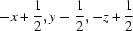
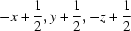
| Symmetry codes: (i) −x+1/2, y−1/2, −z+1/2; (ii) −x+1/2, y+1/2, −z+1/2; (iii) −x+1, −y+3, −z+1. |
Experimental details
| Crystal data | |
| Chemical formula | C6H6O4 |
| Mr | 142.11 |
| Crystal system, space group | Monoclinic, P21/n |
| Temperature (K) | 113 |
| a, b, c (Å) | 6.9400 (14), 6.0648 (12), 14.008 (3) |
| β (°) | 92.77 (3) |
| V (Å3) | 588.9 (2) |
| Z | 4 |
| Radiation type | Mo Kα |
| µ (mm−1) | 0.14 |
| Crystal size (mm) | 0.14 × 0.12 × 0.10 |
| Data collection | |
| Diffractometer | Rigaku Saturn diffractometer |
| Absorption correction | Multi-scan (CrystalClear; Rigaku/MSC, 2005) |
| Tmin, Tmax | 0.981, 0.986 |
| No. of measured, independent and observed [I > 2σ(I)] reflections | 3970, 1381, 1166 |
| Rint | 0.025 |
| (sin θ/λ)max (Å−1) | 0.657 |
| Refinement | |
| R[F2 > 2σ(F2)], wR(F2), S | 0.032, 0.096, 1.11 |
| No. of reflections | 1381 |
| No. of parameters | 115 |
| H-atom treatment | All H-atom parameters refined |
| Δρmax, Δρmin (e Å−3) | 0.37, −0.24 |
Computer programs: CrystalClear (Rigaku/MSC, 2005), SHELXS97 (Sheldrick, 2008), SHELXL97 (Sheldrick, 2008), SHELXTL (Sheldrick, 2008).
| D—H···A | D—H | H···A | D···A | D—H···A |
| O4—H6···O3i | 0.838 (18) | 1.89 (2) | 2.6902 (12) | 159.6 (13) |
| O2—H5···O3ii | 0.94 (2) | 1.75 (2) | 2.6596 (12) | 162.6 (17) |
| O4—H6···O3 | 0.838 (18) | 2.44 (2) | 2.7820 (12) | 105.4 (10) |
| C1—H3···O4 | 1.005 (15) | 2.537 (14) | 2.8957 (15) | 100.5 (9) |
| C6—H4···O2iii | 0.936 (14) | 2.412 (13) | 3.3354 (14) | 169.4 (12) |
| Symmetry codes: (i) −x+1/2, y−1/2, −z+1/2; (ii) −x+1/2, y+1/2, −z+1/2; (iii) −x+1, −y+3, −z+1. |
References
 Gibbons, S., Denny, B. J., Ali-Amine, S., Mathew, K. T., Skelton, B. W., White, A. H. & Gray, A. I. (2000). J. Nat. Prod. 63, 839–840. Web of Science CSD CrossRef PubMed CAS Google Scholar
Rigaku/MSC. (2005). CrystalClear. Rigaku/MSC, The Woodlands, Texas, USA. Google Scholar
Sheldrick, G. M. (2008). Acta Cryst. A64, 112–122. Web of Science CrossRef CAS IUCr Journals Google Scholar
Shinoda, Y., Murata, M., Homma, S. & Komura, H. (2004). Biosci. Biotechnol. Biochem. 68, 529–536. Web of Science CrossRef PubMed CAS Google Scholar
Yao, G.-M., Wang, Y.-B., Wang, L.-Q. & Qin, G.-W. (2005). Acta Cryst. E61, o1403–o1405. Web of Science CSD CrossRef IUCr Journals Google Scholar
This is an open-access article distributed under the terms of the Creative Commons Attribution (CC-BY) Licence, which permits unrestricted use, distribution, and reproduction in any medium, provided the original authors and source are cited.
| CRYSTALLOGRAPHIC COMMUNICATIONS |


The title compound, 3,5-dihydroxy-2-methyl-pyran-4-one, (I) was identified as a decomposition product in the stored solution of orange juice (Shinoda, et al., 2004). We report here the crystal structure of the title compound (Fig. 1) which was isolated from Hydrocotyle sibthorpoioides Lam. The structure of (I) is stabilized by two strong intermolecular hydrogen bonds of the type O—H···O and a weak intermolecular interaction of the type C—H···O. Intramolecular interactions are also observed which result in five membered rings; details are given in Table 1. There is indication of π-π interactions between the pyran rings lying about inversion centers with minimum separation of 3.5692 (9) Å. The crystal structures of 2-hydroxymethyl analogue (Yao et al., 2005) and 5-hydroxy-3-methoxy-pyran-4-one (Gibbons et al., 2000) have been reported.