 | Acta Crystallographica Section E Acta Crystallographica Section E CRYSTALLOGRAPHIC COMMUNICATIONS |


 journal menu


metal-organic compounds
| CRYSTALLOGRAPHIC COMMUNICATIONS |
 access
catena-Poly[[aquaglycolatocopper(II)]-μ-chlorido]

aX-ray Crystallography Unit, School of Physics, Universiti Sains Malaysia, 11800 USM, Penang, Malaysia, and bDepartment of Physics, National Institute of Technology, Tiruchirappalli 620 015, India
*Correspondence e-mail: [email protected]
In the of the title compound, [Cu(C2H3O3)Cl(H2O)]n, the CuII ion is five-coordinate in a distorted square-pyramidal geometry. Two O atoms from a chelating glycolate anion, an O atom from a coordinated water molecule and a chloride anion comprise the basal plane. A chloride ion from a neighbouring unit occupies the apical position and these Cu—Cl—Cu bridges link the aquaglycolatocopper(II) units into one-dimensional chains along the [001] direction. These chains are connected by O—H⋯O and O—H⋯Cl hydrogen bonds, forming an infinite three-dimensional polymeric network.
Related literature
For background to the coordination chemistry of glycolic acid, see: Gao et al. (2004![[Gao, S., Huo, L.-H., Zhang, Z.-Y., Zhao, H. & Zhao, J.-G. (2004). Acta Cryst. E60, m1278-m1280.]](../../../../../../logos/arrows/e_arr.gif "Gao, S., Huo, L.-H., Zhang, Z.-Y., Zhao, H. & Zhao, J.-G. (2004). Acta Cryst. E60, m1278-m1280.") ). For related structures, see: Dengel et al. (1987); Lanfranchi et al. (1993); Medina et al. (2000); Prout et al. (1993).
). For related structures, see: Dengel et al. (1987); Lanfranchi et al. (1993); Medina et al. (2000); Prout et al. (1993).
![[Scheme 1]](sj2487scheme1.gif)
Experimental
Crystal data
|
Refinement
|
|
 .
. Data collection: APEX2 (Bruker, 2005); cell refinement: APEX2; data reduction: SAINT (Bruker, 2005); program(s) used to solve structure: SHELXTL (Sheldrick, 2008); program(s) used to refine structure: SHELXTL; molecular graphics: SHELXTL; software used to prepare material for publication: SHELXTL and PLATON (Spek, 2003).
Supporting information
contains datablocks global, I. DOI: 10.1107/S1600536808012166/sj2487sup1.cif
Structure factors: contains datablock I. DOI: 10.1107/S1600536808012166/sj2487Isup2.hkl
Equimolar amounts of glycolic acid and CuCl2 were dissolved in ethanol. The solution was refluxed at a temperature of 333°K for a period of 48 h. The clear blue colour solution was allowed to evaporate slowly yielding blue crystals of (I) after one month.
All the hydrogen atoms were located from the Fourier map and were allowed to refine freely.
Data collection: APEX2 (Bruker, 2005); cell APEX2 (Bruker, 2005); data reduction: SAINT (Bruker, 2005); program(s) used to solve structure: SHELXTL (Sheldrick, 2008); program(s) used to refine structure: SHELXTL (Sheldrick, 2008); molecular graphics: SHELXTL (Sheldrick, 2008); software used to prepare material for publication: SHELXTL (Sheldrick, 2008) and PLATON (Spek, 2003).
![[Figure 1]](./sj2487fig1thm.gif) | Fig. 1. The molecular structure of the title compound, showing 50% probability displacement ellipsoids and the atomic numbering scheme. Symmetry code for atoms labelled A: x, -y + 1/2, z + 1/2. |
![[Figure 2]](./sj2487fig2thm.gif) | Fig. 2. The crystal packing of the title compound, viewed along the a axis, showing a polymeric chain along the c axis. |
| [Cu(C2H3O3)Cl(H2O)] | F(000) = 380 |
| Mr = 192.05 | Dx = 2.358 Mg m−3 |
| Monoclinic, P21/c | Mo Kα radiation, λ = 0.71073 Å |
| Hall symbol: -P 2ybc | Cell parameters from 6364 reflections |
| a = 7.6296 (2) Å | θ = 2.8–41.4° |
| b = 10.0896 (3) Å | µ = 4.45 mm−1 |
| c = 7.4603 (2) Å | T = 100 K |
| β = 109.632 (1)° | Block, blue |
| V = 540.91 (3) Å3 | 0.56 × 0.19 × 0.17 mm |
| Z = 4 |
| Bruker SMART APEXII CCD area-detector diffractometer | 2372 independent reflections |
| Radiation source: fine-focus sealed tube | 2147 reflections with I > 2σ(I) |
| Graphite monochromator | Rint = 0.025 |
| ϕ and ω scans | θmax = 35.0°, θmin = 2.8° |
| Absorption correction: multi-scan (SADABS; Bruker, 2005) | h = −12→12 |
| Tmin = 0.189, Tmax = 0.512 | k = −15→16 |
| 10874 measured reflections | l = −12→12 |
| Refinement on F2 | Primary atom site location: structure-invariant direct methods |
| Least-squares matrix: full | Secondary atom site location: difference Fourier map |
| R[F2 > 2σ(F2)] = 0.022 | Hydrogen site location: inferred from neighbouring sites |
| wR(F2) = 0.058 | All H-atom parameters refined |
| S = 1.05 | w = 1/[σ2(Fo2) + (0.035P)2 + 0.0909P] where P = (Fo2 + 2Fc2)/3 |
| 2372 reflections | (Δ/σ)max < 0.001 |
| 93 parameters | Δρmax = 0.80 e Å−3 |
| 0 restraints | Δρmin = −0.66 e Å−3 |
| [Cu(C2H3O3)Cl(H2O)] | V = 540.91 (3) Å3 |
| Mr = 192.05 | Z = 4 |
| Monoclinic, P21/c | Mo Kα radiation |
| a = 7.6296 (2) Å | µ = 4.45 mm−1 |
| b = 10.0896 (3) Å | T = 100 K |
| c = 7.4603 (2) Å | 0.56 × 0.19 × 0.17 mm |
| β = 109.632 (1)° |
| Bruker SMART APEXII CCD area-detector diffractometer | 2372 independent reflections |
| Absorption correction: multi-scan (SADABS; Bruker, 2005) | 2147 reflections with I > 2σ(I) |
| Tmin = 0.189, Tmax = 0.512 | Rint = 0.025 |
| 10874 measured reflections |
| R[F2 > 2σ(F2)] = 0.022 | 0 restraints |
| wR(F2) = 0.058 | All H-atom parameters refined |
| S = 1.05 | Δρmax = 0.80 e Å−3 |
| 2372 reflections | Δρmin = −0.66 e Å−3 |
| 93 parameters |
Experimental. The data was collected with the Oxford Cyrosystem Cobra low-temperature attachment. |
Geometry. All e.s.d.'s (except the e.s.d. in the dihedral angle between two l.s. planes) are estimated using the full covariance matrix. The cell e.s.d.'s are taken into account individually in the estimation of e.s.d.'s in distances, angles and torsion angles; correlations between e.s.d.'s in cell parameters are only used when they are defined by crystal symmetry. An approximate (isotropic) treatment of cell e.s.d.'s is used for estimating e.s.d.'s involving l.s. planes. |
Refinement. Refinement of F2 against ALL reflections. The weighted R-factor wR and goodness of fit S are based on F2, conventional R-factors R are based on F, with F set to zero for negative F2. The threshold expression of F2 > σ(F2) is used only for calculating R-factors(gt) etc. and is not relevant to the choice of reflections for refinement. R-factors based on F2 are statistically about twice as large as those based on F, and R- factors based on ALL data will be even larger. |
| x | y | z | Uiso*/Ueq | ||
| Cu1 | 0.709943 (18) | 0.143386 (14) | 0.84591 (2) | 0.01140 (5) | |
| Cl1 | 0.55544 (4) | 0.22147 (3) | 0.48054 (4) | 0.01285 (6) | |
| O1 | 0.92698 (11) | 0.26130 (9) | 0.90217 (13) | 0.01339 (15) | |
| O2 | 0.87233 (11) | 0.01710 (9) | 0.78289 (13) | 0.01408 (15) | |
| O3 | 1.15672 (12) | −0.01023 (10) | 0.76906 (14) | 0.01787 (17) | |
| C1 | 1.08255 (15) | 0.20052 (12) | 0.86756 (17) | 0.01349 (19) | |
| C2 | 1.03389 (15) | 0.05935 (12) | 0.80059 (16) | 0.01302 (18) | |
| O1W | 0.52646 (12) | 0.00559 (10) | 0.80898 (13) | 0.01492 (16) | |
| H1A | 1.114 (3) | 0.2483 (19) | 0.773 (3) | 0.017 (4)* | |
| H1B | 1.183 (3) | 0.2001 (19) | 0.981 (3) | 0.014 (4)* | |
| H1W1 | 0.526 (3) | −0.050 (3) | 0.740 (3) | 0.033 (6)* | |
| H2W1 | 0.422 (3) | 0.026 (2) | 0.809 (3) | 0.034 (6)* | |
| H1O1 | 0.904 (3) | 0.331 (2) | 0.849 (3) | 0.025 (5)* |
| U11 | U22 | U33 | U12 | U13 | U23 | |
| Cu1 | 0.01055 (7) | 0.00927 (8) | 0.01456 (7) | −0.00050 (4) | 0.00446 (5) | −0.00081 (4) |
| Cl1 | 0.01344 (10) | 0.01174 (12) | 0.01357 (10) | −0.00079 (9) | 0.00481 (8) | 0.00024 (8) |
| O1 | 0.0120 (3) | 0.0100 (4) | 0.0183 (4) | 0.0004 (3) | 0.0053 (3) | 0.0003 (3) |
| O2 | 0.0115 (3) | 0.0117 (4) | 0.0188 (4) | −0.0006 (3) | 0.0049 (3) | −0.0012 (3) |
| O3 | 0.0139 (3) | 0.0142 (4) | 0.0264 (4) | 0.0003 (3) | 0.0078 (3) | −0.0043 (3) |
| C1 | 0.0127 (4) | 0.0117 (5) | 0.0170 (4) | 0.0001 (4) | 0.0063 (4) | −0.0010 (4) |
| C2 | 0.0119 (4) | 0.0122 (5) | 0.0143 (4) | 0.0003 (4) | 0.0034 (3) | 0.0009 (4) |
| O1W | 0.0141 (3) | 0.0129 (4) | 0.0193 (4) | −0.0030 (3) | 0.0076 (3) | −0.0037 (3) |
| Cu1—O1W | 1.9260 (9) | O2—C2 | 1.2686 (13) |
| Cu1—O2 | 1.9419 (8) | O3—C2 | 1.2548 (14) |
| Cu1—O1 | 1.9664 (9) | C1—C2 | 1.5138 (17) |
| Cu1—Cl1i | 2.2480 (3) | C1—H1A | 0.951 (19) |
| Cu1—Cl1 | 2.6983 (3) | C1—H1B | 0.928 (19) |
| Cl1—Cu1ii | 2.2479 (3) | O1W—H1W1 | 0.76 (3) |
| O1—C1 | 1.4344 (14) | O1W—H2W1 | 0.82 (2) |
| O1—H1O1 | 0.80 (2) | ||
| O1W—Cu1—O2 | 89.08 (4) | C2—O2—Cu1 | 115.53 (8) |
| O1W—Cu1—O1 | 170.67 (4) | O1—C1—C2 | 109.61 (9) |
| O2—Cu1—O1 | 83.61 (4) | O1—C1—H1A | 110.3 (11) |
| O1W—Cu1—Cl1i | 92.11 (3) | C2—C1—H1A | 109.0 (12) |
| O2—Cu1—Cl1i | 168.29 (3) | O1—C1—H1B | 108.4 (11) |
| O1—Cu1—Cl1i | 93.90 (3) | C2—C1—H1B | 109.3 (12) |
| O1W—Cu1—Cl1 | 90.94 (3) | H1A—C1—H1B | 110.2 (16) |
| O2—Cu1—Cl1 | 92.56 (3) | O3—C2—O2 | 123.59 (11) |
| O1—Cu1—Cl1 | 95.15 (3) | O3—C2—C1 | 118.20 (10) |
| Cl1i—Cu1—Cl1 | 99.065 (9) | O2—C2—C1 | 118.20 (10) |
| Cu1ii—Cl1—Cu1 | 120.780 (12) | Cu1—O1W—H1W1 | 118.1 (17) |
| C1—O1—Cu1 | 113.04 (7) | Cu1—O1W—H2W1 | 118.3 (16) |
| C1—O1—H1O1 | 109.9 (16) | H1W1—O1W—H2W1 | 114 (2) |
| Cu1—O1—H1O1 | 113.7 (16) | ||
| O1W—Cu1—Cl1—Cu1ii | −165.23 (3) | O1—Cu1—O2—C2 | −0.62 (8) |
| O2—Cu1—Cl1—Cu1ii | −76.11 (3) | Cl1i—Cu1—O2—C2 | −78.90 (16) |
| O1—Cu1—Cl1—Cu1ii | 7.70 (3) | Cl1—Cu1—O2—C2 | 94.27 (8) |
| Cl1i—Cu1—Cl1—Cu1ii | 102.489 (19) | Cu1—O1—C1—C2 | −1.27 (11) |
| O1W—Cu1—O1—C1 | 39.6 (3) | Cu1—O2—C2—O3 | 178.65 (9) |
| O2—Cu1—O1—C1 | 1.08 (8) | Cu1—O2—C2—C1 | 0.04 (13) |
| Cl1i—Cu1—O1—C1 | 169.58 (7) | O1—C1—C2—O3 | −177.86 (10) |
| Cl1—Cu1—O1—C1 | −90.94 (7) | O1—C1—C2—O2 | 0.83 (15) |
| O1W—Cu1—O2—C2 | −174.83 (8) |
| Symmetry codes: (i) x, −y+1/2, z+1/2; (ii) x, −y+1/2, z−1/2. |
| D—H···A | D—H | H···A | D···A | D—H···A |
| O1W—H1W1···Cl1iii | 0.76 (3) | 2.32 (3) | 3.0654 (10) | 166 (2) |
| O1W—H2W1···O3iv | 0.82 (2) | 1.98 (2) | 2.7400 (12) | 153 (2) |
| O1—H1O1···O3v | 0.80 (2) | 1.81 (2) | 2.6086 (13) | 177 (2) |
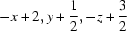
| Symmetry codes: (iii) −x+1, −y, −z+1; (iv) x−1, y, z; (v) −x+2, y+1/2, −z+3/2. |
Experimental details
| Crystal data | |
| Chemical formula | [Cu(C2H3O3)Cl(H2O)] |
| Mr | 192.05 |
| Crystal system, space group | Monoclinic, P21/c |
| Temperature (K) | 100 |
| a, b, c (Å) | 7.6296 (2), 10.0896 (3), 7.4603 (2) |
| β (°) | 109.632 (1) |
| V (Å3) | 540.91 (3) |
| Z | 4 |
| Radiation type | Mo Kα |
| µ (mm−1) | 4.45 |
| Crystal size (mm) | 0.56 × 0.19 × 0.17 |
| Data collection | |
| Diffractometer | Bruker SMART APEXII CCD area-detector diffractometer |
| Absorption correction | Multi-scan (SADABS; Bruker, 2005) |
| Tmin, Tmax | 0.189, 0.512 |
| No. of measured, independent and observed [I > 2σ(I)] reflections | 10874, 2372, 2147 |
| Rint | 0.025 |
| (sin θ/λ)max (Å−1) | 0.807 |
| Refinement | |
| R[F2 > 2σ(F2)], wR(F2), S | 0.022, 0.058, 1.05 |
| No. of reflections | 2372 |
| No. of parameters | 93 |
| H-atom treatment | All H-atom parameters refined |
| Δρmax, Δρmin (e Å−3) | 0.80, −0.66 |
Computer programs: APEX2 (Bruker, 2005), SAINT (Bruker, 2005), SHELXTL (Sheldrick, 2008) and PLATON (Spek, 2003).
| D—H···A | D—H | H···A | D···A | D—H···A |
| O1W—H1W1···Cl1i | 0.76 (3) | 2.32 (3) | 3.0654 (10) | 166 (2) |
| O1W—H2W1···O3ii | 0.82 (2) | 1.98 (2) | 2.7400 (12) | 153 (2) |
| O1—H1O1···O3iii | 0.80 (2) | 1.81 (2) | 2.6086 (13) | 177 (2) |
| Symmetry codes: (i) −x+1, −y, −z+1; (ii) x−1, y, z; (iii) −x+2, y+1/2, −z+3/2. |
Footnotes
‡Permanent address: Department of Physics, Karunya University, Karunya Nagar, Coimbatore 641 114, India.
Acknowledgements
HKF and SRJ thank the Malaysian Government and the Universiti Sains Malaysia for the Science Fund grant No. 305/PFIZIK/613312. SRJ thanks the Universiti Sains Malaysia for a post–doctoral research fellowship.
References
 Bruker (2005). APEX2, SAINT and SADABS. Bruker AXS Inc., Madison, Wisconsin, USA. Google Scholar
Dengel, A. C., Griffth, W. P., Powell, R. D. & Skapski, A. C. (1987). J. Chem. Soc. Dalton Trans. pp. 991–995. CSD CrossRef Web of Science Google Scholar
Gao, S., Huo, L.-H., Zhang, Z.-Y., Zhao, H. & Zhao, J.-G. (2004). Acta Cryst. E60, m1278–m1280. Web of Science CSD CrossRef IUCr Journals Google Scholar
Lanfranchi, M., Prati, L., Rossi, M. & Tiripicchio, A. (1993). J. Chem. Soc. Chem. Commun. pp. 1698–1699. CrossRef Web of Science Google Scholar
Medina, G., Gasque, L. & Bernès, S. (2000). Acta Cryst. C56, 766–768. Web of Science CSD CrossRef CAS IUCr Journals Google Scholar
Prout, K., Mtetwa, V. S. B. & Rossotti, F. J. C. (1993). Acta Cryst. B49, 73–79. CSD CrossRef CAS Web of Science IUCr Journals Google Scholar
Sheldrick, G. M. (2008). Acta Cryst. A64, 112–122. Web of Science CrossRef CAS IUCr Journals Google Scholar
Spek, A. L. (2003). J. Appl. Cryst. 36, 7–13. Web of Science CrossRef CAS IUCr Journals Google Scholar
This is an open-access article distributed under the terms of the Creative Commons Attribution (CC-BY) Licence, which permits unrestricted use, distribution, and reproduction in any medium, provided the original authors and source are cited.
| CRYSTALLOGRAPHIC COMMUNICATIONS |


Glycolic acid (2-hydroxyethanoic acid) is a biologically active compound and has versatile binding modes for metals. (Gao et al., 2004). A number of structures of metal complexes containing the glycolate ligand have been reported (Medina et al., 2000; Prout et al.1993) with the chelating glycolate ligand coordinating to metal ions through the hydroxy and carboxy groups. In some coordination modes, the hydroxy groups of the glycolate are deprotonated (Dengel et al.,1987; Lanfranchi et al., 1993). In this paper we report the structure of a novel three dimensional polymeric chloro-bridged copper complex with glycolate and water as auxiliary ligands.
In the asymmetric unit of the title compound, the CuII ion is five–coordinated with a distorted square–pyramidal geometry. The basal plane is formed by atoms O1 and O2 from the glycolate ligand in a chelating mode, a water oxygen and a chloride anion. Cl- anions from neighbouring molecules link the [C2H5ClCuO4] units into polymeric chains along the [0 0 1] direction. The five membered ring [Cu1—O2—C2—C1—O1] is essentially planar with the maximum deviation from planarity being 0.008 (2)Å for the atom O1. The atom Cu1 is displaced by -0.1603 (1)Å out of the basal plane of the square pyramid towards atom Cl1.
The molecules are linked into one dimensional polymeric chains along the [0 0 1] direction through bridging chloride ions. Adjacent chains are interconnected by O—H···O, and O—H···Cl hydrogen bonds to form an infinite three dimensional polymeric network.