 | Acta Crystallographica Section E Acta Crystallographica Section E CRYSTALLOGRAPHIC COMMUNICATIONS |


 journal menu


organic compounds
| CRYSTALLOGRAPHIC COMMUNICATIONS |
 access
N-Hydroxy-N-methylammonium chloride

aDepartment of Chemistry, University of Malaya, 50603 Kuala Lumpur, Malaysia
*Correspondence e-mail: [email protected]
In the of the title compound, CH6NO+·Cl−, the cations and anions are linked by N–H⋯Cl and O–H⋯Cl hydrogen bonds into an undulating layer motif [Schläfli symbol: 4(8).6(8).8(2)]. All non-H atoms lie on a mirror plane.
Related literature
Only the cell dimensions of N-methyhydroxylammonium chloride have hitherto been reported; see: Toft & Jerslev (1967![[Toft, L. & Jerslev, B. R. (1967). Acta Chem. Scand. 21, 1383-1384.]](../../../../../../logos/arrows/e_arr.gif "Toft, L. & Jerslev, B. R. (1967). Acta Chem. Scand. 21, 1383-1384.") ).
).
![[Scheme 1]](tk2270scheme1.gif)
Experimental
Crystal data
|
Refinement
|
| ||||||||||||||||||||||
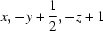 .
. Data collection: APEX2 (Bruker, 2007); cell refinement: SAINT (Bruker, 2007); data reduction: SAINT; program(s) used to solve structure: SHELXS97 (Sheldrick, 2008); program(s) used to refine structure: SHELXL97 (Sheldrick, 2008); molecular graphics: X-SEED (Barbour, 2001); OLEX (Dolomanov et al., 2003); software used to prepare material for publication: publCIF (Westrip, 2008).
Supporting information
contains datablocks global, I. DOI: 10.1107/S160053680801355X/tk2270sup1.cif
Structure factors: contains datablock I. DOI: 10.1107/S160053680801355X/tk2270Isup2.hkl
All hydrogen atoms were located in a difference Fouier map, and were refined with distance restraints (C–H 0.99±0.01, N–H 0.88±0.01 and O–H 0.84±0.01 Å). For the methyl group, an additional H···H = 1.59±0.01 Å was imposed. The temperature factors were freely refined.
Data collection: APEX2 (Bruker, 2007); cell SAINT (Bruker, 2007); data reduction: SAINT (Bruker, 2007); program(s) used to solve structure: SHELXS97 (Sheldrick, 2008); program(s) used to refine structure: SHELXL97 (Sheldrick, 2008); molecular graphics: X-SEED (Barbour, 2001); OLEX (Dolomanov et al., 2003); software used to prepare material for publication: publCIF (Westrip, 2008).
![[Figure 1]](./tk2270fig1thm.gif) | Fig. 1. Thermal ellipsoid plot (Barbour, 2001) of N-methylhydroxylammonium chloride at the 70% probability level. |
![[Figure 2]](./tk2270fig2thm.gif) | Fig. 2. OLEX (Dolomanov et al., 2003) representation of the hydrogen-bonded layer structure. |
| CH6NO+·Cl− | F(000) = 176 |
| Mr = 83.52 | Dx = 1.354 Mg m−3 |
| Orthorhombic, Pbcm | Mo Kα radiation, λ = 0.71073 Å |
| Hall symbol: -P 2c 2b | Cell parameters from 1402 reflections |
| a = 7.8084 (3) Å | θ = 2.6–28.2° |
| b = 8.7109 (3) Å | µ = 0.73 mm−1 |
| c = 6.0232 (1) Å | T = 100 K |
| V = 409.69 (2) Å3 | Prism, colorless |
| Z = 4 | 0.25 × 0.20 × 0.15 mm |
| Bruker SMART APEX diffractometer | 558 independent reflections |
| Radiation source: fine-focus sealed tube | 493 reflections with I > 2σ(I) |
| Graphite monochromator | Rint = 0.029 |
| ω scans | θmax = 28.4°, θmin = 2.6° |
| Absorption correction: multi-scan (SADABS; Sheldrick, 1996) | h = −10→8 |
| Tmin = 0.839, Tmax = 0.899 | k = −11→11 |
| 3330 measured reflections | l = −8→8 |
| Refinement on F2 | Secondary atom site location: difference Fourier map |
| Least-squares matrix: full | Hydrogen site location: inferred from neighbouring sites |
| R[F2 > 2σ(F2)] = 0.024 | All H-atom parameters refined |
| wR(F2) = 0.070 | w = 1/[σ2(Fo2) + (0.0402P)2 + 0.0529P] where P = (Fo2 + 2Fc2)/3 |
| S = 1.07 | (Δ/σ)max = 0.001 |
| 558 reflections | Δρmax = 0.28 e Å−3 |
| 40 parameters | Δρmin = −0.26 e Å−3 |
| 6 restraints | Extinction correction: SHELXL, Fc*=kFc[1+0.001xFc2λ3/sin(2θ)]-1/4 |
| Primary atom site location: structure-invariant direct methods | Extinction coefficient: 0.15 (1) |
| CH6NO+·Cl− | V = 409.69 (2) Å3 |
| Mr = 83.52 | Z = 4 |
| Orthorhombic, Pbcm | Mo Kα radiation |
| a = 7.8084 (3) Å | µ = 0.73 mm−1 |
| b = 8.7109 (3) Å | T = 100 K |
| c = 6.0232 (1) Å | 0.25 × 0.20 × 0.15 mm |
| Bruker SMART APEX diffractometer | 558 independent reflections |
| Absorption correction: multi-scan (SADABS; Sheldrick, 1996) | 493 reflections with I > 2σ(I) |
| Tmin = 0.839, Tmax = 0.899 | Rint = 0.029 |
| 3330 measured reflections |
| R[F2 > 2σ(F2)] = 0.024 | 6 restraints |
| wR(F2) = 0.070 | All H-atom parameters refined |
| S = 1.07 | Δρmax = 0.28 e Å−3 |
| 558 reflections | Δρmin = −0.26 e Å−3 |
| 40 parameters |
| x | y | z | Uiso*/Ueq | ||
| Cl | 0.35777 (6) | 0.42790 (6) | 0.2500 | 0.0433 (2) | |
| O | 0.1297 (2) | 0.1511 (2) | 0.2500 | 0.0389 (3) | |
| N | 0.2586 (2) | 0.0376 (2) | 0.2500 | 0.0300 (3) | |
| C | 0.1739 (3) | −0.1127 (3) | 0.2500 | 0.0457 (5) | |
| H1 | 0.184 (3) | 0.2349 (17) | 0.2500 | 0.048 (6)* | |
| H2 | 0.3265 (17) | 0.0482 (17) | 0.366 (2) | 0.041 (4)* | |
| H3 | 0.2644 (18) | −0.190 (2) | 0.2500 | 0.048 (6)* | |
| H4 | 0.1075 (14) | −0.121 (2) | 0.1170 (8) | 0.064 (5)* |
| U11 | U22 | U33 | U12 | U13 | U23 | |
| Cl | 0.0455 (3) | 0.0591 (4) | 0.0254 (3) | −0.0196 (2) | 0.000 | 0.000 |
| O | 0.0315 (7) | 0.0324 (7) | 0.0529 (8) | 0.0032 (5) | 0.000 | 0.000 |
| N | 0.0282 (6) | 0.0336 (7) | 0.0282 (7) | 0.0016 (5) | 0.000 | 0.000 |
| C | 0.053 (1) | 0.033 (1) | 0.051 (1) | −0.004 (1) | 0.000 | 0.000 |
| O—N | 1.411 (2) | N—H2 | 0.88 (1) |
| N—C | 1.467 (3) | C—H3 | 0.98 (1) |
| O—H1 | 0.84 (1) | C—H4 | 0.96 (1) |
| N—O—H1 | 104.5 (16) | N—C—H3 | 107.0 (12) |
| O—N—C | 107.70 (14) | N—C—H4 | 108.0 (11) |
| O—N—H2 | 110.8 (10) | H3—C—H4 | 110.0 (9) |
| C—N—H2 | 111.3 (10) |
| D—H···A | D—H | H···A | D···A | D—H···A |
| O—H1···Cl | 0.84 (1) | 2.16 (1) | 2.998 (1) | 171 (2) |
| N—H2···Cli | 0.88 (1) | 2.33 (1) | 3.1241 (4) | 149 (1) |
| Symmetry code: (i) x, −y+1/2, −z+1. |
Experimental details
| Crystal data | |
| Chemical formula | CH6NO+·Cl− |
| Mr | 83.52 |
| Crystal system, space group | Orthorhombic, Pbcm |
| Temperature (K) | 100 |
| a, b, c (Å) | 7.8084 (3), 8.7109 (3), 6.0232 (1) |
| V (Å3) | 409.69 (2) |
| Z | 4 |
| Radiation type | Mo Kα |
| µ (mm−1) | 0.73 |
| Crystal size (mm) | 0.25 × 0.20 × 0.15 |
| Data collection | |
| Diffractometer | Bruker SMART APEX diffractometer |
| Absorption correction | Multi-scan (SADABS; Sheldrick, 1996) |
| Tmin, Tmax | 0.839, 0.899 |
| No. of measured, independent and observed [I > 2σ(I)] reflections | 3330, 558, 493 |
| Rint | 0.029 |
| (sin θ/λ)max (Å−1) | 0.669 |
| Refinement | |
| R[F2 > 2σ(F2)], wR(F2), S | 0.024, 0.070, 1.07 |
| No. of reflections | 558 |
| No. of parameters | 40 |
| No. of restraints | 6 |
| H-atom treatment | All H-atom parameters refined |
| Δρmax, Δρmin (e Å−3) | 0.28, −0.26 |
Computer programs: APEX2 (Bruker, 2007), SAINT (Bruker, 2007), SHELXS97 (Sheldrick, 2008), SHELXL97 (Sheldrick, 2008), X-SEED (Barbour, 2001); OLEX (Dolomanov et al., 2003), publCIF (Westrip, 2008).
| D—H···A | D—H | H···A | D···A | D—H···A |
| O—H1···Cl | 0.84 (1) | 2.16 (1) | 2.998 (1) | 171 (2) |
| N—H2···Cli | 0.88 (1) | 2.33 (1) | 3.1241 (4) | 149 (1) |
| Symmetry code: (i) x, −y+1/2, −z+1. |
Acknowledgements
I thank the University of Malaya for the purchase of the diffractometer.
References
 Barbour, L. J. (2001). J. Supramol. Chem. 1, 189–191. CrossRef CAS Google Scholar
Bruker (2007). APEX2 and SAINT. Bruker AXS Inc., Madison, Wisconsin, USA. Google Scholar
Dolomanov, O. V., Blake, A. J., Champness, N. R. & Schröder, M. (2003). J. Appl. Cryst. 36, 1283–1284. Web of Science CrossRef CAS IUCr Journals Google Scholar
Sheldrick, G. M. (1996). SADABS. University of Göttingen, Germany. Google Scholar
Sheldrick, G. M. (2008). Acta Cryst. A64, 112–122. Web of Science CrossRef CAS IUCr Journals Google Scholar
Toft, L. & Jerslev, B. R. (1967). Acta Chem. Scand. 21, 1383–1384. CrossRef CAS Web of Science Google Scholar
Westrip, S. P. (2008). publCIF. In preparation. Google Scholar
This is an open-access article distributed under the terms of the Creative Commons Attribution (CC-BY) Licence, which permits unrestricted use, distribution, and reproduction in any medium, provided the original authors and source are cited.
| CRYSTALLOGRAPHIC COMMUNICATIONS |


We are interested in the crystal structures of small organic molecules, molecules whose asymmetric unit consist of four or five non-hydrogen atoms only. N-Methylhydroxylammonium chloride (Scheme I) provides an example of such a system. However, the crystal structure is not known with only unit-cell dimensions reported (Toft & Jerslev, 1967).
The structure (Fig. 1) consists of cations and anions that are linked by N–H···Cl and O–H···Cl hydrogen bonds into an undulating layer motif [Schläfli symbol: 4(8).6(8).8(2)], Fig. 2 & Table 1. The non-hydrogen atoms lie on a mirror plane.