 | Acta Crystallographica Section E Acta Crystallographica Section E CRYSTALLOGRAPHIC COMMUNICATIONS |


 journal menu


inorganic compounds
| CRYSTALLOGRAPHIC COMMUNICATIONS |
 access
Trilithium scandium bis(orthoborate)

aFujian Institute of Research on the Structure of Matter, Chinese Academy of Sciences, Fuzhou, Fujian 350002, People's Republic of China
*Correspondence e-mail: [email protected]
Single crystals of the title compound, Li3Sc(BO3)2, have been obtained by spontaneous nucleation from a high-temperature melt. The title compound adopts a framework structure and is composed of distorted [ScO6] octahedra, [LiO4] tetrahedra, [LiO4] rectangles and isolated [BO3] triangles. Except for the Sc and one Li atom (both on inversion centres), all atoms are in general positions.
Related literature
For a review of structural data of BO3 groups, see: Zobetz (1982![[Zobetz, E. (1982). Z. Kristallogr. 160, 81-92.]](../../../../../../logos/arrows/e_arr.gif "Zobetz, E. (1982). Z. Kristallogr. 160, 81-92.") ). For sodium scandium borates, see: Becker & Held (2001); Zhang et al. (2006).
). For sodium scandium borates, see: Becker & Held (2001); Zhang et al. (2006).
Experimental
Crystal data
|
Refinement
|
| |||||||||||||||||||||||||||||||||||||
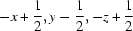 ; (iv)
 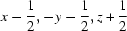 ; (v)
; (v) 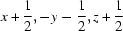 ; (vi)
 Data collection: CrystalClear (Rigaku, 2000); cell refinement: CrystalClear; data reduction: CrystalClear; program(s) used to solve structure: SHELXS97 (Sheldrick, 2008); program(s) used to refine structure: SHELXL97 (Sheldrick, 2008); molecular graphics: DIAMOND (Brandenburg, 2004); software used to prepare material for publication: enCIFer (Allen et al., 2004).
Supporting information
contains datablocks global, I. DOI: 10.1107/S1600536808014797/wm2180sup1.cif
Structure factors: contains datablock I. DOI: 10.1107/S1600536808014797/wm2180Isup2.hkl
Single crystals of compound (I) were grown using a LiBO2-containing The composition of the mixture for crystal growth was 4:1:4 of Li2CO3 (Sinopharm Reagents, 99.99%), Sc2O3 (Sinopharm Reagents, 4 N), and B2O3 (Sinopharm Reagents, 99%). This mixture was heated in a platinum crucible to 1373 K, held at this temperature for several hours, and then cooled at a rate of 10 K/h from 1373 to 873 K. The remaining attached to the crystals was readily dissolved in water. Crystals with an average size of 0.5 mm and mostly block shaped habit were obtained.
Data collection: CrystalClear (Rigaku, 2000); cell CrystalClear (Rigaku, 2000); data reduction: CrystalClear (Rigaku, 2000); program(s) used to solve structure: SHELXS97 (Sheldrick, 2008); program(s) used to refine structure: SHELXL97 (Sheldrick, 2008); molecular graphics: DIAMOND (Brandenburg, 2004); software used to prepare material for publication: enCIFer (Allen et al., 2004).
![[Figure 1]](./wm2180fig1thm.gif) | Fig. 1. The structure of (I) in a projection approximatly along the [001] direction with displacement ellipsoids drawn at the 85% probability level. |
![[Figure 2]](./wm2180fig2thm.gif) | Fig. 2. The structure of (I) given in the polyhedral description. [ScO6] octahedra are blue, [LiO4] tetrahedra are green, [LiO4] rectangles are purple, and [BO3] units are yellow. |
| Li3Sc(BO3)2 | F(000) = 176 |
| Mr = 183.4 | Dx = 2.62 Mg m−3 |
| Monoclinic, P21/n | Mo Kα radiation, λ = 0.71073 Å |
| Hall symbol: -P 2yn | Cell parameters from 623 reflections |
| a = 4.7831 (17) Å | θ = 4.2–23.6° |
| b = 5.954 (2) Å | µ = 1.53 mm−1 |
| c = 8.163 (3) Å | T = 293 K |
| β = 90.702 (9)° | Block, colourless |
| V = 232.44 (15) Å3 | 0.12 × 0.10 × 0.10 mm |
| Z = 2 |
| Rigaku Mercury CCD diffractometer | 534 independent reflections |
| Radiation source: Sealed Tube | 518 reflections with I > 2σ(I) |
| Graphite Monochromator monochromator | Rint = 0.015 |
| Detector resolution: 14.6306 pixels mm-1 | θmax = 27.5°, θmin = 4.2° |
| CCD_Profile_fitting scans | h = −6→4 |
| Absorption correction: multi-scan (CrystalClear; Rigaku, 2000) | k = −7→7 |
| Tmin = 0.833, Tmax = 0.858 | l = −10→10 |
| 1734 measured reflections |
| Refinement on F2 | 0 restraints |
| Least-squares matrix: full | Primary atom site location: structure-invariant direct methods |
| R[F2 > 2σ(F2)] = 0.017 | w = 1/[σ2(Fo2) + (0.0318P)2 + 0.216P] where P = (Fo2 + 2Fc2)/3 |
| wR(F2) = 0.058 | (Δ/σ)max < 0.001 |
| S = 1.10 | Δρmax = 0.28 e Å−3 |
| 534 reflections | Δρmin = −0.23 e Å−3 |
| 58 parameters | Extinction correction: SHELXL97 (Sheldrick, 2008) |
| Li3Sc(BO3)2 | V = 232.44 (15) Å3 |
| Mr = 183.4 | Z = 2 |
| Monoclinic, P21/n | Mo Kα radiation |
| a = 4.7831 (17) Å | µ = 1.53 mm−1 |
| b = 5.954 (2) Å | T = 293 K |
| c = 8.163 (3) Å | 0.12 × 0.10 × 0.10 mm |
| β = 90.702 (9)° |
| Rigaku Mercury CCD diffractometer | 534 independent reflections |
| Absorption correction: multi-scan (CrystalClear; Rigaku, 2000) | 518 reflections with I > 2σ(I) |
| Tmin = 0.833, Tmax = 0.858 | Rint = 0.015 |
| 1734 measured reflections |
| R[F2 > 2σ(F2)] = 0.017 | 58 parameters |
| wR(F2) = 0.058 | 0 restraints |
| S = 1.10 | Δρmax = 0.28 e Å−3 |
| 534 reflections | Δρmin = −0.23 e Å−3 |
Geometry. All e.s.d.'s (except the e.s.d. in the dihedral angle between two l.s. planes) are estimated using the full covariance matrix. The cell e.s.d.'s are taken into account individually in the estimation of e.s.d.'s in distances, angles and torsion angles; correlations between e.s.d.'s in cell parameters are only used when they are defined by crystal symmetry. An approximate (isotropic) treatment of cell e.s.d.'s is used for estimating e.s.d.'s involving l.s. planes. |
| x | y | z | Uiso*/Ueq | ||
| Sc | 0 | 0 | 0 | 0.00510 (15) | |
| Li1 | 0 | −0.5 | 0 | 0.0209 (10) | |
| Li2 | −0.0144 (6) | −0.2513 (5) | 0.2977 (4) | 0.0133 (6) | |
| B | 0.5149 (4) | −0.3045 (3) | 0.1254 (2) | 0.0061 (3) | |
| O1 | 0.3101 (2) | 0.24622 (18) | 0.00179 (14) | 0.0077 (2) | |
| O2 | 0.2330 (2) | −0.26155 (19) | 0.11029 (14) | 0.0086 (3) | |
| O3 | 0.1280 (2) | −0.08686 (19) | −0.23947 (13) | 0.0086 (3) |
| U11 | U22 | U33 | U12 | U13 | U23 | |
| Sc | 0.0050 (2) | 0.0054 (2) | 0.0049 (2) | −0.00002 (13) | 0.00011 (14) | 0.00009 (12) |
| Li1 | 0.015 (2) | 0.012 (2) | 0.035 (3) | 0.0000 (15) | −0.008 (2) | −0.0062 (17) |
| Li2 | 0.0119 (13) | 0.0182 (15) | 0.0098 (13) | −0.0025 (11) | −0.0018 (10) | 0.0015 (10) |
| B | 0.0074 (7) | 0.0042 (7) | 0.0067 (7) | −0.0009 (6) | 0.0000 (6) | −0.0014 (6) |
| O1 | 0.0065 (5) | 0.0095 (5) | 0.0070 (5) | −0.0013 (4) | 0.0004 (4) | 0.0005 (4) |
| O2 | 0.0060 (5) | 0.0099 (5) | 0.0099 (6) | 0.0013 (4) | 0.0000 (4) | 0.0012 (4) |
| O3 | 0.0084 (5) | 0.0102 (6) | 0.0071 (5) | 0.0006 (4) | −0.0009 (4) | −0.0023 (4) |
| Sc—O1 | 2.0854 (12) | Li2—O1x | 1.896 (3) |
| Sc—O1i | 2.0854 (12) | Li2—O2 | 1.946 (3) |
| Sc—O2i | 2.1101 (12) | Li2—O3xi | 1.983 (3) |
| Sc—O2 | 2.1101 (12) | Li2—O3i | 2.137 (3) |
| Sc—O3i | 2.1197 (13) | Li2—Bviii | 2.659 (3) |
| Sc—O3 | 2.1197 (13) | Li2—Bxi | 2.697 (3) |
| Sc—Li2i | 2.855 (3) | Li2—Bxii | 2.733 (4) |
| Sc—Li2 | 2.855 (3) | Li2—Scix | 3.226 (3) |
| Sc—Li1ii | 2.9768 (11) | Li2—Li1iii | 3.234 (3) |
| Sc—Li1 | 2.9768 (11) | Li2—Scx | 3.297 (3) |
| Sc—Li2iii | 3.226 (3) | B—O2 | 1.376 (2) |
| Sc—Li2iv | 3.226 (3) | B—O3xiii | 1.384 (2) |
| Li1—O2 | 2.0107 (12) | B—O1xiv | 1.385 (2) |
| Li1—O2v | 2.0107 (12) | B—Li2xv | 2.659 (3) |
| Li1—O1vi | 2.1173 (12) | B—Li2iv | 2.697 (3) |
| Li1—O1i | 2.1173 (12) | B—Li2x | 2.733 (4) |
| Li1—Bvii | 2.8008 (18) | B—Li1xv | 2.8008 (18) |
| Li1—Bviii | 2.8008 (18) | O1—Bxiv | 1.385 (2) |
| Li1—Li2v | 2.847 (3) | O1—Li2xii | 1.896 (3) |
| Li1—Li2 | 2.847 (3) | O1—Li1ii | 2.1173 (12) |
| Li1—Scvi | 2.9768 (11) | O3—Bxvi | 1.384 (2) |
| Li1—Li2ix | 3.234 (3) | O3—Li2iv | 1.983 (3) |
| Li1—Li2iv | 3.234 (3) | O3—Li2i | 2.137 (3) |
| O1—Sc—O1i | 180.00 (4) | O1x—Li2—O3i | 109.04 (14) |
| O1—Sc—O2i | 81.73 (5) | O2—Li2—O3i | 90.58 (12) |
| O1i—Sc—O2i | 98.27 (5) | O3xi—Li2—O3i | 101.95 (13) |
| O1—Sc—O2 | 98.27 (5) | O2—B—O3xiii | 122.09 (14) |
| O1i—Sc—O2 | 81.73 (5) | O2—B—O1xiv | 119.13 (14) |
| O2i—Sc—O2 | 180.00 (8) | O3xiii—B—O1xiv | 118.72 (14) |
| O1—Sc—O3i | 92.04 (4) | Bxiv—O1—Li2xii | 109.58 (13) |
| O1i—Sc—O3i | 87.96 (4) | Bxiv—O1—Sc | 127.37 (10) |
| O2i—Sc—O3i | 93.23 (5) | Li2xii—O1—Sc | 111.74 (11) |
| O2—Sc—O3i | 86.77 (5) | Bxiv—O1—Li1ii | 104.23 (9) |
| O1—Sc—O3 | 87.96 (4) | Li2xii—O1—Li1ii | 110.73 (10) |
| O1i—Sc—O3 | 92.04 (4) | Sc—O1—Li1ii | 90.19 (5) |
| O2i—Sc—O3 | 86.77 (5) | B—O2—Li2 | 122.67 (13) |
| O2—Sc—O3 | 93.23 (5) | B—O2—Li1 | 116.47 (10) |
| O3i—Sc—O3 | 180.00 (5) | Li2—O2—Li1 | 92.02 (10) |
| O2—Li1—O2v | 180.00 (6) | B—O2—Sc | 133.37 (10) |
| O2—Li1—O1vi | 96.68 (5) | Li2—O2—Sc | 89.39 (10) |
| O2v—Li1—O1vi | 83.32 (5) | Li1—O2—Sc | 92.47 (5) |
| O2—Li1—O1i | 83.32 (5) | Bxvi—O3—Li2iv | 102.89 (13) |
| O2v—Li1—O1i | 96.68 (5) | Bxvi—O3—Sc | 137.30 (10) |
| O1vi—Li1—O1i | 180 | Li2iv—O3—Sc | 103.64 (10) |
| O1x—Li2—O2 | 111.51 (16) | Bxvi—O3—Li2i | 99.62 (12) |
| O1x—Li2—O3xi | 124.23 (16) | Li2iv—O3—Li2i | 135.08 (11) |
| O2—Li2—O3xi | 113.33 (15) | Sc—O3—Li2i | 84.24 (9) |
| Symmetry codes: (i) −x, −y, −z; (ii) x, y+1, z; (iii) −x−1/2, y+1/2, −z+1/2; (iv) x+1/2, −y−1/2, z−1/2; (v) −x, −y−1, −z; (vi) x, y−1, z; (vii) −x+1, −y−1, −z; (viii) x−1, y, z; (ix) −x−1/2, y−1/2, −z+1/2; (x) −x+1/2, y−1/2, −z+1/2; (xi) x−1/2, −y−1/2, z+1/2; (xii) −x+1/2, y+1/2, −z+1/2; (xiii) x+1/2, −y−1/2, z+1/2; (xiv) −x+1, −y, −z; (xv) x+1, y, z; (xvi) x−1/2, −y−1/2, z−1/2. |
Experimental details
| Crystal data | |
| Chemical formula | Li3Sc(BO3)2 |
| Mr | 183.4 |
| Crystal system, space group | Monoclinic, P21/n |
| Temperature (K) | 293 |
| a, b, c (Å) | 4.7831 (17), 5.954 (2), 8.163 (3) |
| β (°) | 90.702 (9) |
| V (Å3) | 232.44 (15) |
| Z | 2 |
| Radiation type | Mo Kα |
| µ (mm−1) | 1.53 |
| Crystal size (mm) | 0.12 × 0.10 × 0.10 |
| Data collection | |
| Diffractometer | Rigaku Mercury CCD diffractometer |
| Absorption correction | Multi-scan (CrystalClear; Rigaku, 2000) |
| Tmin, Tmax | 0.833, 0.858 |
| No. of measured, independent and observed [I > 2σ(I)] reflections | 1734, 534, 518 |
| Rint | 0.015 |
| (sin θ/λ)max (Å−1) | 0.650 |
| Refinement | |
| R[F2 > 2σ(F2)], wR(F2), S | 0.017, 0.058, 1.10 |
| No. of reflections | 534 |
| No. of parameters | 58 |
| Δρmax, Δρmin (e Å−3) | 0.28, −0.23 |
Computer programs: CrystalClear (Rigaku, 2000), SHELXS97 (Sheldrick, 2008), SHELXL97 (Sheldrick, 2008), DIAMOND (Brandenburg, 2004), enCIFer (Allen et al., 2004).
| Sc—O1 | 2.0854 (12) | Li2—O2 | 1.946 (3) |
| Sc—O2i | 2.1101 (12) | Li2—O3iv | 1.983 (3) |
| Sc—O3i | 2.1197 (13) | Li2—O3i | 2.137 (3) |
| Li1—O2 | 2.0107 (12) | B—O2 | 1.376 (2) |
| Li1—O1ii | 2.1173 (12) | B—O3v | 1.384 (2) |
| Li2—O1iii | 1.896 (3) | B—O1vi | 1.385 (2) |
| O2—B—O3v | 122.09 (14) | O3v—B—O1vi | 118.72 (14) |
| O2—B—O1vi | 119.13 (14) |
| Symmetry codes: (i) −x, −y, −z; (ii) x, y−1, z; (iii) −x+1/2, y−1/2, −z+1/2; (iv) x−1/2, −y−1/2, z+1/2; (v) x+1/2, −y−1/2, z+1/2; (vi) −x+1, −y, −z. |
Acknowledgements
This project was supported by the National Science Foundation of China (grant No. 60608018).
References
 Allen, F. H., Johnson, O., Shields, G. P., Smith, B. R. & Towler, M. (2004). J. Appl. Cryst. 37, 335–338. Web of Science CrossRef CAS IUCr Journals Google Scholar
Becker, P. & Held, P. (2001). Z. Krist. New Cryst. Struct. 216, 35.. Google Scholar
Brandenburg, K. (2004). DIAMOND. Crystal Impact GbR, Bonn, Germany. Google Scholar
Rigaku (2000). CrystalClear. Rigaku Corporation, Tokyo, Japan. Google Scholar
Sheldrick, G. M. (2008). Acta Cryst. A64, 112–122. Web of Science CrossRef CAS IUCr Journals Google Scholar
Zhang, Y., Ye, N. & Keszler, D. A. (2006). Acta Cryst. E62, i266–i268. Web of Science CrossRef IUCr Journals Google Scholar
Zobetz, E. (1982). Z. Kristallogr. 160, 81–92. CrossRef CAS Web of Science Google Scholar
This is an open-access article distributed under the terms of the Creative Commons Attribution (CC-BY) Licence, which permits unrestricted use, distribution, and reproduction in any medium, provided the original authors and source are cited.
| CRYSTALLOGRAPHIC COMMUNICATIONS |


Li3Sc(BO3)2, (I), was found from analysis of phase equilibria in the system Li2O—Sc2O3—B2O3, in which it is the first characterized pseudo-ternary phase. For the heavier Na homologue, two phases are already known, viz. Na3Sc2(BO3)3 (Zhang et al., 2006) and NaScB2O5 (Becker & Held, 2001).
The framework structure of (I) is made up of distorted [ScO6] octahedra, [LiO4] tetrahedra, [LiO4] rectangles and [BO3] triangles as single building units. The [ScO6] octahedra are linked via [LiO4] rectangles by sharing edges to form columns parallel to [010]. The columns are linked to each other through [LiO4] tetrahedra and [BO3] triangles by sharing edges and corners (Figs 1 and 2).
The B atom is coordinated to three oxygen atoms forming nearly trigonal planar [BO3]3- anions. The B—O bond lengths range from 1.376 (2) to 1.385 (2) Å, and the O—B—O angles are close to 120° (Table 1), values that are typical for BO3 groups (Zobetz, 1982). The Sc3+ cation is coordinated by six oxygen atoms to form a distorted [ScO6] ocahedron with Sc—O bond lengths ranging from 2.0854 (12) to 2.1197 (13) Å. There are two crystallographically different Li atoms. One is situated on an inversion centre (1 symmetry) and is coordinated to four oxygen atoms forming a nearly planar [LiO4] rectangle with Li1—O bond lengths ranging from 2.0107 (12) to 2.1173 (12) Å. The other Li atom is also coordinated to four O atoms, but is in the centre of a distorted tetrahedron with Li2—O bond lengths from 1.896 (3) to 2.137 (3) Å (Table 1). The average Li—O bond length of the [Li1O4] rectangle (2.064 Å) is slightly longer than that of the [Li2O4] tetrahedron (1.991 Å).