Experimental
Crystal data
Cs[Mg(H2O)6](PO4) Mr = 360.29 Hexagonal, P 63 m c a = 6.8827 (8) Å c = 11.9188 (16) Å V = 488.97 (10) Å3 Z = 2 Mo Kα radiation μ = 4.04 mm−1 T = 293 (2) K 0.46 × 0.38 × 0.38 mm
|
Data collection
Stoe IPDS diffractometer Absorption correction: numerical (HABITUS; Herrendorf, 1997![[Herrendorf, W. (1997). HABITUS. University of Giessen, Germany.]](../../../../../../logos/arrows/e_arr.gif "Herrendorf, W. (1997). HABITUS. University of Giessen, Germany.") ) Tmin = 0.213, Tmax = 0.327 ) Tmin = 0.213, Tmax = 0.327 5412 measured reflections 368 independent reflections 367 reflections with I > 2σ(I) Rint = 0.025
|
Refinement
R[F2 > 2σ(F2)] = 0.016 wR(F2) = 0.034 S = 1.29 368 reflections 39 parameters 4 restraints H atoms treated by a mixture of independent and constrained refinement Δρmax = 0.40 e Å−3 Δρmin = −0.31 e Å−3 Absolute structure: Flack (1983), with 164 Friedel pairs Flack parameter: −0.01 (3)
|
| Cs—O3i | 3.469 (5) | | Cs—O4i | 3.470 (4) | | Cs—O4ii | 3.742 (4) | | Mg—O3 | 2.054 (4) | | Mg—O4 | 2.082 (3) | | P—O1 | 1.536 (3) | | P—O2 | 1.539 (6) | Symmetry codes: (i) -y, x-y, z; (ii) 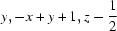 . .
| |
| D—H⋯A | D—H | H⋯A | D⋯A | D—H⋯A | | O3—H1⋯O2 | 0.93 (4) | 1.71 (4) | 2.643 (5) | 180 (6) | | O3—H2⋯O1iii | 0.88 (4) | 1.76 (5) | 2.630 (5) | 168 (7) | | O4—H3⋯O1iv | 0.83 (4) | 1.85 (4) | 2.672 (3) | 177 (8) | Symmetry codes: (iii)  ; (iv) -x+y, -x, z. ; (iv) -x+y, -x, z.
| |
Data collection: EXPOSE in IPDS Software (Stoe & Cie, 1998); cell refinement: CELL in IPDS Software; data reduction: INTEGRATE in IPDS Software; program(s) used to solve structure: SHELXS97 (Sheldrick, 2008); program(s) used to refine structure: SHELXL97 (Sheldrick, 2008); molecular graphics: ATOMS (Dowty, 2004); software used to prepare material for publication: SHELXL97.
Supporting information
Colourless crystals of Cs[Mg(OH2)6](PO4) with an edge-length up to 2 mm and mostly spherical habit were grown by means of the gel diffusion technique, following a slightly modified procedure as that given by Banks et al. (1975). Aqueous solutions of 0.025 M MgSO4 and 0.02 M Na4edta (edta = ethylenediaminetetraacetate) were adjusted to pH 10 with NaOH. Commercially available gelatine foils (5 g) were dissolved in the hot resulting 100 ml solution and allowed to form a gel inside a large test tube overnight. When the gel had set, an equivalent amount of a solution of 0.025 M CsH2PO4 (50 ml) was carefully poured over the gel. This solution was then adjusted to pH 8.5 with NaOH. The test tube was covered with parafilm and the crystal growth proceeded at the gel–liquid interface and into the gel. Crystals large enough for conventional X-ray analysis grew within one week at room temperature. They were separated mechanically from the gel and were washed with a water/ethanol/acetone (1/3/1) mixture.
The positions of the H atoms were found from difference Fourier maps and were refined with soft distance restraints (d(O—H) = 0.90 (5) Å) and a common Uiso parameter.
Data collection: EXPOSE in IPDS Software (Stoe & Cie, 1998); cell refinement: CELL in IPDS Software (Stoe & Cie, 1998); data reduction: INTEGRATE in IPDS Software (Stoe & Cie, 1998); program(s) used to solve structure: SHELXS97 (Sheldrick, 2008); program(s) used to refine structure: SHELXL97 (Sheldrick, 2008); molecular graphics: ATOMS (Dowty, 2004); software used to prepare material for publication: SHELXL97 (Sheldrick, 2008).
Caesium hexaaquamagnesium orthophosphate
top Crystal data top | Cs[Mg(H2O)6](PO4) | Dx = 2.447 Mg m−3 |
| Mr = 360.29 | Mo Kα radiation, λ = 0.71073 Å |
| Hexagonal, P63mc | Cell parameters from 1544 reflections |
| Hall symbol: P 6c -2c | θ = 3.4–25.9° |
| a = 6.8827 (8) Å | µ = 4.04 mm−1 |
| c = 11.9188 (16) Å | T = 293 K |
| V = 488.97 (10) Å3 | Block, colourless |
| Z = 2 | 0.46 × 0.38 × 0.38 mm |
| F(000) = 348 | |
Data collection top Stoe IPDS
diffractometer | 368 independent reflections |
| Radiation source: fine-focus sealed tube | 367 reflections with I > 2σ(I) |
| Graphite monochromator | Rint = 0.025 |
| ω scans | θmax = 25.7°, θmin = 3.4° |
Absorption correction: numerical
(HABITUS; Herrendorf, 1997) | h = −8→8 |
| Tmin = 0.213, Tmax = 0.327 | k = −8→8 |
| 5412 measured reflections | l = −12→13 |
Refinement top | Refinement on F2 | Secondary atom site location: difference Fourier map |
| Least-squares matrix: full | Hydrogen site location: difference Fourier map |
| R[F2 > 2σ(F2)] = 0.016 | H atoms treated by a mixture of independent and constrained refinement |
| wR(F2) = 0.034 | w = 1/[σ2(Fo2) + (0.0029P)2 + 0.8141P]
where P = (Fo2 + 2Fc2)/3 |
| S = 1.29 | (Δ/σ)max < 0.001 |
| 368 reflections | Δρmax = 0.40 e Å−3 |
| 39 parameters | Δρmin = −0.31 e Å−3 |
| 4 restraints | Absolute structure: Flack (1983), with 164 Friedel pairs |
| Primary atom site location: structure-invariant direct methods | Absolute structure parameter: −0.01 (3) |
Crystal data top | Cs[Mg(H2O)6](PO4) | Z = 2 |
| Mr = 360.29 | Mo Kα radiation |
| Hexagonal, P63mc | µ = 4.04 mm−1 |
| a = 6.8827 (8) Å | T = 293 K |
| c = 11.9188 (16) Å | 0.46 × 0.38 × 0.38 mm |
| V = 488.97 (10) Å3 | |
Data collection top Stoe IPDS
diffractometer | 368 independent reflections |
Absorption correction: numerical
(HABITUS; Herrendorf, 1997) | 367 reflections with I > 2σ(I) |
| Tmin = 0.213, Tmax = 0.327 | Rint = 0.025 |
| 5412 measured reflections | |
Refinement top | R[F2 > 2σ(F2)] = 0.016 | H atoms treated by a mixture of independent and constrained refinement |
| wR(F2) = 0.034 | Δρmax = 0.40 e Å−3 |
| S = 1.29 | Δρmin = −0.31 e Å−3 |
| 368 reflections | Absolute structure: Flack (1983), with 164 Friedel pairs |
| 39 parameters | Absolute structure parameter: −0.01 (3) |
| 4 restraints | |
Special details top Geometry. All e.s.d.'s (except the e.s.d. in the dihedral angle between two l.s. planes) are estimated using the full covariance matrix. The cell e.s.d.'s are taken into account individually in the estimation of e.s.d.'s in distances, angles and torsion angles; correlations between e.s.d.'s in cell parameters are only used when they are defined by crystal symmetry. An approximate (isotropic) treatment of cell e.s.d.'s is used for estimating e.s.d.'s involving l.s. planes. |
Refinement. Refinement of F2 against ALL reflections. The weighted R-factor wR and goodness of fit S are based on F2, conventional R-factors R are based on F, with F set to zero for negative F2. The threshold expression of F2 > σ(F2) is used only for calculating R-factors(gt) etc. and is not relevant to the choice of reflections for refinement. R-factors based on F2 are statistically about twice as large as those based on F, and R- factors based on ALL data will be even larger. |
Fractional atomic coordinates and isotropic or equivalent isotropic displacement parameters (Å2) top| | x | y | z | Uiso*/Ueq | |
| Cs | 0.3333 | 0.6667 | 0.02181 (4) | 0.03126 (15) | |
| Mg | 0.6667 | 0.3333 | 0.1436 (2) | 0.0159 (5) | |
| P | 0.0000 | 0.0000 | 0.29985 (14) | 0.0137 (5) | |
| O1 | 0.1220 (2) | 0.2440 (4) | 0.3413 (3) | 0.0173 (6) | |
| O2 | 0.0000 | 0.0000 | 0.1707 (5) | 0.0189 (13) | |
| O3 | 0.3747 (6) | 0.1873 (3) | 0.0521 (3) | 0.0265 (9) | |
| O4 | 0.5229 (3) | 0.0458 (5) | 0.2427 (3) | 0.0282 (8) | |
| H1 | 0.243 (8) | 0.122 (4) | 0.094 (5) | 0.048 (9)* | |
| H2 | 0.350 (12) | 0.175 (6) | −0.021 (4) | 0.048 (9)* | |
| H3 | 0.397 (8) | −0.010 (14) | 0.272 (5) | 0.048 (9)* | |
Atomic displacement parameters (Å2) top| | U11 | U22 | U33 | U12 | U13 | U23 |
| Cs | 0.02671 (16) | 0.02671 (16) | 0.0404 (3) | 0.01335 (8) | 0.000 | 0.000 |
| Mg | 0.0158 (8) | 0.0158 (8) | 0.0160 (16) | 0.0079 (4) | 0.000 | 0.000 |
| P | 0.0139 (5) | 0.0139 (5) | 0.0134 (13) | 0.0069 (2) | 0.000 | 0.000 |
| O1 | 0.0172 (9) | 0.0139 (13) | 0.0195 (17) | 0.0070 (7) | −0.0023 (6) | −0.0046 (12) |
| O2 | 0.0177 (19) | 0.0177 (19) | 0.021 (4) | 0.0089 (10) | 0.000 | 0.000 |
| O3 | 0.0142 (14) | 0.0406 (14) | 0.016 (3) | 0.0071 (7) | −0.0023 (11) | −0.0012 (5) |
| O4 | 0.0191 (11) | 0.0252 (19) | 0.042 (2) | 0.0126 (10) | 0.0096 (7) | 0.0191 (15) |
Geometric parameters (Å, º) top | Cs—O3i | 3.469 (5) | Mg—O3 | 2.054 (4) |
| Cs—O3ii | 3.469 (5) | Mg—O3v | 2.054 (4) |
| Cs—O3iii | 3.469 (5) | Mg—O4ix | 2.082 (3) |
| Cs—O3iv | 3.469 (5) | Mg—O4 | 2.082 (3) |
| Cs—O3v | 3.469 (5) | Mg—O4v | 2.082 (3) |
| Cs—O3 | 3.469 (5) | Mg—Csx | 4.2306 (10) |
| Cs—O4i | 3.470 (4) | Mg—Csxi | 4.2306 (10) |
| Cs—O4iv | 3.470 (4) | Mg—Csxii | 4.508 (3) |
| Cs—O4v | 3.470 (4) | P—O1 | 1.536 (3) |
| Cs—O4vi | 3.742 (4) | P—O1iv | 1.536 (3) |
| Cs—O4vii | 3.742 (4) | P—O1xiii | 1.536 (3) |
| Cs—O4viii | 3.742 (4) | P—O2 | 1.539 (6) |
| Mg—O3ix | 2.054 (4) | | |
| | | |
| O3i—Cs—O3ii | 51.51 (11) | O3v—Cs—O4vii | 97.18 (5) |
| O3i—Cs—O3iii | 67.77 (11) | O3—Cs—O4vii | 118.02 (7) |
| O3ii—Cs—O3iii | 118.93 (2) | O4i—Cs—O4vii | 112.101 (19) |
| O3i—Cs—O3iv | 118.93 (2) | O4iv—Cs—O4vii | 145.46 (3) |
| O3ii—Cs—O3iv | 165.52 (11) | O4v—Cs—O4vii | 145.46 (3) |
| O3iii—Cs—O3iv | 51.51 (11) | O4vi—Cs—O4vii | 46.74 (8) |
| O3i—Cs—O3v | 118.93 (2) | O3i—Cs—O4viii | 118.02 (7) |
| O3ii—Cs—O3v | 67.77 (11) | O3ii—Cs—O4viii | 97.18 (5) |
| O3iii—Cs—O3v | 165.52 (11) | O3iii—Cs—O4viii | 118.02 (7) |
| O3iv—Cs—O3v | 118.93 (2) | O3iv—Cs—O4viii | 97.18 (5) |
| O3i—Cs—O3 | 165.52 (11) | O3v—Cs—O4viii | 71.50 (7) |
| O3ii—Cs—O3 | 118.93 (2) | O3—Cs—O4viii | 71.50 (7) |
| O3iii—Cs—O3 | 118.93 (2) | O4i—Cs—O4viii | 145.46 (3) |
| O3iv—Cs—O3 | 67.77 (11) | O4iv—Cs—O4viii | 145.46 (3) |
| O3v—Cs—O3 | 51.51 (11) | O4v—Cs—O4viii | 112.101 (19) |
| O3i—Cs—O4i | 48.58 (7) | O4vi—Cs—O4viii | 46.74 (8) |
| O3ii—Cs—O4i | 48.58 (7) | O4vii—Cs—O4viii | 46.74 (8) |
| O3iii—Cs—O4i | 88.12 (6) | O3ix—Mg—O3 | 94.42 (16) |
| O3iv—Cs—O4i | 117.22 (7) | O3ix—Mg—O3v | 94.42 (16) |
| O3v—Cs—O4i | 88.12 (6) | O3—Mg—O3v | 94.42 (16) |
| O3—Cs—O4i | 117.22 (7) | O3ix—Mg—O4ix | 87.27 (10) |
| O3i—Cs—O4iv | 88.12 (6) | O3—Mg—O4ix | 177.5 (2) |
| O3ii—Cs—O4iv | 117.22 (7) | O3v—Mg—O4ix | 87.27 (10) |
| O3iii—Cs—O4iv | 48.58 (7) | O3ix—Mg—O4 | 87.27 (10) |
| O3iv—Cs—O4iv | 48.58 (7) | O3—Mg—O4 | 87.27 (10) |
| O3v—Cs—O4iv | 117.22 (7) | O3v—Mg—O4 | 177.5 (2) |
| O3—Cs—O4iv | 88.12 (6) | O4ix—Mg—O4 | 90.98 (19) |
| O4i—Cs—O4iv | 68.67 (8) | O3ix—Mg—O4v | 177.5 (2) |
| O3i—Cs—O4v | 117.22 (7) | O3—Mg—O4v | 87.27 (10) |
| O3ii—Cs—O4v | 88.12 (6) | O3v—Mg—O4v | 87.27 (10) |
| O3iii—Cs—O4v | 117.22 (7) | O4ix—Mg—O4v | 90.98 (19) |
| O3iv—Cs—O4v | 88.12 (6) | O4—Mg—O4v | 90.98 (19) |
| O3v—Cs—O4v | 48.58 (7) | O1—P—O1iv | 110.17 (14) |
| O3—Cs—O4v | 48.58 (7) | O1—P—O1xiii | 110.17 (14) |
| O4i—Cs—O4v | 68.67 (8) | O1iv—P—O1xiii | 110.17 (14) |
| O4iv—Cs—O4v | 68.67 (8) | O1—P—O2 | 108.76 (14) |
| O3i—Cs—O4vi | 97.18 (5) | O1iv—P—O2 | 108.76 (14) |
| O3ii—Cs—O4vi | 118.02 (7) | O1xiii—P—O2 | 108.76 (14) |
| O3iii—Cs—O4vi | 71.50 (7) | Mg—O3—Csx | 96.63 (6) |
| O3iv—Cs—O4vi | 71.50 (7) | Mg—O3—Cs | 96.63 (6) |
| O3v—Cs—O4vi | 118.02 (7) | Csx—O3—Cs | 165.52 (11) |
| O3—Cs—O4vi | 97.18 (5) | Mg—O3—H1 | 116 (4) |
| O4i—Cs—O4vi | 145.46 (3) | Mg—O3—H2 | 132 (5) |
| O4iv—Cs—O4vi | 112.101 (19) | H1—O3—H2 | 113 (6) |
| O4v—Cs—O4vi | 145.46 (3) | Mg—O4—Csx | 96.07 (16) |
| O3i—Cs—O4vii | 71.50 (7) | Mg—O4—Csxii | 97.31 (14) |
| O3ii—Cs—O4vii | 71.50 (7) | Csx—O4—Csxii | 166.63 (10) |
| O3iii—Cs—O4vii | 97.18 (5) | Mg—O4—H3 | 125 (4) |
| O3iv—Cs—O4vii | 118.02 (7) | | |
| Symmetry codes: (i) x, y+1, z; (ii) −y+1, x−y+1, z; (iii) −x+y, −x+1, z; (iv) −y, x−y, z; (v) −x+y+1, −x+1, z; (vi) y, −x+y+1, z−1/2; (vii) −x+1, −y+1, z−1/2; (viii) x−y, x, z−1/2; (ix) −y+1, x−y, z; (x) x, y−1, z; (xi) x+1, y, z; (xii) x−y+1, x, z+1/2; (xiii) −x+y, −x, z. |
Hydrogen-bond geometry (Å, º) top | D—H···A | D—H | H···A | D···A | D—H···A |
| O3—H1···O2 | 0.93 (4) | 1.71 (4) | 2.643 (5) | 180 (6) |
| O3—H2···O1xiv | 0.88 (4) | 1.76 (5) | 2.630 (5) | 168 (7) |
| O4—H3···O1xiii | 0.83 (4) | 1.85 (4) | 2.672 (3) | 177 (8) |
| Symmetry codes: (xiii) −x+y, −x, z; (xiv) y, −x+y, z−1/2. |
Experimental details
| Crystal data |
| Chemical formula | Cs[Mg(H2O)6](PO4) |
| Mr | 360.29 |
| Crystal system, space group | Hexagonal, P63mc |
| Temperature (K) | 293 |
| a, c (Å) | 6.8827 (8), 11.9188 (16) |
| V (Å3) | 488.97 (10) |
| Z | 2 |
| Radiation type | Mo Kα |
| µ (mm−1) | 4.04 |
| Crystal size (mm) | 0.46 × 0.38 × 0.38 |
| |
| Data collection |
| Diffractometer | Stoe IPDS
diffractometer |
| Absorption correction | Numerical
(HABITUS; Herrendorf, 1997) |
| Tmin, Tmax | 0.213, 0.327 |
No. of measured, independent and
observed [I > 2σ(I)] reflections | 5412, 368, 367 |
| Rint | 0.025 |
| (sin θ/λ)max (Å−1) | 0.611 |
| |
| Refinement |
| R[F2 > 2σ(F2)], wR(F2), S | 0.016, 0.034, 1.29 |
| No. of reflections | 368 |
| No. of parameters | 39 |
| No. of restraints | 4 |
| H-atom treatment | H atoms treated by a mixture of independent and constrained refinement |
| Δρmax, Δρmin (e Å−3) | 0.40, −0.31 |
| Absolute structure | Flack (1983), with 164 Friedel pairs |
| Absolute structure parameter | −0.01 (3) |
Selected bond lengths (Å) top| Cs—O3i | 3.469 (5) | Mg—O4 | 2.082 (3) |
| Cs—O4i | 3.470 (4) | P—O1 | 1.536 (3) |
| Cs—O4ii | 3.742 (4) | P—O2 | 1.539 (6) |
| Mg—O3 | 2.054 (4) | | |
| Symmetry codes: (i) −y, x−y, z; (ii) y, −x+y+1, z−1/2. |
Hydrogen-bond geometry (Å, º) top | D—H···A | D—H | H···A | D···A | D—H···A |
| O3—H1···O2 | 0.93 (4) | 1.71 (4) | 2.643 (5) | 180 (6) |
| O3—H2···O1iii | 0.88 (4) | 1.76 (5) | 2.630 (5) | 168 (7) |
| O4—H3···O1iv | 0.83 (4) | 1.85 (4) | 2.672 (3) | 177 (8) |
| Symmetry codes: (iii) y, −x+y, z−1/2; (iv) −x+y, −x, z. |
Acknowledgements
The author thanks B. Müller (University of Ulm, Germany) for collecting the intensity data.
References
 Banks, E., Chianelli, R. & Korenstein, R. (1975). Inorg. Chem. 14, 1634–1639. CrossRef CAS Web of Science Google Scholar
Dowty, E. (2004). ATOMS for Windows. Shape Software, Kingsport, Tennessee, USA. Google Scholar
Ferrari, A., Calvaca, L. & Nardelli, M. (1955). Gazz. Chim. Ital. 85, 1232–1238. CAS Google Scholar
Flack, H. D. (1983). Acta Cryst. A39, 876–881. CrossRef CAS Web of Science IUCr Journals Google Scholar
Herrendorf, W. (1997). HABITUS. University of Giessen, Germany. Google Scholar
Massa, W., Yakubovich, O. V. & Dimitrova, O. V. (2003). Acta Cryst. C59, i83–i85. Web of Science CrossRef CAS IUCr Journals Google Scholar
Sheldrick, G. M. (2008). Acta Cryst. A64, 112–122. Web of Science CrossRef CAS IUCr Journals Google Scholar
Stoe & Cie (1998). IPDS Software. Stoe & Cie, Darmstadt, Germany. Google Scholar
Whitaker, A. & Jeffery, J. W. (1970a). Acta Cryst. B26, 1429–1440. CrossRef CAS IUCr Journals Web of Science Google Scholar
Whitaker, A. & Jeffery, J. W. (1970b). Acta Cryst. B26, 1440–1444. CrossRef CAS IUCr Journals Web of Science Google Scholar
This is an open-access article distributed under the terms of the Creative Commons Attribution (CC-BY) Licence, which permits unrestricted use, distribution, and reproduction in any medium, provided the original authors and source are cited.
 | CRYSTALLOGRAPHIC
COMMUNICATIONS |
ISSN: 2056-9890
Open

access


 journal menu



![[Figure 1]](./br2080fig1thm.gif)
![[Figure 2]](./br2080fig2thm.gif)


Numerous compounds with general formula A[B(OH2)6]XO4, where A = alkali metal, NH4 or Tl, B = Mg or first row transition metal, and X = P or As, are known to crystallize in the orthorhombic struvite (NH4[Mg(OH2)6](PO4)) structure in space group Pmn21 (Whitaker & Jeffery, 1979a,b). However, for the isoformular compounds Cs[Mg(OH2)6](XO4), where X = P and As, cubic and hexagonal forms were reported and structurally characterized (Ferrari et al., 1955; Massa et al., 2003). The cubic polymorph forms under hydrothermal conditions, whereas the hexagonal form is obtained under normal pressure and temperatures. All these structures can be described in terms of closed-packed layers with different stacking sequences (Massa et al., 2003).
In this communication the redetermination of hexagonal Cs[Mg(OH2)6](PO4) is reported. The previous refinement from photographic data (Ferrari et al., 1955) was basically confirmed, but with all H atoms located and with all non H-atoms refined with anisotropic displacement parameters.
In addition to the description of the hexagonal Cs[Mg(OH2)6](PO4) structure in terms of closed-packed layers (Massa et al., 2003), the structure can be described as a derivative of the NiAs structure type. The centres of the slightly distorted PO4 tetrahedra (3m. symmetry) are situated on the Ni positions, whereas the centres of the likewise slightly distorted complex [Mg(H2O)6] octahedra (3m. symmetry) are situated on the As positions (Fig. 1). Thus one [Mg(H2O)6] octahedron is surrounded by six PO4 tetrahedra in a distorted trigonal–prismatic arrangement, whereas one PO4 tetrahedron is surrounded by six [Mg(H2O)6] octahedra in a distorted octahedral arrangement. The corresponding P—O and Mg—O distances are in the normal range (Table 1). These building units are linked via medium-strong hydrogen bonds (Table 2, Fig. 2). Details and differences of the hydrogen bonding schemes in cubic, hexagonal and struvite-type structures were discussed by Massa et al. (2003). The Cs+ cations are located in the voids of this arrangement and exhibit a distorted cuboctahedral 12-coordination [9+3] to the oxygen atoms of the water molecules (Table 1).