 | Acta Crystallographica Section E Acta Crystallographica Section E CRYSTALLOGRAPHIC COMMUNICATIONS |


 journal menu


organic compounds
| CRYSTALLOGRAPHIC COMMUNICATIONS |
 access
N-(4-Chloro-2-nitrophenyl)methanesulfonamide

aApplied Chemistry Research Centre, PCSIR Laboratories Complex, Lahore 54600, Pakistan, bInstitute of Chemistry, University of the Punjab, Lahore 54590, Pakistan, cCentre for High Energy Physics, University of the Punjab, Lahore 54590, Pakistan, and dDepartment of Chemistry, Government College University, Lahore 54000, Pakistan
*Correspondence e-mail: [email protected]
The title compound, C7H7ClN2O4S, is of interest as a precursor to biologically active substituted quinolines. Its structure resembles those of the previously reported N-phenylmethane sulfonamide and its 4-nitro, 4-fluoro and 4-bromo derivatives, with slightly different geometric parameters. An intramolecular N—H⋯O hydrogen bond gives rise to a six-membered ring. Intermolecular C—H⋯O contacts stabilize the crystal packing.
Related literature
For related literature, see: Ahn et al. (1997![[Ahn, K. H., Ham, C., Kim, S.-K. & Cho, C.-W. (1997). J. Org. Chem. 62, 7047-7048.]](../../../../../../logos/arrows/e_arr.gif "Ahn, K. H., Ham, C., Kim, S.-K. & Cho, C.-W. (1997). J. Org. Chem. 62, 7047-7048.") ); Allen et al. (1987); Ozbek et al. (2007); Siddiqui et al. (2007); Gennarti et al. (1994); Gowda et al. (2007a,b,c); Hanson et al. (1999); Moree et al. (1991); Oppolzer et al. (1991); Rough et al. (1998); Zia-ur-Rehman et al. (2005, 2006, 2007, 2008).
); Allen et al. (1987); Ozbek et al. (2007); Siddiqui et al. (2007); Gennarti et al. (1994); Gowda et al. (2007a,b,c); Hanson et al. (1999); Moree et al. (1991); Oppolzer et al. (1991); Rough et al. (1998); Zia-ur-Rehman et al. (2005, 2006, 2007, 2008).
![[Scheme 1]](bt2794scheme1.gif)
Experimental
Crystal data
|
Data collection
|
Refinement
|
|
 ; (ii)
 Data collection: APEX2 (Bruker, 2007); cell refinement: SAINT (Bruker, 2007); data reduction: SAINT; program(s) used to solve structure: SHELXS97 (Sheldrick, 2008); program(s) used to refine structure: SHELXL97 (Sheldrick, 2008); molecular graphics: SHELXTL (Sheldrick, 2008); software used to prepare material for publication: WinGX (Farrugia, 1999) and PLATON (Spek, 2003).
Supporting information
contains datablocks I, global. DOI: 10.1107/S1600536808031048/bt2794sup1.cif
Structure factors: contains datablock I. DOI: 10.1107/S1600536808031048/bt2794Isup2.hkl
A mixture of 4-chloro-2-nitroaniline (3.452 g; 20.0 mmoles) and mesyl chloride (2.52 g; 22.0 mmoles) and toluene (25.0 ml) was heated to reflux for half an hour. Solvent was then distilled off under reduced pressure and the resultant solids were washed with cold methanol. Crystals suitable for analysis were obtained by slow evaporation of methanolic solution over a period of two days.
H atoms bound to C were placed in calculated positions (C—H distance = 0.95 Å) using a riding model. H atoms on N and O were freely refined.
Data collection: APEX2 (Bruker, 2007); cell SAINT (Bruker, 2007); data reduction: SAINT (Bruker, 2007); program(s) used to solve structure: SHELXS97 (Sheldrick, 2008); program(s) used to refine structure: SHELXL97 (Sheldrick, 2008); molecular graphics: SHELXTL (Sheldrick, 2008); software used to prepare material for publication: WinGX (Farrugia, 1999) and PLATON (Spek, 2003).
![[Figure 1]](./bt2794fig1thm.gif) | Fig. 1. The asymmetric unit of the title compound. Displacement ellipsoids are drawn at the 50% probability level. |
![[Figure 2]](./bt2794fig2thm.gif) | Fig. 2. Perspective view of the crystal packing showing hydrogen bonds (dashed lines). H atoms not involved in hydrogen bonding have been omitted for clarity. |
| C7H7ClN2O4S | F(000) = 512 |
| Mr = 250.67 | Dx = 1.660 Mg m−3 |
| Monoclinic, P21/n | Melting point: 388 K |
| Hall symbol: -P 2yn | Mo Kα radiation, λ = 0.71073 Å |
| a = 11.728 (3) Å | Cell parameters from 1283 reflections |
| b = 4.9798 (13) Å | θ = 2.4–20.9° |
| c = 17.988 (5) Å | µ = 0.58 mm−1 |
| β = 107.334 (8)° | T = 296 K |
| V = 1002.8 (5) Å3 | Needle, light yellow |
| Z = 4 | 0.22 × 0.14 × 0.07 mm |
| Bruker APEXII CCD area-detector diffractometer | 1199 reflections with I > 2σ(I) |
| Radiation source: fine-focus sealed tube | Rint = 0.081 |
| Graphite monochromator | θmax = 28.7°, θmin = 1.9° |
| Detector resolution: 7.5 pixels mm-1 | h = −15→15 |
| ϕ and ω scans | k = −6→6 |
| 10700 measured reflections | l = −23→24 |
| 2590 independent reflections |
| Refinement on F2 | Primary atom site location: structure-invariant direct methods |
| Least-squares matrix: full | Secondary atom site location: difference Fourier map |
| R[F2 > 2σ(F2)] = 0.050 | Hydrogen site location: inferred from neighbouring sites |
| wR(F2) = 0.148 | H atoms treated by a mixture of independent and constrained refinement |
| S = 0.97 | w = 1/[σ2(Fo2) + (0.0627P)2] where P = (Fo2 + 2Fc2)/3 |
| 2556 reflections | (Δ/σ)max < 0.001 |
| 140 parameters | Δρmax = 0.25 e Å−3 |
| 0 restraints | Δρmin = −0.39 e Å−3 |
| C7H7ClN2O4S | V = 1002.8 (5) Å3 |
| Mr = 250.67 | Z = 4 |
| Monoclinic, P21/n | Mo Kα radiation |
| a = 11.728 (3) Å | µ = 0.58 mm−1 |
| b = 4.9798 (13) Å | T = 296 K |
| c = 17.988 (5) Å | 0.22 × 0.14 × 0.07 mm |
| β = 107.334 (8)° |
| Bruker APEXII CCD area-detector diffractometer | 1199 reflections with I > 2σ(I) |
| 10700 measured reflections | Rint = 0.081 |
| 2590 independent reflections |
| R[F2 > 2σ(F2)] = 0.050 | 0 restraints |
| wR(F2) = 0.148 | H atoms treated by a mixture of independent and constrained refinement |
| S = 0.97 | Δρmax = 0.25 e Å−3 |
| 2556 reflections | Δρmin = −0.39 e Å−3 |
| 140 parameters |
Geometry. All e.s.d.'s (except the e.s.d. in the dihedral angle between two l.s. planes) are estimated using the full covariance matrix. The cell e.s.d.'s are taken into account individually in the estimation of e.s.d.'s in distances, angles and torsion angles; correlations between e.s.d.'s in cell parameters are only used when they are defined by crystal symmetry. An approximate (isotropic) treatment of cell e.s.d.'s is used for estimating e.s.d.'s involving l.s. planes. |
Refinement. Refinement of F2 against ALL reflections. The weighted R-factor wR and goodness of fit S are based on F2, conventional R-factors R are based on F, with F set to zero for negative F2. The threshold expression of F2 > σ(F2) is used only for calculating R-factors(gt) etc. and is not relevant to the choice of reflections for refinement. R-factors based on F2 are statistically about twice as large as those based on F, and R- factors based on ALL data will be even larger. |
| x | y | z | Uiso*/Ueq | ||
| Cl1 | 0.36565 (9) | −0.3010 (2) | 0.78879 (7) | 0.0757 (4) | |
| S1 | 0.82089 (9) | 0.53780 (17) | 1.02558 (6) | 0.0499 (3) | |
| O1 | 0.9148 (3) | 0.7102 (5) | 1.01960 (19) | 0.0756 (9) | |
| O2 | 0.7141 (2) | 0.6562 (5) | 1.03188 (16) | 0.0647 (8) | |
| O3 | 0.8855 (2) | 0.1004 (5) | 0.85222 (14) | 0.0554 (7) | |
| O4 | 0.8088 (2) | −0.2740 (5) | 0.80406 (15) | 0.0613 (7) | |
| H1 | 0.852 (3) | 0.324 (7) | 0.938 (2) | 0.047 (11)* | |
| N1 | 0.7906 (3) | 0.3571 (6) | 0.94717 (19) | 0.0509 (8) | |
| N2 | 0.8034 (3) | −0.0641 (6) | 0.83722 (16) | 0.0441 (7) | |
| C1 | 0.6920 (3) | 0.1941 (6) | 0.91264 (19) | 0.0416 (8) | |
| C2 | 0.6953 (3) | −0.0052 (6) | 0.85865 (19) | 0.0397 (8) | |
| C3 | 0.5963 (3) | −0.1573 (7) | 0.8216 (2) | 0.0473 (9) | |
| H3 | 0.6013 | −0.2884 | 0.7859 | 0.057* | |
| C4 | 0.4913 (3) | −0.1147 (7) | 0.8376 (2) | 0.0507 (9) | |
| C5 | 0.4847 (3) | 0.0733 (7) | 0.8916 (2) | 0.0559 (10) | |
| H5 | 0.4136 | 0.0974 | 0.9037 | 0.067* | |
| C6 | 0.5830 (4) | 0.2266 (7) | 0.9282 (2) | 0.0556 (10) | |
| H6 | 0.5767 | 0.3554 | 0.9642 | 0.067* | |
| C7 | 0.8741 (4) | 0.3148 (8) | 1.1025 (3) | 0.0756 (13) | |
| H8 | 0.9413 | 0.2183 | 1.0959 | 0.113* | |
| H9 | 0.8121 | 0.1903 | 1.1036 | 0.113* | |
| H7 | 0.8984 | 0.4127 | 1.1507 | 0.113* |
| U11 | U22 | U33 | U12 | U13 | U23 | |
| Cl1 | 0.0495 (6) | 0.0871 (8) | 0.0875 (9) | −0.0078 (5) | 0.0156 (6) | −0.0033 (6) |
| S1 | 0.0594 (6) | 0.0414 (5) | 0.0527 (6) | 0.0081 (4) | 0.0224 (5) | −0.0082 (4) |
| O1 | 0.083 (2) | 0.0540 (15) | 0.100 (2) | −0.0184 (14) | 0.0431 (19) | −0.0276 (15) |
| O2 | 0.0700 (18) | 0.0622 (16) | 0.0661 (19) | 0.0267 (13) | 0.0267 (14) | −0.0096 (13) |
| O3 | 0.0468 (15) | 0.0678 (16) | 0.0571 (18) | −0.0027 (13) | 0.0238 (13) | −0.0109 (13) |
| O4 | 0.0608 (17) | 0.0650 (16) | 0.0627 (19) | 0.0092 (12) | 0.0255 (14) | −0.0258 (13) |
| N1 | 0.050 (2) | 0.0539 (18) | 0.058 (2) | 0.0022 (16) | 0.0296 (17) | −0.0131 (14) |
| N2 | 0.0457 (18) | 0.0526 (17) | 0.0364 (17) | 0.0107 (15) | 0.0157 (13) | −0.0016 (13) |
| C1 | 0.048 (2) | 0.0412 (18) | 0.040 (2) | 0.0068 (16) | 0.0205 (17) | 0.0032 (15) |
| C2 | 0.042 (2) | 0.0445 (18) | 0.0361 (19) | 0.0112 (15) | 0.0167 (16) | 0.0071 (14) |
| C3 | 0.050 (2) | 0.053 (2) | 0.040 (2) | 0.0066 (17) | 0.0149 (17) | −0.0007 (16) |
| C4 | 0.042 (2) | 0.058 (2) | 0.053 (2) | 0.0034 (17) | 0.0137 (18) | 0.0078 (18) |
| C5 | 0.044 (2) | 0.061 (2) | 0.071 (3) | 0.0128 (19) | 0.029 (2) | 0.006 (2) |
| C6 | 0.060 (3) | 0.053 (2) | 0.063 (3) | 0.0093 (19) | 0.032 (2) | −0.0051 (18) |
| C7 | 0.086 (3) | 0.075 (3) | 0.058 (3) | 0.021 (2) | 0.010 (2) | 0.003 (2) |
| Cl1—C4 | 1.741 (4) | C1—C6 | 1.397 (5) |
| S1—O2 | 1.419 (3) | C2—C3 | 1.380 (5) |
| S1—O1 | 1.426 (3) | C3—C4 | 1.363 (4) |
| S1—N1 | 1.621 (3) | C3—H3 | 0.9300 |
| S1—C7 | 1.739 (4) | C4—C5 | 1.368 (5) |
| O3—N2 | 1.231 (3) | C5—C6 | 1.375 (5) |
| O4—N2 | 1.215 (3) | C5—H5 | 0.9300 |
| N1—C1 | 1.397 (4) | C6—H6 | 0.9300 |
| N1—H1 | 0.80 (3) | C7—H8 | 0.9600 |
| N2—C2 | 1.461 (4) | C7—H9 | 0.9600 |
| C1—C2 | 1.397 (4) | C7—H7 | 0.9600 |
| O2—S1—O1 | 118.43 (17) | C4—C3—C2 | 119.7 (3) |
| O2—S1—N1 | 109.28 (17) | C4—C3—H3 | 120.1 |
| O1—S1—N1 | 104.05 (17) | C2—C3—H3 | 120.1 |
| O2—S1—C7 | 108.5 (2) | C3—C4—C5 | 120.2 (3) |
| O1—S1—C7 | 110.0 (2) | C3—C4—Cl1 | 119.5 (3) |
| N1—S1—C7 | 105.77 (19) | C5—C4—Cl1 | 120.3 (3) |
| C1—N1—S1 | 130.3 (3) | C4—C5—C6 | 120.2 (3) |
| C1—N1—H1 | 118 (3) | C4—C5—H5 | 119.9 |
| S1—N1—H1 | 108 (3) | C6—C5—H5 | 119.9 |
| O4—N2—O3 | 121.9 (3) | C5—C6—C1 | 121.8 (3) |
| O4—N2—C2 | 118.6 (3) | C5—C6—H6 | 119.1 |
| O3—N2—C2 | 119.5 (3) | C1—C6—H6 | 119.1 |
| C2—C1—C6 | 116.0 (3) | S1—C7—H8 | 109.5 |
| C2—C1—N1 | 122.1 (3) | S1—C7—H9 | 109.5 |
| C6—C1—N1 | 121.9 (3) | H8—C7—H9 | 109.5 |
| C3—C2—C1 | 122.1 (3) | S1—C7—H7 | 109.5 |
| C3—C2—N2 | 115.7 (3) | H8—C7—H7 | 109.5 |
| C1—C2—N2 | 122.2 (3) | H9—C7—H7 | 109.5 |
| O2—S1—N1—C1 | −37.6 (4) | O4—N2—C2—C1 | 163.9 (3) |
| O1—S1—N1—C1 | −165.0 (3) | O3—N2—C2—C1 | −17.0 (4) |
| C7—S1—N1—C1 | 79.0 (4) | C1—C2—C3—C4 | −0.1 (5) |
| S1—N1—C1—C2 | −161.2 (3) | N2—C2—C3—C4 | −179.5 (3) |
| S1—N1—C1—C6 | 21.0 (5) | C2—C3—C4—C5 | −1.7 (5) |
| C6—C1—C2—C3 | 1.3 (5) | C2—C3—C4—Cl1 | 178.3 (3) |
| N1—C1—C2—C3 | −176.7 (3) | C3—C4—C5—C6 | 2.2 (6) |
| C6—C1—C2—N2 | −179.3 (3) | Cl1—C4—C5—C6 | −177.8 (3) |
| N1—C1—C2—N2 | 2.7 (5) | C4—C5—C6—C1 | −1.0 (6) |
| O4—N2—C2—C3 | −16.6 (4) | C2—C1—C6—C5 | −0.7 (5) |
| O3—N2—C2—C3 | 162.5 (3) | N1—C1—C6—C5 | 177.2 (3) |
| D—H···A | D—H | H···A | D···A | D—H···A |
| N1—H1···O3 | 0.80 (4) | 2.03 (4) | 2.631 (4) | 131 (3) |
| C3—H3···O3i | 0.93 | 2.59 | 3.417 (4) | 148 |
| C5—H5···O2ii | 0.93 | 2.47 | 3.325 (5) | 152 |
| C6—H6···O2 | 0.93 | 2.27 | 2.951 (5) | 130 |
| C7—H8···O3iii | 0.96 | 2.53 | 3.394 (5) | 150 |
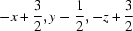
| Symmetry codes: (i) −x+3/2, y−1/2, −z+3/2; (ii) −x+1, −y+1, −z+2; (iii) −x+2, −y, −z+2. |
Experimental details
| Crystal data | |
| Chemical formula | C7H7ClN2O4S |
| Mr | 250.67 |
| Crystal system, space group | Monoclinic, P21/n |
| Temperature (K) | 296 |
| a, b, c (Å) | 11.728 (3), 4.9798 (13), 17.988 (5) |
| β (°) | 107.334 (8) |
| V (Å3) | 1002.8 (5) |
| Z | 4 |
| Radiation type | Mo Kα |
| µ (mm−1) | 0.58 |
| Crystal size (mm) | 0.22 × 0.14 × 0.07 |
| Data collection | |
| Diffractometer | Bruker APEXII CCD area-detector diffractometer |
| Absorption correction | – |
| No. of measured, independent and observed [I > 2σ(I)] reflections | 10700, 2590, 1199 |
| Rint | 0.081 |
| (sin θ/λ)max (Å−1) | 0.675 |
| Refinement | |
| R[F2 > 2σ(F2)], wR(F2), S | 0.050, 0.148, 0.97 |
| No. of reflections | 2556 |
| No. of parameters | 140 |
| H-atom treatment | H atoms treated by a mixture of independent and constrained refinement |
| Δρmax, Δρmin (e Å−3) | 0.25, −0.39 |
Computer programs: APEX2 (Bruker, 2007), SAINT (Bruker, 2007), SHELXS97 (Sheldrick, 2008), SHELXL97 (Sheldrick, 2008), SHELXTL (Sheldrick, 2008), WinGX (Farrugia, 1999) and PLATON (Spek, 2003).
| D—H···A | D—H | H···A | D···A | D—H···A |
| N1—H1···O3 | 0.80 (4) | 2.03 (4) | 2.631 (4) | 131 (3) |
| C3—H3···O3i | 0.93 | 2.59 | 3.417 (4) | 148 |
| C5—H5···O2ii | 0.93 | 2.47 | 3.325 (5) | 152 |
| C6—H6···O2 | 0.93 | 2.27 | 2.951 (5) | 130 |
| C7—H8···O3iii | 0.96 | 2.53 | 3.394 (5) | 150 |
| Symmetry codes: (i) −x+3/2, y−1/2, −z+3/2; (ii) −x+1, −y+1, −z+2; (iii) −x+2, −y, −z+2. |
Acknowledgements
The authors are grateful to the PCSIR Laboratories Complex, Lahore, Pakistan, for provision of the necessary chemicals, and to the Higher Education Commission of Pakistan for the grant to purchase the diffractometer.
References
 Ahn, K. H., Ham, C., Kim, S.-K. & Cho, C.-W. (1997). J. Org. Chem. 62, 7047–7048. CSD CrossRef CAS Web of Science Google Scholar
Allen, F. H., Kennard, O., Watson, D. G., Brammer, L., Orpen, A. G. & Taylor, R. (1987). J. Chem. Soc. Perkin Trans. 2, pp. S1–19. CrossRef Web of Science Google Scholar
Bruker (2007). APEX2 and SAINT. Bruker AXS Inc., Madison, Wisconsin, USA. Google Scholar
Farrugia, L. J. (1999). J. Appl. Cryst. 32, 837–838. CrossRef CAS IUCr Journals Google Scholar
Gennarti, C., Salom, B., Potenza, D. & Williams, A. (1994). Angew. Chem. Int. Ed. Engl. 33, 2067–2069. Google Scholar
Gowda, B. T., Foro, S. & Fuess, H. (2007a). Acta Cryst. E63, o2339. Web of Science CSD CrossRef IUCr Journals Google Scholar
Gowda, B. T., Foro, S. & Fuess, H. (2007b). Acta Cryst. E63, o2570. Web of Science CSD CrossRef IUCr Journals Google Scholar
Gowda, B. T., Foro, S. & Fuess, H. (2007c). Acta Cryst. E63, o2597. Web of Science CSD CrossRef IUCr Journals Google Scholar
Hanson, P. R., Probst, D. A., Robinson, R. E. & Yau, M. (1999). Tetrahedron Lett. 40, 4761–4763. Web of Science CrossRef CAS Google Scholar
Moree, W. J., Van der Marel, G. A. & Liskamp, R. M. (1991). Tetrahedron Lett. 32, 409–411. CrossRef CAS Web of Science Google Scholar
Oppolzer, W., Kingma, A. J. & Pillai, S.-K. (1991). Tetrahedron Lett. 32, 4893–4895. CrossRef CAS Web of Science Google Scholar
Ozbek, N., Katircioğlu, H., Karacan, N. & Baykal, T. (2007). Bioorg. Med. Chem. 15, 5105–5109. Web of Science CrossRef PubMed Google Scholar
Rough, W. R., Gwaltney, S. L., Cheng, J., Scheidt, K. A., Mc Kerrow, J. H. & Hansell, E. (1998). J. Am. Chem. Soc. 120, 10994–10995. Google Scholar
Sheldrick, G. M. (2008). Acta Cryst. A64, 112–122. Web of Science CrossRef CAS IUCr Journals Google Scholar
Siddiqui, N., Pandeya, S. N., Khan, S. A., Stables, J., Rana, A., Alam, M., Arshad, M. F. & Bhat, M. A. (2007). Bioorg. Med. Chem. Lett. 17, 255–259. Web of Science CrossRef PubMed CAS Google Scholar
Spek, A. L. (2003). J. Appl. Cryst. 36, 7–13. Web of Science CrossRef CAS IUCr Journals Google Scholar
Zia-ur-Rehman, M., Choudary, J. A. & Ahmad, S. (2005). Bull. Korean Chem. Soc. 26, 1771–1775. CAS Google Scholar
Zia-ur-Rehman, M. Z., Choudary, J. A., Ahmad, S. & Siddiqui, H. L. (2006). Chem. Pharm. Bull. 54, 1175–1178. Web of Science CrossRef PubMed CAS Google Scholar
Zia-ur-Rehman, M., Choudary, J. A., Elsegood, M. R. J., Siddiqui, H. L. & Khan, K. M. (2008). Eur. J. Med. Chem. In the press. doi: 10.1016/j.ejmech.2008.08.002. Google Scholar
Zia-ur-Rehman, M., Choudary, J. A., Elsegood, M. R. J., Siddiqui, H. L. & Weaver, G. W. (2007). Acta Cryst. E63, o4215–o4216. Web of Science CSD CrossRef IUCr Journals Google Scholar
This is an open-access article distributed under the terms of the Creative Commons Attribution (CC-BY) Licence, which permits unrestricted use, distribution, and reproduction in any medium, provided the original authors and source are cited.
| CRYSTALLOGRAPHIC COMMUNICATIONS |


Sulfonamides are familiar for their enormous potential as biologically active molecules (Hanson et al., 1999; Moree et al., 1991; Rough et al., 1998). They are being used as anti-microbial (Ozbek et al., 2007), anti-convulsant (Siddiqui et al., 2007), and for the treatment of inflammatory rheumatic and non-rheumatic processes including onsets and traumatologic lesions (Gennarti et al., 1994). Besides, these are known as compounds being used as agricultural agents and chiral auxiliaries (Ahn et al., 1997; Oppolzer et al., 1991). Among these, alkyl sulfonanilides are of special interest due to their stereochemistry with amide hydrogen on one side of the plane of benzene ring making it a good receptor site for biological reactions. In the present paper, the structure of N-(4-chloro-2-nitrophenyl)methanesulfonamide has been determined as part of a research program involving the synthesis and biological evaluation of sulfur containing heterocyclic compounds (Zia-ur-Rehman et al., 2005, 2006, 2007, 2008). In the molecule of (I) (Fig. 1), bond lengths and bond angles are almost similar to those in the related molecules (Gowda et al., 2007a,b,c) and are within normal ranges (Allen et al., 1987). Intramolecular interaction [N1—H1···O3] is observed in the title molecule giving rise to six-membered hydrogen bonded ring. Each molecule is centrosymmetrically linked to its adjacent one through intermolecular [N1—H1···O1] hydrogen bonds on one side, and via [C5—H5···O2] hydrogen bonds on the other side, giving rise to a zigzag chain along a axis. Each molecule of a chain is further linked to the member of adjacent chain via [C3—H3···O3] hydrogen bonds along c giving rise to a three dimensional network.