 | Acta Crystallographica Section E Acta Crystallographica Section E CRYSTALLOGRAPHIC COMMUNICATIONS |


 journal menu


metal-organic compounds
| CRYSTALLOGRAPHIC COMMUNICATIONS |
 access
Bis(2,6-dimethylpyridine-κN)gold(I) tetrachloridoaurate(III)

aIslamic Azad University, Shahr-e-Rey Branch, Tehran, Iran, and bDepartment of Chemistry, Shahid Beheshti University, Tehran 1983963113, Iran
*Correspondence e-mail: [email protected]
In the cation of the title compound, [Au(C7H9N)2][AuCl4], the AuI atom is two-coordinated in a linear arrangement by two N atoms from two 2,6-dimethylpyridine ligands. In the anion, the AuIII atom has a virtually square-planar coordination geometry. The Au atoms both are located on centers of inversion. The involves intermolecular C—H⋯Cl hydrogen bonds.
Related literature
For related literature, see: Abbate et al. (2000![[Abbate, F., Orioli, P., Bruni, B., Marcon, G. & Messori, L. (2000). Inorg. Chim. Acta, 311, 1-5.]](../../../../../../logos/arrows/e_arr.gif "Abbate, F., Orioli, P., Bruni, B., Marcon, G. & Messori, L. (2000). Inorg. Chim. Acta, 311, 1-5.") ); Adams & Strähle (1982); Ahmadi et al. (2008); Amani et al. (2008); Bjernemose et al. (2004); Hayoun et al. (2006); Hojjat Kashani et al. (2008); Hollis & Lippard (1983); McInnes et al. (1995); Yildirim et al. (2008).
); Adams & Strähle (1982); Ahmadi et al. (2008); Amani et al. (2008); Bjernemose et al. (2004); Hayoun et al. (2006); Hojjat Kashani et al. (2008); Hollis & Lippard (1983); McInnes et al. (1995); Yildirim et al. (2008).
![[Scheme 1]](hy2150scheme1.gif)
Experimental
Crystal data
|
Refinement
|
| |||||||||||||||||
| |||||||||||||||||
 .
. Data collection: SMART (Bruker, 2007); cell refinement: SAINT (Bruker, 2007); data reduction: SAINT; program(s) used to solve structure: SHELXTL (Sheldrick, 2008); program(s) used to refine structure: SHELXTL; molecular graphics: SHELXTL; software used to prepare material for publication: WinGX (Farrugia, 1999).
Supporting information
contains datablocks global, I. DOI: 10.1107/S1600536808027876/hy2150sup1.cif
Structure factors: contains datablock I. DOI: 10.1107/S1600536808027876/hy2150Isup2.hkl
A solution of 2,6-dimethylpyridine (0.12 g, 1.09 mmol) in methanol (15 ml) was added to a solution of HAuCl3.3H2O, (0.37 g, 1.09 mmol) in acetonitrile (15 ml). The resulting yellow solution was stirred for 10 min at 313 K, and then it was left to evaporate slowly at room temperature. After one week, yellow block crystals of (I) were isolated (yield 75.8%, 0.31 g; m. p. 489 K).
All H atoms were positioned geometrically and refined as riding atoms, with C—H = 0.93 (aromatic) and 0.96 (methyl) Å and with Uiso(H) = 1.2Ueq(C). The highest residual electron density was found 0.90 Å from atom Au2 and the deepest hole 0.81 Å from atom Au2.
Data collection: SMART (Bruker, 2007); cell SAINT (Bruker, 2007); data reduction: SAINT (Bruker, 2007); program(s) used to solve structure: SHELXTL (Sheldrick, 2008); program(s) used to refine structure: SHELXTL (Sheldrick, 2008); molecular graphics: SHELXTL (Sheldrick, 2008); software used to prepare material for publication: WinGX (Farrugia, 1999).
![[Figure 1]](./hy2150fig1thm.gif) | Fig. 1. The molecular structure of the title compound. Displacement ellipsoids are drawn at the 40% probability level. [Symmetry code: (i) -x, y, 1 - z.] |
| [Au(C7H9N)2][AuCl4] | F(000) = 684 |
| Mr = 750.04 | Dx = 2.62 Mg m−3 |
| Monoclinic, C2/m | Mo Kα radiation, λ = 0.71073 Å |
| Hall symbol: -C 2y | Cell parameters from 971 reflections |
| a = 17.773 (3) Å | θ = 2.6–29.2° |
| b = 6.8395 (8) Å | µ = 15.97 mm−1 |
| c = 8.3728 (14) Å | T = 298 K |
| β = 110.929 (12)° | Block, yellow |
| V = 950.6 (3) Å3 | 0.20 × 0.12 × 0.08 mm |
| Z = 2 |
| Bruker SMART APEX CCD area-detector diffractometer | 1123 reflections with I > 2σ(I) |
| ϕ and ω scans | Rint = 0.092 |
| Absorption correction: multi-scan (SADABS; Sheldrick, 1996) | θmax = 29.2°, θmin = 2.6° |
| Tmin = 0.112, Tmax = 0.275 | h = −23→24 |
| 5473 measured reflections | k = −9→8 |
| 1384 independent reflections | l = −11→11 |
| Refinement on F2 | 0 restraints |
| Least-squares matrix: full | H-atom parameters constrained |
| R[F2 > 2σ(F2)] = 0.044 | w = 1/[σ2(Fo2) + (0.0468P)2 + 5.4887P] where P = (Fo2 + 2Fc2)/3 |
| wR(F2) = 0.115 | (Δ/σ)max = 0.004 |
| S = 1.20 | Δρmax = 1.76 e Å−3 |
| 1384 reflections | Δρmin = −2.1 e Å−3 |
| 69 parameters |
| [Au(C7H9N)2][AuCl4] | V = 950.6 (3) Å3 |
| Mr = 750.04 | Z = 2 |
| Monoclinic, C2/m | Mo Kα radiation |
| a = 17.773 (3) Å | µ = 15.97 mm−1 |
| b = 6.8395 (8) Å | T = 298 K |
| c = 8.3728 (14) Å | 0.20 × 0.12 × 0.08 mm |
| β = 110.929 (12)° |
| Bruker SMART APEX CCD area-detector diffractometer | 1384 independent reflections |
| Absorption correction: multi-scan (SADABS; Sheldrick, 1996) | 1123 reflections with I > 2σ(I) |
| Tmin = 0.112, Tmax = 0.275 | Rint = 0.092 |
| 5473 measured reflections |
| R[F2 > 2σ(F2)] = 0.044 | 0 restraints |
| wR(F2) = 0.115 | H-atom parameters constrained |
| S = 1.20 | Δρmax = 1.76 e Å−3 |
| 1384 reflections | Δρmin = −2.1 e Å−3 |
| 69 parameters |
Geometry. All e.s.d.'s (except the e.s.d. in the dihedral angle between two l.s. planes) are estimated using the full covariance matrix. The cell e.s.d.'s are taken into account individually in the estimation of e.s.d.'s in distances, angles and torsion angles; correlations between e.s.d.'s in cell parameters are only used when they are defined by crystal symmetry. An approximate (isotropic) treatment of cell e.s.d.'s is used for estimating e.s.d.'s involving l.s. planes. |
| x | y | z | Uiso*/Ueq | ||
| Au1 | 0 | 0.5 | 0.5 | 0.04157 (18) | |
| Au2 | 0 | 0 | 0.5 | 0.0484 (2) | |
| Cl1 | 0.13598 (17) | 0 | 0.6416 (5) | 0.0656 (9) | |
| Cl2 | 0.0196 (2) | 0 | 0.2445 (5) | 0.0726 (10) | |
| N1 | 0.1180 (5) | 0.5 | 0.6531 (12) | 0.044 (2) | |
| C1 | 0.0754 (8) | 0.5 | 0.8993 (16) | 0.068 (4) | |
| H1A | 0.0803 | 0.6146 | 0.9684 | 0.081* | |
| H1B | 0.0238 | 0.5 | 0.8084 | 0.081* | |
| C2 | 0.1398 (7) | 0.5 | 0.8262 (15) | 0.054 (3) | |
| C3 | 0.2206 (8) | 0.5 | 0.9317 (17) | 0.071 (4) | |
| H3 | 0.2353 | 0.5 | 1.05 | 0.085* | |
| C4 | 0.2774 (8) | 0.5 | 0.859 (2) | 0.079 (5) | |
| H4 | 0.3315 | 0.5 | 0.9288 | 0.095* | |
| C5 | 0.2568 (8) | 0.5 | 0.684 (2) | 0.065 (3) | |
| H5 | 0.2965 | 0.5 | 0.6361 | 0.078* | |
| C6 | 0.1763 (6) | 0.5 | 0.5816 (15) | 0.047 (2) | |
| C7 | 0.1497 (8) | 0.5 | 0.3949 (19) | 0.069 (4) | |
| H7A | 0.1702 | 0.386 | 0.3574 | 0.083* | |
| H7B | 0.0919 | 0.5 | 0.3473 | 0.083* |
| U11 | U22 | U33 | U12 | U13 | U23 | |
| Au1 | 0.0319 (3) | 0.0531 (4) | 0.0374 (3) | 0 | 0.00961 (19) | 0 |
| Au2 | 0.0327 (3) | 0.0502 (4) | 0.0538 (3) | 0 | 0.0053 (2) | 0 |
| Cl1 | 0.0327 (12) | 0.071 (2) | 0.077 (2) | 0 | −0.0006 (12) | 0 |
| Cl2 | 0.0641 (19) | 0.090 (3) | 0.0611 (18) | 0 | 0.0195 (15) | 0 |
| N1 | 0.024 (3) | 0.050 (5) | 0.050 (5) | 0 | 0.002 (3) | 0 |
| C1 | 0.060 (7) | 0.097 (12) | 0.045 (6) | 0 | 0.017 (5) | 0 |
| C2 | 0.038 (5) | 0.065 (8) | 0.042 (5) | 0 | −0.006 (4) | 0 |
| C3 | 0.047 (6) | 0.098 (12) | 0.047 (6) | 0 | −0.008 (5) | 0 |
| C4 | 0.036 (6) | 0.098 (13) | 0.086 (10) | 0 | 0.002 (6) | 0 |
| C5 | 0.045 (6) | 0.075 (10) | 0.078 (9) | 0 | 0.026 (6) | 0 |
| C6 | 0.040 (5) | 0.050 (6) | 0.053 (6) | 0 | 0.020 (4) | 0 |
| C7 | 0.057 (7) | 0.088 (11) | 0.074 (9) | 0 | 0.037 (7) | 0 |
| Au1—N1 | 2.030 (8) | C2—C3 | 1.392 (15) |
| Au1—N1i | 2.030 (8) | C3—C4 | 1.35 (2) |
| Au2—Cl1i | 2.280 (3) | C3—H3 | 0.93 |
| Au2—Cl1 | 2.280 (3) | C4—C5 | 1.38 (2) |
| Au2—Cl2 | 2.286 (4) | C4—H4 | 0.93 |
| Au2—Cl2i | 2.286 (4) | C5—C6 | 1.381 (17) |
| N1—C2 | 1.360 (15) | C5—H5 | 0.93 |
| N1—C6 | 1.370 (14) | C6—C7 | 1.463 (18) |
| C1—C2 | 1.479 (18) | C7—H7A | 0.96 |
| C1—H1A | 0.96 | C7—H7B | 0.96 |
| C1—H1B | 0.96 | ||
| N1—Au1—N1i | 180.0 (3) | C4—C3—C2 | 118.8 (12) |
| Cl1i—Au2—Cl1 | 180.00 (8) | C4—C3—H3 | 120.6 |
| Cl1i—Au2—Cl2 | 90.05 (14) | C2—C3—H3 | 120.6 |
| Cl1—Au2—Cl2 | 89.95 (14) | C3—C4—C5 | 121.4 (12) |
| Cl1i—Au2—Cl2i | 89.95 (14) | C3—C4—H4 | 119.3 |
| Cl1—Au2—Cl2i | 90.05 (14) | C5—C4—H4 | 119.3 |
| Cl2—Au2—Cl2i | 180.00 (17) | C4—C5—C6 | 119.0 (12) |
| C2—N1—C6 | 119.6 (9) | C4—C5—H5 | 120.5 |
| C2—N1—Au1 | 120.7 (8) | C6—C5—H5 | 120.5 |
| C6—N1—Au1 | 119.7 (7) | N1—C6—C5 | 120.3 (11) |
| C2—C1—H1A | 109.5 | N1—C6—C7 | 117.4 (10) |
| C2—C1—H1B | 109.5 | C5—C6—C7 | 122.3 (11) |
| H1A—C1—H1B | 109.5 | C6—C7—H7A | 109.5 |
| N1—C2—C3 | 120.9 (12) | C6—C7—H7B | 109.5 |
| N1—C2—C1 | 118.2 (10) | H7A—C7—H7B | 109.5 |
| C3—C2—C1 | 120.9 (11) | ||
| C6—N1—C2—C3 | 0.000 (4) | C3—C4—C5—C6 | 0.000 (5) |
| Au1—N1—C2—C3 | 180.000 (4) | C2—N1—C6—C5 | 0.000 (4) |
| C6—N1—C2—C1 | 180.000 (4) | Au1—N1—C6—C5 | 180.000 (3) |
| Au1—N1—C2—C1 | 0.000 (3) | C2—N1—C6—C7 | 180.000 (3) |
| N1—C2—C3—C4 | 0.000 (6) | Au1—N1—C6—C7 | 0.000 (3) |
| C1—C2—C3—C4 | 180.000 (5) | C4—C5—C6—N1 | 0.000 (4) |
| C2—C3—C4—C5 | 0.000 (6) | C4—C5—C6—C7 | 180.000 (4) |
| Symmetry code: (i) −x, y, −z+1. |
| D—H···A | D—H | H···A | D···A | D—H···A |
| C3—H3···Cl1ii | 0.93 | 2.77 | 3.572 (14) | 145 |
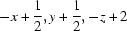
| Symmetry code: (ii) −x+1/2, y+1/2, −z+2. |
Experimental details
| Crystal data | |
| Chemical formula | [Au(C7H9N)2][AuCl4] |
| Mr | 750.04 |
| Crystal system, space group | Monoclinic, C2/m |
| Temperature (K) | 298 |
| a, b, c (Å) | 17.773 (3), 6.8395 (8), 8.3728 (14) |
| β (°) | 110.929 (12) |
| V (Å3) | 950.6 (3) |
| Z | 2 |
| Radiation type | Mo Kα |
| µ (mm−1) | 15.97 |
| Crystal size (mm) | 0.20 × 0.12 × 0.08 |
| Data collection | |
| Diffractometer | Bruker SMART APEX CCD area-detector diffractometer |
| Absorption correction | Multi-scan (SADABS; Sheldrick, 1996) |
| Tmin, Tmax | 0.112, 0.275 |
| No. of measured, independent and observed [I > 2σ(I)] reflections | 5473, 1384, 1123 |
| Rint | 0.092 |
| (sin θ/λ)max (Å−1) | 0.687 |
| Refinement | |
| R[F2 > 2σ(F2)], wR(F2), S | 0.044, 0.115, 1.20 |
| No. of reflections | 1384 |
| No. of parameters | 69 |
| H-atom treatment | H-atom parameters constrained |
| Δρmax, Δρmin (e Å−3) | 1.76, −2.1 |
Computer programs: SMART (Bruker, 2007), SAINT (Bruker, 2007), SHELXTL (Sheldrick, 2008), WinGX (Farrugia, 1999).
| Au1—N1 | 2.030 (8) | Au2—Cl2 | 2.286 (4) |
| Au2—Cl1 | 2.280 (3) | ||
| Cl1i—Au2—Cl2 | 90.05 (14) | Cl1—Au2—Cl2 | 89.95 (14) |
| Symmetry code: (i) −x, y, −z+1. |
| D—H···A | D—H | H···A | D···A | D—H···A |
| C3—H3···Cl1ii | 0.93 | 2.77 | 3.572 (14) | 145 |
| Symmetry code: (ii) −x+1/2, y+1/2, −z+2. |
Acknowledgements
We are grateful to Islamic Azad University, Shahr-e-Rey Branch, for financial support.
References
 Abbate, F., Orioli, P., Bruni, B., Marcon, G. & Messori, L. (2000). Inorg. Chim. Acta, 311, 1–5. Web of Science CSD CrossRef CAS Google Scholar
Adams, H. N. & Strähle, J. (1982). Z. Anorg. Allg. Chem. 485, 65–80. CSD CrossRef CAS Web of Science Google Scholar
Ahmadi, R., Amani, V. & Khavasi, H. R. (2008). Acta Cryst. E64, m1156–m1157. Web of Science CSD CrossRef CAS IUCr Journals Google Scholar
Amani, V., Rahimi, R. & Khavasi, H. R. (2008). Acta Cryst. E64, m1143–m1144. Web of Science CSD CrossRef CAS IUCr Journals Google Scholar
Bjernemose, J. K., Raithby, P. R. & Toftlund, H. (2004). Acta Cryst. E60, m1719–m1721. Web of Science CSD CrossRef IUCr Journals Google Scholar
Bruker (2007). SMART and SAINT. Bruker AXS Inc., Madison, Wisconsin, USA. Google Scholar
Farrugia, L. J. (1999). J. Appl. Cryst. 32, 837–838. CrossRef CAS IUCr Journals Google Scholar
Hayoun, R., Zhong, D. K., Rheingold, A. L. & Doerrer, L. H. (2006). Inorg. Chem. 45, 6120–6122. Web of Science CSD CrossRef PubMed CAS Google Scholar
Hojjat Kashani, L., Yousefi, M., Amani, V. & Khavasi, H. R. (2008). Acta Cryst. E64, m840–m841. Web of Science CSD CrossRef IUCr Journals Google Scholar
Hollis, L. S. & Lippard, S. J. (1983). J. Am. Chem. Soc. 105, 4293–4299. CSD CrossRef CAS Web of Science Google Scholar
McInnes, E. J. L., Welch, A. J. & Yellowlees, L. J. (1995). Acta Cryst. C51, 2023–2025. CSD CrossRef CAS Web of Science IUCr Journals Google Scholar
Sheldrick, G. M. (1996). SADABS. University of Göttingen, Germany. Google Scholar
Sheldrick, G. M. (2008). Acta Cryst. A64, 112–122. Web of Science CrossRef CAS IUCr Journals Google Scholar
Yıldırım, S. Ö., Akkurt, M., Safari, N., Amani, V., McKee, V., Abedi, A. & Khavasi, H. R. (2008). Acta Cryst. E64, m1189–m1190. Web of Science CSD CrossRef IUCr Journals Google Scholar
This is an open-access article distributed under the terms of the Creative Commons Attribution (CC-BY) Licence, which permits unrestricted use, distribution, and reproduction in any medium, provided the original authors and source are cited.
| CRYSTALLOGRAPHIC COMMUNICATIONS |


Recently, we reported the syntheses and crystal structures of [Au(dmphen)Cl2][AuCl4], (II), (Ahmadi et al., 2008), [dmpyH][PtCl6], (III), (Amani et al., 2008) and [H2DA18C6][AuCl4].2H2O, (IV), (Hojjat Kashani et al., 2008) (dmphen = 4,7-diphenyl-1,10-phenanthroline; dmpyH = 2,6-dimethylpyridinium and H2DA18C6 = 1,10-diazonia-18-crown-6). Several AuIII complexes with formula [AuCl2L]X, such as [AuCl2(bipy)](BF4), (V), (McInnes et al., 1995), [AuCl2(bipy)](NO3), (VI), (Bjernemose et al., 2004), [AuCl2(bipy)][AuBr4], (VII), (Hayoun et al., 2006), [AuCl2(dtbpy)][AuCl4].CH3CN, (VIII), (Yildirim et al., 2008) and [AuCl2(phen)]Cl.H2O, (IX), (Abbate et al., 2000) (bipy = 2,2'-bipyridine; dtbpy = 4,4'-ditertbutyl-2,2'-bipyridine; phen = 1,10-phenanthroline) have been synthesized and characterized by single-crystal X-ray diffraction methods. Two AuIII complexes with formula [AuCl2L2]X, [AuCl2(py)2][AuCl4], (X), and [AuCl2(py)2]Cl.H2O, (XI), (Adams & Strahle, 1982) (py = pyridine) and only one mixed-valence AuI–AuIII complex, [Au(terpy)Cl]2[AuCl2]3[AuCl4], (XII), (Hollis & Lippard, 1983) (terpy = 2,2',2''-terpyridine) have been synthesized and characterized by single-crystal X-ray diffraction methods. We report herein the synthesis and crystal structure of the title compound (I).
In the cation of the title compound (Fig. 1), the AuI atom is two-coordinated in a linear arrangement by two N atoms from two 2,6-dimethylpyridine ligands. In the anion, the AuIII atom has a square-planar coordination geometry. The Au atoms each are located on an inversion center. In the cation, the Au—N bond length (Table 1) is in good agreement with the corresponding values in (X) and (XI) and in the anion, the Au—Cl bond lengths and angles (Table 1) are within a normal range, comparable with those in (II), (VIII) and (XII). In the crystal structure, intermolecular C—H···Cl hydrogen bonds are observed.