 | Acta Crystallographica Section E Acta Crystallographica Section E CRYSTALLOGRAPHIC COMMUNICATIONS |


 journal menu


inorganic compounds
| CRYSTALLOGRAPHIC COMMUNICATIONS |
 access
Mg4Sb2O9 of the ilmenite structure type

aNational Institute for Materials Science, 1-1 Namiki, Tsukuba, Ibaraki 305-0044, Japan
*Correspondence e-mail: [email protected]
Single crystals of the title compound, tetramagnesium diantimonate(V), were obtained by the slow cooling method with K2CO3. The structure is isotypic with ilmenite, which is constructed by the alternate stacking of layers consisting of metal–oxygen coordination octahedra. In each layer, the octahedra are connected by sharing edges so as to make holes. One of the two non-equivalent metal sites is fully occupied by Mg (3 symmetry), while the second metal site (3 symmetry) is disordered and occupied by Mg and Sb with occupation factors of 1/3 and 2/3, respectively.
Related literature
For ilmenite structures, see: Wechsler & Prewitt (1984![[Wechsler, B. A. & Prewitt, C. T. (1984). Am. Mineral. 69, 176-185.]](../../../../../../logos/arrows/e_arr.gif "Wechsler, B. A. & Prewitt, C. T. (1984). Am. Mineral. 69, 176-185.") ) for FeTiO3 and Wechsler & Von Dreele (1989) for MgTiO3. For further phases in the MgO–Sb2O5 system, see: Kasper (1969). For related literature, see: Becker & Coppens (1974); Blasse (1964); Michiue (2007).
) for FeTiO3 and Wechsler & Von Dreele (1989) for MgTiO3. For further phases in the MgO–Sb2O5 system, see: Kasper (1969). For related literature, see: Becker & Coppens (1974); Blasse (1964); Michiue (2007).
Experimental
Crystal data
|

Refinement
|
|
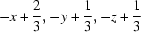 ; (ii)
 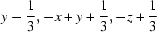 ; (iv)
 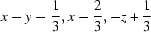 ; (vi)
 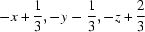 ; (vii)
 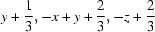 ; (viii)
 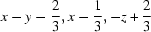 .
. Data collection: MSC/AFC Diffractometer Control Software (Molecular Structure Corporation, 1994); cell refinement: MSC/AFC Diffractometer Control Software; data reduction: CrystalStructure (Rigaku, 2004); method used to solve structure: structure of the present compound is isotypic with ilmenite; program(s) used to refine structure: JANA2000 (Petříček et al., 2000); molecular graphics: ATOMS (Dowty, 2005); software used to prepare material for publication: JANA2000.
Supporting information
contains datablocks global, I. DOI: 10.1107/S160053680802789X/si2101sup1.cif
Structure factors: contains datablock I. DOI: 10.1107/S160053680802789X/si2101Isup2.hkl
Single crystals of the title compound were obtained unintentionally as the product of a synthesis of K-hollandite by the slow cooling method with excess K2CO3 (Michiue, 2007).
Partial substitution of Sb for Mg at the Mg2 site was checked by refining the occupation factors of Mg and Sb at the site. In the the full occupation at all the metal and oxygen sites was assumed and the charge neutrality of the whole crystal was kept by imposing constraint conditions. The possibility of the existence of Sb ions at the Mg2 site was excluded because the occupation factor of Sb at the site was slightly negative, -0.001, and that of Mg was 1.001 after the Thus, it was concluded that Sb ions are only at the Mg1/Sb1 site.
Data collection: MSC/AFC Diffractometer Control Software (Molecular Structure Corporation, 1994); cell MSC/AFC Diffractometer Control Software (Molecular Structure Corporation, 1994); data reduction: (Rigaku, 2004); program(s) used to solve structure: structure of the present compound is isotypic with ilmenite; program(s) used to refine structure: (JANA2000; Petříček et al., 2000); molecular graphics: ATOMS (Dowty, 2005); software used to prepare material for publication: (JANA2000; Petříček et al., 2000).
![[Figure 1]](./si2101fig1thm.gif) | Fig. 1. The projection of Mg4Sb2O9 along [110]. |
![[Figure 2]](./si2101fig2thm.gif) | Fig. 2. Layers with holes consisting of (a) Mg2O6 octahedra extending around z = 0 and (b) (Mg1/Sb1)O6 octahedra around z = 1/6 in Mg4Sb2O9. |
| Mg4O9Sb2 | Dx = 4.952 Mg m−3 |
| Mr = 484.7 | Mo Kα radiation, λ = 0.71069 Å |
| Trigonal, R3 | Cell parameters from 20 reflections |
| Hall symbol: -R 3 | θ = 9.3–13.5° |
| a = 5.1722 (11) Å | µ = 8.73 mm−1 |
| c = 14.028 (2) Å | T = 295 K |
| V = 324.99 (11) Å3 | Plate, colorless |
| Z = 2 | 0.22 × 0.22 × 0.04 mm |
| F(000) = 444 |
| Rigaku AFC-7R diffractometer | 715 reflections with I > 2σ(I) |
| Radiation source: rotating-anode X-ray tube | Rint = 0.047 |
| Graphite monochromator | θmax = 50.1°, θmin = 4.4° |
| ω/2θ scans | h = −11→11 |
| Absorption correction: analytical (Tompa Analytical, Rigaku 2004) | k = −11→11 |
| Tmin = 0.210, Tmax = 0.671 | l = 0→30 |
| 2359 measured reflections | 3 standard reflections every 200 reflections |
| 773 independent reflections | intensity decay: 4.6% |
| Refinement on F2 | Primary atom site location: isomorphous structure methods |
| Least-squares matrix: full | Weighting scheme based on measured s.u.'s w = 1/(σ2(I) + 0.0009I2) |
| R[F2 > 2σ(F2)] = 0.032 | (Δ/σ)max = 0.0004 |
| wR(F2) = 0.075 | Δρmax = 3.78 e Å−3 |
| S = 1.55 | Δρmin = −3.64 e Å−3 |
| 773 reflections | Extinction correction: B-C type 1 Lorentzian isotropic (Becker & Coppens, 1974) |
| 17 parameters | Extinction coefficient: 0.071 (3) |
| 0 restraints |
| Mg4O9Sb2 | Z = 2 |
| Mr = 484.7 | Mo Kα radiation |
| Trigonal, R3 | µ = 8.73 mm−1 |
| a = 5.1722 (11) Å | T = 295 K |
| c = 14.028 (2) Å | 0.22 × 0.22 × 0.04 mm |
| V = 324.99 (11) Å3 |
| Rigaku AFC-7R diffractometer | 715 reflections with I > 2σ(I) |
| Absorption correction: analytical (Tompa Analytical, Rigaku 2004) | Rint = 0.047 |
| Tmin = 0.210, Tmax = 0.671 | 3 standard reflections every 200 reflections |
| 2359 measured reflections | intensity decay: 4.6% |
| 773 independent reflections |
| R[F2 > 2σ(F2)] = 0.032 | 17 parameters |
| wR(F2) = 0.075 | 0 restraints |
| S = 1.55 | Δρmax = 3.78 e Å−3 |
| 773 reflections | Δρmin = −3.64 e Å−3 |
| x | y | z | Uiso*/Ueq | Occ. (<1) | |
| Mg1 | 0 | 0 | 0.152618 (14) | 0.00628 (7) | 0.3333 |
| M1 | 0 | 0 | 0.152618 (14) | 0.00628 (7) | 0.6667 |
| Mg2 | 0 | 0 | 0.35806 (10) | 0.0098 (2) | |
| O1 | 0.3091 (3) | 0.0125 (3) | 0.24710 (7) | 0.0078 (3) |
| U11 | U22 | U33 | U12 | U13 | U23 | |
| Mg1 | 0.00711 (10) | 0.00711 (10) | 0.00461 (10) | 0.00356 (5) | 0 | 0 |
| M1 | 0.00711 (10) | 0.00711 (10) | 0.00461 (10) | 0.00356 (5) | 0 | 0 |
| Mg2 | 0.0080 (3) | 0.0080 (3) | 0.0133 (4) | 0.00401 (13) | 0 | 0 |
| O1 | 0.0097 (4) | 0.0073 (4) | 0.0069 (3) | 0.0047 (3) | −0.0010 (3) | 0.0011 (2) |
| M1—O1 | 2.0527 (15) | Mg2—O1 | 2.2091 (17) |
| M1—O1i | 1.9928 (11) | Mg2—O1vi | 2.0455 (17) |
| M1—O1ii | 2.0527 (19) | Mg2—O1ii | 2.209 (2) |
| M1—O1iii | 1.9928 (18) | Mg2—O1vii | 2.0455 (14) |
| M1—O1iv | 2.0527 (12) | Mg2—O1iv | 2.2091 (15) |
| M1—O1v | 1.9928 (17) | Mg2—O1viii | 2.046 (2) |
| O1—M1—O1i | 83.77 (5) | O1—Mg2—O1vi | 87.88 (6) |
| O1—M1—O1ii | 82.80 (6) | O1—Mg2—O1ii | 75.84 (7) |
| O1—M1—O1iii | 166.22 (6) | O1—Mg2—O1vii | 89.32 (5) |
| O1—M1—O1iv | 82.80 (6) | O1—Mg2—O1iv | 75.84 (7) |
| O1—M1—O1v | 92.43 (7) | O1—Mg2—O1viii | 160.12 (8) |
| O1i—M1—O1 | 83.77 (5) | O1vi—Mg2—O1 | 87.88 (6) |
| O1i—M1—O1ii | 92.43 (5) | O1vi—Mg2—O1ii | 160.12 (8) |
| O1i—M1—O1iii | 99.93 (6) | O1vi—Mg2—O1vii | 103.48 (8) |
| O1i—M1—O1iv | 166.22 (6) | O1vi—Mg2—O1iv | 89.32 (6) |
| O1i—M1—O1v | 99.93 (6) | O1vi—Mg2—O1viii | 103.48 (7) |
| O1ii—M1—O1 | 82.80 (6) | O1ii—Mg2—O1 | 75.84 (7) |
| O1ii—M1—O1i | 92.43 (5) | O1ii—Mg2—O1vi | 160.12 (8) |
| O1ii—M1—O1iii | 83.77 (7) | O1ii—Mg2—O1vii | 87.88 (6) |
| O1ii—M1—O1iv | 82.80 (6) | O1ii—Mg2—O1iv | 75.84 (7) |
| O1ii—M1—O1v | 166.22 (5) | O1ii—Mg2—O1viii | 89.32 (6) |
| O1iii—M1—O1 | 166.22 (6) | O1vii—Mg2—O1 | 89.32 (5) |
| O1iii—M1—O1i | 99.93 (6) | O1vii—Mg2—O1vi | 103.48 (8) |
| O1iii—M1—O1ii | 83.77 (7) | O1vii—Mg2—O1ii | 87.88 (6) |
| O1iii—M1—O1iv | 92.43 (7) | O1vii—Mg2—O1iv | 160.12 (8) |
| O1iii—M1—O1v | 99.93 (8) | O1vii—Mg2—O1viii | 103.48 (7) |
| O1iv—M1—O1 | 82.80 (6) | O1iv—Mg2—O1 | 75.84 (7) |
| O1iv—M1—O1i | 166.22 (6) | O1iv—Mg2—O1vi | 89.32 (6) |
| O1iv—M1—O1ii | 82.80 (6) | O1iv—Mg2—O1ii | 75.84 (7) |
| O1iv—M1—O1iii | 92.43 (7) | O1iv—Mg2—O1vii | 160.12 (8) |
| O1iv—M1—O1v | 83.77 (6) | O1iv—Mg2—O1viii | 87.88 (6) |
| O1v—M1—O1 | 92.43 (7) | O1viii—Mg2—O1 | 160.12 (8) |
| O1v—M1—O1i | 99.93 (6) | O1viii—Mg2—O1vi | 103.48 (7) |
| O1v—M1—O1ii | 166.22 (5) | O1viii—Mg2—O1ii | 89.32 (6) |
| O1v—M1—O1iii | 99.93 (8) | O1viii—Mg2—O1vii | 103.48 (7) |
| O1v—M1—O1iv | 83.77 (6) | O1viii—Mg2—O1iv | 87.88 (6) |
| Symmetry codes: (i) −x+2/3, −y+1/3, −z+1/3; (ii) −y, x−y, z; (iii) y−1/3, −x+y+1/3, −z+1/3; (iv) −x+y, −x, z; (v) x−y−1/3, x−2/3, −z+1/3; (vi) −x+1/3, −y−1/3, −z+2/3; (vii) y+1/3, −x+y+2/3, −z+2/3; (viii) x−y−2/3, x−1/3, −z+2/3. |
Experimental details
| Crystal data | |
| Chemical formula | Mg4O9Sb2 |
| Mr | 484.7 |
| Crystal system, space group | Trigonal, R3 |
| Temperature (K) | 295 |
| a, c (Å) | 5.1722 (11), 14.028 (2) |
| V (Å3) | 324.99 (11) |
| Z | 2 |
| Radiation type | Mo Kα |
| µ (mm−1) | 8.73 |
| Crystal size (mm) | 0.22 × 0.22 × 0.04 |
| Data collection | |
| Diffractometer | Rigaku AFC-7R diffractometer |
| Absorption correction | Analytical (Tompa Analytical, Rigaku 2004) |
| Tmin, Tmax | 0.210, 0.671 |
| No. of measured, independent and observed [I > 2σ(I)] reflections | 2359, 773, 715 |
| Rint | 0.047 |
| (sin θ/λ)max (Å−1) | 1.080 |
| Refinement | |
| R[F2 > 2σ(F2)], wR(F2), S | 0.032, 0.075, 1.55 |
| No. of reflections | 773 |
| No. of parameters | 17 |
| Δρmax, Δρmin (e Å−3) | 3.78, −3.64 |
Computer programs: MSC/AFC Diffractometer Control Software (Molecular Structure Corporation, 1994), (Rigaku, 2004), structure of the present compound is isotypic with ilmenite, (JANA2000; Petříček et al., 2000), ATOMS (Dowty, 2005).
| M1—O1 | 2.0527 (15) | Mg2—O1 | 2.2091 (17) |
| M1—O1i | 1.9928 (11) | Mg2—O1vi | 2.0455 (17) |
| M1—O1ii | 2.0527 (19) | Mg2—O1ii | 2.209 (2) |
| M1—O1iii | 1.9928 (18) | Mg2—O1vii | 2.0455 (14) |
| M1—O1iv | 2.0527 (12) | Mg2—O1iv | 2.2091 (15) |
| M1—O1v | 1.9928 (17) | Mg2—O1viii | 2.046 (2) |
| Symmetry codes: (i) −x+2/3, −y+1/3, −z+1/3; (ii) −y, x−y, z; (iii) y−1/3, −x+y+1/3, −z+1/3; (iv) −x+y, −x, z; (v) x−y−1/3, x−2/3, −z+1/3; (vi) −x+1/3, −y−1/3, −z+2/3; (vii) y+1/3, −x+y+2/3, −z+2/3; (viii) x−y−2/3, x−1/3, −z+2/3. |
References
 Becker, P. J. & Coppens, P. (1974). Acta Cryst. A30, 129–147. CrossRef IUCr Journals Web of Science Google Scholar
Blasse, G. (1964). Z. Anorg. Allg. Chem. 331, 44–50. CrossRef CAS Web of Science Google Scholar
Dowty, E. (2005). ATOMS. Shape Software, Kingsport, Tennessee, USA. Google Scholar
Kasper, H. (1969). Z. Kristallogr. 128, 72–84. CrossRef Google Scholar
Michiue, Y. (2007). J. Solid State Chem. 180, 1840–1845. Web of Science CrossRef CAS Google Scholar
Molecular Structure Corporation (1994). MSC/AFC Diffractometer Control Software. MSC, The Woodlands, Texas, USA. Google Scholar
Petříček, V., Dušek, M. & Palatinus, L. (2000). JANA2000. Institute of Physics, Prague, Czech Republic. Google Scholar
Rigaku (2004). CrystalStructure and Tompa Analytical. Rigaku Corporation, Tokyo, Japan. Google Scholar
Wechsler, B. A. & Von Dreele, R. B. (1989). Acta Cryst. B45, 542–549. CrossRef CAS Web of Science IUCr Journals Google Scholar
Wechsler, B. A. & Prewitt, C. T. (1984). Am. Mineral. 69, 176–185. CAS Google Scholar
This is an open-access article distributed under the terms of the Creative Commons Attribution (CC-BY) Licence, which permits unrestricted use, distribution, and reproduction in any medium, provided the original authors and source are cited.
| CRYSTALLOGRAPHIC COMMUNICATIONS |


A pronounced resemblance of X-ray diffraction patterns for Mg4Sb2O9 and the ilmenite MgTiO3 was pointed out by Blasse (1964). In general, ilmenite structure is represented by A2+B4+O3, that is including equal amounts of divalent and tetravalent cations such as FeTiO3 and MgTiO3. Although the chemical composition Mg4Sb2O9 is away from that of the typical ilmenite structure, the present analysis has confirmed that the structure of Mg4Sb2O9 is deduced from the ilmenite MgTiO3 by replacing the Ti4+ ions statistically by 1/3 Mg2+ and 2/3 Sb5+, as was supposed by Blasse (1964).
The structure is constructed by the alternate stacking of atomic layers along c as shown in Fig. 1. Each of the two nonequivalent metal sites is octahedrally coordinated by six oxygen ions. Two types of layers consisting of edge-shared octahedra are seen in the structure, both of which have holes as illustrated in Fig. 2.