 | Acta Crystallographica Section E Acta Crystallographica Section E CRYSTALLOGRAPHIC COMMUNICATIONS |


 journal menu


inorganic compounds
| CRYSTALLOGRAPHIC COMMUNICATIONS |
 access
Co3(PO4)2·4H2O

aDepartment of Chemistry, Kyungpook National University, Daegu 702-701, Republic of Korea, bCentre for Heavy Metals Research, School of Chemistry, F11, University of Sydney, New South Wales 2006, Australia, cARC Centre of Excellence for Functional Nanomaterials, AIBN, University of Queensland, Brisbane, Queensland 4072, Australia, and dDepartment of Chemistry and Advanced Materials, Kosin University, 149-1 Dongsam-dong, Yeongdo-gu, Busan 606-701, Republic of Korea
*Correspondence e-mail: [email protected]
Single crystals of Co3(PO4)2·4H2O, tricobalt(II) bis[orthophosphate(V)] tetrahydrate, were obtained under hydrothermal conditions. The title compound is isotypic with its zinc analogue Zn3(PO4)2·4H2O (mineral name hopeite) and contains two independent Co2+ cations. One Co2+ cation exhibits a slightly distorted tetrahedral coordination, while the second, located on a mirror plane, has a distorted octahedral coordination environment. The tetrahedrally coordinated Co2+ is bonded to four O atoms of four PO43− anions, whereas the six-coordinate Co2+ is cis-bonded to two phosphate groups and to four O atoms of four water molecules (two of which are located on mirror planes), forming a framework structure. In addition, hydrogen bonds of the type O—H⋯O are present throughout the crystal structure.
Related literature
Besides crystals of the title compound, crystals of Co3(PO4)2·H2O (Lee et al., 2008![[Lee, Y. H., Clegg, J. K., Lindoy, L. F., Lu, G. Q. M., Park, Y.-C. & Kim, Y. (2008). Acta Cryst. E64, i69-i70.]](../../../../../../logos/arrows/e_arr.gif "Lee, Y. H., Clegg, J. K., Lindoy, L. F., Lu, G. Q. M., Park, Y.-C. & Kim, Y. (2008). Acta Cryst. E64, i69-i70.") ) have also been obtained under hydrothermal conditions. For reviews, synthesis, structures and applications of open framework structures with different cations and/or structure directing molecules, see: Kuzicki et al. (2001); Chen et al. (2006); Jiang & Gao (2007); Cheetham et al. (1999); Forster et al. (2003); Jiang et al. (2001); Cooper et al. (2004); Choudhury et al. (2000). The structure of the isotypic mineral hopeite was first described by Liebau (1965).
) have also been obtained under hydrothermal conditions. For reviews, synthesis, structures and applications of open framework structures with different cations and/or structure directing molecules, see: Kuzicki et al. (2001); Chen et al. (2006); Jiang & Gao (2007); Cheetham et al. (1999); Forster et al. (2003); Jiang et al. (2001); Cooper et al. (2004); Choudhury et al. (2000). The structure of the isotypic mineral hopeite was first described by Liebau (1965).
Experimental
Crystal data
|
Refinement
|
|
 ; (iii)
|
 ; (v)
; (v)  ; (vi)
  ; (viii)
 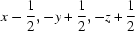 .
. Data collection: SMART (Siemens, 1995); cell refinement: SAINT (Siemens, 1995); data reduction: SAINT and XPREP (Siemens, 1995); program(s) used to solve structure: SIR97 (Altomare et al., 1999); program(s) used to refine structure: SHELXL97 (Sheldrick, 2008); molecular graphics: ORTEP-3 (Farrugia, 1997), WebLab ViewerPro (Molecular Simulations, 2000) and POV-RAY (Cason, 2002); software used to prepare material for publication: enCIFer (Allen et al., 2004).
Supporting information
contains datablocks global, I. DOI: 10.1107/S1600536808028377/wm2193sup1.cif
Structure factors: contains datablock I. DOI: 10.1107/S1600536808028377/wm2193Isup2.hkl
H3PO4 (85%wt, 2.3 g, 20 mmol) was added to an aqueous solution (20 ml) of Co(NO3)2.6H2O (2.6 g, 9 mmol) with stirring for 30 min and the ionic liquid, 1-butyl-3-methylimidazolium bromide (2.7 g, 9 mmol), was added dropwise under continuous stirring. The mixture was transferred to a teflon-coated autoclave, heated at 453 K for 3 d and then allowed to cool slowly. A mixture of plate-like and prismatic purple crystals had formed and was filtered off. The crystals were washed with water, dried under vacuum and were manually separated under a microscope. The yields were approximately 0.4 g of the plate-like crystals of the compound Co3(PO4)2.H2O (Lee et al., 2008) and and 0.2 g of the prismatic crystals of compound (I).
Water H atoms were located in difference Fourier maps and were refined with Uiso(H) values fixed at 1.5Ueq of the parent O atoms. O—H bond length restraints of 0.89 (1) Å were also employed. The highest peak and the deepest hole in the final Fourier map are located 0.49 Å from Co1 and 0.33 Å from P2, respectively.
Data collection: SMART (Siemens, 1995); cell SAINT (Siemens, 1995); data reduction: SAINT and XPREP (Siemens, 1995); program(s) used to solve structure: SIR97 (Altomare et al., 1999); program(s) used to refine structure: SHELXL97 (Sheldrick, 2008); molecular graphics: ORTEP-3 (Farrugia, 1997), WebLab ViewerPro (Molecular Simulations, 2000) and POV-RAY (Cason, 2002); software used to prepare material for publication: enCIFer (Allen et al., 2004).
![[Figure 1]](./wm2193fig1thm.gif) | Fig. 1. The asymmetric unit of compound (I), drawn with displacement parameters at the 50% probability level. H atoms are given as spheres of arbitrary radius. |
![[Figure 2]](./wm2193fig2thm.gif) | Fig. 2. A schematic representation of a section of the three-dimensional network in a projection along [001]. Hydrogen atoms are omitted for clarity. |
| Co3(PO4)3·4H2O | F(000) = 860 |
| Mr = 438.79 | Dx = 3.002 Mg m−3 |
| Orthorhombic, Pnma | Mo Kα radiation, λ = 0.71073 Å |
| Hall symbol: -P 2ac 2n | Cell parameters from 5943 reflections |
| a = 10.604 (3) Å | θ = 2.9–28.3° |
| b = 18.288 (5) Å | µ = 5.46 mm−1 |
| c = 5.0070 (13) Å | T = 150 K |
| V = 971.0 (5) Å3 | Prism, purple |
| Z = 4 | 0.52 × 0.39 × 0.38 mm |
| Siemens SMART 1000 CCD diffractometer | 1228 independent reflections |
| Radiation source: sealed tube | 1166 reflections with I > 2σ(I) |
| Graphite monochromator | Rint = 0.026 |
| ω scans | θmax = 28.3°, θmin = 2.2° |
| Absorption correction: multi-scan (SADABS; Sheldrick, 1999) | h = −13→13 |
| Tmin = 0.068, Tmax = 0.125 | k = −24→24 |
| 8780 measured reflections | l = −6→6 |
| Refinement on F2 | Primary atom site location: structure-invariant direct methods |
| Least-squares matrix: full | Secondary atom site location: difference Fourier map |
| R[F2 > 2σ(F2)] = 0.035 | Hydrogen site location: difference Fourier map |
| wR(F2) = 0.102 | H atoms treated by a mixture of independent and constrained refinement |
| S = 1.16 | w = 1/[σ2(Fo2) + (0.059P)2 + 3.8213P] where P = (Fo2 + 2Fc2)/3 |
| 1228 reflections | (Δ/σ)max < 0.001 |
| 101 parameters | Δρmax = 0.55 e Å−3 |
| 10 restraints | Δρmin = −1.38 e Å−3 |
| Co3(PO4)3·4H2O | V = 971.0 (5) Å3 |
| Mr = 438.79 | Z = 4 |
| Orthorhombic, Pnma | Mo Kα radiation |
| a = 10.604 (3) Å | µ = 5.46 mm−1 |
| b = 18.288 (5) Å | T = 150 K |
| c = 5.0070 (13) Å | 0.52 × 0.39 × 0.38 mm |
| Siemens SMART 1000 CCD diffractometer | 1228 independent reflections |
| Absorption correction: multi-scan (SADABS; Sheldrick, 1999) | 1166 reflections with I > 2σ(I) |
| Tmin = 0.068, Tmax = 0.125 | Rint = 0.026 |
| 8780 measured reflections |
| R[F2 > 2σ(F2)] = 0.035 | 10 restraints |
| wR(F2) = 0.102 | H atoms treated by a mixture of independent and constrained refinement |
| S = 1.16 | Δρmax = 0.55 e Å−3 |
| 1228 reflections | Δρmin = −1.38 e Å−3 |
| 101 parameters |
Experimental. The crystal was coated in Exxon Paratone N hydrocarbon oil and mounted on a thin mohair fibre attached to a copper pin. Upon mounting on the diffractometer, the crystal was quenched to 150(K) under a cold nitrogen gas stream supplied by an Oxford Cryosystems Cryostream and data were collected at this temperature. |
Geometry. All esds (except the esd in the dihedral angle between two l.s. planes) are estimated using the full covariance matrix. The cell esds are taken into account individually in the estimation of esds in distances, angles and torsion angles; correlations between esds in cell parameters are only used when they are defined by crystal symmetry. An approximate (isotropic) treatment of cell esds is used for estimating esds involving l.s. planes. |
Refinement. Refinement of F2 against ALL reflections. The weighted R-factor wR and goodness of fit S are based on F2, conventional R-factors R are based on F, with F set to zero for negative F2. The threshold expression of F2 > σ(F2) is used only for calculating R-factors(gt) etc. and is not relevant to the choice of reflections for refinement. R-factors based on F2 are statistically about twice as large as those based on F, and R- factors based on ALL data will be even larger. |
| x | y | z | Uiso*/Ueq | Occ. (<1) | |
| Co1 | 0.64313 (4) | 0.00064 (2) | 0.20676 (8) | 0.00402 (17) | |
| Co2 | 0.26113 (6) | 0.2500 | 0.42866 (12) | 0.00838 (19) | |
| P1 | 0.39745 (9) | 0.09462 (5) | 0.27639 (18) | 0.0123 (2) | |
| O1 | 0.5259 (3) | 0.07872 (14) | 0.1463 (7) | 0.0202 (6) | |
| O2 | 0.3026 (2) | 0.03968 (15) | 0.1432 (5) | 0.0148 (5) | |
| O3 | 0.3601 (3) | 0.17305 (16) | 0.2139 (6) | 0.0201 (7) | |
| O4 | 0.3927 (4) | 0.2500 | 0.7439 (7) | 0.0155 (8) | |
| O5 | 0.1149 (4) | 0.2500 | 0.1406 (9) | 0.0192 (8) | |
| O6 | 0.1642 (3) | 0.16927 (15) | 0.6593 (6) | 0.0197 (6) | |
| O7 | 0.4000 (4) | 0.08075 (16) | 0.5755 (6) | 0.0311 (8) | |
| H1 | 0.098 (4) | 0.161 (3) | 0.553 (10) | 0.047* | |
| H2 | 0.2194 (15) | 0.1390 (19) | 0.739 (9) | 0.047* | |
| H3 | 0.132 (8) | 0.280 (5) | 0.005 (15) | 0.047* | 0.50 |
| H4 | 0.044 (5) | 0.231 (5) | 0.204 (18) | 0.047* | 0.50 |
| H5 | 0.403 (13) | 0.296 (3) | 0.80 (3) | 0.047* | 0.50 |
| H6 | 0.366 (13) | 0.210 (4) | 0.83 (3) | 0.047* | 0.50 |
| U11 | U22 | U33 | U12 | U13 | U23 | |
| Co1 | 0.0038 (3) | 0.0055 (3) | 0.0027 (3) | 0.00152 (13) | 0.00023 (14) | 0.00025 (13) |
| Co2 | 0.0081 (3) | 0.0088 (3) | 0.0082 (3) | 0.000 | 0.0006 (2) | 0.000 |
| P1 | 0.0179 (5) | 0.0077 (4) | 0.0114 (4) | 0.0004 (3) | −0.0004 (3) | 0.0003 (3) |
| O1 | 0.0128 (13) | 0.0123 (12) | 0.0357 (16) | −0.0008 (10) | −0.0008 (12) | 0.0038 (12) |
| O2 | 0.0135 (12) | 0.0177 (12) | 0.0134 (11) | −0.0024 (10) | 0.0020 (10) | −0.0028 (10) |
| O3 | 0.0331 (17) | 0.0099 (13) | 0.0174 (14) | 0.0061 (11) | 0.0094 (11) | 0.0022 (10) |
| O4 | 0.017 (2) | 0.0169 (19) | 0.0130 (16) | 0.000 | −0.0012 (15) | 0.000 |
| O5 | 0.0136 (18) | 0.026 (2) | 0.0183 (18) | 0.000 | −0.0003 (16) | 0.000 |
| O6 | 0.0175 (14) | 0.0149 (13) | 0.0267 (14) | −0.0024 (11) | 0.0027 (12) | 0.0026 (12) |
| O7 | 0.066 (2) | 0.0131 (13) | 0.0142 (13) | −0.0105 (14) | −0.0095 (15) | 0.0020 (10) |
| Co1—O7i | 1.901 (3) | P1—O7 | 1.519 (3) |
| Co1—O1 | 1.918 (3) | P1—O3 | 1.521 (3) |
| Co1—O2ii | 1.983 (3) | P1—O1 | 1.537 (3) |
| Co1—O2iii | 1.986 (3) | P1—O2 | 1.570 (3) |
| Co2—O3iv | 2.058 (3) | O4—H5 | 0.893 (10) |
| Co2—O3 | 2.058 (3) | O4—H6 | 0.893 (10) |
| Co2—O4 | 2.106 (4) | O5—H3 | 0.892 (10) |
| Co2—O5 | 2.118 (4) | O5—H4 | 0.891 (10) |
| Co2—O6 | 2.138 (3) | O6—H1 | 0.89 (4) |
| Co2—O6iv | 2.138 (3) | O6—H2 | 0.90 (3) |
| O7i—Co1—O1 | 121.18 (15) | O7—P1—O3 | 111.40 (17) |
| O7i—Co1—O2ii | 105.64 (13) | O7—P1—O1 | 111.8 (2) |
| O1—Co1—O2ii | 110.16 (12) | O3—P1—O1 | 108.79 (16) |
| O7i—Co1—O2iii | 106.57 (12) | O7—P1—O2 | 108.84 (17) |
| O1—Co1—O2iii | 108.97 (13) | O3—P1—O2 | 110.43 (17) |
| O2ii—Co1—O2iii | 102.75 (8) | O1—P1—O2 | 105.46 (16) |
| O3iv—Co2—O3 | 86.26 (16) | P1—O1—Co1 | 130.42 (18) |
| O3iv—Co2—O4 | 93.09 (12) | P1—O2—Co1v | 128.01 (16) |
| O3—Co2—O4 | 93.09 (12) | P1—O2—Co1iii | 115.24 (15) |
| O3iv—Co2—O5 | 91.00 (12) | Co1v—O2—Co1iii | 116.58 (13) |
| O3—Co2—O5 | 91.00 (12) | P1—O3—Co2 | 132.08 (17) |
| O4—Co2—O5 | 174.38 (15) | Co2—O4—H5 | 108 (10) |
| O3iv—Co2—O6 | 178.01 (12) | Co2—O4—H6 | 98 (10) |
| O3—Co2—O6 | 93.16 (12) | H5—O4—H6 | 133 (3) |
| O4—Co2—O6 | 85.03 (11) | Co2—O5—H3 | 112 (6) |
| O5—Co2—O6 | 90.91 (12) | Co2—O5—H4 | 112 (6) |
| O3iv—Co2—O6iv | 93.16 (12) | H3—O5—H4 | 134 (3) |
| O3—Co2—O6iv | 178.01 (12) | Co2—O6—H1 | 100 (4) |
| O4—Co2—O6iv | 85.03 (11) | Co2—O6—H2 | 110.7 (10) |
| O5—Co2—O6iv | 90.91 (12) | H1—O6—H2 | 132 (2) |
| O6—Co2—O6iv | 87.36 (16) | P1—O7—Co1i | 133.79 (19) |
| O7—P1—O1—Co1 | 41.2 (3) | O1—P1—O2—Co1iii | −20.9 (2) |
| O3—P1—O1—Co1 | 164.7 (2) | O7—P1—O3—Co2 | −22.9 (3) |
| O2—P1—O1—Co1 | −76.9 (3) | O1—P1—O3—Co2 | −146.5 (2) |
| O7i—Co1—O1—P1 | 8.8 (3) | O2—P1—O3—Co2 | 98.2 (3) |
| O2ii—Co1—O1—P1 | −115.1 (2) | O3iv—Co2—O3—P1 | 153.57 (18) |
| O2iii—Co1—O1—P1 | 132.9 (2) | O4—Co2—O3—P1 | 60.7 (3) |
| O7—P1—O2—Co1v | 34.1 (3) | O5—Co2—O3—P1 | −115.5 (3) |
| O3—P1—O2—Co1v | −88.5 (2) | O6—Co2—O3—P1 | −24.5 (3) |
| O1—P1—O2—Co1v | 154.17 (19) | O3—P1—O7—Co1i | 143.7 (3) |
| O7—P1—O2—Co1iii | −140.96 (19) | O1—P1—O7—Co1i | −94.4 (4) |
| O3—P1—O2—Co1iii | 96.45 (18) | O2—P1—O7—Co1i | 21.7 (4) |
| Symmetry codes: (i) −x+1, −y, −z+1; (ii) x+1/2, y, −z+1/2; (iii) −x+1, −y, −z; (iv) x, −y+1/2, z; (v) x−1/2, y, −z+1/2. |
| D—H···A | D—H | H···A | D···A | D—H···A |
| O4—H5···O3vi | 0.89 (1) | 2.25 (8) | 2.764 (4) | 116 (7) |
| O4—H5···O7iv | 0.89 (1) | 2.49 (8) | 3.209 (3) | 138 (9) |
| O4—H6···O3vii | 0.89 (1) | 2.02 (7) | 2.764 (4) | 140 (10) |
| O5—H4···O3v | 0.89 (1) | 2.25 (2) | 3.133 (5) | 170 (8) |
| O5—H4···O3viii | 0.89 (1) | 2.66 (8) | 3.133 (5) | 115 (6) |
| O6—H1···O1v | 0.90 (4) | 1.94 (3) | 2.690 (4) | 140 (4) |
| O6—H2···O7 | 0.90 (3) | 2.35 (3) | 3.008 (5) | 130 (3) |
| Symmetry codes: (iv) x, −y+1/2, z; (v) x−1/2, y, −z+1/2; (vi) x, −y+1/2, z+1; (vii) x, y, z+1; (viii) x−1/2, −y+1/2, −z+1/2. |
Experimental details
| Crystal data | |
| Chemical formula | Co3(PO4)3·4H2O |
| Mr | 438.79 |
| Crystal system, space group | Orthorhombic, Pnma |
| Temperature (K) | 150 |
| a, b, c (Å) | 10.604 (3), 18.288 (5), 5.0070 (13) |
| V (Å3) | 971.0 (5) |
| Z | 4 |
| Radiation type | Mo Kα |
| µ (mm−1) | 5.46 |
| Crystal size (mm) | 0.52 × 0.39 × 0.38 |
| Data collection | |
| Diffractometer | Siemens SMART 1000 CCD diffractometer |
| Absorption correction | Multi-scan (SADABS; Sheldrick, 1999) |
| Tmin, Tmax | 0.068, 0.125 |
| No. of measured, independent and observed [I > 2σ(I)] reflections | 8780, 1228, 1166 |
| Rint | 0.026 |
| (sin θ/λ)max (Å−1) | 0.668 |
| Refinement | |
| R[F2 > 2σ(F2)], wR(F2), S | 0.035, 0.102, 1.16 |
| No. of reflections | 1228 |
| No. of parameters | 101 |
| No. of restraints | 10 |
| H-atom treatment | H atoms treated by a mixture of independent and constrained refinement |
| Δρmax, Δρmin (e Å−3) | 0.55, −1.38 |
Computer programs: SMART (Siemens, 1995), SAINT (Siemens, 1995), SAINT and XPREP (Siemens, 1995), SIR97 (Altomare et al., 1999), SHELXL97 (Sheldrick, 2008), ORTEP-3 (Farrugia, 1997), WebLab ViewerPro (Molecular Simulations, 2000) and POV-RAY (Cason, 2002), enCIFer (Allen et al., 2004).
| Co1—O7i | 1.901 (3) | Co2—O6 | 2.138 (3) |
| Co1—O1 | 1.918 (3) | P1—O7 | 1.519 (3) |
| Co1—O2ii | 1.983 (3) | P1—O3 | 1.521 (3) |
| Co1—O2iii | 1.986 (3) | P1—O1 | 1.537 (3) |
| Co2—O4 | 2.106 (4) | P1—O2 | 1.570 (3) |
| Co2—O5 | 2.118 (4) |
| Symmetry codes: (i) −x+1, −y, −z+1; (ii) x+1/2, y, −z+1/2; (iii) −x+1, −y, −z. |
| D—H···A | D—H | H···A | D···A | D—H···A |
| O4—H5···O3iv | 0.894 (10) | 2.25 (8) | 2.764 (4) | 116 (7) |
| O4—H5···O7v | 0.894 (10) | 2.49 (8) | 3.209 (3) | 138 (9) |
| O4—H6···O3vi | 0.894 (10) | 2.02 (7) | 2.764 (4) | 140 (10) |
| O5—H4···O3vii | 0.892 (10) | 2.25 (2) | 3.133 (5) | 170 (8) |
| O5—H4···O3viii | 0.892 (10) | 2.66 (8) | 3.133 (5) | 115 (6) |
| O6—H1···O1vii | 0.90 (4) | 1.94 (3) | 2.690 (4) | 140 (4) |
| O6—H2···O7 | 0.90 (3) | 2.35 (3) | 3.008 (5) | 130 (3) |
| Symmetry codes: (iv) x, −y+1/2, z+1; (v) x, −y+1/2, z; (vi) x, y, z+1; (vii) x−1/2, y, −z+1/2; (viii) x−1/2, −y+1/2, −z+1/2. |
Acknowledgements
We gratefully acknowledge the Brain Korea 21 programme and the Australian Research Council for support.
References
 Allen, F. H., Johnson, O., Shields, G. P., Smith, B. R. & Towler, M. (2004). J. Appl. Cryst. 37, 335–338. Web of Science CrossRef CAS IUCr Journals Google Scholar
Altomare, A., Burla, M. C., Camalli, M., Cascarano, G. L., Giacovazzo, C., Guagliardi, A., Moliterni, A. G. G., Polidori, G. & Spagna, R. (1999). J. Appl. Cryst. 32, 115–119. Web of Science CrossRef CAS IUCr Journals Google Scholar
Cason, C. J. (2002). POV-RAY. Hallam Oaks Pty Ltd, Williamstown, Victoria, Australia. Google Scholar
Cheetham, A. K., Férey, G. & Loiseau, T. (1999). Angew. Chem. Int. Ed. 38, 3268–3292. Web of Science CrossRef CAS Google Scholar
Chen, Z., Gao, Q., Gao, D., Wei, Q. & Ruan, M. (2006). Mater. Lett. 60, 1816–1822. Web of Science CrossRef CAS Google Scholar
Choudhury, A., Natarajan, S. & Rao, C. N. R. (2000). Inorg. Chem. 39, 4295–4304. Web of Science CSD CrossRef PubMed CAS Google Scholar
Cooper, E. R., Andrews, C. D., Wheatley, P. S., Webb, P. B., Wormald, P. & Morris, R. E. (2004). Nature (London), 430, 1012–1016. Web of Science CSD CrossRef PubMed CAS Google Scholar
Farrugia, L. J. (1997). J. Appl. Cryst. 30, 565. CrossRef IUCr Journals Google Scholar
Forster, P. M., Eckert, J., Chang, J.-S., Park, J.-S., Férey, G. & Cheatham, A. K. (2003). J. Am. Chem. Soc. 125, 1309–1312. Web of Science CrossRef PubMed CAS Google Scholar
Jiang, Y. & Gao, Q. (2007). Mater. Lett. 61, 2212–2216. Web of Science CrossRef CAS Google Scholar
Jiang, Y.-C., Lai, Y.-C., Wang, S.-L. & Lii, K.-H. (2001). Inorg. Chem. 40, 5320–5321. Web of Science CSD CrossRef PubMed CAS Google Scholar
Kuzicki, S. M., Bell, V. A., Nair, S., Hillhouse, H. W., Jacubinas, R. M., Braunbarth, V. M., Toby, B. H. & Tsapatsis, M. (2001). Nature (London), 412, 720–724. Web of Science PubMed Google Scholar
Lee, Y. H., Clegg, J. K., Lindoy, L. F., Lu, G. Q. M., Park, Y.-C. & Kim, Y. (2008). Acta Cryst. E64, i69–i70. Web of Science CrossRef IUCr Journals Google Scholar
Liebau, F. (1965). Acta Cryst. 18, 352–354. CrossRef CAS IUCr Journals Web of Science Google Scholar
Molecular Simulations (2000). WebLab ViewerPro. Accelrys Software Inc., San Diego, California, USA. Google Scholar
Sheldrick, G. M. (1999). SADABS. University of Göttingen, Germany. Google Scholar
Sheldrick, G. M. (2008). Acta Cryst. A64, 112–122. Web of Science CrossRef CAS IUCr Journals Google Scholar
Siemens (1995). SMART, SAINT and XPREP. Siemens Analytical X-ray Instruments Inc., Madison, Wisconsin, USA. Google Scholar
This is an open-access article distributed under the terms of the Creative Commons Attribution (CC-BY) Licence, which permits unrestricted use, distribution, and reproduction in any medium, provided the original authors and source are cited.
| CRYSTALLOGRAPHIC COMMUNICATIONS |


The synthesis and investigation of open-framework transition-metal phosphates has been a growing area of research over recent times. This is not only because of the rich structural chemistry involved, but is also due to many potential applications such as for catalysis, as alternatives for zeolites in separation and storage applications and, in particular, as potential gas storage materials (Kuzicki et al., 2001; Chen et al., 2006; Jiang & Gao, 2007; Cheetham et al., 1999). For example, microporous nickel phosphates incorporating 24-membered rings such as VSB-5 (Versailles/Santa Barbara-5) have been demonstrated to exhibit hydrogen uptake at low temperatures (Forster et al., 2003). Over the past couple of decades, a considerable number of metal phosphates/phosphites with open molecular architectures have also been synthesized incorporating organic units (see, for example: Jiang et al., 2001) and ionic liquids (Cooper et al., 2004) as structure-directing agents, often under hydrothermal or solvothermal conditions. One of the best known families of this type consists of zinc phosphate structures; individual materials of this type can exist as one dimensional (chain and ladder), two dimensional (layer) and three dimensional framework arrangements (Choudhury et al., 2000).
We are currently investigating the synthesis of a variety of similar functional materials through templation effects under hydrothermal conditions. The title compound, Co3(PO4)2.4H2O, (I), and the related compound Co3(PO4)2.H2O (Lee et al., 2008) were synthesized and structurally characterized as a part of these studies.
The structure of (I) is isotypic with the mineral hopeite, Zn3(PO4)2.4H2O (Liebau, 1965) and contains two different Co2+ centres bridged by orthophosphate anions (Fig. 1). The coordination environment of Co1 is slightly distorted tetrahedral while that of Co2 is close to octahedral (Table 1). Co1 is bonded to the O atoms of four different phosphate ligands, while Co2 is bonded to the O atoms of two orthophosphate ligands in a cis-arrangement. The other coordination sites are occupied by O atoms of the water ligands. A mirror plane passes through Co2 and two of the water molecules (O4 and O5). This coordination geometry leads to the formation of a three-dimensional framework (Fig. 2). A number of hydrogen bonding interactions O—H···O are present and stabilize the structure (Table 2).