 | Acta Crystallographica Section E Acta Crystallographica Section E CRYSTALLOGRAPHIC COMMUNICATIONS |


 journal menu


organic compounds
| CRYSTALLOGRAPHIC COMMUNICATIONS |
 access
2-Chloro-4-iodoaniline

aSchool of Science, Beijing Jiaotong University, Beijing 100044, People's Republic of China, and bCollege of Chemistry and Molecular Sciences, Wuhan University, Wuhan, Hubei 430072, People's Republic of China
*Correspondence e-mail: [email protected]
The title dihaloaniline, C6H5ClIN, shows no significant hydrogen bonds nor the commonly observed I⋯I interactions in the crystal structure, although an amino group and an I atom are available for such contacts. The crystal structure is stabilized by weak interactions involving the amine functionality as donor group and N or halogen atoms as acceptors.
Related literature
The title compound was first synthesized 90 years ago (Dains et al., 1918![[Dains, F. B., Vaughan, T. H. & Janney, W. M. (1918). J. Am. Chem. Soc. 40, 930-936.]](../../../../../../logos/arrows/e_arr.gif "Dains, F. B., Vaughan, T. H. & Janney, W. M. (1918). J. Am. Chem. Soc. 40, 930-936.") ). For structures of halogenated anilines, see: Cox (2001); Dey et al. (2003); Dou et al. (1993); Fukuyo et al. (1982); Goubitz et al. (2001); Parkin et al. (2005); Sakurai et al. (1963).
). For structures of halogenated anilines, see: Cox (2001); Dey et al. (2003); Dou et al. (1993); Fukuyo et al. (1982); Goubitz et al. (2001); Parkin et al. (2005); Sakurai et al. (1963).
![[Scheme 1]](bh2201scheme1.gif)
Experimental
Crystal data
|
|
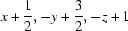 ; (ii)
 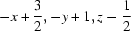 .
. Data collection: COLLECT (Nonius, 2002); cell refinement: SCALEPACK (Otwinowski & Minor, 1997); data reduction: DENZO–SMN (Otwinowski & Minor, 1997); program(s) used to solve structure: SHELXS97 (Sheldrick, 2008); program(s) used to refine structure: SHELXL97 (Sheldrick, 2008); molecular graphics: SHELXTL (Sheldrick, 2008); software used to prepare material for publication: SHELXL97 and local procedures.
Supporting information
contains datablocks global, I. DOI: 10.1107/S1600536808036076/bh2201sup1.cif
Structure factors: contains datablock I. DOI: 10.1107/S1600536808036076/bh2201Isup2.hkl
The compound was purchased from TCI America Laboratory Chemicals as colorless block crystals suitable for single-crystal X-ray diffraction measurement.
H atoms were found in a difference map and those on the aromatic ring subsequently placed in idealized positions with C—H distances of 0.95 Å and isotropic displacement parameters equal to 1.2Ueq of the carrier C atom. Amine H atoms H1N and H2N were refined freely but were restrained to converge to the same N—H bond lengths, with a standard deviation of 0.02 Å. Isotropic displacement parameters for H1N and H2N were computed as 1.5Ueq(N1)
Data collection: COLLECT (Nonius, 2002); cell SCALEPACK (Otwinowski & Minor, 1997); data reduction: DENZO-SMN (Otwinowski & Minor, 1997); program(s) used to solve structure: SHELXS97 (Sheldrick, 2008); program(s) used to refine structure: SHELXL97 (Sheldrick, 2008); molecular graphics: SHELXTL (Sheldrick, 2008); software used to prepare material for publication: SHELXL97 (Sheldrick, 2008) and local procedures.
![[Figure 1]](./bh2201fig1thm.gif) | Fig. 1. The molecular structure of (I), with displacement ellipsoids drawn at the 50% probability level (arbitrary spheres for the H atoms). |
![[Figure 2]](./bh2201fig2thm.gif) | Fig. 2. A packing diagram of (I) down the a axis. |
| C6H5ClIN | F(000) = 472 |
| Mr = 253.46 | Dx = 2.282 Mg m−3 |
| Orthorhombic, P212121 | Mo Kα radiation, λ = 0.71073 Å |
| Hall symbol: P 2ac 2ab | Cell parameters from 1019 reflections |
| a = 5.6277 (2) Å | θ = 1.0–27.5° |
| b = 8.7859 (3) Å | µ = 4.61 mm−1 |
| c = 14.9217 (5) Å | T = 90 K |
| V = 737.79 (4) Å3 | Rounded block, colourless |
| Z = 4 | 0.22 × 0.15 × 0.10 mm |
| Nonius KappaCCD diffractometer | 1696 independent reflections |
| Radiation source: fine-focus sealed tube | 1587 reflections with I > 2σ(I) |
| Graphite monochromator | Rint = 0.033 |
| Detector resolution: 18 pixels mm-1 | θmax = 27.5°, θmin = 2.7° |
| ω scans at fixed χ = 55° | h = −7→7 |
| Absorption correction: multi-scan (SCALEPACK; Otwinowski & Minor, 1997) | k = −11→11 |
| Tmin = 0.424, Tmax = 0.630 | l = −19→19 |
| 5635 measured reflections |
| Refinement on F2 | Hydrogen site location: inferred from neighbouring sites |
| Least-squares matrix: full | H atoms treated by a mixture of independent and constrained refinement |
| R[F2 > 2σ(F2)] = 0.024 | w = 1/[σ2(Fo2) + (0.P)2 + 0.4678P] where P = (Fo2 + 2Fc2)/3 |
| wR(F2) = 0.046 | (Δ/σ)max = 0.001 |
| S = 1.14 | Δρmax = 1.18 e Å−3 |
| 1696 reflections | Δρmin = −0.76 e Å−3 |
| 89 parameters | Extinction correction: SHELXL97, Fc*=kFc[1+0.001xFc2λ3/sin(2θ)]-1/4 |
| 1 restraint | Extinction coefficient: 0.0021 (3) |
| Primary atom site location: structure-invariant direct methods | Absolute structure: Flack (1983), 681 Friedel pairs |
| Secondary atom site location: difference Fourier map | Absolute structure parameter: −0.03 (3) |
| C6H5ClIN | V = 737.79 (4) Å3 |
| Mr = 253.46 | Z = 4 |
| Orthorhombic, P212121 | Mo Kα radiation |
| a = 5.6277 (2) Å | µ = 4.61 mm−1 |
| b = 8.7859 (3) Å | T = 90 K |
| c = 14.9217 (5) Å | 0.22 × 0.15 × 0.10 mm |
| Nonius KappaCCD diffractometer | 1696 independent reflections |
| Absorption correction: multi-scan (SCALEPACK; Otwinowski & Minor, 1997) | 1587 reflections with I > 2σ(I) |
| Tmin = 0.424, Tmax = 0.630 | Rint = 0.033 |
| 5635 measured reflections |
| R[F2 > 2σ(F2)] = 0.024 | H atoms treated by a mixture of independent and constrained refinement |
| wR(F2) = 0.046 | Δρmax = 1.18 e Å−3 |
| S = 1.14 | Δρmin = −0.76 e Å−3 |
| 1696 reflections | Absolute structure: Flack (1983), 681 Friedel pairs |
| 89 parameters | Absolute structure parameter: −0.03 (3) |
| 1 restraint |
| x | y | z | Uiso*/Ueq | ||
| I1 | 0.48590 (4) | 0.17882 (2) | 0.730162 (15) | 0.01928 (9) | |
| Cl1 | 0.46148 (17) | 0.51349 (10) | 0.40305 (6) | 0.0194 (2) | |
| N1 | 0.9067 (6) | 0.6647 (5) | 0.4646 (2) | 0.0188 (8) | |
| H1N | 1.048 (5) | 0.679 (5) | 0.474 (3) | 0.028* | |
| H2N | 0.882 (7) | 0.656 (5) | 0.411 (2) | 0.028* | |
| C1 | 0.6370 (6) | 0.3328 (4) | 0.6386 (2) | 0.0133 (7) | |
| C2 | 0.5194 (7) | 0.3639 (3) | 0.5594 (2) | 0.0138 (7) | |
| H2 | 0.3764 | 0.3121 | 0.5448 | 0.017* | |
| C3 | 0.6128 (6) | 0.4711 (4) | 0.5018 (2) | 0.0145 (8) | |
| C4 | 0.8253 (6) | 0.5480 (4) | 0.5199 (3) | 0.0152 (8) | |
| C5 | 0.9422 (6) | 0.5117 (4) | 0.5999 (2) | 0.0166 (8) | |
| H5 | 1.0875 | 0.5611 | 0.6142 | 0.020* | |
| C6 | 0.8494 (7) | 0.4049 (4) | 0.6588 (3) | 0.0163 (8) | |
| H6 | 0.9312 | 0.3812 | 0.7127 | 0.020* |
| U11 | U22 | U33 | U12 | U13 | U23 | |
| I1 | 0.02354 (13) | 0.01764 (13) | 0.01666 (14) | −0.00271 (12) | 0.00379 (13) | 0.00106 (9) |
| Cl1 | 0.0189 (5) | 0.0231 (4) | 0.0163 (4) | 0.0003 (4) | −0.0036 (4) | −0.0007 (3) |
| N1 | 0.0163 (16) | 0.0192 (18) | 0.0208 (18) | −0.0046 (15) | 0.0035 (15) | 0.0025 (15) |
| C1 | 0.0136 (16) | 0.0101 (17) | 0.0161 (19) | 0.0001 (15) | 0.0027 (15) | −0.0029 (16) |
| C2 | 0.0142 (18) | 0.0107 (15) | 0.0165 (17) | 0.0005 (16) | 0.003 (2) | −0.0046 (13) |
| C3 | 0.0134 (18) | 0.0133 (17) | 0.0169 (19) | 0.0020 (16) | −0.0006 (16) | −0.0017 (16) |
| C4 | 0.0121 (18) | 0.0129 (18) | 0.020 (2) | 0.0043 (15) | 0.0034 (16) | −0.0031 (17) |
| C5 | 0.0096 (18) | 0.0154 (17) | 0.025 (2) | 0.0007 (14) | 0.0002 (16) | −0.0053 (15) |
| C6 | 0.0172 (19) | 0.0182 (19) | 0.0133 (18) | 0.0019 (16) | −0.0003 (16) | −0.0034 (16) |
| I1—C1 | 2.103 (4) | C2—C3 | 1.379 (5) |
| Cl1—C3 | 1.742 (4) | C2—H2 | 0.9500 |
| N1—C4 | 1.394 (5) | C3—C4 | 1.400 (5) |
| N1—H1N | 0.82 (3) | C4—C5 | 1.400 (5) |
| N1—H2N | 0.81 (3) | C5—C6 | 1.387 (5) |
| C1—C2 | 1.382 (5) | C5—H5 | 0.9500 |
| C1—C6 | 1.386 (5) | C6—H6 | 0.9500 |
| C4—N1—H1N | 110 (3) | C4—C3—Cl1 | 118.6 (3) |
| C4—N1—H2N | 117 (3) | N1—C4—C5 | 121.2 (3) |
| H1N—N1—H2N | 110 (5) | N1—C4—C3 | 121.4 (3) |
| C2—C1—C6 | 120.6 (3) | C5—C4—C3 | 117.2 (3) |
| C2—C1—I1 | 119.3 (3) | C6—C5—C4 | 121.1 (3) |
| C6—C1—I1 | 120.1 (3) | C6—C5—H5 | 119.4 |
| C3—C2—C1 | 119.0 (3) | C4—C5—H5 | 119.4 |
| C3—C2—H2 | 120.5 | C1—C6—C5 | 119.7 (3) |
| C1—C2—H2 | 120.5 | C1—C6—H6 | 120.1 |
| C2—C3—C4 | 122.3 (3) | C5—C6—H6 | 120.1 |
| C2—C3—Cl1 | 119.1 (3) | ||
| C6—C1—C2—C3 | −1.9 (5) | Cl1—C3—C4—C5 | 179.8 (3) |
| I1—C1—C2—C3 | 176.5 (2) | N1—C4—C5—C6 | 174.2 (3) |
| C1—C2—C3—C4 | 1.2 (5) | C3—C4—C5—C6 | −0.5 (5) |
| C1—C2—C3—Cl1 | −178.6 (3) | C2—C1—C6—C5 | 1.5 (5) |
| C2—C3—C4—N1 | −174.7 (3) | I1—C1—C6—C5 | −176.9 (2) |
| Cl1—C3—C4—N1 | 5.1 (5) | C4—C5—C6—C1 | −0.3 (5) |
| C2—C3—C4—C5 | 0.0 (5) |
| D—H···A | D—H | H···A | D···A | D—H···A |
| N1—H1N···N1i | 0.82 (3) | 2.61 (3) | 3.359 (4) | 153 (4) |
| N1—H1N···Cl1ii | 0.82 (3) | 2.94 (4) | 3.515 (4) | 129 (4) |
| N1—H2N···I1iii | 0.81 (3) | 3.16 (3) | 3.807 (4) | 139 (4) |
| Symmetry codes: (i) x+1/2, −y+3/2, −z+1; (ii) x+1, y, z; (iii) −x+3/2, −y+1, z−1/2. |
Experimental details
| Crystal data | |
| Chemical formula | C6H5ClIN |
| Mr | 253.46 |
| Crystal system, space group | Orthorhombic, P212121 |
| Temperature (K) | 90 |
| a, b, c (Å) | 5.6277 (2), 8.7859 (3), 14.9217 (5) |
| V (Å3) | 737.79 (4) |
| Z | 4 |
| Radiation type | Mo Kα |
| µ (mm−1) | 4.61 |
| Crystal size (mm) | 0.22 × 0.15 × 0.10 |
| Data collection | |
| Diffractometer | Nonius KappaCCD diffractometer |
| Absorption correction | Multi-scan (SCALEPACK; Otwinowski & Minor, 1997) |
| Tmin, Tmax | 0.424, 0.630 |
| No. of measured, independent and observed [I > 2σ(I)] reflections | 5635, 1696, 1587 |
| Rint | 0.033 |
| (sin θ/λ)max (Å−1) | 0.649 |
| Refinement | |
| R[F2 > 2σ(F2)], wR(F2), S | 0.024, 0.046, 1.14 |
| No. of reflections | 1696 |
| No. of parameters | 89 |
| No. of restraints | 1 |
| H-atom treatment | H atoms treated by a mixture of independent and constrained refinement |
| Δρmax, Δρmin (e Å−3) | 1.18, −0.76 |
| Absolute structure | Flack (1983), 681 Friedel pairs |
| Absolute structure parameter | −0.03 (3) |
Computer programs: COLLECT (Nonius, 2002), SCALEPACK (Otwinowski & Minor, 1997), DENZO-SMN (Otwinowski & Minor, 1997), SHELXS97 (Sheldrick, 2008), SHELXTL (Sheldrick, 2008), SHELXL97 (Sheldrick, 2008) and local procedures.
| D—H···A | D—H | H···A | D···A | D—H···A |
| N1—H1N···N1i | 0.82 (3) | 2.61 (3) | 3.359 (4) | 153 (4) |
| N1—H1N···Cl1ii | 0.82 (3) | 2.94 (4) | 3.515 (4) | 129 (4) |
| N1—H2N···I1iii | 0.81 (3) | 3.16 (3) | 3.807 (4) | 139 (4) |
| Symmetry codes: (i) x+1/2, −y+3/2, −z+1; (ii) x+1, y, z; (iii) −x+3/2, −y+1, z−1/2. |
Acknowledgements
Y-HX thanks Dr Sihui Long for helpful discussions and invaluable suggestions.
References
 Cox, P. J. (2001). Acta Cryst. E57, o1203–o1205. Web of Science CSD CrossRef IUCr Journals Google Scholar
Dains, F. B., Vaughan, T. H. & Janney, W. M. (1918). J. Am. Chem. Soc. 40, 930–936. CrossRef CAS Google Scholar
Dey, A., Jetti, R. K. R., Boese, R. & Desiraju, G. R. (2003). CrystEngComm, 5, 248–252. Web of Science CSD CrossRef CAS Google Scholar
Dou, S. Q., Weiden, N. & Weiss, A. (1993). Acta Chim. Hung. 130, 497–522. CAS Google Scholar
Flack, H. D. (1983). Acta Cryst. A39, 876–881. CrossRef CAS Web of Science IUCr Journals Google Scholar
Fukuyo, M., Hirotsu, K. & Higuchi, T. (1982). Acta Cryst. B38, 640–643. CSD CrossRef CAS IUCr Journals Google Scholar
Goubitz, K., Sonneveld, E. J. & Schenk, H. (2001). Z. Kristallogr. 216, 176–181. Web of Science CSD CrossRef CAS Google Scholar
Nonius (2002). COLLECT. Nonius BV, Delft, The Netherlands. Google Scholar
Otwinowski, Z. & Minor, W. (1997). Methods in Enzymology, Vol. 276, Macromolecular Crystallography, Part A, edited by C. W. Carter Jr & R. M. Sweet, pp. 307–326. New York: Academic Press. Google Scholar
Parkin, A., Spanswick, C. K., Pulham, C. R. & Wilson, C. C. (2005). Acta Cryst. E61, o1087–o1089. Web of Science CSD CrossRef CAS IUCr Journals Google Scholar
Sakurai, T., Sundaralingam, M. & Jeffrey, G. A. (1963). Acta Cryst. 16, 354–363. CSD CrossRef CAS IUCr Journals Web of Science Google Scholar
Sheldrick, G. M. (2008). Acta Cryst. A64, 112–122. Web of Science CrossRef CAS IUCr Journals Google Scholar
This is an open-access article distributed under the terms of the Creative Commons Attribution (CC-BY) Licence, which permits unrestricted use, distribution, and reproduction in any medium, provided the original authors and source are cited.
| CRYSTALLOGRAPHIC COMMUNICATIONS |


Although structurally simple and readily available, few crystal structures of dihaloanilines have been measured. A total of 10 structures were found in the 2007 CSD; the refcodes are CAJWEQ, CAJWEQ01 (Goubitz et al., 2001), DCHLAN, DCHLAN01 (Sakurai et al., 1963), KUMTER (Cox, 2001), WEMDAT, WEMDEX, WEMDIB, WEMDOH, WEMDUN (Dou et al., 1993). 2-Chloro-4-iodoaniline, (I), an aniline with two different halogen substituents, was first synthesized 90 years ago (Dains et al., 1918), yet its crystal structure is reported here for the first time.
The asymmetric unit contains one molecule (Fig. 1). The N atom is not coplanar with the aromatic ring; H atoms of the amino group are also out of the halogenated benzene ring, but in the opposite direction to that of the N atom. So, the C(Ar)NH2 group has a pyramidal shape. This is similar to the structure of aniline at 252 K (Fukuyo et al., 1982), 2-iodoaniline at 100 K (Parkin et al., 2005) and 4-iodoaniline at 203 K (Dey et al., 2003).
Despite the presence of amino, chloro and iodo groups, no classic interactions associated with them, such as hydrogen bonds, Cl···Cl, or I···I contacts were observed in the crystal structure of (I). Instead, weak interactions such as N—H···N, N—H···I, and N—H···Cl are found to provide stability to the crystal (Fig. 2).