 | Acta Crystallographica Section E Acta Crystallographica Section E CRYSTALLOGRAPHIC COMMUNICATIONS |


 journal menu


organic compounds
| CRYSTALLOGRAPHIC COMMUNICATIONS |
 access
2,4-Bis(3-bromophenyl)-3-azabicyclo[3.3.1]nonan-9-one

aDivision of Image Science and Information Engineering, Pukyong National University, Busan 608 739, Republic of Korea, and bDepartment of Chemistry, IIT Madras, Chennai, Tamilnadu, India
*Correspondence e-mail: [email protected]
The complete molecule of the title compound, C20H19Br2NO, is generated by crystallographic mirror symmetry, with two C, one O and one N atom lying on the mirror plane. The compound exists in a twin-chair conformation with equatorial dispositions of the 3-bromophenyl groups [dihedral angle between rings = 27.37 (3)°]. The packing is stabilized by weak N—H⋯O and C—H⋯O interactions.
Related literature
For background, see: Barker et al. (2005![[Barker, D., Lin, D. H. S., Carland, J. E., Chu, C. P. Y., Chebib, M., Brimble, M. A., Savage, G. P. & McLeod, M. D. (2005). Bioorg. Med. Chem. 13, 4565-4575.]](../../../../../../logos/arrows/e_arr.gif "Barker, D., Lin, D. H. S., Carland, J. E., Chu, C. P. Y., Chebib, M., Brimble, M. A., Savage, G. P. & McLeod, M. D. (2005). Bioorg. Med. Chem. 13, 4565-4575.") ); Jeyaraman & Avila (1981); Padegimas & Kovacic (1972); Smith-Verdier et al. (1983). For a similiar structure, see: Parthiban et al. (2008). For puckering parameters, see: Cremer & Pople (1975); Web & Becker (1967).
); Jeyaraman & Avila (1981); Padegimas & Kovacic (1972); Smith-Verdier et al. (1983). For a similiar structure, see: Parthiban et al. (2008). For puckering parameters, see: Cremer & Pople (1975); Web & Becker (1967).
![[Scheme 1]](hb2838scheme1.gif)
Experimental
Crystal data
|
Refinement
|
| ||||||||||||||||||||||
 .
. Data collection: SMART (Bruker, 1999); cell refinement: SAINT (Bruker, 1999); data reduction: SAINT; program(s) used to solve structure: SHELXS97 (Sheldrick, 2008); program(s) used to refine structure: SHELXL97 (Sheldrick, 2008); molecular graphics: SHELXTL (Sheldrick, 2008); software used to prepare material for publication: SHELXTL.
Supporting information
contains datablocks global, I. DOI: 10.1107/S1600536808036660/hb2838sup1.cif
Structure factors: contains datablock I. DOI: 10.1107/S1600536808036660/hb2838Isup2.hkl
0.1 mol of meta Bromobenzaldehyde and 0.05 mol of cyclohexanone were simultaneously added to a warm solution of 0.075 mol ammonium acetate in 50 ml of absolute ethanol. The mixture was gently warmed on a hot plate till the yellow colour formed during the mixing of the reactants and cooled to room temperature. Then 50 ml of ether was added and allowed to stir over night at warm condition (303–305 K). At the end, the crude azabicyclic ketone was separated by filtration and washed with 1:5 v/v ethanol-ether mixture until the solid become colourless. Colourless blocks of (I) were recrystallised from acetone.
The nitrogen-bound H atom was located in a difference map and refined isotropically. The other hydrogen atoms were fixed geometrically (C—H = 0.93–0.98Å) and refined as riding with Uiso(H) = 1.2Ueq(C).
Data collection: SMART (Bruker, 1999); cell SAINT (Bruker, 1999); data reduction: SAINT (Bruker, 1999); program(s) used to solve structure: SHELXS97 (Sheldrick, 2008); program(s) used to refine structure: SHELXL97 (Sheldrick, 2008); molecular graphics: SHELXTL (Sheldrick, 2008); software used to prepare material for publication: SHELXTL (Sheldrick, 2008).
![[Figure 1]](./hb2838fig1thm.gif) | Fig. 1. The molecular structure of (I) with non-hydrogen atoms represented as 30% probability ellipsoids. |
![[Figure 2]](./hb2838fig2thm.gif) | Fig. 2. Packing diagram with N—H···O (blue) and C—H···O (red) interactions. |
| C20H19Br2NO | F(000) = 896 |
| Mr = 449.18 | Dx = 1.652 Mg m−3 |
| Orthorhombic, Pnma | Mo Kα radiation, λ = 0.71073 Å |
| Hall symbol: -P 2ac 2n | Cell parameters from 3647 reflections |
| a = 7.1595 (6) Å | θ = 3.2–23.5° |
| b = 24.5891 (19) Å | µ = 4.49 mm−1 |
| c = 10.2598 (6) Å | T = 298 K |
| V = 1806.2 (2) Å3 | Block, colourless |
| Z = 4 | 0.34 × 0.25 × 0.18 mm |
| Bruker SMART CCD diffractometer | 2286 independent reflections |
| Radiation source: fine-focus sealed tube | 1554 reflections with I > 2σ(I) |
| Graphite monochromator | Rint = 0.035 |
| ω scans | θmax = 28.9°, θmin = 2.2° |
| Absorption correction: multi-scan (SADABS; Bruker, 1999) | h = −9→9 |
| Tmin = 0.310, Tmax = 0.498 | k = −33→33 |
| 12758 measured reflections | l = −13→9 |
| Refinement on F2 | Primary atom site location: structure-invariant direct methods |
| Least-squares matrix: full | Secondary atom site location: difference Fourier map |
| R[F2 > 2σ(F2)] = 0.042 | Hydrogen site location: inferred from neighbouring sites |
| wR(F2) = 0.103 | H atoms treated by a mixture of independent and constrained refinement |
| S = 1.05 | w = 1/[σ2(Fo2) + (0.0338P)2 + 2.5194P] where P = (Fo2 + 2Fc2)/3 |
| 2286 reflections | (Δ/σ)max < 0.001 |
| 118 parameters | Δρmax = 0.84 e Å−3 |
| 0 restraints | Δρmin = −0.71 e Å−3 |
| C20H19Br2NO | V = 1806.2 (2) Å3 |
| Mr = 449.18 | Z = 4 |
| Orthorhombic, Pnma | Mo Kα radiation |
| a = 7.1595 (6) Å | µ = 4.49 mm−1 |
| b = 24.5891 (19) Å | T = 298 K |
| c = 10.2598 (6) Å | 0.34 × 0.25 × 0.18 mm |
| Bruker SMART CCD diffractometer | 2286 independent reflections |
| Absorption correction: multi-scan (SADABS; Bruker, 1999) | 1554 reflections with I > 2σ(I) |
| Tmin = 0.310, Tmax = 0.498 | Rint = 0.035 |
| 12758 measured reflections |
| R[F2 > 2σ(F2)] = 0.042 | 0 restraints |
| wR(F2) = 0.103 | H atoms treated by a mixture of independent and constrained refinement |
| S = 1.05 | Δρmax = 0.84 e Å−3 |
| 2286 reflections | Δρmin = −0.71 e Å−3 |
| 118 parameters |
Geometry. All e.s.d.'s (except the e.s.d. in the dihedral angle between two l.s. planes) are estimated using the full covariance matrix. The cell e.s.d.'s are taken into account individually in the estimation of e.s.d.'s in distances, angles and torsion angles; correlations between e.s.d.'s in cell parameters are only used when they are defined by crystal symmetry. An approximate (isotropic) treatment of cell e.s.d.'s is used for estimating e.s.d.'s involving l.s. planes. |
Refinement. Refinement of F2 against ALL reflections. The weighted R-factor wR and goodness of fit S are based on F2, conventional R-factors R are based on F, with F set to zero for negative F2. The threshold expression of F2 > σ(F2) is used only for calculating R-factors(gt) etc. and is not relevant to the choice of reflections for refinement. R-factors based on F2 are statistically about twice as large as those based on F, and R- factors based on ALL data will be even larger. |
| x | y | z | Uiso*/Ueq | ||
| Br1 | 0.06375 (6) | 0.580496 (16) | 0.86233 (5) | 0.07173 (19) | |
| C1 | 0.5903 (4) | 0.70119 (11) | 1.1050 (3) | 0.0328 (6) | |
| H1 | 0.6284 | 0.7040 | 1.1965 | 0.039* | |
| C2 | 0.7711 (4) | 0.69950 (12) | 1.0210 (3) | 0.0353 (6) | |
| H2 | 0.8451 | 0.6677 | 1.0462 | 0.042* | |
| C3 | 0.8806 (6) | 0.7500 | 1.0506 (4) | 0.0332 (9) | |
| C4 | 0.7389 (4) | 0.69827 (13) | 0.8727 (3) | 0.0401 (7) | |
| H4A | 0.8577 | 0.6919 | 0.8298 | 0.048* | |
| H4B | 0.6577 | 0.6679 | 0.8521 | 0.048* | |
| C5 | 0.6529 (6) | 0.7500 | 0.8173 (4) | 0.0418 (10) | |
| H5A | 0.6685 | 0.7500 | 0.7234 | 0.050* | |
| H5B | 0.5200 | 0.7500 | 0.8356 | 0.050* | |
| C6 | 0.4822 (4) | 0.64879 (11) | 1.0899 (3) | 0.0350 (6) | |
| C7 | 0.3394 (4) | 0.64162 (11) | 1.0003 (3) | 0.0376 (7) | |
| H7 | 0.2983 | 0.6707 | 0.9498 | 0.045* | |
| C8 | 0.2582 (4) | 0.59064 (12) | 0.9868 (3) | 0.0431 (8) | |
| C9 | 0.3157 (5) | 0.54686 (12) | 1.0597 (4) | 0.0541 (9) | |
| H9 | 0.2610 | 0.5129 | 1.0488 | 0.065* | |
| C10 | 0.4556 (6) | 0.55456 (15) | 1.1489 (4) | 0.0621 (11) | |
| H10 | 0.4955 | 0.5254 | 1.1996 | 0.074* | |
| C11 | 0.5382 (5) | 0.60472 (14) | 1.1647 (4) | 0.0511 (9) | |
| H11 | 0.6324 | 0.6091 | 1.2262 | 0.061* | |
| N1 | 0.4821 (5) | 0.7500 | 1.0736 (3) | 0.0303 (7) | |
| O1 | 1.0403 (4) | 0.7500 | 1.0910 (3) | 0.0493 (8) | |
| H1A | 0.376 (6) | 0.7500 | 1.115 (4) | 0.033 (12)* |
| U11 | U22 | U33 | U12 | U13 | U23 | |
| Br1 | 0.0813 (3) | 0.0450 (2) | 0.0889 (4) | −0.01841 (19) | −0.0190 (2) | −0.0091 (2) |
| C1 | 0.0371 (15) | 0.0305 (14) | 0.0308 (16) | 0.0038 (12) | 0.0021 (12) | 0.0031 (12) |
| C2 | 0.0324 (15) | 0.0331 (14) | 0.0404 (16) | 0.0064 (12) | 0.0004 (12) | 0.0023 (13) |
| C3 | 0.030 (2) | 0.045 (2) | 0.025 (2) | 0.000 | 0.0024 (16) | 0.000 |
| C4 | 0.0390 (16) | 0.0432 (17) | 0.0382 (17) | −0.0025 (13) | 0.0047 (13) | −0.0087 (14) |
| C5 | 0.039 (2) | 0.058 (3) | 0.028 (2) | 0.000 | 0.0000 (19) | 0.000 |
| C6 | 0.0401 (16) | 0.0260 (13) | 0.0387 (16) | 0.0037 (12) | 0.0105 (13) | 0.0017 (12) |
| C7 | 0.0434 (17) | 0.0247 (14) | 0.0447 (18) | 0.0012 (12) | 0.0046 (14) | 0.0023 (13) |
| C8 | 0.0480 (18) | 0.0284 (15) | 0.0531 (19) | −0.0031 (13) | 0.0108 (16) | −0.0070 (14) |
| C9 | 0.066 (2) | 0.0213 (14) | 0.075 (3) | −0.0032 (15) | 0.016 (2) | 0.0009 (16) |
| C10 | 0.071 (3) | 0.0344 (18) | 0.081 (3) | 0.0068 (17) | −0.001 (2) | 0.0204 (19) |
| C11 | 0.054 (2) | 0.0394 (18) | 0.060 (2) | 0.0025 (15) | −0.0034 (17) | 0.0154 (16) |
| N1 | 0.0286 (17) | 0.0237 (16) | 0.0385 (19) | 0.000 | 0.0056 (15) | 0.000 |
| O1 | 0.0322 (17) | 0.064 (2) | 0.0520 (19) | 0.000 | −0.0072 (14) | 0.000 |
| Br1—C8 | 1.905 (3) | C5—H5A | 0.9700 |
| C1—N1 | 1.464 (3) | C5—H5B | 0.9700 |
| C1—C6 | 1.511 (4) | C6—C7 | 1.386 (4) |
| C1—C2 | 1.555 (4) | C6—C11 | 1.387 (4) |
| C1—H1 | 0.9800 | C7—C8 | 1.389 (4) |
| C2—C3 | 1.500 (4) | C7—H7 | 0.9300 |
| C2—C4 | 1.540 (4) | C8—C9 | 1.374 (5) |
| C2—H2 | 0.9800 | C9—C10 | 1.369 (5) |
| C3—O1 | 1.216 (5) | C9—H9 | 0.9300 |
| C3—C2i | 1.500 (4) | C10—C11 | 1.377 (5) |
| C4—C5 | 1.523 (4) | C10—H10 | 0.9300 |
| C4—H4A | 0.9700 | C11—H11 | 0.9300 |
| C4—H4B | 0.9700 | N1—C1i | 1.464 (3) |
| C5—C4i | 1.523 (4) | N1—H1A | 0.87 (5) |
| N1—C1—C6 | 113.9 (2) | C4i—C5—H5B | 108.9 |
| N1—C1—C2 | 109.9 (2) | C4—C5—H5B | 108.9 |
| C6—C1—C2 | 110.3 (2) | H5A—C5—H5B | 107.7 |
| N1—C1—H1 | 107.5 | C7—C6—C11 | 118.8 (3) |
| C6—C1—H1 | 107.5 | C7—C6—C1 | 123.7 (3) |
| C2—C1—H1 | 107.5 | C11—C6—C1 | 117.4 (3) |
| C3—C2—C4 | 107.1 (3) | C6—C7—C8 | 119.3 (3) |
| C3—C2—C1 | 107.5 (2) | C6—C7—H7 | 120.3 |
| C4—C2—C1 | 115.1 (2) | C8—C7—H7 | 120.3 |
| C3—C2—H2 | 109.0 | C9—C8—C7 | 121.8 (3) |
| C4—C2—H2 | 109.0 | C9—C8—Br1 | 118.8 (2) |
| C1—C2—H2 | 109.0 | C7—C8—Br1 | 119.4 (2) |
| O1—C3—C2 | 124.10 (16) | C10—C9—C8 | 118.3 (3) |
| O1—C3—C2i | 124.10 (17) | C10—C9—H9 | 120.8 |
| C2—C3—C2i | 111.8 (3) | C8—C9—H9 | 120.8 |
| C5—C4—C2 | 114.4 (3) | C9—C10—C11 | 121.1 (3) |
| C5—C4—H4A | 108.7 | C9—C10—H10 | 119.5 |
| C2—C4—H4A | 108.7 | C11—C10—H10 | 119.4 |
| C5—C4—H4B | 108.7 | C10—C11—C6 | 120.7 (3) |
| C2—C4—H4B | 108.7 | C10—C11—H11 | 119.7 |
| H4A—C4—H4B | 107.6 | C6—C11—H11 | 119.7 |
| C4i—C5—C4 | 113.3 (4) | C1i—N1—C1 | 110.1 (3) |
| C4i—C5—H5A | 108.9 | C1i—N1—H1A | 110.7 (13) |
| C4—C5—H5A | 108.9 | C1—N1—H1A | 110.7 (14) |
| N1—C1—C2—C3 | 59.2 (3) | C2—C1—C6—C11 | 82.1 (3) |
| C6—C1—C2—C3 | −174.5 (2) | C11—C6—C7—C8 | −0.8 (4) |
| N1—C1—C2—C4 | −60.1 (3) | C1—C6—C7—C8 | 175.0 (3) |
| C6—C1—C2—C4 | 66.3 (3) | C6—C7—C8—C9 | −0.1 (5) |
| C4—C2—C3—O1 | −113.3 (4) | C6—C7—C8—Br1 | −179.3 (2) |
| C1—C2—C3—O1 | 122.5 (4) | C7—C8—C9—C10 | 0.8 (5) |
| C4—C2—C3—C2i | 65.3 (4) | Br1—C8—C9—C10 | 180.0 (3) |
| C1—C2—C3—C2i | −58.9 (4) | C8—C9—C10—C11 | −0.5 (6) |
| C3—C2—C4—C5 | −52.8 (3) | C9—C10—C11—C6 | −0.4 (6) |
| C1—C2—C4—C5 | 66.7 (4) | C7—C6—C11—C10 | 1.1 (5) |
| C2—C4—C5—C4i | 43.3 (5) | C1—C6—C11—C10 | −175.0 (3) |
| N1—C1—C6—C7 | 30.3 (4) | C6—C1—N1—C1i | 173.61 (18) |
| C2—C1—C6—C7 | −93.7 (3) | C2—C1—N1—C1i | −62.1 (4) |
| N1—C1—C6—C11 | −153.8 (3) |
| Symmetry code: (i) x, −y+3/2, z. |
| D—H···A | D—H | H···A | D···A | D—H···A |
| N1—H1A···O1ii | 0.87 (5) | 2.41 (5) | 3.168 (5) | 145 (4) |
| C1—H1···O1iii | 0.98 | 2.54 | 3.361 (4) | 142 |
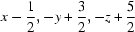
| Symmetry codes: (ii) x−1, y, z; (iii) x−1/2, −y+3/2, −z+5/2. |
Experimental details
| Crystal data | |
| Chemical formula | C20H19Br2NO |
| Mr | 449.18 |
| Crystal system, space group | Orthorhombic, Pnma |
| Temperature (K) | 298 |
| a, b, c (Å) | 7.1595 (6), 24.5891 (19), 10.2598 (6) |
| V (Å3) | 1806.2 (2) |
| Z | 4 |
| Radiation type | Mo Kα |
| µ (mm−1) | 4.49 |
| Crystal size (mm) | 0.34 × 0.25 × 0.18 |
| Data collection | |
| Diffractometer | Bruker SMART CCD diffractometer |
| Absorption correction | Multi-scan (SADABS; Bruker, 1999) |
| Tmin, Tmax | 0.310, 0.498 |
| No. of measured, independent and observed [I > 2σ(I)] reflections | 12758, 2286, 1554 |
| Rint | 0.035 |
| (sin θ/λ)max (Å−1) | 0.679 |
| Refinement | |
| R[F2 > 2σ(F2)], wR(F2), S | 0.042, 0.103, 1.05 |
| No. of reflections | 2286 |
| No. of parameters | 118 |
| H-atom treatment | H atoms treated by a mixture of independent and constrained refinement |
| Δρmax, Δρmin (e Å−3) | 0.84, −0.71 |
Computer programs: SMART (Bruker, 1999), SAINT (Bruker, 1999), SHELXS97 (Sheldrick, 2008), SHELXL97 (Sheldrick, 2008), SHELXTL (Sheldrick, 2008).
| D—H···A | D—H | H···A | D···A | D—H···A |
| N1—H1A···O1i | 0.87 (5) | 2.41 (5) | 3.168 (5) | 145 (4) |
| C1—H1···O1ii | 0.98 | 2.54 | 3.361 (4) | 142 |
| Symmetry codes: (i) x−1, y, z; (ii) x−1/2, −y+3/2, −z+5/2. |
Acknowledgements
The authors acknowledge the Department of Chemistry, IIT Madras, for the X-ray data collection.
References
 Barker, D., Lin, D. H. S., Carland, J. E., Chu, C. P. Y., Chebib, M., Brimble, M. A., Savage, G. P. & McLeod, M. D. (2005). Bioorg. Med. Chem. 13, 4565–4575. Web of Science CrossRef PubMed CAS Google Scholar
Bruker (1999). SADABS, SMART and SAINT. Bruker AXS Inc., Madison, Wisconsin, USA. Google Scholar
Cremer, D. & Pople, J. A. (1975). J. Am. Chem. Soc. 97, 1354–1358. CrossRef CAS Web of Science Google Scholar
Jeyaraman, R. & Avila, S. (1981). Chem. Rev. 81, 149–174. CrossRef CAS Web of Science Google Scholar
Padegimas, S. J. & Kovacic, P. (1972). J. Org. Chem. 37, 2672–2676. CrossRef CAS Web of Science Google Scholar
Parthiban, P., Ramkumar, V., Kim, M. S., Lim, K. T. & Jeong, Y. T. (2008). Acta Cryst. E64, o1586. Web of Science CSD CrossRef IUCr Journals Google Scholar
Sheldrick, G. M. (2008). Acta Cryst. A64, 112–122. Web of Science CrossRef CAS IUCr Journals Google Scholar
Smith-Verdier, P., Florencio, F. & García-Blanco, S. (1983). Acta Cryst. C39, 101–103. CSD CrossRef CAS Web of Science IUCr Journals Google Scholar
Web, N. C. & Becker, M. R. (1967). J. Chem. Soc. B, pp. 1317–1321. Google Scholar
This is an open-access article distributed under the terms of the Creative Commons Attribution (CC-BY) Licence, which permits unrestricted use, distribution, and reproduction in any medium, provided the original authors and source are cited.
| CRYSTALLOGRAPHIC COMMUNICATIONS |


Azabicyclic ketones are an important class of heterocycles due to their broad-spectrum biological activities (Jeyaraman & Avila, 1981; Barker et al., 2005). Owing to the diverse possibilities in conformations, viz., chair-chair (Parthiban et al., 2008), chair-boat (Smith-Verdier et al., 1983) and boat-boat (Padegimas & Kovacic, 1972) for the azabicycle, the present crystal study was undertaken to explore the conformation, stereochemistry and bondings in the title compound, (I).
The piperidine ring in (I) adopts an ideal chair conformation with the deviation of ring atoms C3 and N1 from the C1/C2/C2i/C1i (i = x, 3/2-y, z) plane being 0.686 (3) and -0.702 (3) Å, respectively. The q2 and q3 values are 0.010 (3) and -0.617 (3)Å and the total puckering amplitude, QT = 0.617 (3)Å and θ = 180.0 (3)° (Cremer & Pople, 1975; Web & Becker, 1967).
The cyclohexane ring deviate from the ideal chair conformation by the deviation of ring atoms C3 and C5 from the C2/C4/C4i/C2i plane by -0.725 (4) and 0.525 (3)Å, respectively. For the cyclohexane, the q2 and q3 parameters are 0.150 (4) and 0.543 (4)Å respectively. The total puckering amplitude, QT = 0.563 (3)Å and θ =15.6 (4)°. Hence, the title compound, exists in a twin-chair conformation with equatorial orientations of the 3-bromophenyl groups on the heterocycle, which are orientated at an angle of 27.37 (3)° to each other. The torsion angles of C3—C2—C1—C6 and its mirror plane C3—C2i—C1i—C6i is 174.45 (4)°. The packing is stabilized by weak N—H···O and C—H···O bonds (Table 1).