 | Acta Crystallographica Section E Acta Crystallographica Section E CRYSTALLOGRAPHIC COMMUNICATIONS |


 journal menu


metal-organic compounds
| CRYSTALLOGRAPHIC COMMUNICATIONS |
 access
Poly[bis[3,10-bis(2-hydroxyethyl)-1,3,5,8,10,12-hexaazacyclotetradecane]tetra-μ-cyanido-tetracyanidodicopper(II)molybdenum(IV)] tetrahydrate]

aSchool of Materials Science and Engineering, Jiangsu University of Science and Technology, Zhenjiang 212003, People's Republic of China
*Correspondence e-mail: [email protected]
In the title complex, {[Cu2Mo(CN)8(C12H30N6O2)2]·4H2O}n, the polyhedron around Mo has site symmetry  with a distorted square-antiprismatic shape, while the Cu atom (2 symmetry) is in a distorted axially elongated octahedral coordination environment. The uncoordinated water molecule is disordered over three sites with occupancies of 0.445 (7), 0.340 (7) and 0.215 (7). Mo and Cu atoms acting as basic components are connected by an Mo—CN—Cu—NC—Mo— linkage to form a distorted diamond-like network. Additional hydrogen bonding between the N—H groups and the water molecules stabilizes this arrangement.
Related literature
For background information, see: Larionova et al. (2004![[Larionova, J., Willemin, S., Donnadieu, B., Henner, B., Guérin, C., Gillon, B. & Goujon, A. (2004). J. Phys. Chem. Solids, 65, 677-691.]](../../../../../../logos/arrows/e_arr.gif "Larionova, J., Willemin, S., Donnadieu, B., Henner, B., Guérin, C., Gillon, B. & Goujon, A. (2004). J. Phys. Chem. Solids, 65, 677-691.") ); Przychodzeń et al. (2006). For related structures, see: Chen et al. (2007); Zhou et al. (2007; 2008). For literature related to the synthesis, see: Suh & Kang (1988); Leipoldt et al. (1974).
); Przychodzeń et al. (2006). For related structures, see: Chen et al. (2007); Zhou et al. (2007; 2008). For literature related to the synthesis, see: Suh & Kang (1988); Leipoldt et al. (1974).
![[Scheme 1]](pv2114scheme1.gif)
Experimental
Crystal data
|
Refinement
|
|
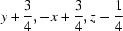 ; (iii)
 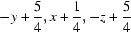 ; (iv)
 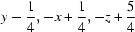 .
. Data collection: APEX2 (Bruker, 2004); cell refinement: SAINT (Bruker, 2004); data reduction: SAINT; program(s) used to solve structure: SHELXS97 (Sheldrick, 2008); program(s) used to refine structure: SHELXL97 (Sheldrick, 2008); molecular graphics: SHELXTL (Sheldrick, 2008); software used to prepare material for publication: SHELXTL.
Supporting information
contains datablocks I, New_Global_Publ_Block. DOI: 10.1107/S1600536808036131/pv2114sup1.cif
Structure factors: contains datablock I. DOI: 10.1107/S1600536808036131/pv2114Isup2.hkl
Well shaped brown crystals of the title complex suitable for X-ray single-crystal were grown at room temperature by slow diffusion of a DMF solution (15 ml) of [CuL](ClO4)2 (0.30 mmol) (Suh and Kang, 1988) and an aqueous solution (15 ml) of K4[Mo(CN)8].2H2O (0.15 mmol) (Leipoldt et al., 1974) in a U-shaped tube containing agar for about one month. The resulting crystals were collected, washed with H2O and dried in air.
All hydrogen atoms except for hydrogen atoms bound to water molecules were calculated at idealized positions with C–H = 0.99, N–H = 0.93 and O–H = 0.85 Å and included in the in a riding mode with Uiso for H assigned as 1.2 times Ueq of the attached atoms. The O atom of the water of hydration molecule was disordered over three sites with unequal site occupancy factors at locations O2, O3 and O4. The H atoms of the disordered water molecule were located from difference maps and were included in the refinements at geometrically idealized positions with O–H distances 0.85 Å and Uiso assigned as 1.2 times Ueq of the attached O atoms.
Data collection: APEX2 (Bruker, 2004); cell SMART (Bruker, 2004); data reduction: SAINT (Bruker, 2004); program(s) used to solve structure: SHELXS97 (Sheldrick, 2008); program(s) used to refine structure: SHELXL97 (Sheldrick, 2008); molecular graphics: SHELXTL (Sheldrick, 2008); software used to prepare material for publication: SHELXTL (Sheldrick, 2008).
![[Figure 1]](./pv2114fig1thm.gif) | Fig. 1. ORTEP drawing of the title complex, showing the atom labeling. Hydrogen atoms and water molecules are omitted for clarity. Symmetry codes: A: 2-x, 1-y, -z; B: 2-x, 0.5-y, z; C: 1.25-y, -0.75+x, 0.25-z. |
![[Figure 2]](./pv2114fig2thm.gif) | Fig. 2. Topological depiction of the title complex, where the Mo nodes and the Cu connectors are shown in pink and green colors, respectively. |
| [Cu2Mo(CN)8(C12H30N6O2)2]·4H2O | Dx = 1.158 Mg m−3 |
| Mr = 1084.08 | Mo Kα radiation, λ = 0.71073 Å |
| Tetragonal, I41/a | Cell parameters from 3093 reflections |
| Hall symbol: -I 4ad | θ = 2.6–21.2° |
| a = 20.0707 (10) Å | µ = 0.93 mm−1 |
| c = 15.4380 (17) Å | T = 293 K |
| V = 6218.9 (8) Å3 | Block, brown |
| Z = 4 | 0.32 × 0.28 × 0.26 mm |
| F(000) = 2256 |
| Bruker SMART APEXII diffractometer | 3053 independent reflections |
| Radiation source: sealed tube | 2459 reflections with I > 2σ(I) |
| Graphite monochromator | Rint = 0.058 |
| phi and ω scans | θmax = 26.0°, θmin = 1.7° |
| Absorption correction: multi-scan (SADABS; Bruker, 2002) | h = −24→24 |
| Tmin = 0.75, Tmax = 0.79 | k = −19→24 |
| 16289 measured reflections | l = −16→19 |
| Refinement on F2 | Primary atom site location: structure-invariant direct methods |
| Least-squares matrix: full | Secondary atom site location: difference Fourier map |
| R[F2 > 2σ(F2)] = 0.043 | Hydrogen site location: inferred from neighbouring sites |
| wR(F2) = 0.103 | H-atom parameters constrained |
| S = 1.06 | w = 1/[σ2(Fo2) + (0.0515P)2 + 3.1936P] where P = (Fo2 + 2Fc2)/3 |
| 3053 reflections | (Δ/σ)max < 0.001 |
| 165 parameters | Δρmax = 0.23 e Å−3 |
| 1 restraint | Δρmin = −0.38 e Å−3 |
| [Cu2Mo(CN)8(C12H30N6O2)2]·4H2O | Z = 4 |
| Mr = 1084.08 | Mo Kα radiation |
| Tetragonal, I41/a | µ = 0.93 mm−1 |
| a = 20.0707 (10) Å | T = 293 K |
| c = 15.4380 (17) Å | 0.32 × 0.28 × 0.26 mm |
| V = 6218.9 (8) Å3 |
| Bruker SMART APEXII diffractometer | 3053 independent reflections |
| Absorption correction: multi-scan (SADABS; Bruker, 2002) | 2459 reflections with I > 2σ(I) |
| Tmin = 0.75, Tmax = 0.79 | Rint = 0.058 |
| 16289 measured reflections |
| R[F2 > 2σ(F2)] = 0.043 | 1 restraint |
| wR(F2) = 0.103 | H-atom parameters constrained |
| S = 1.06 | Δρmax = 0.23 e Å−3 |
| 3053 reflections | Δρmin = −0.38 e Å−3 |
| 165 parameters |
Geometry. All esds (except the esd in the dihedral angle between two l.s. planes) are estimated using the full covariance matrix. The cell esds are taken into account individually in the estimation of esds in distances, angles and torsion angles; correlations between esds in cell parameters are only used when they are defined by crystal symmetry. An approximate (isotropic) treatment of cell esds is used for estimating esds involving l.s. planes. |
Refinement. Refinement of F2 against ALL reflections. The weighted R-factor wR and goodness of fit S are based on F2, conventional R-factors R are based on F, with F set to zero for negative F2. The threshold expression of F2 > σ(F2) is used only for calculating R-factors(gt) etc. and is not relevant to the choice of reflections for refinement. R-factors based on F2 are statistically about twice as large as those based on F, and R- factors based on ALL data will be even larger. |
| x | y | z | Uiso*/Ueq | Occ. (<1) | |
| C1 | 0.96688 (13) | 0.34611 (15) | 0.08263 (19) | 0.0392 (6) | |
| C2 | 1.06251 (16) | 0.27104 (17) | 0.0121 (2) | 0.0485 (7) | |
| C3 | 0.86789 (19) | 0.5451 (2) | 0.0135 (2) | 0.0615 (9) | |
| H3A | 0.8364 | 0.5817 | 0.0269 | 0.074* | |
| H3B | 0.8476 | 0.5025 | 0.0322 | 0.074* | |
| C4 | 0.92199 (19) | 0.5426 (2) | 0.1513 (2) | 0.0610 (9) | |
| H4A | 0.8863 | 0.5716 | 0.1746 | 0.073* | |
| H4B | 0.9081 | 0.4957 | 0.1597 | 0.073* | |
| C5 | 1.0360 (2) | 0.5073 (2) | 0.1850 (2) | 0.0627 (10) | |
| H5A | 1.0195 | 0.4618 | 0.1971 | 0.075* | |
| H5B | 1.0715 | 0.5172 | 0.2277 | 0.075* | |
| C6 | 1.1181 (2) | 0.4567 (2) | 0.0813 (2) | 0.0649 (10) | |
| H6A | 1.1023 | 0.4126 | 0.1013 | 0.078* | |
| H6B | 1.1591 | 0.4682 | 0.1137 | 0.078* | |
| C7 | 0.99694 (18) | 0.62268 (18) | 0.2106 (2) | 0.0570 (9) | |
| H7A | 0.9623 | 0.6491 | 0.1805 | 0.068* | |
| H7B | 1.0397 | 0.6317 | 0.1808 | 0.068* | |
| C8 | 1.0028 (2) | 0.6495 (2) | 0.3018 (3) | 0.0694 (11) | |
| H8A | 1.0505 | 0.6519 | 0.3175 | 0.083* | |
| H8B | 0.9848 | 0.6954 | 0.3030 | 0.083* | |
| Cu2 | 1.0000 | 0.5000 | 0.0000 | 0.04929 (18) | |
| Mo1 | 1.0000 | 0.2500 | 0.1250 | 0.03165 (14) | |
| N1 | 0.94948 (13) | 0.39753 (13) | 0.05790 (17) | 0.0467 (6) | |
| N2 | 1.09533 (14) | 0.28414 (15) | −0.04505 (19) | 0.0554 (7) | |
| N3 | 0.92993 (13) | 0.55566 (15) | 0.05812 (19) | 0.0539 (7) | |
| H3C | 0.9417 | 0.6002 | 0.0514 | 0.065* | |
| N4 | 0.98158 (17) | 0.55421 (16) | 0.1980 (3) | 0.0737 (9) | |
| N5 | 1.06603 (14) | 0.50813 (15) | 0.09613 (16) | 0.0500 (7) | |
| H5C | 1.0866 | 0.5493 | 0.0896 | 0.060* | |
| O1 | 0.9722 (2) | 0.6148 (2) | 0.3594 (3) | 0.1107 (12) | |
| H1C | 0.9917 | 0.5774 | 0.3651 | 0.133* | |
| O2 | 0.1088 (4) | 0.4119 (4) | 0.3446 (5) | 0.072 (3) | 0.340 (7) |
| H2A | 0.0857 | 0.4473 | 0.3454 | 0.087* | 0.340 (7) |
| H2B | 0.0994 | 0.3893 | 0.3896 | 0.087* | 0.340 (7) |
| O3 | 0.2794 (8) | 0.5343 (7) | 0.0656 (10) | 0.088 (6) | 0.215 (7) |
| H3D | 0.2957 | 0.5708 | 0.0836 | 0.105* | 0.215 (7) |
| H3E | 0.3107 | 0.5076 | 0.0526 | 0.105* | 0.215 (7) |
| O4 | 0.2103 (3) | 0.2935 (3) | 0.8613 (3) | 0.065 (2) | 0.445 (7) |
| H4D | 0.1814 | 0.3166 | 0.8882 | 0.078* | 0.445 (7) |
| H4E | 0.1970 | 0.2534 | 0.8577 | 0.078* | 0.445 (7) |
| U11 | U22 | U33 | U12 | U13 | U23 | |
| C1 | 0.0211 (12) | 0.0461 (17) | 0.0503 (17) | 0.0025 (11) | −0.0005 (11) | 0.0068 (13) |
| C2 | 0.0437 (17) | 0.0534 (19) | 0.0485 (18) | −0.0006 (14) | 0.0066 (14) | −0.0020 (15) |
| C3 | 0.058 (2) | 0.064 (2) | 0.063 (2) | −0.0125 (18) | −0.0127 (17) | 0.0055 (18) |
| C4 | 0.058 (2) | 0.083 (3) | 0.0428 (19) | −0.0050 (19) | 0.0110 (15) | 0.0042 (17) |
| C5 | 0.068 (2) | 0.079 (3) | 0.0419 (18) | 0.0000 (19) | −0.0184 (17) | −0.0064 (17) |
| C6 | 0.072 (2) | 0.079 (3) | 0.044 (2) | −0.007 (2) | −0.0283 (18) | 0.0000 (17) |
| C7 | 0.060 (2) | 0.056 (2) | 0.0550 (19) | −0.0147 (16) | 0.0152 (16) | −0.0383 (16) |
| C8 | 0.071 (2) | 0.068 (2) | 0.069 (3) | −0.003 (2) | 0.019 (2) | −0.024 (2) |
| Cu2 | 0.0514 (3) | 0.0560 (3) | 0.0405 (3) | −0.0020 (3) | −0.0059 (2) | 0.0008 (2) |
| Mo1 | 0.01805 (15) | 0.01805 (15) | 0.0589 (3) | 0.000 | 0.000 | 0.000 |
| N1 | 0.0459 (14) | 0.0452 (14) | 0.0490 (15) | 0.0031 (11) | −0.0036 (12) | 0.0120 (12) |
| N2 | 0.0549 (17) | 0.0586 (17) | 0.0528 (17) | −0.0083 (14) | 0.0019 (14) | 0.0287 (14) |
| N3 | 0.0405 (14) | 0.0671 (18) | 0.0540 (16) | 0.0017 (13) | 0.0018 (12) | 0.0123 (14) |
| N4 | 0.071 (2) | 0.0478 (18) | 0.103 (3) | −0.0030 (15) | 0.018 (2) | −0.0012 (17) |
| N5 | 0.0521 (16) | 0.0572 (17) | 0.0406 (14) | 0.0061 (13) | −0.0163 (12) | −0.0079 (12) |
| O1 | 0.115 (3) | 0.113 (3) | 0.104 (3) | 0.004 (2) | 0.011 (2) | 0.006 (2) |
| O2 | 0.060 (5) | 0.092 (6) | 0.065 (5) | 0.023 (4) | −0.024 (4) | −0.028 (4) |
| O3 | 0.097 (11) | 0.063 (8) | 0.103 (11) | −0.006 (7) | 0.041 (9) | −0.006 (8) |
| O4 | 0.064 (4) | 0.091 (5) | 0.041 (3) | −0.014 (3) | 0.016 (2) | 0.009 (3) |
| C1—N1 | 1.154 (4) | C8—O1 | 1.285 (5) |
| C1—Mo1 | 2.143 (3) | C8—H8A | 0.9900 |
| C2—N2 | 1.132 (4) | C8—H8B | 0.9900 |
| C2—Mo1 | 2.188 (3) | Cu2—N5i | 1.996 (2) |
| C3—N3 | 1.439 (4) | Cu2—N5 | 1.996 (2) |
| C3—C6i | 1.490 (5) | Cu2—N3 | 2.008 (3) |
| C3—H3A | 0.9900 | Cu2—N3i | 2.008 (3) |
| C3—H3B | 0.9900 | Cu2—N1i | 2.461 (3) |
| C4—N4 | 1.416 (5) | Cu2—N1 | 2.461 (3) |
| C4—N3 | 1.470 (5) | Mo1—C1ii | 2.143 (3) |
| C4—H4A | 0.9900 | Mo1—C1iii | 2.143 (3) |
| C4—H4B | 0.9900 | Mo1—C1iv | 2.143 (3) |
| C5—N4 | 1.457 (5) | Mo1—C2iii | 2.188 (3) |
| C5—N5 | 1.499 (5) | Mo1—C2iv | 2.188 (3) |
| C5—H5A | 0.9900 | Mo1—C2ii | 2.188 (3) |
| C5—H5B | 0.9900 | N3—H3C | 0.9300 |
| C6—N5 | 1.487 (5) | N5—H5C | 0.9300 |
| C6—C3i | 1.490 (5) | O1—H1C | 0.8501 |
| C6—H6A | 0.9900 | O2—H2A | 0.8500 |
| C6—H6B | 0.9900 | O2—H2B | 0.8500 |
| C7—N4 | 1.422 (4) | O3—H3D | 0.8500 |
| C7—C8 | 1.512 (5) | O3—H3E | 0.8500 |
| C7—H7A | 0.9900 | O4—H4D | 0.8498 |
| C7—H7B | 0.9900 | O4—H4E | 0.8498 |
| N1—C1—Mo1 | 178.4 (3) | N3i—Cu2—N1 | 89.19 (10) |
| N2—C2—Mo1 | 177.5 (3) | N1i—Cu2—N1 | 180.00 (11) |
| N3—C3—C6i | 108.1 (3) | C1ii—Mo1—C1iii | 95.35 (5) |
| N3—C3—H3A | 110.1 | C1ii—Mo1—C1 | 144.45 (16) |
| C6i—C3—H3A | 110.1 | C1iii—Mo1—C1 | 95.35 (5) |
| N3—C3—H3B | 110.1 | C1ii—Mo1—C1iv | 95.35 (5) |
| C6i—C3—H3B | 110.1 | C1iii—Mo1—C1iv | 144.45 (16) |
| H3A—C3—H3B | 108.4 | C1—Mo1—C1iv | 95.35 (5) |
| N4—C4—N3 | 112.2 (3) | C1ii—Mo1—C2iii | 145.00 (12) |
| N4—C4—H4A | 109.2 | C1iii—Mo1—C2iii | 76.18 (12) |
| N3—C4—H4A | 109.2 | C1—Mo1—C2iii | 70.56 (12) |
| N4—C4—H4B | 109.2 | C1iv—Mo1—C2iii | 75.69 (12) |
| N3—C4—H4B | 109.2 | C1ii—Mo1—C2iv | 70.56 (12) |
| H4A—C4—H4B | 107.9 | C1iii—Mo1—C2iv | 75.69 (12) |
| N4—C5—N5 | 114.8 (3) | C1—Mo1—C2iv | 144.99 (12) |
| N4—C5—H5A | 108.6 | C1iv—Mo1—C2iv | 76.18 (12) |
| N5—C5—H5A | 108.6 | C2iii—Mo1—C2iv | 74.44 (17) |
| N4—C5—H5B | 108.6 | C1ii—Mo1—C2 | 75.69 (12) |
| N5—C5—H5B | 108.6 | C1iii—Mo1—C2 | 144.99 (12) |
| H5A—C5—H5B | 107.5 | C1—Mo1—C2 | 76.17 (12) |
| N5—C6—C3i | 107.5 (3) | C1iv—Mo1—C2 | 70.55 (12) |
| N5—C6—H6A | 110.2 | C2iii—Mo1—C2 | 129.35 (11) |
| C3i—C6—H6A | 110.2 | C2iv—Mo1—C2 | 129.35 (11) |
| N5—C6—H6B | 110.2 | C1ii—Mo1—C2ii | 76.17 (12) |
| C3i—C6—H6B | 110.2 | C1iii—Mo1—C2ii | 70.55 (12) |
| H6A—C6—H6B | 108.5 | C1—Mo1—C2ii | 75.69 (12) |
| N4—C7—C8 | 119.2 (4) | C1iv—Mo1—C2ii | 144.99 (12) |
| N4—C7—H7A | 107.5 | C2iii—Mo1—C2ii | 129.36 (11) |
| C8—C7—H7A | 107.5 | C2iv—Mo1—C2ii | 129.35 (11) |
| N4—C7—H7B | 107.5 | C2—Mo1—C2ii | 74.44 (17) |
| C8—C7—H7B | 107.5 | C1—N1—Cu2 | 137.9 (2) |
| H7A—C7—H7B | 107.0 | C3—N3—C4 | 110.4 (3) |
| O1—C8—C7 | 114.5 (4) | C3—N3—Cu2 | 108.1 (2) |
| O1—C8—H8A | 108.6 | C4—N3—Cu2 | 114.4 (2) |
| C7—C8—H8A | 108.6 | C3—N3—H3C | 107.9 |
| O1—C8—H8B | 108.6 | C4—N3—H3C | 107.9 |
| C7—C8—H8B | 108.6 | Cu2—N3—H3C | 107.9 |
| H8A—C8—H8B | 107.6 | C4—N4—C7 | 114.3 (3) |
| N5i—Cu2—N5 | 180.0 | C4—N4—C5 | 117.2 (3) |
| N5i—Cu2—N3 | 84.99 (12) | C7—N4—C5 | 118.8 (3) |
| N5—Cu2—N3 | 95.01 (12) | C6—N5—C5 | 114.6 (3) |
| N5i—Cu2—N3i | 95.01 (12) | C6—N5—Cu2 | 107.20 (19) |
| N5—Cu2—N3i | 84.99 (12) | C5—N5—Cu2 | 114.4 (2) |
| N3—Cu2—N3i | 180.0 | C6—N5—H5C | 106.7 |
| N5i—Cu2—N1i | 94.12 (11) | C5—N5—H5C | 106.7 |
| N5—Cu2—N1i | 85.88 (11) | Cu2—N5—H5C | 106.7 |
| N3—Cu2—N1i | 89.19 (10) | C8—O1—H1C | 109.3 |
| N3i—Cu2—N1i | 90.81 (10) | H2A—O2—H2B | 108.2 |
| N5i—Cu2—N1 | 85.88 (11) | H3D—O3—H3E | 109.5 |
| N5—Cu2—N1 | 94.12 (11) | H4D—O4—H4E | 109.5 |
| N3—Cu2—N1 | 90.81 (10) | ||
| N4—C7—C8—O1 | −22.2 (6) | N3—C4—N4—C5 | −70.7 (4) |
| N5i—Cu2—N1—C1 | 129.7 (4) | C8—C7—N4—C4 | 120.0 (4) |
| N5—Cu2—N1—C1 | −50.3 (4) | C8—C7—N4—C5 | −94.9 (4) |
| N3—Cu2—N1—C1 | −145.4 (4) | N5—C5—N4—C4 | 66.8 (4) |
| N3i—Cu2—N1—C1 | 34.6 (4) | N5—C5—N4—C7 | −77.3 (4) |
| C6i—C3—N3—C4 | −166.9 (3) | C3i—C6—N5—C5 | 168.3 (3) |
| C6i—C3—N3—Cu2 | −41.1 (3) | C3i—C6—N5—Cu2 | 40.2 (3) |
| N4—C4—N3—C3 | −178.4 (3) | N4—C5—N5—C6 | −175.7 (3) |
| N4—C4—N3—Cu2 | 59.5 (4) | N4—C5—N5—Cu2 | −51.3 (4) |
| N5i—Cu2—N3—C3 | 14.8 (2) | N3—Cu2—N5—C6 | 165.6 (2) |
| N5—Cu2—N3—C3 | −165.2 (2) | N3i—Cu2—N5—C6 | −14.4 (2) |
| N1i—Cu2—N3—C3 | 109.0 (2) | N1i—Cu2—N5—C6 | −105.5 (2) |
| N1—Cu2—N3—C3 | −71.0 (2) | N1—Cu2—N5—C6 | 74.5 (2) |
| N5i—Cu2—N3—C4 | 138.2 (3) | N3—Cu2—N5—C5 | 37.4 (3) |
| N5—Cu2—N3—C4 | −41.8 (3) | N3i—Cu2—N5—C5 | −142.6 (3) |
| N1i—Cu2—N3—C4 | −127.6 (2) | N1i—Cu2—N5—C5 | 126.3 (3) |
| N1—Cu2—N3—C4 | 52.4 (2) | N1—Cu2—N5—C5 | −53.7 (3) |
| N3—C4—N4—C7 | 75.0 (4) |
| Symmetry codes: (i) −x+2, −y+1, −z; (ii) −x+2, −y+1/2, z; (iii) −y+5/4, x−3/4, −z+1/4; (iv) y+3/4, −x+5/4, −z+1/4. |
| D—H···A | D—H | H···A | D···A | D—H···A |
| N3—H3C···N2i | 0.93 | 2.44 | 3.261 (4) | 147 |
| N5—H5C···O2v | 0.93 | 2.38 | 3.291 (8) | 165 |
| O1—H1C···O4vi | 0.85 | 2.48 | 3.149 (7) | 136 |
| O4—H4D···N2vii | 0.85 | 2.11 | 2.729 (6) | 129 |
| O4—H4E···O2viii | 0.85 | 2.47 | 3.279 (9) | 159 |
| Symmetry codes: (i) −x+2, −y+1, −z; (v) y+3/4, −x+3/4, z−1/4; (vi) −y+5/4, x+1/4, −z+5/4; (vii) x−1, y, z+1; (viii) y−1/4, −x+1/4, −z+5/4. |
Experimental details
| Crystal data | |
| Chemical formula | [Cu2Mo(CN)8(C12H30N6O2)2]·4H2O |
| Mr | 1084.08 |
| Crystal system, space group | Tetragonal, I41/a |
| Temperature (K) | 293 |
| a, c (Å) | 20.0707 (10), 15.4380 (17) |
| V (Å3) | 6218.9 (8) |
| Z | 4 |
| Radiation type | Mo Kα |
| µ (mm−1) | 0.93 |
| Crystal size (mm) | 0.32 × 0.28 × 0.26 |
| Data collection | |
| Diffractometer | Bruker SMART APEXII diffractometer |
| Absorption correction | Multi-scan (SADABS; Bruker, 2002) |
| Tmin, Tmax | 0.75, 0.79 |
| No. of measured, independent and observed [I > 2σ(I)] reflections | 16289, 3053, 2459 |
| Rint | 0.058 |
| (sin θ/λ)max (Å−1) | 0.617 |
| Refinement | |
| R[F2 > 2σ(F2)], wR(F2), S | 0.043, 0.103, 1.06 |
| No. of reflections | 3053 |
| No. of parameters | 165 |
| No. of restraints | 1 |
| H-atom treatment | H-atom parameters constrained |
| Δρmax, Δρmin (e Å−3) | 0.23, −0.38 |
Computer programs: APEX2 (Bruker, 2004), SMART (Bruker, 2004), SAINT (Bruker, 2004), SHELXS97 (Sheldrick, 2008), SHELXL97 (Sheldrick, 2008), SHELXTL (Sheldrick, 2008).
| D—H···A | D—H | H···A | D···A | D—H···A |
| N3—H3C···N2i | 0.93 | 2.44 | 3.261 (4) | 147.3 |
| N5—H5C···O2ii | 0.93 | 2.38 | 3.291 (8) | 164.9 |
| O1—H1C···O4iii | 0.85 | 2.48 | 3.149 (7) | 136.0 |
| O4—H4D···N2iv | 0.85 | 2.11 | 2.729 (6) | 128.9 |
| O4—H4E···O2v | 0.85 | 2.47 | 3.279 (9) | 158.9 |
| Symmetry codes: (i) −x+2, −y+1, −z; (ii) y+3/4, −x+3/4, z−1/4; (iii) −y+5/4, x+1/4, −z+5/4; (iv) x−1, y, z+1; (v) y−1/4, −x+1/4, −z+5/4. |
Acknowledgements
This work is supported by the University Natural Science Foundation of Jiangsu Province (grant No. 07KJB150030).
References
 Bruker (2002). SADABS. Bruker AXS Inc., Madison, Wisconsin, USA. Google Scholar
Bruker (2004). APEX2 and SAINT. Bruker AXS Inc., Madison, Wisconsin, USA. Google Scholar
Chen, Y. Y., Zhou, H., Shen, X. P., Lu, H. F. & Yuan, A. H. (2007). J. Mol. Struct. 839, 64–68. Web of Science CSD CrossRef CAS Google Scholar
Larionova, J., Willemin, S., Donnadieu, B., Henner, B., Guérin, C., Gillon, B. & Goujon, A. (2004). J. Phys. Chem. Solids, 65, 677–691. Web of Science CrossRef CAS Google Scholar
Leipoldt, J. G., Bok, L. D. C. & Cillier, P. J. (1974). Z. Anorg. Allg. Chem. 409, 343–344. CrossRef CAS Web of Science Google Scholar
Przychodzeń, P., Korzeniak, T., Podgajny, R. & Sieklucka, B. (2006). Coord. Chem. Rev. 250, 2234–2260. Google Scholar
Sheldrick, G. M. (2008). Acta Cryst. A64, 112–122. Web of Science CrossRef CAS IUCr Journals Google Scholar
Suh, M. P. & Kang, S. G. (1988). Inorg. Chem. 27, 2544–2546. CrossRef CAS Web of Science Google Scholar
Zhou, H., Chen, Y. Y., Yuan, A. H. & Shen, X. P. (2008). Inorg. Chem. Commun. 11, 363–366. Web of Science CSD CrossRef CAS Google Scholar
Zhou, H., Yuan, A. H., Shen, X. P., Chen, Y. Y., Price, D. J. & Kepert, C. J. (2007). Inorg. Chem. Commun. 10, 940–943. Web of Science CSD CrossRef CAS Google Scholar
This is an open-access article distributed under the terms of the Creative Commons Attribution (CC-BY) Licence, which permits unrestricted use, distribution, and reproduction in any medium, provided the original authors and source are cited.
| CRYSTALLOGRAPHIC COMMUNICATIONS |


Recently, octacyanometalates [M(CN)8]3-/4- (M = Mo, W and Nb) have been found to be versatile building blocks and investigated extensively (Larionova et al., 2004; Przychodzeń et al., 2006). For [CuL]2+/[M(CN)8]3-/4- (L = macrocyclic ligands) bimetallic systems, macrocyclic ligands block partly coordination sites of the metal ions and release their apical ones, which can be used to construct cyano-bridged bimetallic complexes with octacyanometalate [M(CN)8]3-/4- ions. In a recent study, we chose [CuL]2+ (L = 3,10-diethanol-1,3,5,8,10,12-hexaazacyclotetradecane) as building block to synthesize successfully an octacyanometalate-based bimetallic complex [CuL]2[Mo(CN)8].4H2O, (I), with a distorted diamond network.
The title complex crystallizes in the tetragonal (I41/a) space group. As displayed in Fig. 1, the Mo atom is coordinated by eight CN groups in a distorted square antiprism. The Cu atom is in a distorted axially elongated octahedral coordination environment, in which four nitrogen atoms from the ligand (L) occupy the equatorial positions, while the axial sites are occupied by two nitrogen atoms from the bridging cyanide groups on different [Mo(CN)8]4- anions. The bonding parameters of the macrocyclic ligand L are reminiscent of those found in related complexes reported previously (Chen et al., 2007).
As shown in Fig. 2, Mo and Cu atoms acting as basic components (linker and connector, respectively) are connected by the Mo—CN—Cu—NC—Mo— linkages to form a three-dimensional structure. The network is composed of [CuL]2+ unit that is linked via cyanides to adjacent four-connected [Mo(CN)8(µ-CN)4]4- centers. From a topological standpoint, each [Mo(CN)8] unit is a tetrahedral four-connecting node. These nodes are linked to four adjacent [Mo(CN)8] units by the [CuL] units, acting as linear two-connectors. The result is a distorted diamond network (Fig. 2), which is similar to octacyanometalate-based bimetallic complexes reported previously (Zhou et al., 2007; 2008).