 | Acta Crystallographica Section E Acta Crystallographica Section E CRYSTALLOGRAPHIC COMMUNICATIONS |


 journal menu


organic compounds
| CRYSTALLOGRAPHIC COMMUNICATIONS |
 access
(1R,2S)-N,N′-(1,2-Dihydroxyethylene)diformamide

aDepartment of Chemistry, Imam Hossein University, Tehran, Iran
*Correspondence e-mail: [email protected]
The of the title compound, C4H8N2O4, contains one half-molecule which is completed via a crystallographic inversion centre. In the molecules are arranged in undulating layers parallel to (001). Intermolecular N—H⋯O and O—H⋯O hydrogen bonds consolidate this arrangement.
Related literature
The title compound has been synthesized as a by-product of a procedure described by Sidney et al. (1965![[Sidney, V., Clifford, M. & Barker, R. (1965). J. Org. Chem. 30, 1195-1199.]](../../../../../../logos/arrows/e_arr.gif "Sidney, V., Clifford, M. & Barker, R. (1965). J. Org. Chem. 30, 1195-1199.") ) and Ferguson (1968a,b). For related literature regarding the synthesis, see: Mitsch (1965). For the application of the intermediates, see: Ramakrishnan et al. (1990); Vedachalam et al. (1991). For bond-length data, see: Allen et al. (1987).
) and Ferguson (1968a,b). For related literature regarding the synthesis, see: Mitsch (1965). For the application of the intermediates, see: Ramakrishnan et al. (1990); Vedachalam et al. (1991). For bond-length data, see: Allen et al. (1987).
![[Scheme 1]](wm2200scheme1.gif)
Experimental
Crystal data
|
Data collection
|
Refinement
|
| ||||||||||||||||||||||
 ; (ii)
  .
. Data collection: SMART (Bruker, 1998); cell refinement: SAINT-Plus (Bruker, 1998); data reduction: SAINT-Plus; program(s) used to solve structure: SHELXTL (Sheldrick, 2008); program(s) used to refine structure: SHELXTL; molecular graphics: SHELXTL; software used to prepare material for publication: SHELXTL.
Supporting information
contains datablocks I, global. DOI: 10.1107/S1600536808036209/wm2200sup1.cif
Structure factors: contains datablock I. DOI: 10.1107/S1600536808036209/wm2200Isup2.hkl
76 mass parts of glyoxal monohydrate were stirred with 90 parts of formamide at room temperature. Then 6 mass parts of sodium bicarbonate were added. After 3 days, the crude crystalline product was washed with cold methanol and was dried, yielding 84.2 mass parts of 1,4-diformyl-2,3,5,6-tetrahydroxypiperazine (decomposition temperature 463 K). After filtering off the crystals, the aqueous mother liquor was kept at 273 K for 1 day and 2.2 mass parts of 1,2-dihydroxy-1,2-diformamidoethane were obtained (decomposition temperature 408 - 413 K). Crystals suitable for were grown by recrystallization from dimethyl sulfoxide (DMSO).
H atoms were positioned geometrically, with N—H = 0.88 Å (for NH), O—H = 0.86 Å (for OH) and C—H = 0.95 Å (for the aldehyde group) and and C—H = 1.00 Å (for the aliphatic C atom), and constrained to ride on their parent atoms, with Uiso(H) = 1.2Ueq(N, O, C).
Data collection: SMART (Bruker, 1998); cell SAINT-Plus (Bruker, 1998); data reduction: SAINT-Plus (Bruker, 1998); program(s) used to solve structure: SHELXTL (Sheldrick, 2008); program(s) used to refine structure: SHELXTL (Sheldrick, 2008); molecular graphics: SHELXTL (Sheldricr, 2008); software used to prepare material for publication: SHELXTL (Sheldrick, 2008).
![[Figure 1]](./wm2200fig1thm.gif) | Fig. 1. The molecular structure of the title compound, drawn with displacement ellipsoids at the 50% probability level. H atoms are shown as spheres of arbitrary radius. |
![[Figure 2]](./wm2200fig2thm.gif) | Fig. 2. A packing diagram of the title compound. Hydrogen bonds are shown as dashed lines. |
| C4H8N2O4 | F(000) = 312 |
| Mr = 148.12 | Dx = 1.630 Mg m−3 |
| Orthorhombic, Pbca | Mo Kα radiation, λ = 0.71073 Å |
| Hall symbol: -P 2ac 2ab | Cell parameters from 854 reflections |
| a = 6.5065 (11) Å | θ = 3–30° |
| b = 7.2634 (12) Å | µ = 0.15 mm−1 |
| c = 12.772 (2) Å | T = 120 K |
| V = 603.59 (17) Å3 | Prism, colourless |
| Z = 4 | 0.20 × 0.20 × 0.15 mm |
| Bruker SMART 1000 CCD area-detector diffractometer | 662 reflections with I > 2σ(I) |
| Radiation source: fine-focus sealed tube | Rint = 0.031 |
| Graphite monochromator | θmax = 29.0°, θmin = 3.2° |
| ϕ and ω scans | h = −8→8 |
| 5931 measured reflections | k = −9→9 |
| 796 independent reflections | l = −17→17 |
| Refinement on F2 | Primary atom site location: structure-invariant direct methods |
| Least-squares matrix: full | Secondary atom site location: difference Fourier map |
| R[F2 > 2σ(F2)] = 0.042 | Hydrogen site location: mixed |
| wR(F2) = 0.107 | H-atom parameters constrained |
| S = 1.00 | w = 1/[σ2(Fo2) + (0.0499P)2 + 0.531P] where P = (Fo2 + 2Fc2)/3 |
| 796 reflections | (Δ/σ)max < 0.001 |
| 46 parameters | Δρmax = 0.41 e Å−3 |
| 0 restraints | Δρmin = −0.24 e Å−3 |
| C4H8N2O4 | V = 603.59 (17) Å3 |
| Mr = 148.12 | Z = 4 |
| Orthorhombic, Pbca | Mo Kα radiation |
| a = 6.5065 (11) Å | µ = 0.15 mm−1 |
| b = 7.2634 (12) Å | T = 120 K |
| c = 12.772 (2) Å | 0.20 × 0.20 × 0.15 mm |
| Bruker SMART 1000 CCD area-detector diffractometer | 662 reflections with I > 2σ(I) |
| 5931 measured reflections | Rint = 0.031 |
| 796 independent reflections |
| R[F2 > 2σ(F2)] = 0.042 | 0 restraints |
| wR(F2) = 0.107 | H-atom parameters constrained |
| S = 1.00 | Δρmax = 0.41 e Å−3 |
| 796 reflections | Δρmin = −0.24 e Å−3 |
| 46 parameters |
Geometry. All e.s.d.'s (except the e.s.d. in the dihedral angle between two l.s. planes) are estimated using the full covariance matrix. The cell e.s.d.'s are taken into account individually in the estimation of e.s.d.'s in distances, angles and torsion angles; correlations between e.s.d.'s in cell parameters are only used when they are defined by crystal symmetry. An approximate (isotropic) treatment of cell e.s.d.'s is used for estimating e.s.d.'s involving l.s. planes. |
Refinement. Refinement of F2 against ALL reflections. The weighted R-factor wR and goodness of fit S are based on F2, conventional R-factors R are based on F, with F set to zero for negative F2. The threshold expression of F2 > σ(F2) is used only for calculating R-factors(gt) etc. and is not relevant to the choice of reflections for refinement. R-factors based on F2 are statistically about twice as large as those based on F, and R- factors based on ALL data will be even larger. |
| x | y | z | Uiso*/Ueq | ||
| N1 | 0.07678 (19) | 0.16658 (16) | 0.39820 (9) | 0.0180 (3) | |
| H1N | 0.1170 | 0.2562 | 0.4397 | 0.022* | |
| O1 | −0.25095 (15) | 0.06643 (13) | 0.45643 (7) | 0.0193 (3) | |
| H1O | −0.3145 | 0.0628 | 0.3970 | 0.023* | |
| O2 | 0.07384 (16) | 0.05127 (14) | 0.23276 (7) | 0.0207 (3) | |
| C1 | −0.0424 (2) | 0.01985 (18) | 0.44519 (10) | 0.0164 (3) | |
| H1A | −0.0304 | −0.0935 | 0.4012 | 0.020* | |
| C2 | 0.1269 (2) | 0.16978 (19) | 0.29690 (10) | 0.0178 (3) | |
| H2A | 0.2085 | 0.2694 | 0.2725 | 0.021* |
| U11 | U22 | U33 | U12 | U13 | U23 | |
| N1 | 0.0226 (6) | 0.0168 (5) | 0.0147 (5) | −0.0028 (4) | −0.0004 (4) | −0.0002 (4) |
| O1 | 0.0165 (5) | 0.0254 (5) | 0.0160 (4) | 0.0025 (4) | −0.0025 (4) | −0.0020 (4) |
| O2 | 0.0203 (5) | 0.0258 (5) | 0.0160 (5) | −0.0010 (4) | 0.0020 (4) | −0.0012 (4) |
| C1 | 0.0164 (6) | 0.0182 (6) | 0.0146 (6) | −0.0005 (5) | −0.0003 (5) | 0.0004 (5) |
| C2 | 0.0168 (6) | 0.0196 (6) | 0.0170 (6) | 0.0025 (5) | 0.0007 (5) | 0.0035 (5) |
| N1—C2 | 1.3344 (17) | O2—C2 | 1.2374 (17) |
| N1—C1 | 1.4483 (17) | C1—C1i | 1.532 (3) |
| N1—H1N | 0.88 | C1—H1A | 1.0000 |
| O1—C1 | 1.4056 (16) | C2—H2A | 0.9500 |
| O1—H1O | 0.86 | ||
| C2—N1—C1 | 123.06 (11) | O1—C1—H1A | 109.3 |
| C2—N1—H1N | 119.9 | N1—C1—H1A | 109.3 |
| C1—N1—H1N | 117.0 | C1i—C1—H1A | 109.3 |
| C1—O1—H1O | 111.4 | O2—C2—N1 | 124.17 (13) |
| O1—C1—N1 | 112.47 (11) | O2—C2—H2A | 117.9 |
| O1—C1—C1i | 107.45 (13) | N1—C2—H2A | 117.9 |
| N1—C1—C1i | 108.91 (13) | ||
| C2—N1—C1—O1 | −99.08 (15) | C1—N1—C2—O2 | 1.6 (2) |
| C2—N1—C1—C1i | 141.93 (15) |
| Symmetry code: (i) −x, −y, −z+1. |
| D—H···A | D—H | H···A | D···A | D—H···A |
| N1—H1N···O1ii | 0.88 | 2.04 | 2.9093 (16) | 170 |
| O1—H1O···O2iii | 0.86 | 1.81 | 2.6740 (14) | 175 |
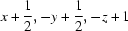
| Symmetry codes: (ii) x+1/2, −y+1/2, −z+1; (iii) x−1/2, y, −z+1/2. |
Experimental details
| Crystal data | |
| Chemical formula | C4H8N2O4 |
| Mr | 148.12 |
| Crystal system, space group | Orthorhombic, Pbca |
| Temperature (K) | 120 |
| a, b, c (Å) | 6.5065 (11), 7.2634 (12), 12.772 (2) |
| V (Å3) | 603.59 (17) |
| Z | 4 |
| Radiation type | Mo Kα |
| µ (mm−1) | 0.15 |
| Crystal size (mm) | 0.20 × 0.20 × 0.15 |
| Data collection | |
| Diffractometer | Bruker SMART 1000 CCD area-detector diffractometer |
| Absorption correction | – |
| No. of measured, independent and observed [I > 2σ(I)] reflections | 5931, 796, 662 |
| Rint | 0.031 |
| (sin θ/λ)max (Å−1) | 0.682 |
| Refinement | |
| R[F2 > 2σ(F2)], wR(F2), S | 0.042, 0.107, 1.00 |
| No. of reflections | 796 |
| No. of parameters | 46 |
| H-atom treatment | H-atom parameters constrained |
| Δρmax, Δρmin (e Å−3) | 0.41, −0.24 |
Computer programs: SMART (Bruker, 1998), SAINT-Plus (Bruker, 1998), SHELXTL (Sheldrick, 2008), SHELXTL (Sheldricr, 2008).
| D—H···A | D—H | H···A | D···A | D—H···A |
| N1—H1N···O1i | 0.88 | 2.04 | 2.9093 (16) | 170 |
| O1—H1O···O2ii | 0.86 | 1.81 | 2.6740 (14) | 175 |
| Symmetry codes: (i) x+1/2, −y+1/2, −z+1; (ii) x−1/2, y, −z+1/2. |
References
 Allen, F. H., Kennard, O., Watson, D. G., Brammer, L., Orpen, A. G. & Taylor, R. (1987). J. Chem. Soc. Perkin Trans. 2, pp. S1–19. CrossRef Web of Science Google Scholar
Bruker (1998). SMART and SAINT-Plus. Bruker AXS Inc., Madison, Wisconsin, USA. Google Scholar
Ferguson, A. N. (1968a). US Patent 3 369 020. Google Scholar
Ferguson, A. N. (1968b). US Patent 3 365 454. Google Scholar
Mitsch, R. A. (1965). J. Am. Chem. Soc. 87, 328–333. CrossRef CAS Web of Science Google Scholar
Ramakrishnan, V. T., Vedachalam, M. & Boyer, J. H. (1990). Heterocycles, 31, 479-480. CAS Google Scholar
Sheldrick, G. M. (2008). Acta Cryst. A64, 112–122. Web of Science CrossRef CAS IUCr Journals Google Scholar
Sidney, V., Clifford, M. & Barker, R. (1965). J. Org. Chem. 30, 1195-1199. Google Scholar
Vedachalam, M., Ramakrishnan, V. T., Boyer, H., Dagley, I. J., Nelson, K. A. & Adolph, H. G. (1991). J. Org. Chem. 56, 3413–3419. CSD CrossRef CAS Web of Science Google Scholar
This is an open-access article distributed under the terms of the Creative Commons Attribution (CC-BY) Licence, which permits unrestricted use, distribution, and reproduction in any medium, provided the original authors and source are cited.
| CRYSTALLOGRAPHIC COMMUNICATIONS |


1,4-Diformyl-2,3,5,6-tetrahydroxypiperazine is an important intermediate (Mitsch, 1965) for the preparation of high energetic materials (Ramakrishnan et al. 1990; Vedachalam et al. 1991). The title compound, (I), was obtained as an unexpected by-product during synthesis of 1,4-diformyl-2,3,5,6-tetrahydroxypiperazine (Sidney et al., 1965; Ferguson, 1968a,b). In a modified procedure we have synthesized compound (I) in much better yield and present its crystal structure in this communication.
Formally, compound (I) is a derivative of ethane with two hydroxyl and two formyl groups as substitutes of the corresponding H atoms. The asymmetric unit of compound (I) contains one half of the molecule that is completed via an inversion centre, leading to a R,S conformation for the two C atoms (Fig. 1). The bond lengths (Allen et al., 1987) and angles in the molecule are within normal ranges.
In the crystal structure, molecules are arranged in undulated layers parallel to (001). Intermolecular N—H···O and O—H···O hydrogen bonds consolidate this arrangement (Fig. 2 and Table 1).