 | Acta Crystallographica Section E Acta Crystallographica Section E CRYSTALLOGRAPHIC COMMUNICATIONS |


 journal menu


inorganic compounds
| CRYSTALLOGRAPHIC COMMUNICATIONS |
 access
Redetermination of K4[Bi2Cl10]·4H2O

aFaculté des Sciences de Sfax, Laboratoire de Sciences des Matériaux et d'Environnement, BP 115 Sfax 3052, Tunisia
*Correspondence e-mail: [email protected]
In comparison with the previous of tetrapotassium di-μ-chlorido-bis[tetrachloridobismuthate(III)] tetrahydrate [Volkova, Udovenko, Levin & Shevchenko (1983). Koord. Khim. 9, 356–360], the current redetermination reveals anisotropic displacement parameters for all non-H atoms, localization of the H atoms, and higher precision of lattice parameters and interatomic distances. The crystal structure is built up of edge-sharing [Bi2Cl10]4− double octahedra with the bridging Cl atoms situated on a mirror plane, three K+ counter-cations (two of which are on mirror planes), and two water molecules that are solely coordinated to the K+ cations. These building units are linked into a three-dimensional network structure. Additional O—H⋯Cl hydrogen bonds between the water molecules and the complex anions stabilize this arrangement.
Related literature
The isotypic Br compound was reported by Lazarini (1977![[Lazarini, F. (1977). Acta Cryst. B33, 1954-1956.]](../../../../../../logos/arrows/e_arr.gif "Lazarini, F. (1977). Acta Cryst. B33, 1954-1956.") ). For related structures, see: Belkyal et al. (1997); Benachenhou et al. (1986). For general background, see: Larson (1970); Prince (1982); Watkin (1994).
). For related structures, see: Belkyal et al. (1997); Benachenhou et al. (1986). For general background, see: Larson (1970); Prince (1982); Watkin (1994).
Experimental
Crystal data
|
Refinement
|
| ||||||||||||||||
 .
.
|
 ; (iv)
  ; (v)
; (v)  ; (vi)
  .
. Data collection: APEX2 (Bruker, 2006); cell refinement: APEX2; data reduction: APEX2; program(s) used to solve structure: SHELXS97 (Sheldrick, 2008); program(s) used to refine structure: SHELXL97 (Sheldrick, 2008) and CRYSTALS (Betteridge et al., 2003); molecular graphics: DIAMOND (Brandenburg, 2001); software used to prepare material for publication: CRYSTALS and publCIF (Westrip, 2008).
Supporting information
contains datablocks I, global. DOI: 10.1107/S1600536808035435/wm2201sup1.cif
Structure factors: contains datablock I. DOI: 10.1107/S1600536808035435/wm2201Isup2.hkl
(BiO)2CO3 was dissolved in concentrated hydrochloric acid in order to prepare a BiCl3 solution. The latter was then added to an aqueous KCl solution in a molar ratio of 1:2. The resulting solution has been kept under stirring for 1 h and was allowed to stand at room temperature for some days. After this time colourless crystals of the title compound were obtained and isolated from the acid solution by filtration.
The H atom positions were located from difference Fourier maps and were refined freely.
Data collection: APEX2 (Bruker, 2006); cell APEX2 (Bruker, 2006); data reduction: APEX2 (Bruker, 2006); program(s) used to solve structure: SHELXS97 (Sheldrick, 2008); program(s) used to refine structure: SHELXL97 (Sheldrick, 2008) and CRYSTALS (Betteridge et al., 2003); molecular graphics: DIAMOND (Brandenburg, 2001); software used to prepare material for publication: CRYSTALS (Betteridge et al., 2003) and publCIF (Westrip, 2008).
![[Figure 1]](./wm2201fig1thm.gif) | Fig. 1. Part of the crystal structure of the title compound with displacement ellipsoids drawn at the 50% probability level. H atoms are shown as spheres of arbitary radius. [Symmetry codes: (i) x, y, z + 1; (ii) -x, -1/2 - y, z + 1.] |
![[Figure 2]](./wm2201fig2thm.gif) | Fig. 2. Projection of the K4[Bi2Cl10].4H2O structure along the a axis, showing the pairs of edge-sharing [BiCl6] octahedra. |
| K4[Bi2Cl10]·4H2O | F(000) = 1808 |
| Mr = 1000.94 | Dx = 2.945 Mg m−3 |
| Orthorhombic, Pnma | Mo Kα radiation, λ = 0.71073 Å |
| Hall symbol: -P 2ac 2n | Cell parameters from 4596 reflections |
| a = 8.4310 (1) Å | θ = 1.9–34.2° |
| b = 21.8444 (3) Å | µ = 17.49 mm−1 |
| c = 12.2561 (2) Å | T = 295 K |
| V = 2257.21 (6) Å3 | Prism, colourless |
| Z = 4 | 0.28 × 0.12 × 0.08 mm |
| Bruker APEXII CCD diffractometer | 2801 reflections with I > 3.0σ(I) |
| Graphite monochromator | Rint = 0.034 |
| ω scans | θmax = 34.2°, θmin = 1.9° |
| Absorption correction: multi-scan (SADABS; Bruker, 2006) | h = −10→12 |
| Tmin = 0.067, Tmax = 0.247 | k = −22→33 |
| 26961 measured reflections | l = −19→17 |
| 4596 independent reflections |
| Refinement on F | Secondary atom site location: difference Fourier map |
| Least-squares matrix: full | Hydrogen site location: difference Fourier map |
| R[F2 > 2σ(F2)] = 0.017 | All H-atom parameters refined |
| wR(F2) = 0.017 | Method, part 1, Chebychev polynomial, (Watkin, 1994, Prince, 1982) [weight] = 1.0/[A0*T0(x) + A1*T1(x) ··· + An-1]*Tn-1(x)] where Ai are the Chebychev coefficients listed below and x = F /Fmax Method = Robust Weighting (Prince, 1982) W = [weight] * [1-(deltaF/6*sigmaF)2]2 Ai are: 0.260 0.753E-01 0.968E-01 |
| S = 1.08 | (Δ/σ)max = 0.002 |
| 2801 reflections | Δρmax = 1.01 e Å−3 |
| 114 parameters | Δρmin = −0.82 e Å−3 |
| 0 restraints | Extinction correction: Larson (1970), Equation 22 |
| Primary atom site location: structure-invariant direct methods | Extinction coefficient: 33.8 (8) |
| K4[Bi2Cl10]·4H2O | V = 2257.21 (6) Å3 |
| Mr = 1000.94 | Z = 4 |
| Orthorhombic, Pnma | Mo Kα radiation |
| a = 8.4310 (1) Å | µ = 17.49 mm−1 |
| b = 21.8444 (3) Å | T = 295 K |
| c = 12.2561 (2) Å | 0.28 × 0.12 × 0.08 mm |
| Bruker APEXII CCD diffractometer | 4596 independent reflections |
| Absorption correction: multi-scan (SADABS; Bruker, 2006) | 2801 reflections with I > 3.0σ(I) |
| Tmin = 0.067, Tmax = 0.247 | Rint = 0.034 |
| 26961 measured reflections |
| R[F2 > 2σ(F2)] = 0.017 | 0 restraints |
| wR(F2) = 0.017 | All H-atom parameters refined |
| S = 1.08 | Δρmax = 1.01 e Å−3 |
| 2801 reflections | Δρmin = −0.82 e Å−3 |
| 114 parameters |
| x | y | z | Uiso*/Ueq | ||
| Bi1 | 0.367812 (10) | −0.349919 (4) | 0.996881 (8) | 0.0204 | |
| Cl2 | 0.49635 (11) | −0.35057 (4) | 0.79938 (7) | 0.0394 | |
| Cl3 | 0.17101 (13) | −0.2500 | 0.92700 (9) | 0.0308 | |
| Cl4 | 0.15802 (11) | −0.43464 (4) | 0.95182 (7) | 0.0360 | |
| Cl5 | 0.56356 (13) | −0.2500 | 0.06223 (10) | 0.0308 | |
| Cl6 | 0.24213 (9) | −0.34605 (4) | 0.20120 (6) | 0.0302 | |
| Cl7 | 0.57912 (10) | −0.42888 (4) | 0.05937 (7) | 0.0331 | |
| K8 | 0.44796 (13) | −0.2500 | 0.34052 (9) | 0.0349 | |
| K9 | 0.28965 (14) | −0.2500 | 0.66630 (9) | 0.0379 | |
| K10 | 0.02601 (12) | −0.54772 (5) | 0.80949 (8) | 0.0506 | |
| O11 | 0.3695 (3) | −0.16188 (16) | 0.5001 (3) | 0.0504 | |
| O12 | 0.2459 (5) | −0.47915 (15) | 0.6858 (3) | 0.0552 | |
| H13 | 0.278 (9) | −0.140 (3) | 0.487 (5) | 0.10 (2)* | |
| H8 | 0.205 (8) | −0.481 (3) | 0.629 (5) | 0.09 (2)* | |
| H14 | 0.428 (8) | −0.142 (3) | 0.535 (5) | 0.09 (2)* | |
| H15 | 0.223 (5) | −0.445 (8) | 0.707 (6) | 0.08 (3)* |
| U11 | U22 | U33 | U12 | U13 | U23 | |
| Bi1 | 0.02127 (5) | 0.01939 (4) | 0.02050 (4) | 0.00016 (3) | 0.00160 (4) | −0.00009 (4) |
| Cl2 | 0.0440 (4) | 0.0469 (5) | 0.0272 (3) | 0.0084 (4) | 0.0102 (3) | 0.0035 (3) |
| Cl3 | 0.0218 (5) | 0.0365 (6) | 0.0342 (5) | 0.0000 | −0.0043 (4) | 0.0000 |
| Cl4 | 0.0351 (4) | 0.0338 (4) | 0.0392 (4) | −0.0049 (3) | −0.0057 (3) | −0.0086 (3) |
| Cl5 | 0.0228 (5) | 0.0305 (5) | 0.0390 (5) | 0.0000 | −0.0037 (4) | 0.0000 |
| Cl6 | 0.0316 (3) | 0.0338 (4) | 0.0252 (3) | −0.0039 (3) | 0.0044 (3) | −0.0028 (3) |
| Cl7 | 0.0338 (4) | 0.0302 (4) | 0.0354 (4) | 0.0042 (3) | −0.0028 (3) | 0.0025 (3) |
| K8 | 0.0329 (5) | 0.0334 (5) | 0.0383 (5) | 0.0000 | −0.0061 (4) | 0.0000 |
| K9 | 0.0370 (6) | 0.0432 (6) | 0.0335 (5) | 0.0000 | −0.0037 (4) | 0.0000 |
| K10 | 0.0460 (5) | 0.0586 (5) | 0.0472 (5) | −0.0134 (4) | 0.0086 (4) | −0.0190 (4) |
| O11 | 0.0291 (13) | 0.0507 (16) | 0.071 (2) | −0.0020 (11) | −0.0121 (15) | −0.0093 (17) |
| O12 | 0.076 (2) | 0.0449 (17) | 0.0446 (17) | 0.0092 (17) | 0.0009 (17) | −0.0044 (14) |
| Bi1—Cl7i | 2.5954 (8) | Bi1—Cl3 | 2.8724 (7) |
| Bi1—Cl4 | 2.6190 (8) | O11—H13 | 0.92 (7) |
| Bi1—Cl2 | 2.6522 (8) | O11—H14 | 0.78 (7) |
| Bi1—Cl6i | 2.7205 (7) | O12—H8 | 0.79 (6) |
| Bi1—Cl5ii | 2.8512 (7) | O12—H15 | 0.81 (12) |
| Cl6i—Bi1—Cl7i | 90.94 (3) | Cl6i—Bi1—Cl4 | 87.31 (3) |
| Cl6i—Bi1—Cl5ii | 86.74 (3) | Cl7i—Bi1—Cl4 | 93.22 (3) |
| Cl7i—Bi1—Cl5ii | 91.64 (2) | Cl5ii—Bi1—Cl4 | 172.37 (3) |
| Cl6i—Bi1—Cl2 | 178.11 (3) | Cl2—Bi1—Cl4 | 94.57 (3) |
| Cl7i—Bi1—Cl2 | 89.16 (3) | Cl3—Bi1—Cl4 | 94.82 (3) |
| Cl5ii—Bi1—Cl2 | 91.37 (3) | Bi1iii—Cl3—Bi1 | 98.91 (3) |
| Cl6i—Bi1—Cl3 | 91.48 (3) | Bi1iv—Cl5—Bi1v | 99.91 (3) |
| Cl7i—Bi1—Cl3 | 171.71 (3) | H13—O11—H14 | 110 (6) |
| Cl5ii—Bi1—Cl3 | 80.58 (2) | H8—O12—H15 | 103 (7) |
| Cl2—Bi1—Cl3 | 88.16 (3) |
| Symmetry codes: (i) x, y, z+1; (ii) x, −y−1/2, z+1; (iii) x, −y−1/2, z; (iv) x, y, z−1; (v) x, −y−1/2, z−1. |
| D—H···A | D—H | H···A | D···A | D—H···A |
| O11—H13···Cl7vi | 0.92 (7) | 2.32 (7) | 3.234 (4) | 169 (7) |
| O11—H14···Cl4vii | 0.78 (7) | 2.56 (8) | 3.273 (3) | 150 (9) |
| O12—H8···Cl7viii | 0.79 (6) | 2.78 (7) | 3.497 (4) | 152 (7) |
| O12—H15···Cl2ix | 0.81 (17) | 2.81 (8) | 3.514 (3) | 145 (9) |
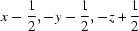
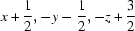
| Symmetry codes: (vi) x−1/2, −y−1/2, −z+1/2; (vii) x+1/2, −y−1/2, −z+3/2; (viii) x−1/2, y, −z+1/2; (ix) x−1/2, y, −z+3/2. |
Experimental details
| Crystal data | |
| Chemical formula | K4[Bi2Cl10]·4H2O |
| Mr | 1000.94 |
| Crystal system, space group | Orthorhombic, Pnma |
| Temperature (K) | 295 |
| a, b, c (Å) | 8.4310 (1), 21.8444 (3), 12.2561 (2) |
| V (Å3) | 2257.21 (6) |
| Z | 4 |
| Radiation type | Mo Kα |
| µ (mm−1) | 17.49 |
| Crystal size (mm) | 0.28 × 0.12 × 0.08 |
| Data collection | |
| Diffractometer | Bruker APEXII CCD diffractometer |
| Absorption correction | Multi-scan (SADABS; Bruker, 2006) |
| Tmin, Tmax | 0.067, 0.247 |
| No. of measured, independent and observed [I > 3.0σ(I)] reflections | 26961, 4596, 2801 |
| Rint | 0.034 |
| (sin θ/λ)max (Å−1) | 0.790 |
| Refinement | |
| R[F2 > 2σ(F2)], wR(F2), S | 0.017, 0.017, 1.08 |
| No. of reflections | 2801 |
| No. of parameters | 114 |
| H-atom treatment | All H-atom parameters refined |
| Δρmax, Δρmin (e Å−3) | 1.01, −0.82 |
Computer programs: APEX2 (Bruker, 2006), SHELXS97 (Sheldrick, 2008), SHELXL97 (Sheldrick, 2008) and CRYSTALS (Betteridge et al., 2003), DIAMOND (Brandenburg, 2001), CRYSTALS (Betteridge et al., 2003) and publCIF (Westrip, 2008).
| Bi1—Cl7i | 2.5954 (8) | Bi1—Cl6i | 2.7205 (7) |
| Bi1—Cl4 | 2.6190 (8) | Bi1—Cl5ii | 2.8512 (7) |
| Bi1—Cl2 | 2.6522 (8) | Bi1—Cl3 | 2.8724 (7) |
| Symmetry codes: (i) x, y, z+1; (ii) x, −y−1/2, z+1. |
| D—H···A | D—H | H···A | D···A | D—H···A |
| O11—H13···Cl7iii | 0.92 (7) | 2.32 (7) | 3.234 (4) | 169 (7) |
| O11—H14···Cl4iv | 0.78 (7) | 2.56 (8) | 3.273 (3) | 150 (9) |
| O12—H8···Cl7v | 0.79 (6) | 2.78 (7) | 3.497 (4) | 152 (7) |
| O12—H15···Cl2vi | 0.81 (17) | 2.81 (8) | 3.514 (3) | 145 (9) |
| Symmetry codes: (iii) x−1/2, −y−1/2, −z+1/2; (iv) x+1/2, −y−1/2, −z+3/2; (v) x−1/2, y, −z+1/2; (vi) x−1/2, y, −z+3/2. |
References
 Belkyal, L., Mokhlisse, R., Tanouti, B., Hesse, K.-F. & Depmeier, W. (1997). Eur. J. Solid. State Inorg. Chem. 34, 1085–1091. CAS Google Scholar
Benachenhou, F., Mairesse, G., Nowogrocki, G. & Thomas, D. (1986). J. Solid State Chem. 65, 13–26. CrossRef CAS Web of Science Google Scholar
Betteridge, P. W., Carruthers, J. R., Cooper, R. I., Prout, K. & Watkin, D. J. (2003). J. Appl. Cryst. 36, 1487. Web of Science CrossRef IUCr Journals Google Scholar
Brandenburg, K. (2001). DIAMOND. Crystal Impact GbR, Bonn, Germany. Google Scholar
Bruker (2006). APEX2 and SADABS. Bruker AXS Inc., Madison, Wisconsin, USA. Google Scholar
Larson, A. C. (1970). Crystallographic Computing, edited by F. R. Ahmed, S. R. Hall & C. P. Huber, pp. 291–294. Copenhagen: Munksgaard. Google Scholar
Lazarini, F. (1977). Acta Cryst. B33, 1954–1956. CrossRef CAS IUCr Journals Web of Science Google Scholar
Prince, E. (1982). Mathematical Techniques in Crystallography and Materials Science. New York: Springer-Verlag. Google Scholar
Sheldrick, G. M. (2008). Acta Cryst. A64, 112–122. Web of Science CrossRef CAS IUCr Journals Google Scholar
Volkova, L. M., Udovenko, A. A., Levin, A. N. & Shevchenko, V. Ya. (1983). Koord. Khim. 9, 356–360. CAS Google Scholar
Watkin, D. (1994). Acta Cryst. A50, 411–437. CrossRef CAS Web of Science IUCr Journals Google Scholar
Westrip, S. P. (2008). publCIF. In preparation. Google Scholar
This is an open-access article distributed under the terms of the Creative Commons Attribution (CC-BY) Licence, which permits unrestricted use, distribution, and reproduction in any medium, provided the original authors and source are cited.
| CRYSTALLOGRAPHIC COMMUNICATIONS |


Some bismuth-containing compounds (Belkyal et al., 1997; Benachenhou et al., 1986) exhibit phase transitions and have interesting physical properties which make them the object of an intensive research due to their potential application in catalysis.
Under investigation of a series of these materials, we have selected the K4[Bi2Cl10].4H2O compound and redetermined its structure. For the previous crystallographic study on this compound, see: Volkova et al. (1983). The isotypic Br compound was reported by Lazarini (1977).
The structure of the title compound can be described by [Bi2Cl10]4- pairs of octahedra, K+ cations and water molecules (Fig. 1), forming a three-dimensional network (Fig. 2). The [Bi2Cl10]4- anions are formed by pairs of distorted [BiCl6] octahedra sharing an edge. The mean Bi—Cl distances range from 2.5954 (8) to 2.8724 (7) Å with the Cl—Bi—Cl angles varying between 80.58 (2) and 94.82 (3)°, likewise showing the distortions of the BiCl6 octahedra. Compared to the previous study, the distortion of the [BiCl6] octahedra is relatively lower. The structure is additionally stabilized by the presence of hydrogen bonds of the type O—H···Cl between water molecules and the binuclear complex anions. For the polyhedra around the K+ cations the coordinations are similar. Whereas two K+ cations (K8 and K9) are located at the 4c sites (m symmetry), the third cation (K10) is on a general position. However, all K+ cations are surrounded by two water O atoms and seven Cl atoms, leading to irregular [KO2Cl7] polyhedra.