 | Acta Crystallographica Section E Acta Crystallographica Section E CRYSTALLOGRAPHIC COMMUNICATIONS |


 journal menu


inorganic compounds
| CRYSTALLOGRAPHIC COMMUNICATIONS |
 access
Ammonium ytterbium(III) diphosphate(V)

aInstitute of Physics, Na Slovance 2, 182 21 Praha 8, Czech Republic, and bDepartment of Chemistry, Faculty of Sciences, University Mohammed 1st, PO Box 717, 60 000 Oujda, Morocco
*Correspondence e-mail: [email protected]
The title compound, NH4YbP2O7, crystallizes in the KAlP2O7 structure type and consists of distorted YbO6 octahedra and bent P2O74− diphosphate units forming together a three-dimensional network. There are channels in the structure running along the c axis, where the NH4+ cations are located. They are connected via N—H⋯O hydrogen bonds to the terminal O atoms of the diphosphate anions.
Related literature
Isotypic compounds were reported by Man-Rong et al. (2005![[Man-Rong, L., Wei, L., Hao-Hong, C., Xin-Xin, Y., Zan-Bin, W., Dun-Hua, C., Mu, G. & Jing-Tai, Z. (2005). Eur. J. Inorg. Chem. pp. 4693-4696.]](../../../../../../logos/arrows/e_arr.gif "Man-Rong, L., Wei, L., Hao-Hong, C., Xin-Xin, Y., Zan-Bin, W., Dun-Hua, C., Mu, G. & Jing-Tai, Z. (2005). Eur. J. Inorg. Chem. pp. 4693-4696.") ), [NH4LuP2O7]; Horchani-Naifer & Férid (2007), [YbP2O7]; Jansen et al. (1991), [CsYbP2O7], that all crystallize with the KAlP2O7 structure type (Ng & Calvo, 1973). For the crystal structures of other isoformular rare earth diphosphates, see: Hamady & Jouini (1996), [NaYP2O7]; Férid et al. (2004), [NaEuP2O7]; Ferid et al. (2004), [NaYbP2O7]; Férid & Horchani-Naifer (2004), [NaLaP2O7]; Horchani-Naifer & Férid (2005), [NaCeP2O7]; Hamady et al. (1994) and Yuan et al. (2007), [KYP2O7]. Possible applications of rare earth phosphates were discussed by Yamada et al. (1974); Hong (1975); Bimberg et al. (1975). For background on crystallographic software, see: Becker & Coppens (1974).
), [NH4LuP2O7]; Horchani-Naifer & Férid (2007), [YbP2O7]; Jansen et al. (1991), [CsYbP2O7], that all crystallize with the KAlP2O7 structure type (Ng & Calvo, 1973). For the crystal structures of other isoformular rare earth diphosphates, see: Hamady & Jouini (1996), [NaYP2O7]; Férid et al. (2004), [NaEuP2O7]; Ferid et al. (2004), [NaYbP2O7]; Férid & Horchani-Naifer (2004), [NaLaP2O7]; Horchani-Naifer & Férid (2005), [NaCeP2O7]; Hamady et al. (1994) and Yuan et al. (2007), [KYP2O7]. Possible applications of rare earth phosphates were discussed by Yamada et al. (1974); Hong (1975); Bimberg et al. (1975). For background on crystallographic software, see: Becker & Coppens (1974).
Experimental
Crystal data
|
Data collection
Refinement
|
| |||||||||||||||||||||||||||||||||||||
 ; (ii)
 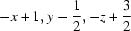 ; (iii)
  ; (iv)
 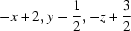 .
.
|
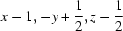 .
. Data collection: CrysAlis CCD (Oxford Diffraction, 2005); cell refinement: CrysAlis RED (Oxford Diffraction, 2008); data reduction: CrysAlis RED; program(s) used to solve structure: SIR2002 (Burla et al., 2003); program(s) used to refine structure: JANA2006 (Petříček et al., 2007); molecular graphics: DIAMOND (Brandenburg & Putz, 2005); software used to prepare material for publication: JANA2006.
Supporting information
contains datablocks global, I. DOI: 10.1107/S1600536808039664/wm2208sup1.cif
Structure factors: contains datablock I. DOI: 10.1107/S1600536808039664/wm2208Isup2.hkl
Three solutions have been mixed in a beaker to prepare the title compound: NH4OH (20 ml, 0.1 mmol), YbCl3.6H2O (20 ml, 0.1 mmol) and Na4P2O7 (20 ml, 0.1 mmol). The pH of the mixture was controlled with diluted hydrochloric acid to be slightly acidic, and the solution was stirred for two hours at room temperature. Crystals suitable for X-ray analysis were formed after a few days.
All hydrogen atoms were discernible in difference Fourier maps and could be refined to reasonable geometry. The N—H distances were restrained to 0.87 Å with σ of 0.02. The isotropic atomic displacement parameters of all hydrogen atoms were refined with 1.2×Ueq of the N atom.
Data collection: CrysAlis CCD (Oxford Diffraction, 2005); cell CrysAlis RED (Oxford Diffraction, 2008); data reduction: CrysAlis RED (Oxford Diffraction, 2008); program(s) used to solve structure: SIR2002 (Burla et al., 2003); program(s) used to refine structure: JANA2006 (Petříček et al., 2007); molecular graphics: DIAMOND (Brandenburg & Putz, 2005); software used to prepare material for publication: JANA2006 (Petříček et al., 2007).
![[Figure 1]](./wm2208fig1thm.gif) | Fig. 1. Part of the structure of NH4YbP2O7. Displacement ellipsoids are drawn at the 50% probability level. [Symmetry codes: (i) 1 - x,-1/2 + y, 1.5 - z; (ii) x, 0.5 - y, -1/2 + z; (iii) x, 0.5 - y, 1/2 + z; (iv) 2 - x, -1/2 + y, 1.5 - z; (v) 1 - x, 1 - y, 1 - z; (vi} -1 + x, 0.5 - y, -1/2 + z; (vii) -1 + x, y, z.] |
![[Figure 2]](./wm2208fig2thm.gif) | Fig. 2. The packing of NH4YbP2O7 viewed along c. Colors: Pink (P2O7), grey (YbO6), blue balls (N), black balls (H). |
| NH4YbP2O7 | F(000) = 668 |
| Mr = 365 | Dx = 3.502 Mg m−3 |
| Monoclinic, P21/c | Mo Kα radiation, λ = 0.71073 Å |
| Hall symbol: -P 2ybc | Cell parameters from 8929 reflections |
| a = 7.6468 (2) Å | θ = 2.8–26.5° |
| b = 10.9119 (2) Å | µ = 13.97 mm−1 |
| c = 8.6129 (3) Å | T = 120 K |
| β = 105.645 (3)° | Prism, colorless |
| V = 692.04 (3) Å3 | 0.26 × 0.08 × 0.07 mm |
| Z = 4 |
| Oxford Diffraction XCalibur 2 with Sapphire 2 area detector diffractometer | 1437 independent reflections |
| Radiation source: X-ray tube | 1362 reflections with I > 3σ(I) |
| Graphite monochromator | Rint = 0.023 |
| Detector resolution: 8.3438 pixels mm-1 | θmax = 26.5°, θmin = 2.8° |
| Rotation method data acquisition using ω scans | h = −9→9 |
| Absorption correction: analytical [implemented in CrysAlis RED (Oxford Diffraction, 2008), according to Clark & Reid (1995)] | k = −13→13 |
| Tmin = 0.169, Tmax = 0.545 | l = −10→10 |
| 8574 measured reflections |
| Refinement on F2 | Only H-atom coordinates refined |
| R[F2 > 2σ(F2)] = 0.016 | Weighting scheme based on measured s.u.'s w = 1/[σ2(I) + 0.0016I2] |
| wR(F2) = 0.061 | (Δ/σ)max = 0.039 |
| S = 1.32 | Δρmax = 0.58 e Å−3 |
| 1437 reflections | Δρmin = −0.50 e Å−3 |
| 113 parameters | Extinction correction: B-C type 1 Lorentzian isotropic (Becker & Coppens, 1974) |
| 4 restraints | Extinction coefficient: 170 (60) |
| 4 constraints |
| NH4YbP2O7 | V = 692.04 (3) Å3 |
| Mr = 365 | Z = 4 |
| Monoclinic, P21/c | Mo Kα radiation |
| a = 7.6468 (2) Å | µ = 13.97 mm−1 |
| b = 10.9119 (2) Å | T = 120 K |
| c = 8.6129 (3) Å | 0.26 × 0.08 × 0.07 mm |
| β = 105.645 (3)° |
| Oxford Diffraction XCalibur 2 with Sapphire 2 area detector diffractometer | 1437 independent reflections |
| Absorption correction: analytical [implemented in CrysAlis RED (Oxford Diffraction, 2008), according to Clark & Reid (1995)] | 1362 reflections with I > 3σ(I) |
| Tmin = 0.169, Tmax = 0.545 | Rint = 0.023 |
| 8574 measured reflections |
| R[F2 > 2σ(F2)] = 0.016 | 4 restraints |
| wR(F2) = 0.061 | Only H-atom coordinates refined |
| S = 1.32 | Δρmax = 0.58 e Å−3 |
| 1437 reflections | Δρmin = −0.50 e Å−3 |
| 113 parameters |
Refinement. The refinement was carried out against all reflections. The conventional R-factor is always based on F. The goodness of fit as well as the weighted R-factor are based on F and F2 for carried out on F and F2, respectively. The threshold expression is used only for calculating R-factors etc. and it is not relevant to the choice of reflections for refinement. The program used for Jana2006, uses the weighting scheme based on the experimental expectations, see _refine_ls_weighting_details, that does not force S to be one. Therefore the values of S are usually larger than the ones from the SHELX program. |
| x | y | z | Uiso*/Ueq | ||
| Yb1 | 0.73470 (3) | 0.100256 (15) | 0.753623 (18) | 0.00555 (9) | |
| P1 | 0.63175 (18) | 0.40147 (9) | 0.81812 (14) | 0.0080 (4) | |
| P2 | 0.93914 (15) | 0.36312 (10) | 0.68708 (13) | 0.0070 (3) | |
| O1 | 0.5777 (4) | 0.2746 (3) | 0.7457 (4) | 0.0124 (10) | |
| O2 | 0.6416 (6) | 0.4080 (3) | 0.9940 (5) | 0.0254 (14) | |
| O3 | 0.8335 (4) | 0.4300 (3) | 0.8037 (4) | 0.0126 (9) | |
| O4 | 0.5107 (4) | 0.5010 (3) | 0.7202 (3) | 0.0097 (9) | |
| O5 | 0.9555 (4) | 0.2277 (3) | 0.7359 (4) | 0.0121 (10) | |
| O6 | 0.8260 (6) | 0.3855 (3) | 0.5169 (5) | 0.0183 (12) | |
| O7 | 1.1241 (4) | 0.4235 (3) | 0.7273 (4) | 0.0142 (10) | |
| N1 | 0.3131 (6) | 0.3233 (4) | 0.4381 (5) | 0.0183 (13) | |
| H1 | 0.281 (7) | 0.348 (5) | 0.523 (4) | 0.0219* | |
| H2 | 0.365 (7) | 0.385 (3) | 0.403 (6) | 0.0219* | |
| H3 | 0.206 (4) | 0.306 (5) | 0.375 (5) | 0.0219* | |
| H4 | 0.373 (7) | 0.267 (4) | 0.501 (5) | 0.0219* |
| U11 | U22 | U33 | U12 | U13 | U23 | |
| Yb1 | 0.00611 (15) | 0.00443 (15) | 0.00616 (16) | −0.00018 (5) | 0.00173 (9) | 0.00025 (5) |
| P1 | 0.0101 (6) | 0.0088 (6) | 0.0056 (5) | 0.0056 (4) | 0.0027 (5) | −0.0006 (4) |
| P2 | 0.0066 (5) | 0.0058 (5) | 0.0084 (5) | −0.0016 (4) | 0.0017 (4) | 0.0016 (4) |
| O1 | 0.0142 (16) | 0.0076 (15) | 0.0178 (16) | 0.0019 (12) | 0.0085 (13) | 0.0023 (12) |
| O2 | 0.034 (3) | 0.039 (2) | 0.0043 (17) | 0.0210 (17) | 0.0062 (17) | 0.0013 (14) |
| O3 | 0.0073 (15) | 0.0117 (14) | 0.0158 (16) | 0.0000 (12) | −0.0019 (13) | −0.0036 (13) |
| O4 | 0.0093 (14) | 0.0097 (13) | 0.0102 (14) | 0.0026 (12) | 0.0028 (11) | 0.0041 (12) |
| O5 | 0.0088 (15) | 0.0113 (15) | 0.0166 (16) | −0.0007 (12) | 0.0041 (12) | 0.0045 (12) |
| O6 | 0.017 (2) | 0.0277 (19) | 0.0086 (18) | −0.0005 (14) | 0.0015 (15) | 0.0090 (14) |
| O7 | 0.0093 (16) | 0.0101 (13) | 0.0228 (17) | −0.0036 (13) | 0.0035 (14) | 0.0014 (12) |
| N1 | 0.017 (2) | 0.021 (2) | 0.013 (2) | −0.0069 (17) | −0.0014 (17) | 0.0046 (16) |
| Yb1—O1 | 2.240 (3) | P1—O4 | 1.525 (3) |
| Yb1—O2i | 2.158 (4) | P2—O3 | 1.622 (4) |
| Yb1—O4ii | 2.230 (3) | P2—O5 | 1.532 (3) |
| Yb1—O5 | 2.224 (3) | P2—O6 | 1.507 (4) |
| Yb1—O6iii | 2.191 (4) | P2—O7 | 1.514 (3) |
| Yb1—O7iv | 2.195 (3) | N1—H1 | 0.87 (5) |
| P1—O1 | 1.529 (3) | N1—H2 | 0.87 (5) |
| P1—O2 | 1.498 (5) | N1—H3 | 0.87 (3) |
| P1—O3 | 1.611 (4) | N1—H4 | 0.86 (4) |
| O1—Yb1—O2i | 88.83 (13) | O2—P1—O3 | 106.3 (2) |
| O1—Yb1—O4ii | 87.53 (11) | O2—P1—O4 | 112.5 (2) |
| O1—Yb1—O5 | 82.94 (12) | O3—P1—O4 | 105.70 (17) |
| O1—Yb1—O6iii | 89.43 (12) | O3—P2—O5 | 106.33 (19) |
| O1—Yb1—O7iv | 175.63 (13) | O3—P2—O6 | 106.2 (2) |
| O2i—Yb1—O4ii | 91.87 (14) | O3—P2—O7 | 104.64 (18) |
| O2i—Yb1—O5 | 89.99 (15) | O5—P2—O6 | 113.98 (18) |
| O2i—Yb1—O6iii | 178.23 (14) | O5—P2—O7 | 110.79 (17) |
| O2i—Yb1—O7iv | 93.37 (13) | O6—P2—O7 | 114.1 (2) |
| O4ii—Yb1—O5 | 170.25 (11) | P1—O3—P2 | 127.40 (19) |
| O4ii—Yb1—O6iii | 88.39 (13) | P1—O4—H2v | 115.2 (13) |
| O4ii—Yb1—O7iv | 88.63 (12) | P2—O5—H3vi | 109.5 (14) |
| O5—Yb1—O6iii | 89.47 (13) | H1—N1—H2 | 108 (5) |
| O5—Yb1—O7iv | 100.82 (12) | H1—N1—H3 | 99 (4) |
| O6iii—Yb1—O7iv | 88.39 (12) | H1—N1—H4 | 85 (5) |
| O1—P1—O2 | 113.0 (2) | H2—N1—H3 | 113 (4) |
| O1—P1—O3 | 107.61 (19) | H2—N1—H4 | 123 (5) |
| O1—P1—O4 | 111.26 (16) | H3—N1—H4 | 119 (4) |
| Symmetry codes: (i) x, −y+1/2, z−1/2; (ii) −x+1, y−1/2, −z+3/2; (iii) x, −y+1/2, z+1/2; (iv) −x+2, y−1/2, −z+3/2; (v) −x+1, −y+1, −z+1; (vi) x+1, −y+1/2, z+1/2. |
| D—H···A | D—H | H···A | D···A | D—H···A |
| N1—H1···O7vii | 0.87 (4) | 2.52 (5) | 3.381 (5) | 168 (4) |
| N1—H2···O4v | 0.88 (4) | 2.03 (5) | 2.888 (5) | 166 (4) |
| N1—H3···O5viii | 0.87 (4) | 2.00 (4) | 2.873 (6) | 177 (7) |
| N1—H4···O1 | 0.86 (5) | 2.26 (4) | 2.916 (5) | 132 (4) |
| Symmetry codes: (v) −x+1, −y+1, −z+1; (vii) x−1, y, z; (viii) x−1, −y+1/2, z−1/2. |
Experimental details
| Crystal data | |
| Chemical formula | NH4YbP2O7 |
| Mr | 365 |
| Crystal system, space group | Monoclinic, P21/c |
| Temperature (K) | 120 |
| a, b, c (Å) | 7.6468 (2), 10.9119 (2), 8.6129 (3) |
| β (°) | 105.645 (3) |
| V (Å3) | 692.04 (3) |
| Z | 4 |
| Radiation type | Mo Kα |
| µ (mm−1) | 13.97 |
| Crystal size (mm) | 0.26 × 0.08 × 0.07 |
| Data collection | |
| Diffractometer | Oxford Diffraction XCalibur 2 with Sapphire 2 area detector diffractometer |
| Absorption correction | Analytical [implemented in CrysAlis RED (Oxford Diffraction, 2008), according to Clark & Reid (1995)] |
| Tmin, Tmax | 0.169, 0.545 |
| No. of measured, independent and observed [I > 3σ(I)] reflections | 8574, 1437, 1362 |
| Rint | 0.023 |
| (sin θ/λ)max (Å−1) | 0.628 |
| Refinement | |
| R[F2 > 2σ(F2)], wR(F2), S | 0.016, 0.061, 1.32 |
| No. of reflections | 1437 |
| No. of parameters | 113 |
| No. of restraints | 4 |
| H-atom treatment | Only H-atom coordinates refined |
| Δρmax, Δρmin (e Å−3) | 0.58, −0.50 |
Computer programs: CrysAlis CCD (Oxford Diffraction, 2005), CrysAlis RED (Oxford Diffraction, 2008), SIR2002 (Burla et al., 2003), JANA2006 (Petříček et al., 2007), DIAMOND (Brandenburg & Putz, 2005).
| Yb1—O1 | 2.240 (3) | P1—O2 | 1.498 (5) |
| Yb1—O2i | 2.158 (4) | P1—O3 | 1.611 (4) |
| Yb1—O4ii | 2.230 (3) | P1—O4 | 1.525 (3) |
| Yb1—O5 | 2.224 (3) | P2—O3 | 1.622 (4) |
| Yb1—O6iii | 2.191 (4) | P2—O5 | 1.532 (3) |
| Yb1—O7iv | 2.195 (3) | P2—O6 | 1.507 (4) |
| P1—O1 | 1.529 (3) | P2—O7 | 1.514 (3) |
| P1—O3—P2 | 127.40 (19) |
| Symmetry codes: (i) x, −y+1/2, z−1/2; (ii) −x+1, y−1/2, −z+3/2; (iii) x, −y+1/2, z+1/2; (iv) −x+2, y−1/2, −z+3/2. |
| D—H···A | D—H | H···A | D···A | D—H···A |
| N1—H1···O7v | 0.87 (4) | 2.52 (5) | 3.381 (5) | 168 (4) |
| N1—H2···O4vi | 0.88 (4) | 2.03 (5) | 2.888 (5) | 166 (4) |
| N1—H3···O5vii | 0.87 (4) | 2.00 (4) | 2.873 (6) | 177 (7) |
| N1—H4···O1 | 0.86 (5) | 2.26 (4) | 2.916 (5) | 132 (4) |
| Symmetry codes: (v) x−1, y, z; (vi) −x+1, −y+1, −z+1; (vii) x−1, −y+1/2, z−1/2. |
Acknowledgements
We acknowledge the Grant Agency of the Czech Republic for grant No. 202/06/0757.
References
 Becker, P. J. & Coppens, P. (1974). Acta Cryst. A30, 129–147. CrossRef IUCr Journals Web of Science Google Scholar
Bimberg, D., Robbins, D. J., Wight, D. R. & Jeser, J. P. (1975). Appl. Phys. Lett. 27, 67–68. CrossRef CAS Web of Science Google Scholar
Brandenburg, K. & Putz, H. (2005). DIAMOND. Crystal Impact GbR, Bonn, Germany. Google Scholar
Burla, M. C., Camalli, M., Carrozzini, B., Cascarano, G. L., Giacovazzo, C., Polidori, G. & Spagna, R. (2003). J. Appl. Cryst. 36, 1103. CrossRef IUCr Journals Google Scholar
Clark, R. C. & Reid, J. S. (1995). Acta Cryst. A51, 887–897. CrossRef CAS Web of Science IUCr Journals Google Scholar
Férid, M., Horchani, K. & Amami, J. (2004). Mater. Res. Bull. 39, 1949–1955. Google Scholar
Férid, M. & Horchani-Naifer, K. (2004). Mater. Res. Bull. 39, 2209–2217. Web of Science CrossRef CAS Google Scholar
Ferid, M., Horchani-Naifer, K. & Trabelsi-Ayedi, M. (2004). Z. Kristallogr. New Cryst. Struct. 219, 353–354. CAS Google Scholar
Hamady, A., Faouzi Zid, M. & Jouini, T. (1994). J. Solid State Chem. 113, 120–124. CrossRef CAS Web of Science Google Scholar
Hamady, A. & Jouini, T. (1996). Acta Cryst. C52, 2949–2951. CrossRef CAS Web of Science IUCr Journals Google Scholar
Hong, H. Y. P. (1975). Mater. Res. Bull. 10, 1105–1110. CrossRef CAS Web of Science Google Scholar
Horchani-Naifer, K. & Férid, M. (2005). Solid State Ionics, 176, 1949–1953. Web of Science CrossRef CAS Google Scholar
Horchani-Naifer, K. & Férid, M. (2007). Acta Cryst. E63, i33–i34. Web of Science CrossRef IUCr Journals Google Scholar
Jansen, M., Wu, G. Q. & Koenigstein, K. (1991). Z. Kristallogr. 197, 245–246. CrossRef CAS Web of Science Google Scholar
Man-Rong, L., Wei, L., Hao-Hong, C., Xin-Xin, Y., Zan-Bin, W., Dun-Hua, C., Mu, G. & Jing-Tai, Z. (2005). Eur. J. Inorg. Chem. pp. 4693–4696. Google Scholar
Ng, H. N. & Calvo, C. (1973). Can. J. Chem. 51, 2613-2620. CrossRef CAS Web of Science Google Scholar
Oxford Diffraction (2005). CrysAlis CCD. Oxford Diffraction Ltd, Abingdon, England. Google Scholar
Oxford Diffraction (2008). CrysAlis RED. Oxford Diffraction Ltd, Abingdon, England. Google Scholar
Petříček, V., Dušek, M. & Palatinus, L. (2007). JANA2006. Institute of Physics, Praha, Czech Republic. Google Scholar
Yamada, T., Otsuka, K. & Nakano, J. (1974). J. Appl. Phys. 45, 5096–5097. CrossRef CAS Web of Science Google Scholar
Yuan, J., Zhang, H., Chen, H., Yang, X., Zhao, J. & Gu, M. (2007). J. Solid State Chem. 180, 3381–3387. Web of Science CrossRef CAS Google Scholar
This is an open-access article distributed under the terms of the Creative Commons Attribution (CC-BY) Licence, which permits unrestricted use, distribution, and reproduction in any medium, provided the original authors and source are cited.
| CRYSTALLOGRAPHIC COMMUNICATIONS |


Rare earth phosphates have many potential applications in the field of optical materials including laser phosphors (Yamada et al., 1974; Hong, 1975; Bimberg et al., 1975). Their crystal structures depend on the ionic radii of the alkali metal and the rare earth ions. The two AYbP2O7 (A = Cs (Jansen et al., 1991), K (Horchani-Naifer & Férid, 2007)) structures known so far belong to the KAlP2O7 structure type (Ng & Calvo, 1973) and crystallize in space group P21/c. For the correspondent isoformular sodium rare earth diphosphates, several other structures have been described, for instance NaYP2O7 in space group P21 (Hamady & Jouini, 1996), NaLnP2O7 (Ln = Eu (Férid, Horchani & Amami, 2004), Yb (Ferid et al., 2004)) in space group P21/n, and NaLnP2O7 (Ln = La (Férid & Horchani-Naifer, 2004), Ce (Horchani-Naifer & Férid, 2005) in space group Pnma. KYP2O7 is dimorphic and can adopt the KAlP2O7 structure type (Yuan et al., 2007), or a structure in space group Cmcm (Hamady et al., 1994).
In the present paper we report the crystal structure of NH4YbP2O7. This compound is isotypic with NH4LuP2O7 (Man-Rong et al. 2005), KYbP2O7 (Horchani-Naifer & Férid, 2007) and CsYbP2O7 (Jansen et al., 1991). The Yb atom is coordinated by six oxygen atoms forming a distorted octahedron that belong to five symmetry-related P2O74- anions (Fig. 1). The average Yb—O bond lenght is 2.206 Å (Table 1). The diphosphate anion is bent with a bridging angle of 127.40 (19) °. The three-dimensional network of YbO6 and P2O74- units forms channels running along the c direcion in which the NH4+ cations are located (Fig. 2). Each NH4+ cation is connected via N—H···O hydrogen bonds to four different P2O74- anions (Table 2).