 | Acta Crystallographica Section E Acta Crystallographica Section E CRYSTALLOGRAPHIC COMMUNICATIONS |


 journal menu


metal-organic compounds
| CRYSTALLOGRAPHIC COMMUNICATIONS |
 access
Bis(2-amino-3-nitropyridinium) dichromate(VI)

aLaboratoire de chimie des Matériaux, Faculté des Sciences de Bizerte, 7021 Zarzouna Bizerte, Tunisia
*Correspondence e-mail: [email protected]
The title compound, (C5H6N3O2)2[Cr2O7], consists of 2-amino-3-nitropyridinium cations and discrete dichromate anions linked together by N—H⋯O and C—H⋯O hydrogen bonds, forming thick layers parallel to (101). Layer cohesion is ensured by N—H⋯O hydrogen bonding in addition to electrostatic and van der Waals interactions, forming a three-dimensional framework. The dichromate anion is located on a twofold axis that passes through its bridging O atom.
Related literature
For related structures, see: Akriche & Rzaigui (2000![[Akriche, S. & Rzaigui, M. (2000). Z. Kristallogr. New Cryst. Struct. 215, 617-618.]](../../../../../../logos/arrows/e_arr.gif "Akriche, S. & Rzaigui, M. (2000). Z. Kristallogr. New Cryst. Struct. 215, 617-618.") ); Khadhrani et al. (2006); Nicoud et al. (1997); Panunto et al. (1987); Sieroń (2007); Le Fur et al. (1998). For a discussion of hydrogen bonding, see: Desiraju (1989, 1995).
); Khadhrani et al. (2006); Nicoud et al. (1997); Panunto et al. (1987); Sieroń (2007); Le Fur et al. (1998). For a discussion of hydrogen bonding, see: Desiraju (1989, 1995).
![[Scheme 1]](dn2417scheme1.gif)
Experimental
Crystal data
|
Data collection
|
Refinement
|
|
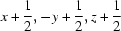 ; (iii)
 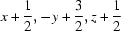 ; (iv)
 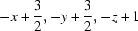 .
. Data collection: CAD-4 EXPRESS (Enraf–Nonius, 1994); cell refinement: CAD-4 EXPRESS; data reduction: XCAD4 (Harms & Wocadlo, 1996); program(s) used to solve structure: SHELXS97 (Sheldrick, 2008); program(s) used to refine structure: SHELXL97 (Sheldrick, 2008); molecular graphics: ORTEP-32 for Windows (Farrugia, 1998); DIAMOND (Brandenburg & Putz, 2005); software used to prepare material for publication: WinGX publication routines (Farrugia, 1999).
Supporting information
contains datablocks I, global. DOI: 10.1107/S1600536808043018/dn2417sup1.cif
Structure factors: contains datablock I. DOI: 10.1107/S1600536808043018/dn2417Isup2.hkl
0.004 mol of 2-amino-3-nitropyridine was dissolved in 20 ml of pure acetic acid. 5 ml solution containing 0.004 mol of CrO3 was added drop by drop under stirring at 333 K. The obtained solution is slowly evaporated at the ambiant temperature. After some days, Brown single crystals of the title compound are formed in the reactionnel midle.
Data collection: CAD-4 EXPRESS (Enraf–Nonius, 1994); cell CAD-4 EXPRESS (Enraf–Nonius, 1994); data reduction: XCAD4 (Harms & Wocadlo, 1996); program(s) used to solve structure: SHELXS97 (Sheldrick, 2008); program(s) used to refine structure: SHELXL97 (Sheldrick, 2008); molecular graphics: ORTEP-32 for Windows (Farrugia, 1998); DIAMOND (Brandenburg & Putz, 2005); software used to prepare material for publication: WinGX publication routines (Farrugia, 1999).
![[Figure 1]](./dn2417fig1thm.gif) | Fig. 1. An ORTEP view of (I) with the atom-labelling scheme. Displacement ellipsoids are drawn at the 30% probability level. H atoms are represented as small spheres of arbitrary radii. Hydrogen bonds are represented as dashed lines. [Symmetry code: (i) -x+1, y, -z+1/2] |
![[Figure 2]](./dn2417fig2thm.gif) | Fig. 2. Projection of (I) along the b axis. |
| (C5H6N3O2)2[Cr2O7] | F(000) = 1000 |
| Mr = 496.26 | Dx = 1.869 Mg m−3 |
| Monoclinic, C2/c | Mo Kα radiation, λ = 0.71073 Å |
| Hall symbol: -C 2yc | Cell parameters from 25 reflections |
| a = 14.799 (2) Å | θ = 9–11° |
| b = 7.464 (3) Å | µ = 1.31 mm−1 |
| c = 17.870 (5) Å | T = 298 K |
| β = 116.71 (4)° | Diamond-shaped, brown |
| V = 1763.3 (11) Å3 | 0.25 × 0.23 × 0.19 mm |
| Z = 4 |
| Enraf–Nonius TurboCAD-4 diffractometer | Rint = 0.021 |
| Radiation source: fine-focus sealed tube | θmax = 28.0°, θmin = 2.6° |
| Graphite monochromator | h = −19→19 |
| non–profiled ω scans | k = 0→9 |
| 3444 measured reflections | l = −10→23 |
| 2123 independent reflections | 2 standard reflections every 120 min |
| 1562 reflections with I > 2σ(I) | intensity decay: 3% |
| Refinement on F2 | Primary atom site location: structure-invariant direct methods |
| Least-squares matrix: full | Secondary atom site location: difference Fourier map |
| R[F2 > 2σ(F2)] = 0.039 | Hydrogen site location: inferred from neighbouring sites |
| wR(F2) = 0.106 | H-atom parameters constrained |
| S = 1.04 | w = 1/[σ2(Fo2) + (0.0546P)2 + 0.8978P] where P = (Fo2 + 2Fc2)/3 |
| 2123 reflections | (Δ/σ)max = 0.002 |
| 132 parameters | Δρmax = 0.44 e Å−3 |
| 0 restraints | Δρmin = −0.37 e Å−3 |
| (C5H6N3O2)2[Cr2O7] | V = 1763.3 (11) Å3 |
| Mr = 496.26 | Z = 4 |
| Monoclinic, C2/c | Mo Kα radiation |
| a = 14.799 (2) Å | µ = 1.31 mm−1 |
| b = 7.464 (3) Å | T = 298 K |
| c = 17.870 (5) Å | 0.25 × 0.23 × 0.19 mm |
| β = 116.71 (4)° |
| Enraf–Nonius TurboCAD-4 diffractometer | Rint = 0.021 |
| 3444 measured reflections | 2 standard reflections every 120 min |
| 2123 independent reflections | intensity decay: 3% |
| 1562 reflections with I > 2σ(I) |
| R[F2 > 2σ(F2)] = 0.039 | 0 restraints |
| wR(F2) = 0.106 | H-atom parameters constrained |
| S = 1.04 | Δρmax = 0.44 e Å−3 |
| 2123 reflections | Δρmin = −0.37 e Å−3 |
| 132 parameters |
Geometry. All esds (except the esd in the dihedral angle between two l.s. planes) are estimated using the full covariance matrix. The cell esds are taken into account individually in the estimation of esds in distances, angles and torsion angles; correlations between esds in cell parameters are only used when they are defined by crystal symmetry. An approximate (isotropic) treatment of cell esds is used for estimating esds involving l.s. planes. |
Refinement. Refinement of F2 against ALL reflections. The weighted R-factor wR and goodness of fit S are based on F2, conventional R-factors R are based on F, with F set to zero for negative F2. The threshold expression of F2 > σ(F2) is used only for calculating R-factors(gt) etc. and is not relevant to the choice of reflections for refinement. R-factors based on F2 are statistically about twice as large as those based on F, and R- factors based on ALL data will be even larger. |
| x | y | z | Uiso*/Ueq | ||
| Cr1 | 0.51253 (3) | 0.65455 (6) | 0.34930 (3) | 0.03488 (15) | |
| O1 | 0.5000 | 0.5931 (6) | 0.2500 | 0.0760 (11) | |
| O2 | 0.63121 (14) | 0.6372 (3) | 0.41598 (13) | 0.0434 (5) | |
| O3 | 0.4736 (2) | 0.8522 (3) | 0.35084 (18) | 0.0672 (7) | |
| O4 | 0.44934 (17) | 0.5121 (3) | 0.37400 (14) | 0.0544 (6) | |
| O5 | 0.7372 (2) | −0.1246 (3) | 0.67939 (16) | 0.0607 (7) | |
| O6 | 0.6258 (2) | −0.0987 (3) | 0.55077 (17) | 0.0687 (7) | |
| N1 | 0.70398 (18) | 0.4291 (3) | 0.55486 (16) | 0.0416 (6) | |
| H1 | 0.6730 | 0.5020 | 0.5139 | 0.050* | |
| N2 | 0.58479 (19) | 0.2213 (4) | 0.47828 (16) | 0.0544 (7) | |
| H2A | 0.5568 | 0.3004 | 0.4397 | 0.065* | |
| H2B | 0.5594 | 0.1155 | 0.4719 | 0.065* | |
| N3 | 0.69260 (19) | −0.0377 (3) | 0.61537 (17) | 0.0425 (6) | |
| C1 | 0.6667 (2) | 0.2622 (4) | 0.54739 (17) | 0.0351 (6) | |
| C2 | 0.72292 (19) | 0.1482 (3) | 0.61610 (16) | 0.0317 (5) | |
| C3 | 0.8061 (2) | 0.2088 (4) | 0.68474 (18) | 0.0402 (6) | |
| H3 | 0.8409 | 0.1320 | 0.7296 | 0.048* | |
| C4 | 0.8388 (2) | 0.3827 (4) | 0.6881 (2) | 0.0499 (8) | |
| H4 | 0.8953 | 0.4252 | 0.7345 | 0.060* | |
| C5 | 0.7856 (2) | 0.4899 (4) | 0.6213 (2) | 0.0494 (8) | |
| H5 | 0.8063 | 0.6077 | 0.6218 | 0.059* |
| U11 | U22 | U33 | U12 | U13 | U23 | |
| Cr1 | 0.0320 (2) | 0.0429 (3) | 0.0274 (2) | 0.0004 (2) | 0.01125 (17) | 0.00519 (19) |
| O1 | 0.073 (2) | 0.122 (3) | 0.0321 (17) | 0.000 | 0.0232 (17) | 0.000 |
| O2 | 0.0357 (9) | 0.0461 (11) | 0.0406 (11) | −0.0011 (9) | 0.0101 (9) | 0.0065 (9) |
| O3 | 0.0642 (15) | 0.0518 (14) | 0.0762 (18) | 0.0208 (12) | 0.0233 (14) | 0.0154 (12) |
| O4 | 0.0483 (12) | 0.0604 (14) | 0.0583 (13) | −0.0093 (11) | 0.0272 (11) | 0.0052 (11) |
| O5 | 0.0850 (18) | 0.0428 (13) | 0.0624 (15) | 0.0050 (12) | 0.0402 (15) | 0.0172 (11) |
| O6 | 0.0712 (16) | 0.0492 (13) | 0.0703 (17) | −0.0253 (12) | 0.0182 (14) | −0.0142 (12) |
| N1 | 0.0445 (13) | 0.0357 (12) | 0.0502 (15) | 0.0080 (11) | 0.0263 (12) | 0.0123 (11) |
| N2 | 0.0428 (14) | 0.0691 (18) | 0.0389 (14) | −0.0034 (13) | 0.0072 (12) | 0.0105 (13) |
| N3 | 0.0505 (14) | 0.0339 (12) | 0.0511 (15) | −0.0035 (11) | 0.0298 (12) | −0.0016 (12) |
| C1 | 0.0334 (12) | 0.0418 (15) | 0.0339 (14) | 0.0036 (12) | 0.0186 (11) | 0.0044 (12) |
| C2 | 0.0343 (12) | 0.0304 (12) | 0.0323 (13) | 0.0013 (11) | 0.0168 (11) | 0.0004 (11) |
| C3 | 0.0407 (14) | 0.0429 (15) | 0.0327 (14) | 0.0044 (12) | 0.0128 (12) | 0.0036 (12) |
| C4 | 0.0453 (16) | 0.0486 (18) | 0.0464 (17) | −0.0110 (14) | 0.0122 (14) | −0.0121 (14) |
| C5 | 0.0550 (18) | 0.0321 (15) | 0.068 (2) | −0.0080 (13) | 0.0342 (17) | −0.0074 (14) |
| Cr1—O3 | 1.588 (2) | N2—H2A | 0.8600 |
| Cr1—O4 | 1.603 (2) | N2—H2B | 0.8600 |
| Cr1—O2 | 1.625 (2) | N3—C2 | 1.457 (3) |
| Cr1—O1 | 1.7601 (14) | C1—C2 | 1.416 (4) |
| O1—Cr1i | 1.7601 (14) | C2—C3 | 1.366 (4) |
| O5—N3 | 1.219 (3) | C3—C4 | 1.377 (4) |
| O6—N3 | 1.221 (4) | C3—H3 | 0.9300 |
| N1—C5 | 1.336 (4) | C4—C5 | 1.356 (5) |
| N1—C1 | 1.344 (4) | C4—H4 | 0.9300 |
| N1—H1 | 0.8600 | C5—H5 | 0.9300 |
| N2—C1 | 1.320 (4) | ||
| O3—Cr1—O4 | 110.50 (14) | N2—C1—N1 | 118.1 (3) |
| O3—Cr1—O2 | 110.01 (13) | N2—C1—C2 | 127.3 (3) |
| O4—Cr1—O2 | 108.49 (11) | N1—C1—C2 | 114.6 (2) |
| O3—Cr1—O1 | 112.62 (17) | C3—C2—C1 | 121.3 (3) |
| O4—Cr1—O1 | 107.14 (15) | C3—C2—N3 | 118.2 (2) |
| O2—Cr1—O1 | 107.93 (9) | C1—C2—N3 | 120.4 (2) |
| Cr1i—O1—Cr1 | 149.8 (3) | C2—C3—C4 | 120.5 (3) |
| C5—N1—C1 | 124.7 (3) | C2—C3—H3 | 119.7 |
| C5—N1—H1 | 117.7 | C4—C3—H3 | 119.7 |
| C1—N1—H1 | 117.7 | C5—C4—C3 | 117.7 (3) |
| C1—N2—H2A | 120.0 | C5—C4—H4 | 121.2 |
| C1—N2—H2B | 120.0 | C3—C4—H4 | 121.2 |
| H2A—N2—H2B | 120.0 | N1—C5—C4 | 121.1 (3) |
| O5—N3—O6 | 123.8 (3) | N1—C5—H5 | 119.4 |
| O5—N3—C2 | 117.6 (3) | C4—C5—H5 | 119.4 |
| O6—N3—C2 | 118.6 (3) |
| Symmetry code: (i) −x+1, y, −z+1/2. |
| D—H···A | D—H | H···A | D···A | D—H···A |
| N1—H1···O2 | 0.86 | 1.87 | 2.707 (3) | 165 |
| N2—H2A···O4 | 0.86 | 2.17 | 2.974 (4) | 155 |
| N2—H2B···O6 | 0.86 | 2.06 | 2.654 (4) | 125 |
| N2—H2B···O6ii | 0.86 | 2.59 | 3.061 (4) | 116 |
| C3—H3···O4iii | 0.93 | 2.58 | 3.494 (4) | 167 |
| C4—H4···O3iv | 0.93 | 2.50 | 3.337 (4) | 150 |
| C5—H5···O2v | 0.93 | 2.34 | 3.232 (4) | 160 |
| Symmetry codes: (ii) −x+1, −y, −z+1; (iii) x+1/2, −y+1/2, z+1/2; (iv) x+1/2, −y+3/2, z+1/2; (v) −x+3/2, −y+3/2, −z+1. |
Experimental details
| Crystal data | |
| Chemical formula | (C5H6N3O2)2[Cr2O7] |
| Mr | 496.26 |
| Crystal system, space group | Monoclinic, C2/c |
| Temperature (K) | 298 |
| a, b, c (Å) | 14.799 (2), 7.464 (3), 17.870 (5) |
| β (°) | 116.71 (4) |
| V (Å3) | 1763.3 (11) |
| Z | 4 |
| Radiation type | Mo Kα |
| µ (mm−1) | 1.31 |
| Crystal size (mm) | 0.25 × 0.23 × 0.19 |
| Data collection | |
| Diffractometer | Enraf–Nonius TurboCAD-4 diffractometer |
| Absorption correction | – |
| No. of measured, independent and observed [I > 2σ(I)] reflections | 3444, 2123, 1562 |
| Rint | 0.021 |
| (sin θ/λ)max (Å−1) | 0.660 |
| Refinement | |
| R[F2 > 2σ(F2)], wR(F2), S | 0.039, 0.106, 1.04 |
| No. of reflections | 2123 |
| No. of parameters | 132 |
| H-atom treatment | H-atom parameters constrained |
| Δρmax, Δρmin (e Å−3) | 0.44, −0.37 |
Computer programs: CAD-4 EXPRESS (Enraf–Nonius, 1994), XCAD4 (Harms & Wocadlo, 1996), SHELXS97 (Sheldrick, 2008), SHELXL97 (Sheldrick, 2008), ORTEP-32 for Windows (Farrugia, 1998); DIAMOND (Brandenburg & Putz, 2005), WinGX publication routines (Farrugia, 1999).
| D—H···A | D—H | H···A | D···A | D—H···A |
| N1—H1···O2 | 0.86 | 1.87 | 2.707 (3) | 164.6 |
| N2—H2A···O4 | 0.86 | 2.17 | 2.974 (4) | 154.7 |
| N2—H2B···O6 | 0.86 | 2.06 | 2.654 (4) | 125.1 |
| N2—H2B···O6i | 0.86 | 2.59 | 3.061 (4) | 115.8 |
| C3—H3···O4ii | 0.93 | 2.58 | 3.494 (4) | 166.5 |
| C4—H4···O3iii | 0.93 | 2.50 | 3.337 (4) | 149.6 |
| C5—H5···O2iv | 0.93 | 2.34 | 3.232 (4) | 159.5 |
| Symmetry codes: (i) −x+1, −y, −z+1; (ii) x+1/2, −y+1/2, z+1/2; (iii) x+1/2, −y+3/2, z+1/2; (iv) −x+3/2, −y+3/2, −z+1. |
References
 Akriche, S. & Rzaigui, M. (2000). Z. Kristallogr. New Cryst. Struct. 215, 617–618. CAS Google Scholar
Brandenburg, K. & Putz, H. (2005). DIAMOND. Crystal impact GbR, Bonn, Germany. Google Scholar
Desiraju, G. R. (1989). Crystal Engineering: The Design of Organic Solids, Vol 54. New York: Elsevier. Google Scholar
Desiraju, G. R. (1995). Angew. Chem. Int. Ed. Engl. 34, 2311–2321. CrossRef CAS Web of Science Google Scholar
Enraf–Nonius (1994). CAD-4 EXPRESS. Enraf–Nonius, Delft, The Netherlands. Google Scholar
Farrugia, L. J. (1998). ORTEP-32 for Windows. University of Glasgow, Scotland. Google Scholar
Farrugia, L. J. (1999). J. Appl. Cryst. 32, 837–838. CrossRef CAS IUCr Journals Google Scholar
Harms, K. & Wocadlo, S. (1996). XCAD4. University of Marburg, Germany. Google Scholar
Khadhrani, H., Ben Smaïl, R., Driss, A. & Jouini, T. (2006). Acta Cryst. E62, m146–m148. Web of Science CSD CrossRef IUCr Journals Google Scholar
Le Fur, Y., Masse, R. & Nicoud, J. F. (1998). New J. Chem. pp. 159–163. Web of Science CSD CrossRef CAS Google Scholar
Nicoud, J. F., Masse, R., Bourgogne, C. & Evans, C. (1997). J. Mater. Chem. 7, 35–39. CSD CrossRef CAS Web of Science Google Scholar
Panunto, T. W., Urbanczyk-Lipkowska, Z., Johnson, R. & Etter, M. C. (1987). J. Am. Chem. Soc. 109, 7786–7797. CSD CrossRef CAS Web of Science Google Scholar
Sheldrick, G. M. (2008). Acta Cryst. A64, 112–122. Web of Science CrossRef CAS IUCr Journals Google Scholar
Sieroń, L. (2007). Acta Cryst. E63, m2068. Web of Science CSD CrossRef IUCr Journals Google Scholar
This is an open-access article distributed under the terms of the Creative Commons Attribution (CC-BY) Licence, which permits unrestricted use, distribution, and reproduction in any medium, provided the original authors and source are cited.
| CRYSTALLOGRAPHIC COMMUNICATIONS |


A new engineering strategy using organic-inorganic hybrid materials have appeared over the past years. The challenge was to combine the advantages of organic crystals and those of the inorganic materials. As a part of our study of crystal packing in amino-nitro "push-pull" system, a new organic-inorganic salt, bis (2-amino-3-nitropyridinium) dichromate (I) have been synthesized.
The dichromate anion has a binary internal symmetry since its bridging oxygen atom is located on a twofold axis, and so is built by only one independent (CrO4) group. This later with one independent (2-NH2-3-NO2C5H3NH)+ cation constitute the asymmetric unit of (I) (Fig. 1).
As expected, the main geometrical features of anion agree with those previously observed for this group in other coumpounds (Sieroń, 2007; Khadhrani et al.,2006). The bond lengths and the angles within the cation are comparable with those observed for 2-amino-3-nitropyridinium dihydrogenphosphate (Akriche et al.,2000), 2-amino-3-nitropyridinium hydrogensulfate(Le Fur et al., 1998) and 2-amino-3-nitropyridinium chloride (Nicoud et al.,1997).
The dichromate and organic entities manifest different interactions (electrostatic, H-bonds, Van Der Waals) to keep up the three-dimensionel network cohesion (Fig. 2). The main links are from the N—H···O bonds (Table 1) with H···O bond lengths falling in the range from 1.87–2.59 Å.
Long C—H···O contacts occur between cations and cation-anion moities with C···O bond lengths ranging from 3.494 (4)–3.232 (4)Å (Desiraju, 1989; Desiraju, 1995).
It's worth noticing the intracation contact N2—H2B···O6 (see Table 1 for symmetry code) which is always present in nitroaniline in which nitro and amino groups are ortho to one another, as clearly shown in a study of hydrogen patterns of nitroaniline derivatives (Panunto et al., 1987). This situation precludes the rotation of the nitro group with respect to pyridinium ring. The angle between the planes of the NO2 group and the heterocycle is 7.98° for cation, indicating a coplanar geometry.