 | Acta Crystallographica Section E Acta Crystallographica Section E CRYSTALLOGRAPHIC COMMUNICATIONS |


 journal menu


organic compounds
| CRYSTALLOGRAPHIC COMMUNICATIONS |
 access
3-Hydroxy-4-nitrophenyl acetate

aSchool of Materials Science and Engineering, Hebei University of Technology, Tianjin 300130, People's Republic of China, bSchool of Pharmacy, Jiangxi Science and Technology, Normal University, Jiangxi 330013, People's Republic of China, and cTianjin Municipal Key Laboratory of Fiber Modification and Functional Fibers, Tianjin Polytechnic University, Tianjin 300160, People's Republic of China
*Correspondence e-mail: [email protected], [email protected]
In the molecule of the title compound, C8H7NO5, the acetate group is oriented with respect to the aromatic ring at a dihedral angle of 85.30 (3)°. An intramolecular O—H⋯O hydrogen bond results in the formation of a non-planar six-membered ring, adopting an envelope conformation. In the crystal structure, intermolecular C—H⋯O hydrogen bonds link the molecules.
Related literature
For general background to phenolic as intermediates in organic synthesis, see: Trollsås et al. (1996![[Trollsås, M., Orrenius, C., Sahlén, F., Gedde, U. W., Norin, T., Hult, A., Hermann, D., Rudquist, P., Komitov, L., Lagerwall, S. T. & Lindström, J. (1996). J. Am. Chem. Soc. 118, 8542-8548.]](../../../../../../logos/arrows/e_arr.gif "Trollsås, M., Orrenius, C., Sahlén, F., Gedde, U. W., Norin, T., Hult, A., Hermann, D., Rudquist, P., Komitov, L., Lagerwall, S. T. & Lindström, J. (1996). J. Am. Chem. Soc. 118, 8542-8548.") ); Svensson et al. (1998); Atkinson et al. (2005); Hu et al. (2001). For a related structure, see: Ji et al. (2006). For bond-length data, see: Allen et al. (1987).
); Svensson et al. (1998); Atkinson et al. (2005); Hu et al. (2001). For a related structure, see: Ji et al. (2006). For bond-length data, see: Allen et al. (1987).
![[Scheme 1]](hk2582scheme1.gif)
Experimental
Crystal data
|
Refinement
|
| |||||||||||||||||||||||||||
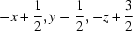 ; (ii)
 Data collection: SMART (Bruker, 1997); cell refinement: SAINT (Bruker, 1997); data reduction: SAINT; program(s) used to solve structure: SHELXS97 (Sheldrick, 2008); program(s) used to refine structure: SHELXL97 (Sheldrick, 2008); molecular graphics: SHELXTL (Sheldrick, 2008) and PLATON (Spek, 2003); software used to prepare material for publication: SHELXTL.
Supporting information
contains datablocks global, I. DOI: 10.1107/S1600536808040981/hk2582sup1.cif
Structure factors: contains datablock I. DOI: 10.1107/S1600536808040981/hk2582Isup2.hkl
For the preparation of the title compound, 2-nitroresorcin acetate (239 mg, 1.0 mmol) was dissolved in chloroform (20 ml). At 273-278 K, anhydrous AlCl3 (133.5 mg, 1 mmol) was added to this solution, the reaction was stirred at room temperature for 1 h, and then hydrochloric acid (5 ml, 10%) was added. The reaction mixture was extracted with chloroform and dried with anhydrous sodium sulfate. After concentration, the residue was separated by flash and purified by recrystallization from chloroform (yield; 144 mg, 73%, m.p. 360 K). Spectroscopic analysis: IR (KBr, ν, cm-1): 3253, 3083, 2946, 1758, 1530, 1204, 1138, 978, 847. Analysis required for C8H7NO5: C 48.74; H 3.58; N 7.10%. Found: C 48.80; H 3.61; N 7.08%.
H atoms were positioned geometrically, with O-H = 0.82 Å (for OH) and C-H = 0.93 and 0.96 Å for aromatic and methyl H, respectively, and constrained to ride on their parent atoms with Uiso(H) = xUeq(C,O), where x = 1.2 for aromatic H and x = 1.5 for all other H atoms.
Data collection: SMART (Bruker, 1997); cell SAINT (Bruker, 1997); data reduction: SAINT (Bruker, 1997); program(s) used to solve structure: SHELXS97 (Sheldrick, 2008); program(s) used to refine structure: SHELXL97 (Sheldrick, 2008); molecular graphics: SHELXTL (Sheldrick, 2008) and PLATON (Spek, 2003); software used to prepare material for publication: SHELXTL (Sheldrick, 2008).
![[Figure 1]](./hk2582fig1thm.gif) | Fig. 1. The molecular structure of the title molecule, with the atom-numbering scheme. Displacement ellipsoids are drawn at the 30% probability level. Hydrogen bond is shown as ashed line. |
![[Figure 2]](./hk2582fig2thm.gif) | Fig. 2. A partial packing diagram of the title compound. Hydrogen bonds are shown as dashed lines. |
| C8H7NO5 | F(000) = 408 |
| Mr = 197.15 | Dx = 1.558 Mg m−3 |
| Monoclinic, P21/n | Melting point: 360 K |
| Hall symbol: -P 2yn | Mo Kα radiation, λ = 0.71073 Å |
| a = 10.881 (2) Å | Cell parameters from 2650 reflections |
| b = 5.0543 (10) Å | θ = 2.2–27.5° |
| c = 15.318 (3) Å | µ = 0.13 mm−1 |
| β = 93.75 (3)° | T = 153 K |
| V = 840.6 (3) Å3 | Block, colorless |
| Z = 4 | 0.24 × 0.20 × 0.16 mm |
| Bruker P4 diffractometer | 1449 independent reflections |
| Radiation source: fine-focus sealed tube | 1232 reflections with I > 2σ(I) |
| Graphite monochromator | Rint = 0.027 |
| ω scans | θmax = 25.0°, θmin = 2.2° |
| Absorption correction: multi-scan (SADABS; Sheldrick, 1996) | h = −12→12 |
| Tmin = 0.969, Tmax = 0.979 | k = −6→5 |
| 5058 measured reflections | l = −18→15 |
| Refinement on F2 | Primary atom site location: structure-invariant direct methods |
| Least-squares matrix: full | Secondary atom site location: difference Fourier map |
| R[F2 > 2σ(F2)] = 0.028 | Hydrogen site location: inferred from neighbouring sites |
| wR(F2) = 0.083 | H-atom parameters constrained |
| S = 1.12 | w = 1/[σ2(Fo2) + (0.0475P)2 + 0.1223P] where P = (Fo2 + 2Fc2)/3 |
| 1449 reflections | (Δ/σ)max = 0.001 |
| 129 parameters | Δρmax = 0.18 e Å−3 |
| 0 restraints | Δρmin = −0.20 e Å−3 |
| C8H7NO5 | V = 840.6 (3) Å3 |
| Mr = 197.15 | Z = 4 |
| Monoclinic, P21/n | Mo Kα radiation |
| a = 10.881 (2) Å | µ = 0.13 mm−1 |
| b = 5.0543 (10) Å | T = 153 K |
| c = 15.318 (3) Å | 0.24 × 0.20 × 0.16 mm |
| β = 93.75 (3)° |
| Bruker P4 diffractometer | 1449 independent reflections |
| Absorption correction: multi-scan (SADABS; Sheldrick, 1996) | 1232 reflections with I > 2σ(I) |
| Tmin = 0.969, Tmax = 0.979 | Rint = 0.027 |
| 5058 measured reflections |
| R[F2 > 2σ(F2)] = 0.028 | 0 restraints |
| wR(F2) = 0.083 | H-atom parameters constrained |
| S = 1.12 | Δρmax = 0.18 e Å−3 |
| 1449 reflections | Δρmin = −0.20 e Å−3 |
| 129 parameters |
Geometry. All e.s.d.'s (except the e.s.d. in the dihedral angle between two l.s. planes) are estimated using the full covariance matrix. The cell e.s.d.'s are taken into account individually in the estimation of e.s.d.'s in distances, angles and torsion angles; correlations between e.s.d.'s in cell parameters are only used when they are defined by crystal symmetry. An approximate (isotropic) treatment of cell e.s.d.'s is used for estimating e.s.d.'s involving l.s. planes. |
Refinement. Refinement of F2 against ALL reflections. The weighted R-factor wR and goodness of fit S are based on F2, conventional R-factors R are based on F, with F set to zero for negative F2. The threshold expression of F2 > σ(F2) is used only for calculating R-factors(gt) etc. and is not relevant to the choice of reflections for refinement. R-factors based on F2 are statistically about twice as large as those based on F, and R- factors based on ALL data will be even larger. |
| x | y | z | Uiso*/Ueq | ||
| O1 | 0.14195 (8) | 0.58036 (19) | 0.89666 (6) | 0.0279 (3) | |
| O2 | 0.31702 (7) | 0.35401 (18) | 0.93249 (5) | 0.0244 (3) | |
| O3 | 0.59843 (8) | 1.04495 (18) | 0.88687 (5) | 0.0223 (2) | |
| H3 | 0.6350 | 1.1192 | 0.8486 | 0.033* | |
| O4 | 0.67226 (8) | 1.08418 (17) | 0.72904 (5) | 0.0230 (2) | |
| O5 | 0.63078 (8) | 0.77288 (18) | 0.63478 (5) | 0.0247 (2) | |
| N1 | 0.61633 (9) | 0.8778 (2) | 0.70551 (6) | 0.0179 (3) | |
| C1 | 0.13908 (11) | 0.2225 (3) | 1.00085 (8) | 0.0213 (3) | |
| H1A | 0.0532 | 0.2620 | 1.0041 | 0.032* | |
| H1B | 0.1807 | 0.2425 | 1.0577 | 0.032* | |
| H1C | 0.1482 | 0.0438 | 0.9810 | 0.032* | |
| C2 | 0.19373 (11) | 0.4079 (2) | 0.93821 (7) | 0.0179 (3) | |
| C3 | 0.38267 (10) | 0.5030 (3) | 0.87381 (8) | 0.0195 (3) | |
| C4 | 0.38272 (11) | 0.4184 (3) | 0.78716 (8) | 0.0207 (3) | |
| H4 | 0.3323 | 0.2804 | 0.7666 | 0.025* | |
| C5 | 0.46001 (11) | 0.5463 (2) | 0.73292 (8) | 0.0194 (3) | |
| H5 | 0.4633 | 0.4919 | 0.6751 | 0.023* | |
| C6 | 0.53337 (10) | 0.7573 (2) | 0.76450 (7) | 0.0164 (3) | |
| C7 | 0.53043 (10) | 0.8455 (2) | 0.85126 (7) | 0.0168 (3) | |
| C8 | 0.45238 (10) | 0.7116 (2) | 0.90598 (7) | 0.0189 (3) | |
| H8 | 0.4480 | 0.7643 | 0.9639 | 0.023* |
| U11 | U22 | U33 | U12 | U13 | U23 | |
| O1 | 0.0222 (5) | 0.0277 (6) | 0.0342 (5) | 0.0061 (4) | 0.0054 (4) | 0.0129 (4) |
| O2 | 0.0180 (5) | 0.0266 (5) | 0.0290 (5) | 0.0010 (4) | 0.0041 (3) | 0.0131 (4) |
| O3 | 0.0269 (5) | 0.0225 (5) | 0.0177 (4) | −0.0062 (4) | 0.0019 (4) | −0.0023 (3) |
| O4 | 0.0233 (5) | 0.0224 (5) | 0.0232 (5) | −0.0057 (4) | 0.0018 (3) | −0.0005 (4) |
| O5 | 0.0302 (5) | 0.0282 (5) | 0.0164 (4) | 0.0030 (4) | 0.0064 (4) | −0.0034 (4) |
| N1 | 0.0165 (5) | 0.0200 (6) | 0.0171 (5) | 0.0032 (4) | 0.0004 (4) | 0.0005 (4) |
| C1 | 0.0219 (6) | 0.0208 (7) | 0.0216 (6) | −0.0008 (5) | 0.0033 (5) | 0.0030 (5) |
| C2 | 0.0176 (6) | 0.0169 (6) | 0.0190 (6) | −0.0003 (5) | 0.0003 (5) | −0.0026 (5) |
| C3 | 0.0143 (6) | 0.0208 (7) | 0.0235 (6) | 0.0042 (5) | 0.0021 (5) | 0.0071 (5) |
| C4 | 0.0177 (6) | 0.0182 (7) | 0.0255 (7) | −0.0008 (5) | −0.0033 (5) | 0.0010 (5) |
| C5 | 0.0204 (6) | 0.0191 (7) | 0.0180 (6) | 0.0029 (5) | −0.0022 (5) | −0.0012 (5) |
| C6 | 0.0150 (6) | 0.0177 (6) | 0.0166 (6) | 0.0033 (5) | 0.0012 (4) | 0.0018 (4) |
| C7 | 0.0162 (6) | 0.0158 (6) | 0.0182 (6) | 0.0035 (5) | −0.0016 (4) | −0.0003 (5) |
| C8 | 0.0197 (6) | 0.0211 (7) | 0.0159 (6) | 0.0043 (5) | 0.0022 (5) | 0.0017 (5) |
| O1—C2 | 1.1982 (15) | C1—H1C | 0.9600 |
| O2—C2 | 1.3773 (15) | C3—C8 | 1.3716 (18) |
| O2—C3 | 1.4032 (14) | C3—C4 | 1.3944 (17) |
| O3—C7 | 1.3447 (15) | C4—C5 | 1.3807 (17) |
| O3—H3 | 0.8200 | C4—H4 | 0.9300 |
| O4—N1 | 1.2489 (13) | C5—C6 | 1.3994 (17) |
| O5—N1 | 1.2255 (12) | C5—H5 | 0.9300 |
| N1—C6 | 1.4521 (15) | C6—C7 | 1.4041 (16) |
| C1—C2 | 1.4923 (16) | C7—C8 | 1.4054 (17) |
| C1—H1A | 0.9600 | C8—H8 | 0.9300 |
| C1—H1B | 0.9600 | ||
| C2—O2—C3 | 118.26 (9) | C4—C3—O2 | 118.51 (11) |
| C7—O3—H3 | 109.5 | C5—C4—C3 | 117.87 (12) |
| O5—N1—O4 | 121.88 (10) | C5—C4—H4 | 121.1 |
| O5—N1—C6 | 119.32 (10) | C3—C4—H4 | 121.1 |
| O4—N1—C6 | 118.79 (9) | C4—C5—C6 | 120.33 (11) |
| C2—C1—H1A | 109.5 | C4—C5—H5 | 119.8 |
| C2—C1—H1B | 109.5 | C6—C5—H5 | 119.8 |
| H1A—C1—H1B | 109.5 | C5—C6—C7 | 121.42 (11) |
| C2—C1—H1C | 109.5 | C5—C6—N1 | 117.92 (10) |
| H1A—C1—H1C | 109.5 | C7—C6—N1 | 120.63 (11) |
| H1B—C1—H1C | 109.5 | O3—C7—C6 | 125.16 (10) |
| O1—C2—O2 | 122.43 (11) | O3—C7—C8 | 117.20 (10) |
| O1—C2—C1 | 127.24 (11) | C6—C7—C8 | 117.62 (11) |
| O2—C2—C1 | 110.33 (10) | C3—C8—C7 | 119.85 (11) |
| C8—C3—C4 | 122.88 (11) | C3—C8—H8 | 120.1 |
| C8—C3—O2 | 118.37 (10) | C7—C8—H8 | 120.1 |
| C3—O2—C2—O1 | −1.83 (17) | O5—N1—C6—C7 | 169.13 (10) |
| C3—O2—C2—C1 | 177.59 (10) | O4—N1—C6—C7 | −9.92 (16) |
| C2—O2—C3—C8 | 98.78 (13) | C5—C6—C7—O3 | 179.46 (10) |
| C2—O2—C3—C4 | −86.75 (14) | N1—C6—C7—O3 | 1.57 (18) |
| C8—C3—C4—C5 | 2.32 (18) | C5—C6—C7—C8 | 0.95 (17) |
| O2—C3—C4—C5 | −171.88 (10) | N1—C6—C7—C8 | −176.94 (10) |
| C3—C4—C5—C6 | −1.34 (18) | C4—C3—C8—C7 | −1.64 (18) |
| C4—C5—C6—C7 | −0.25 (18) | O2—C3—C8—C7 | 172.57 (10) |
| C4—C5—C6—N1 | 177.70 (10) | O3—C7—C8—C3 | −178.67 (10) |
| O5—N1—C6—C5 | −8.83 (15) | C6—C7—C8—C3 | −0.03 (17) |
| O4—N1—C6—C5 | 172.12 (9) |
| D—H···A | D—H | H···A | D···A | D—H···A |
| O3—H3···O4 | 0.82 | 1.91 | 2.605 (2) | 142 |
| C5—H5···O1i | 0.93 | 2.58 | 3.229 (2) | 127 |
| C8—H8···O3ii | 0.93 | 2.56 | 3.481 (2) | 170 |
| Symmetry codes: (i) −x+1/2, y−1/2, −z+3/2; (ii) −x+1, −y+2, −z+2. |
Experimental details
| Crystal data | |
| Chemical formula | C8H7NO5 |
| Mr | 197.15 |
| Crystal system, space group | Monoclinic, P21/n |
| Temperature (K) | 153 |
| a, b, c (Å) | 10.881 (2), 5.0543 (10), 15.318 (3) |
| β (°) | 93.75 (3) |
| V (Å3) | 840.6 (3) |
| Z | 4 |
| Radiation type | Mo Kα |
| µ (mm−1) | 0.13 |
| Crystal size (mm) | 0.24 × 0.20 × 0.16 |
| Data collection | |
| Diffractometer | Bruker P4 diffractometer |
| Absorption correction | Multi-scan (SADABS; Sheldrick, 1996) |
| Tmin, Tmax | 0.969, 0.979 |
| No. of measured, independent and observed [I > 2σ(I)] reflections | 5058, 1449, 1232 |
| Rint | 0.027 |
| (sin θ/λ)max (Å−1) | 0.595 |
| Refinement | |
| R[F2 > 2σ(F2)], wR(F2), S | 0.028, 0.083, 1.12 |
| No. of reflections | 1449 |
| No. of parameters | 129 |
| H-atom treatment | H-atom parameters constrained |
| Δρmax, Δρmin (e Å−3) | 0.18, −0.20 |
Computer programs: SMART (Bruker, 1997), SAINT (Bruker, 1997), SHELXS97 (Sheldrick, 2008), SHELXL97 (Sheldrick, 2008), SHELXTL (Sheldrick, 2008) and PLATON (Spek, 2003), SHELXTL (Sheldrick, 2008).
| D—H···A | D—H | H···A | D···A | D—H···A |
| O3—H3···O4 | 0.82 | 1.91 | 2.605 (2) | 142 |
| C5—H5···O1i | 0.93 | 2.58 | 3.229 (2) | 127 |
| C8—H8···O3ii | 0.93 | 2.56 | 3.481 (2) | 170 |
| Symmetry codes: (i) −x+1/2, y−1/2, −z+3/2; (ii) −x+1, −y+2, −z+2. |
References
 Allen, F. H., Kennard, O., Watson, D. G., Brammer, L., Orpen, A. G. & Taylor, R. (1987). J. Chem. Soc. Perkin Trans. 2, pp. S1–19. CrossRef Web of Science Google Scholar
Atkinson, P. J., Bromidge, S. M., Duxon, M. S., Gaster, L. M., Hadley, M. S., Hammond, B., Johnson, C. N., Middlemiss, D. N., North, S. E., Price, G. W., Rami, H. K., Riley, G. J., Scott, C. M., Shaw, T. E., Starr, K. R., Stemp, G., Thewlis, K. M., Thomas, D. R., Thompson, M., Vong, A. K. K. & Watson, J. M. (2005). Bioorg. Med. Chem. Lett. 15, 737–741. Web of Science CrossRef PubMed CAS Google Scholar
Bruker (1997). SMART and SAINT . Bruker AXS Inc., Madison, Wisconsin, USA. Google Scholar
Hu, B., Ellingboe, J., Gunawan, I., Han, S., Largis, E., Li, Z., Malamas, M., Mulvey, R., Oliphant, A., Sum, F.-W., Tillett, J. & Wong, V. (2001). Bioorg. Med. Chem. Lett. 11, 757–760. Web of Science CrossRef PubMed CAS Google Scholar
Ji, X. & Li, C. (2006). Synthesis, 15, 2478–2482. Google Scholar
Sheldrick, G. M. (1996). SADABS. University of Göttingen, Germany. Google Scholar
Sheldrick, G. M. (2008). Acta Cryst. A64, 112–122. Web of Science CrossRef CAS IUCr Journals Google Scholar
Spek, A. L. (2003). J. Appl. Cryst. 36, 7–13. Web of Science CrossRef CAS IUCr Journals Google Scholar
Svensson, M., Helgee, B., Skarp, K. & Andersson, G. (1998). J. Mater. Chem. 8, 353–362. Web of Science CrossRef CAS Google Scholar
Trollsås, M., Orrenius, C., Sahlén, F., Gedde, U. W., Norin, T., Hult, A., Hermann, D., Rudquist, P., Komitov, L., Lagerwall, S. T. & Lindström, J. (1996). J. Am. Chem. Soc. 118, 8542–8548. CrossRef Web of Science Google Scholar
This is an open-access article distributed under the terms of the Creative Commons Attribution (CC-BY) Licence, which permits unrestricted use, distribution, and reproduction in any medium, provided the original authors and source are cited.
| CRYSTALLOGRAPHIC COMMUNICATIONS |


Phenolic esters are useful intermediates in organic synthesis (Trollsås et al., 1996; Svensson et al., 1998; Atkinson et al., 2005; Hu et al., 2001). We have developed a new method for the syntheses of some phenolic esters (Ji et al., 2006). The title compound is one of the products, and we report herein its crystal structure.
In the molecule of the title compound (Fig. 1) the bond lengths (Allen et al., 1987) and angles are within normal ranges. The acetate group is oriented with respect to the aromatic ring at a dihedral angle of 85.30 (3)°. The intramolecular O-H···O hydrogen bond (Table 1) results in the formation of a nonplanar six-membered ring (N1/O3/O4/C6/C7/H3), adopting envelope conformation.
In the crystal structure, intermolecular C-H···O hydrogen bonds (Table 1) link the molecules (Fig. 2), in which they may be effective in the stabilization of the structure.