 | Acta Crystallographica Section E Acta Crystallographica Section E CRYSTALLOGRAPHIC COMMUNICATIONS |


 journal menu


organic compounds
| CRYSTALLOGRAPHIC COMMUNICATIONS |
 access
4-Amino-3-ammoniopyridinium dichloride

aCollege of Chemistry and Chemical Engineering, Luoyang Normal University, Luoyang 471022, People's Republic of China
*Correspondence e-mail: [email protected]
The anions and cations of the title compound, C5H9N32+·2Cl−, are connected by two chloride-bridged three-centered N—H⋯Cl hydrogen bonds into a three-dimensional network. The aromatic rings are not involved in stacking interactions.
Related literature
For bond distances and angles in pyridine, derived from microwave spectra, see: Sørensen et al. (1974![[Sørensen, G. O., Mahler, L. & Rastrup-Andersen, N. (1974). J. Mol. Struct. 20, 119-126.]](../../../../../../logos/arrows/e_arr.gif "Sørensen, G. O., Mahler, L. & Rastrup-Andersen, N. (1974). J. Mol. Struct. 20, 119-126.") ). For details of the N—H⋯Cl hydrogen bond in 4,4′-bipyridine compounds, see: Iyere et al. (2003). For N—H⋯Cl and secondary interactions in pyridinium chlorides, see: Jones et al. (2002); in 4-acetylpyridinium chloride, see: Kochel (2005). For N—H⋯Cl and O—H⋯Cl contacts in a triphenyl-pyridinium chloride (1/1) adduct, see: Sykora & Cioffi (2007).
). For details of the N—H⋯Cl hydrogen bond in 4,4′-bipyridine compounds, see: Iyere et al. (2003). For N—H⋯Cl and secondary interactions in pyridinium chlorides, see: Jones et al. (2002); in 4-acetylpyridinium chloride, see: Kochel (2005). For N—H⋯Cl and O—H⋯Cl contacts in a triphenyl-pyridinium chloride (1/1) adduct, see: Sykora & Cioffi (2007).
![[Scheme 1]](si2142scheme1.gif)
Experimental
Crystal data
|
Refinement
|
|
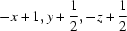 ; (ii)
 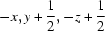 ; (iv)
 Data collection: SMART (Bruker, 1997); cell refinement: SAINT (Bruker, 1997); data reduction: SAINT; program(s) used to solve structure: SHELXS97 (Sheldrick, 2008); program(s) used to refine structure: SHELXL97 (Sheldrick, 2008); molecular graphics: SHELXTL (Sheldrick, 2008); software used to prepare material for publication: SHELXTL.
Supporting information
contains datablocks I, global. DOI: 10.1107/S1600536808041962/si2142sup1.cif
Structure factors: contains datablock I. DOI: 10.1107/S1600536808041962/si2142Isup2.hkl
3,4-diaminopyridine (0.01 mmol) and HCl (0.02 mmol) in 10 ml ethanol. Suitable crystals for X-ray analysis, were grown by allowing the solution to slowly evaporate for 15 days, and were subsequently filtered off, washed with methanol and dried under air.
H atoms were constrained to idealized positions and refined using a riding model, with C—H distances of 0.93 Å [Uiso(H) = 1.2Ueq(C)], and NH distances of 0.86 Å for NH2 [Uiso(H) = 1.2Ueq(N)] and 0.89 Å for NH3 [Uiso(H) = 1.5Ueq(N)].
Data collection: SMART (Bruker, 1997); cell SAINT (Bruker, 1997); data reduction: SAINT (Bruker, 1997); program(s) used to solve structure: SHELXS97 (Sheldrick, 2008); program(s) used to refine structure: SHELXL97 (Sheldrick, 2008); molecular graphics: SHELXTL (Sheldrick, 2008); software used to prepare material for publication: SHELXTL (Sheldrick, 2008).
![[Figure 1]](./si2142fig1thm.gif) | Fig. 1. A view of the asymmetric unit of (I), showing the atom-labelling scheme. Displacement ellipsoids are drawn at the 30% probability level. |
![[Figure 2]](./si2142fig2thm.gif) | Fig. 2. A view of the title compound packing down the b axis. |
| C5H9N32+·2Cl− | F(000) = 376 |
| Mr = 182.05 | Dx = 1.493 Mg m−3 |
| Monoclinic, P21/c | Mo Kα radiation, λ = 0.71073 Å |
| Hall symbol: -P 2ybc | Cell parameters from 2439 reflections |
| a = 8.362 (2) Å | θ = 3.1–28.2° |
| b = 7.3218 (19) Å | µ = 0.73 mm−1 |
| c = 13.239 (3) Å | T = 296 K |
| β = 92.065 (4)° | Block, colorless |
| V = 810.0 (4) Å3 | 0.41 × 0.31 × 0.07 mm |
| Z = 4 |
| Bruker SMART CCD area-detector diffractometer | 1494 independent reflections |
| Radiation source: fine-focus sealed tube | 1345 reflections with I > 2σ(I) |
| Graphite monochromator | Rint = 0.014 |
| ϕ and ω scans | θmax = 25.5°, θmin = 2.4° |
| Absorption correction: multi-scan (SADABS; Bruker, 1997) | h = −10→9 |
| Tmin = 0.734, Tmax = 0.948 | k = −6→8 |
| 3949 measured reflections | l = −16→15 |
| Refinement on F2 | Primary atom site location: structure-invariant direct methods |
| Least-squares matrix: full | Secondary atom site location: difference Fourier map |
| R[F2 > 2σ(F2)] = 0.025 | Hydrogen site location: inferred from neighbouring sites |
| wR(F2) = 0.068 | H-atom parameters constrained |
| S = 1.14 | w = 1/[σ2(Fo2) + (0.0285P)2 + 0.2927P] where P = (Fo2 + 2Fc2)/3 |
| 1494 reflections | (Δ/σ)max = 0.001 |
| 92 parameters | Δρmax = 0.24 e Å−3 |
| 0 restraints | Δρmin = −0.25 e Å−3 |
| C5H9N32+·2Cl− | V = 810.0 (4) Å3 |
| Mr = 182.05 | Z = 4 |
| Monoclinic, P21/c | Mo Kα radiation |
| a = 8.362 (2) Å | µ = 0.73 mm−1 |
| b = 7.3218 (19) Å | T = 296 K |
| c = 13.239 (3) Å | 0.41 × 0.31 × 0.07 mm |
| β = 92.065 (4)° |
| Bruker SMART CCD area-detector diffractometer | 1494 independent reflections |
| Absorption correction: multi-scan (SADABS; Bruker, 1997) | 1345 reflections with I > 2σ(I) |
| Tmin = 0.734, Tmax = 0.948 | Rint = 0.014 |
| 3949 measured reflections |
| R[F2 > 2σ(F2)] = 0.025 | 0 restraints |
| wR(F2) = 0.068 | H-atom parameters constrained |
| S = 1.14 | Δρmax = 0.24 e Å−3 |
| 1494 reflections | Δρmin = −0.25 e Å−3 |
| 92 parameters |
| x | y | z | Uiso*/Ueq | ||
| Cl1 | 0.05806 (5) | 0.10977 (6) | 0.30663 (3) | 0.03884 (15) | |
| Cl2 | 0.51526 (5) | 0.00029 (6) | 0.35359 (3) | 0.03603 (14) | |
| N1 | 0.26647 (16) | 0.68257 (19) | 0.30328 (10) | 0.0320 (3) | |
| H1A | 0.3291 | 0.6281 | 0.2594 | 0.048* | |
| H1B | 0.3026 | 0.7949 | 0.3160 | 0.048* | |
| H1C | 0.1670 | 0.6887 | 0.2772 | 0.048* | |
| N2 | 0.11914 (19) | 0.8105 (2) | 0.48188 (12) | 0.0439 (4) | |
| H2A | 0.1182 | 0.8773 | 0.4284 | 0.053* | |
| H2B | 0.0737 | 0.8485 | 0.5352 | 0.053* | |
| N3 | 0.33856 (18) | 0.3102 (2) | 0.48536 (11) | 0.0376 (4) | |
| H3 | 0.3861 | 0.2061 | 0.4869 | 0.045* | |
| C1 | 0.3383 (2) | 0.4103 (2) | 0.40010 (13) | 0.0329 (4) | |
| H1 | 0.3866 | 0.3649 | 0.3431 | 0.039* | |
| C2 | 0.26762 (18) | 0.5778 (2) | 0.39701 (12) | 0.0271 (3) | |
| C3 | 0.19067 (19) | 0.6488 (2) | 0.48205 (12) | 0.0296 (4) | |
| C4 | 0.1921 (2) | 0.5357 (2) | 0.56891 (13) | 0.0366 (4) | |
| H4 | 0.1422 | 0.5751 | 0.6267 | 0.044* | |
| C5 | 0.2655 (2) | 0.3703 (2) | 0.56862 (14) | 0.0391 (4) | |
| H5 | 0.2656 | 0.2976 | 0.6262 | 0.047* |
| U11 | U22 | U33 | U12 | U13 | U23 | |
| Cl1 | 0.0414 (3) | 0.0428 (3) | 0.0324 (2) | 0.00951 (19) | 0.00267 (18) | −0.00166 (18) |
| Cl2 | 0.0410 (3) | 0.0298 (2) | 0.0379 (2) | 0.00388 (17) | 0.01080 (18) | 0.00231 (17) |
| N1 | 0.0335 (7) | 0.0344 (8) | 0.0283 (7) | 0.0006 (6) | 0.0044 (6) | −0.0002 (6) |
| N2 | 0.0617 (10) | 0.0360 (8) | 0.0348 (8) | 0.0202 (8) | 0.0147 (7) | 0.0032 (7) |
| N3 | 0.0403 (8) | 0.0265 (7) | 0.0462 (9) | 0.0089 (6) | 0.0023 (7) | 0.0007 (6) |
| C1 | 0.0319 (9) | 0.0323 (9) | 0.0346 (9) | 0.0018 (7) | 0.0031 (7) | −0.0054 (7) |
| C2 | 0.0260 (8) | 0.0283 (8) | 0.0270 (8) | −0.0013 (6) | 0.0012 (6) | −0.0008 (6) |
| C3 | 0.0309 (8) | 0.0274 (8) | 0.0306 (8) | 0.0029 (7) | 0.0017 (7) | −0.0016 (7) |
| C4 | 0.0434 (10) | 0.0377 (10) | 0.0291 (9) | 0.0069 (8) | 0.0069 (7) | 0.0021 (7) |
| C5 | 0.0459 (10) | 0.0366 (10) | 0.0349 (10) | 0.0038 (8) | 0.0013 (8) | 0.0077 (8) |
| N1—C2 | 1.458 (2) | N3—H3 | 0.8600 |
| N1—H1A | 0.8900 | C1—C2 | 1.361 (2) |
| N1—H1B | 0.8900 | C1—H1 | 0.9300 |
| N1—H1C | 0.8900 | C2—C3 | 1.416 (2) |
| N2—C3 | 1.326 (2) | C3—C4 | 1.417 (2) |
| N2—H2A | 0.8600 | C4—C5 | 1.358 (3) |
| N2—H2B | 0.8600 | C4—H4 | 0.9300 |
| N3—C1 | 1.346 (2) | C5—H5 | 0.9300 |
| N3—C5 | 1.353 (2) | ||
| C2—N1—H1A | 109.5 | C2—C1—H1 | 119.9 |
| C2—N1—H1B | 109.5 | C1—C2—C3 | 121.06 (15) |
| H1A—N1—H1B | 109.5 | C1—C2—N1 | 119.26 (14) |
| C2—N1—H1C | 109.5 | C3—C2—N1 | 119.65 (14) |
| H1A—N1—H1C | 109.5 | N2—C3—C2 | 122.95 (15) |
| H1B—N1—H1C | 109.5 | N2—C3—C4 | 120.92 (15) |
| C3—N2—H2A | 120.0 | C2—C3—C4 | 116.12 (15) |
| C3—N2—H2B | 120.0 | C5—C4—C3 | 120.64 (16) |
| H2A—N2—H2B | 120.0 | C5—C4—H4 | 119.7 |
| C1—N3—C5 | 121.29 (15) | C3—C4—H4 | 119.7 |
| C1—N3—H3 | 119.4 | N3—C5—C4 | 120.64 (16) |
| C5—N3—H3 | 119.4 | N3—C5—H5 | 119.7 |
| N3—C1—C2 | 120.23 (16) | C4—C5—H5 | 119.7 |
| N3—C1—H1 | 119.9 | ||
| C5—N3—C1—C2 | 1.9 (3) | N1—C2—C3—C4 | 177.72 (15) |
| N3—C1—C2—C3 | −1.2 (2) | N2—C3—C4—C5 | 179.99 (18) |
| N3—C1—C2—N1 | −178.99 (14) | C2—C3—C4—C5 | 0.7 (3) |
| C1—C2—C3—N2 | −179.35 (16) | C1—N3—C5—C4 | −1.2 (3) |
| N1—C2—C3—N2 | −1.6 (2) | C3—C4—C5—N3 | −0.1 (3) |
| C1—C2—C3—C4 | −0.1 (2) |
| D—H···A | D—H | H···A | D···A | D—H···A |
| N1—H1A···Cl2i | 0.89 | 2.22 | 3.1142 (15) | 178 |
| N1—H1B···Cl2ii | 0.89 | 2.37 | 3.1754 (16) | 151 |
| N1—H1C···Cl1iii | 0.89 | 2.23 | 3.0790 (16) | 160 |
| N2—H2A···Cl1ii | 0.86 | 2.39 | 3.2188 (17) | 163 |
| N2—H2B···Cl1iv | 0.86 | 2.42 | 3.2672 (17) | 168 |
| N3—H3···Cl2 | 0.86 | 2.59 | 3.2499 (16) | 135 |
| N3—H3···Cl2v | 0.86 | 2.70 | 3.3198 (16) | 130 |
| Symmetry codes: (i) −x+1, y+1/2, −z+1/2; (ii) x, y+1, z; (iii) −x, y+1/2, −z+1/2; (iv) −x, −y+1, −z+1; (v) −x+1, −y, −z+1. |
Experimental details
| Crystal data | |
| Chemical formula | C5H9N32+·2Cl− |
| Mr | 182.05 |
| Crystal system, space group | Monoclinic, P21/c |
| Temperature (K) | 296 |
| a, b, c (Å) | 8.362 (2), 7.3218 (19), 13.239 (3) |
| β (°) | 92.065 (4) |
| V (Å3) | 810.0 (4) |
| Z | 4 |
| Radiation type | Mo Kα |
| µ (mm−1) | 0.73 |
| Crystal size (mm) | 0.41 × 0.31 × 0.07 |
| Data collection | |
| Diffractometer | Bruker SMART CCD area-detector diffractometer |
| Absorption correction | Multi-scan (SADABS; Bruker, 1997) |
| Tmin, Tmax | 0.734, 0.948 |
| No. of measured, independent and observed [I > 2σ(I)] reflections | 3949, 1494, 1345 |
| Rint | 0.014 |
| (sin θ/λ)max (Å−1) | 0.606 |
| Refinement | |
| R[F2 > 2σ(F2)], wR(F2), S | 0.025, 0.068, 1.14 |
| No. of reflections | 1494 |
| No. of parameters | 92 |
| H-atom treatment | H-atom parameters constrained |
| Δρmax, Δρmin (e Å−3) | 0.24, −0.25 |
Computer programs: SMART (Bruker, 1997), SAINT (Bruker, 1997), SHELXS97 (Sheldrick, 2008), SHELXL97 (Sheldrick, 2008), SHELXTL (Sheldrick, 2008).
| D—H···A | D—H | H···A | D···A | D—H···A |
| N1—H1A···Cl2i | 0.89 | 2.22 | 3.1142 (15) | 178.0 |
| N1—H1B···Cl2ii | 0.89 | 2.37 | 3.1754 (16) | 150.9 |
| N1—H1C···Cl1iii | 0.89 | 2.23 | 3.0790 (16) | 160.3 |
| N2—H2A···Cl1ii | 0.86 | 2.39 | 3.2188 (17) | 163.2 |
| N2—H2B···Cl1iv | 0.86 | 2.42 | 3.2672 (17) | 168.3 |
| N3—H3···Cl2 | 0.86 | 2.59 | 3.2499 (16) | 134.7 |
| N3—H3···Cl2v | 0.86 | 2.70 | 3.3198 (16) | 130.0 |
| Symmetry codes: (i) −x+1, y+1/2, −z+1/2; (ii) x, y+1, z; (iii) −x, y+1/2, −z+1/2; (iv) −x, −y+1, −z+1; (v) −x+1, −y, −z+1. |
Acknowledgements
The authors thank Luo Yang Normal University for supporting this work.
References
 Iyere, P. A., Boadi, W. Y., Atwood, D. & Parkin, S. (2003). Acta Cryst. B59, 664–669. Web of Science CSD CrossRef CAS IUCr Journals Google Scholar
Bruker (1997). SMART, SAINT and SADABS. Bruker AXS Inc., Madison,Wisconsin, USA. Google Scholar
Jones, P. G., Vancea, F. & Herbst-Irmer, R. (2002). Acta Cryst. C58, o665–o668. Web of Science CSD CrossRef CAS IUCr Journals Google Scholar
Kochel, A. (2005). Acta Cryst. E61, o926–o927. Web of Science CSD CrossRef IUCr Journals Google Scholar
Sheldrick, G. M. (2008). Acta Cryst. A64, 112–122. Web of Science CrossRef CAS IUCr Journals Google Scholar
Sørensen, G. O., Mahler, L. & Rastrup-Andersen, N. (1974). J. Mol. Struct. 20, 119–126. Google Scholar
Sykora, R. E. & Cioffi, E. A. (2007). Acta Cryst. E63, o3148–o3149. Web of Science CSD CrossRef CAS IUCr Journals Google Scholar
This is an open-access article distributed under the terms of the Creative Commons Attribution (CC-BY) Licence, which permits unrestricted use, distribution, and reproduction in any medium, provided the original authors and source are cited.
| CRYSTALLOGRAPHIC COMMUNICATIONS |


The title compound is a salt containing a diprotonated 3,4-diaminopyridine cation and two Cl- anions (Fig. 1). The C1—N3—C5 bond angle is wider than that in pyridine (116.94 (3)°; Sørensen et al., 1974) which indicates that the pyridine ring N atom is protonated (Table 1). Also, the 4-amino N atom is protonated. The projection of the crystal packing along the b axis is shown in Fig. 2. The Cl- anions and the 3,4-diaminopyridinium cations in the title compound are bonded by two chlorine-bridged, three-centered N—H···Cl hydrogen bonds into a three-dimensional network (Fig. 2, Table 2). Example structures of related compounds with two- and three-centered N—H···Cl hydrogen bonds are discussed by Iyere et al. (2003); Jones et al. (2002); Kochel (2005) and Sykora & Cioffi (2007).