 | Acta Crystallographica Section E Acta Crystallographica Section E CRYSTALLOGRAPHIC COMMUNICATIONS |


 journal menu


organic compounds
| CRYSTALLOGRAPHIC COMMUNICATIONS |
 access
1,4-Bis(imidazol-1-yl)benzene–terephthalic acid (1/1)

aCollege of Chemistry, Sichuan University, Chengdu 610064, People's Republic of China, and bThe Center of Testing and Analysis, Sichuan University, Chengdu 610064, People's Republic of China
*Correspondence e-mail: [email protected]
In the title compound, C12H10N4·C8H6O4, 1,4-bis(imidazol-1-yl)benzene and terephthalic acid molecules are joined via strong O—H⋯N hydrogen bonds to form infinite zigzag chains. Both molecules are located on crystallographic inversion centers. The O—H⋯N hydrogen-bonded chains are assembled into two-dimensional layers through weak C—H⋯O and strong π–π stacking interactions [centroid–centroid distance = 3.818 (2) Å], leading to the formation of a three-dimensional supramolecular structure.
Related literature
For general background, see: Aakeröy et al. (2006![[Aakeröy, C. B., Salmon, D. J., Smith, M. M. & Desper, J. (2006). Cryst. Growth Des. 6, 1033-1042.]](../../../../../../logos/arrows/e_arr.gif "Aakeröy, C. B., Salmon, D. J., Smith, M. M. & Desper, J. (2006). Cryst. Growth Des. 6, 1033-1042.") ); Aakeröy & Seddon (1993); Desiraju, 2007; Corna et al. (2004); Dobrzanska et al. (2006); Van Roey et al. (1991). For similar structures, see: Wang et al. (2007); Su et al. (2007).
); Aakeröy & Seddon (1993); Desiraju, 2007; Corna et al. (2004); Dobrzanska et al. (2006); Van Roey et al. (1991). For similar structures, see: Wang et al. (2007); Su et al. (2007).
![[Scheme 1]](zl2155scheme1.gif)
Experimental
Crystal data
|
Data collection
|
Refinement
|
| |||||||||||||||||||||||||||
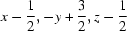 ; (iii)
 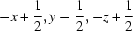 .
. Data collection: DIFRAC (Gabe & White, 1993); cell refinement: DIFRAC; data reduction: NRCVAX (Gabe et al., 1989); program(s) used to solve structure: SHELXS97 (Sheldrick, 2008); program(s) used to refine structure: SHELXL97 (Sheldrick, 2008); molecular graphics: ORTEPIII (Burnett & Johnson, 1996) and Mercury (Macrae et al., 2006); software used to prepare material for publication: SHELXL97.
Supporting information
contains datablocks global, I. DOI: 10.1107/S1600536808040324/zl2155sup1.cif
Structure factors: contains datablock I. DOI: 10.1107/S1600536808040324/zl2155Isup2.hkl
A methanol solution (5 ml) of 1,4-bis(1-imidazolyl)benzene (0.05 mmol, 10.5 mg) was added slowly with constant stirring to a solution of terephthalic acid (0.05 mmol, 8.3 mg) in methanol (2 ml) and water (0.5 ml) to give a clear solution. Then the reaction mixture was filtered and left to stand at room temperature. Colorless block crystals suitable for X-ray analysis were obtained after one week by slow evaporation of the solvent. Yield, 85%; 1H NMR (400 MHz, DMSO-d6): δ 8.34 (s, 2H), 8.04 (s, 4H), 7.83 (t, 6H), 7.13 (s, 2H).
All non-hydrogen atoms were located using and successive difference Fourier syntheses, and refined with anisotropic thermal parameters. All hydrogen atoms were positioned theoretically and refined with the riding model approximation with C—H = 0.93–0.97 Å and Uiso(H) = 1.2Ueq(C), and O—H = 0.82 Å and Uiso(H) = 1.5Ueq(O)
Data collection: DIFRAC (Gabe & White, 1993); cell DIFRAC (Gabe & White, 1993); data reduction: NRCVAX (Gabe et al., 1989); program(s) used to solve structure: SHELXS97 (Sheldrick, 2008); program(s) used to refine structure: SHELXL97 (Sheldrick, 2008); molecular graphics: ORTEPIII (Burnett & Johnson, 1996) and Mercury (Version 1.2; Macrae et al., 2006); software used to prepare material for publication: SHELXL97 (Sheldrick, 2008).
![[Figure 1]](./zl2155fig1thm.gif) | Fig. 1. The molecular structure of the title compound, showing 50% probability displacement ellipisoids; hydrogen bonds are illustrated by dashed lines. |
![[Figure 2]](./zl2155fig2thm.gif) | Fig. 2. A two-dimensional network layer of the title compound viewed along the c axis. Dashed lines indicate O—H···N and C—H···O hydrogen bonds. C, gray; H, green; O, red; N, cyan. |
![[Figure 3]](./zl2155fig3thm.gif) | Fig. 3. A three-dimensional view of the supramolecular layers of the title compound. |
| C12H10N4·C8H6O4 | F(000) = 392 |
| Mr = 376.37 | Dx = 1.447 Mg m−3 |
| Monoclinic, P21/n | Mo Kα radiation, λ = 0.71073 Å |
| Hall symbol: -P 2yn | Cell parameters from 18 reflections |
| a = 5.2780 (17) Å | θ = 4.5–7.6° |
| b = 10.599 (5) Å | µ = 0.10 mm−1 |
| c = 15.449 (5) Å | T = 293 K |
| β = 91.17 (3)° | Block, colourless |
| V = 864.1 (6) Å3 | 0.25 × 0.22 × 0.15 mm |
| Z = 2 |
| Enraf–Nonius CAD-4 diffractometer | Rint = 0.008 |
| Radiation source: fine-focus sealed tube | θmax = 25.5°, θmin = 2.3° |
| Graphite monochromator | h = −6→6 |
| ω/2θ scans | k = 0→12 |
| 1895 measured reflections | l = −9→18 |
| 1538 independent reflections | 3 standard reflections every 200 reflections |
| 904 reflections with I > 2σ(I) | intensity decay: 2.5% |
| Refinement on F2 | Primary atom site location: structure-invariant direct methods |
| Least-squares matrix: full | Secondary atom site location: difference Fourier map |
| R[F2 > 2σ(F2)] = 0.045 | Hydrogen site location: inferred from neighbouring sites |
| wR(F2) = 0.132 | H-atom parameters constrained |
| S = 0.95 | w = 1/[σ2(Fo2) + (0.0842P)2] where P = (Fo2 + 2Fc2)/3 |
| 1538 reflections | (Δ/σ)max < 0.001 |
| 128 parameters | Δρmax = 0.18 e Å−3 |
| 0 restraints | Δρmin = −0.21 e Å−3 |
| C12H10N4·C8H6O4 | V = 864.1 (6) Å3 |
| Mr = 376.37 | Z = 2 |
| Monoclinic, P21/n | Mo Kα radiation |
| a = 5.2780 (17) Å | µ = 0.10 mm−1 |
| b = 10.599 (5) Å | T = 293 K |
| c = 15.449 (5) Å | 0.25 × 0.22 × 0.15 mm |
| β = 91.17 (3)° |
| Enraf–Nonius CAD-4 diffractometer | Rint = 0.008 |
| 1895 measured reflections | 3 standard reflections every 200 reflections |
| 1538 independent reflections | intensity decay: 2.5% |
| 904 reflections with I > 2σ(I) |
| R[F2 > 2σ(F2)] = 0.045 | 0 restraints |
| wR(F2) = 0.132 | H-atom parameters constrained |
| S = 0.95 | Δρmax = 0.18 e Å−3 |
| 1538 reflections | Δρmin = −0.21 e Å−3 |
| 128 parameters |
Experimental. Refinement of F2 against ALL reflections. The weighted R-factor wR and goodness of fit S are based on F2, conventional R-factors R are based on F, with F set to zero for negative F2. The threshold expression of F2 > 2sigma(F2) is used only for calculating R-factors(gt) etc. and is not relevant to the choice of reflections for R-factors based on F2 are statistically about twice as large as those based on F, and R– factors based on ALL data will be even larger. |
Geometry. All e.s.d.'s (except the e.s.d. in the dihedral angle between two l.s. planes) are estimated using the full covariance matrix. The cell e.s.d.'s are taken into account individually in the estimation of e.s.d.'s in distances, angles and torsion angles; correlations between e.s.d.'s in cell parameters are only used when they are defined by crystal symmetry. An approximate (isotropic) treatment of cell e.s.d.'s is used for estimating e.s.d.'s involving l.s. planes. |
Refinement. Refinement of F2 against ALL reflections. The weighted R-factor wR and goodness of fit S are based on F2, conventional R-factors R are based on F, with F set to zero for negative F2. The threshold expression of F2 > σ(F2) is used only for calculating R-factors(gt) etc. and is not relevant to the choice of reflections for refinement. R-factors based on F2 are statistically about twice as large as those based on F, and R- factors based on ALL data will be even larger. |
| x | y | z | Uiso*/Ueq | ||
| N1 | 0.3750 (4) | 0.57026 (17) | 0.12218 (11) | 0.0403 (5) | |
| N2 | 0.7031 (4) | 0.5588 (2) | 0.21140 (12) | 0.0489 (6) | |
| C1 | 0.0819 (5) | 0.6228 (2) | 0.00451 (16) | 0.0467 (6) | |
| H1A | 0.1382 | 0.7059 | 0.0073 | 0.056* | |
| C2 | −0.1041 (5) | 0.5891 (2) | −0.05539 (15) | 0.0467 (6) | |
| H2 | −0.1745 | 0.6495 | −0.0923 | 0.056* | |
| C3 | 0.1844 (4) | 0.5339 (2) | 0.06017 (13) | 0.0375 (5) | |
| C4 | 0.5583 (4) | 0.4962 (2) | 0.15707 (14) | 0.0445 (6) | |
| H4 | 0.5788 | 0.4112 | 0.1440 | 0.053* | |
| C5 | 0.6087 (5) | 0.6786 (2) | 0.21254 (16) | 0.0531 (7) | |
| H5 | 0.6740 | 0.7444 | 0.2460 | 0.064* | |
| C6 | 0.4073 (3) | 0.68757 (13) | 0.15820 (8) | 0.0504 (7) | |
| H6 | 0.3095 | 0.7590 | 0.1472 | 0.061* | |
| O1 | 0.0950 (3) | 0.49725 (13) | 0.30802 (8) | 0.0499 (5) | |
| H1 | −0.0288 | 0.5179 | 0.2784 | 0.075* | |
| O2 | 0.0072 (4) | 0.67524 (16) | 0.37876 (12) | 0.0601 (6) | |
| C7 | 0.1260 (5) | 0.5775 (2) | 0.37186 (15) | 0.0428 (6) | |
| C8 | 0.3231 (4) | 0.5370 (2) | 0.43721 (14) | 0.0387 (6) | |
| C9 | 0.5136 (4) | 0.4536 (2) | 0.41709 (14) | 0.0415 (6) | |
| H9 | 0.5236 | 0.4221 | 0.3611 | 0.050* | |
| C10 | 0.6897 (4) | 0.4164 (2) | 0.47922 (14) | 0.0435 (6) | |
| H10 | 0.8171 | 0.3600 | 0.4650 | 0.052* |
| U11 | U22 | U33 | U12 | U13 | U23 | |
| N1 | 0.0420 (11) | 0.0393 (11) | 0.0391 (10) | 0.0033 (9) | −0.0132 (9) | 0.0005 (8) |
| N2 | 0.0476 (12) | 0.0568 (13) | 0.0415 (11) | −0.0001 (11) | −0.0184 (9) | −0.0007 (9) |
| C1 | 0.0516 (15) | 0.0374 (12) | 0.0504 (13) | 0.0036 (11) | −0.0187 (12) | 0.0008 (10) |
| C2 | 0.0542 (15) | 0.0390 (13) | 0.0460 (12) | 0.0053 (12) | −0.0196 (11) | 0.0056 (10) |
| C3 | 0.0369 (12) | 0.0418 (13) | 0.0334 (11) | 0.0059 (10) | −0.0102 (9) | −0.0028 (9) |
| C4 | 0.0446 (13) | 0.0476 (14) | 0.0405 (12) | 0.0064 (12) | −0.0176 (10) | −0.0021 (10) |
| C5 | 0.0619 (16) | 0.0460 (14) | 0.0506 (14) | −0.0053 (13) | −0.0198 (12) | −0.0023 (12) |
| C6 | 0.0588 (16) | 0.0377 (14) | 0.0539 (15) | 0.0035 (12) | −0.0198 (13) | −0.0039 (11) |
| O1 | 0.0495 (10) | 0.0531 (10) | 0.0462 (9) | 0.0021 (8) | −0.0205 (7) | −0.0019 (8) |
| O2 | 0.0645 (12) | 0.0425 (10) | 0.0720 (13) | 0.0053 (9) | −0.0335 (10) | −0.0041 (9) |
| C7 | 0.0400 (13) | 0.0422 (14) | 0.0457 (13) | −0.0084 (12) | −0.0128 (11) | 0.0030 (11) |
| C8 | 0.0412 (13) | 0.0335 (12) | 0.0409 (12) | −0.0106 (10) | −0.0133 (10) | 0.0058 (9) |
| C9 | 0.0427 (13) | 0.0441 (13) | 0.0372 (11) | −0.0040 (11) | −0.0087 (10) | −0.0003 (10) |
| C10 | 0.0363 (13) | 0.0440 (14) | 0.0498 (13) | −0.0044 (11) | −0.0083 (11) | 0.0019 (11) |
| N1—C4 | 1.349 (3) | C5—H5 | 0.9300 |
| N1—C6 | 1.371 (2) | C6—H6 | 0.9300 |
| N1—C3 | 1.428 (3) | O1—C7 | 1.3101 |
| N2—C4 | 1.305 (3) | O1—H1 | 0.8200 |
| N2—C5 | 1.364 (3) | O2—C7 | 1.217 (3) |
| C1—C3 | 1.379 (3) | C7—C8 | 1.498 (3) |
| C1—C2 | 1.383 (3) | C8—C9 | 1.379 (3) |
| C1—H1A | 0.9300 | C8—C10ii | 1.385 (3) |
| C2—C3i | 1.372 (3) | C9—C10 | 1.380 (3) |
| C2—H2 | 0.9300 | C9—H9 | 0.9300 |
| C3—C2i | 1.372 (3) | C10—C8ii | 1.385 (3) |
| C4—H4 | 0.9300 | C10—H10 | 0.9300 |
| C5—C6 | 1.344 (3) | ||
| C4—N1—C6 | 106.45 (17) | N2—C5—H5 | 125.0 |
| C4—N1—C3 | 126.9 (2) | C5—C6—N1 | 106.22 (16) |
| C6—N1—C3 | 126.66 (17) | C5—C6—H6 | 126.9 |
| C4—N2—C5 | 105.8 (2) | N1—C6—H6 | 126.9 |
| C3—C1—C2 | 120.3 (2) | C7—O1—H1 | 109.5 |
| C3—C1—H1A | 119.8 | O2—C7—O1 | 124.20 |
| C2—C1—H1A | 119.8 | O2—C7—C8 | 122.5 (2) |
| C3i—C2—C1 | 119.7 (2) | O1—C7—C8 | 113.31 |
| C3i—C2—H2 | 120.1 | C9—C8—C10ii | 119.2 (2) |
| C1—C2—H2 | 120.1 | C9—C8—C7 | 122.1 (2) |
| C2i—C3—C1 | 119.9 (2) | C10ii—C8—C7 | 118.7 (2) |
| C2i—C3—N1 | 120.35 (19) | C8—C9—C10 | 120.7 (2) |
| C1—C3—N1 | 119.7 (2) | C8—C9—H9 | 119.7 |
| N2—C4—N1 | 111.5 (2) | C10—C9—H9 | 119.7 |
| N2—C4—H4 | 124.2 | C9—C10—C8ii | 120.1 (2) |
| N1—C4—H4 | 124.2 | C9—C10—H10 | 119.9 |
| C6—C5—N2 | 110.01 (19) | C8ii—C10—H10 | 119.9 |
| C6—C5—H5 | 125.0 | ||
| C3—C1—C2—C3i | −0.9 (4) | N2—C5—C6—N1 | 0.0 (3) |
| C2—C1—C3—C2i | 0.9 (4) | C4—N1—C6—C5 | 0.3 (2) |
| C2—C1—C3—N1 | −179.5 (2) | C3—N1—C6—C5 | −179.9 (2) |
| C4—N1—C3—C2i | 26.8 (4) | O2—C7—C8—C9 | −157.3 (2) |
| C6—N1—C3—C2i | −153.0 (2) | O1—C7—C8—C9 | 23.07 |
| C4—N1—C3—C1 | −152.9 (2) | O2—C7—C8—C10ii | 23.6 (4) |
| C6—N1—C3—C1 | 27.3 (3) | O1—C7—C8—C10ii | −155.90 |
| C5—N2—C4—N1 | 0.5 (3) | C10ii—C8—C9—C10 | 0.2 (4) |
| C6—N1—C4—N2 | −0.5 (3) | C7—C8—C9—C10 | −178.8 (2) |
| C3—N1—C4—N2 | 179.6 (2) | C8—C9—C10—C8ii | −0.2 (4) |
| C4—N2—C5—C6 | −0.3 (3) |
| Symmetry codes: (i) −x, −y+1, −z; (ii) −x+1, −y+1, −z+1. |
| D—H···A | D—H | H···A | D···A | D—H···A |
| O1—H1···N2iii | 0.82 | 1.79 | 2.6089 | 178 |
| C2—H2···O2iv | 0.93 | 2.54 | 3.376 (3) | 150 |
| C4—H4···O2v | 0.93 | 2.56 | 3.463 (3) | 162 |
| Symmetry codes: (iii) x−1, y, z; (iv) x−1/2, −y+3/2, z−1/2; (v) −x+1/2, y−1/2, −z+1/2. |
Experimental details
| Crystal data | |
| Chemical formula | C12H10N4·C8H6O4 |
| Mr | 376.37 |
| Crystal system, space group | Monoclinic, P21/n |
| Temperature (K) | 293 |
| a, b, c (Å) | 5.2780 (17), 10.599 (5), 15.449 (5) |
| β (°) | 91.17 (3) |
| V (Å3) | 864.1 (6) |
| Z | 2 |
| Radiation type | Mo Kα |
| µ (mm−1) | 0.10 |
| Crystal size (mm) | 0.25 × 0.22 × 0.15 |
| Data collection | |
| Diffractometer | Enraf–Nonius CAD-4 diffractometer |
| Absorption correction | – |
| No. of measured, independent and observed [I > 2σ(I)] reflections | 1895, 1538, 904 |
| Rint | 0.008 |
| (sin θ/λ)max (Å−1) | 0.605 |
| Refinement | |
| R[F2 > 2σ(F2)], wR(F2), S | 0.045, 0.132, 0.95 |
| No. of reflections | 1538 |
| No. of parameters | 128 |
| H-atom treatment | H-atom parameters constrained |
| Δρmax, Δρmin (e Å−3) | 0.18, −0.21 |
Computer programs: DIFRAC (Gabe & White, 1993), NRCVAX (Gabe et al., 1989), SHELXS97 (Sheldrick, 2008), SHELXL97 (Sheldrick, 2008), ORTEPIII (Burnett & Johnson, 1996) and Mercury (Version 1.2; Macrae et al., 2006).
| D—H···A | D—H | H···A | D···A | D—H···A |
| O1—H1···N2i | 0.82 | 1.79 | 2.60885 | 178 |
| C2—H2···O2ii | 0.93 | 2.54 | 3.376 (3) | 150 |
| C4—H4···O2iii | 0.93 | 2.56 | 3.463 (3) | 162 |
| Symmetry codes: (i) x−1, y, z; (ii) x−1/2, −y+3/2, z−1/2; (iii) −x+1/2, y−1/2, −z+1/2. |
Acknowledgements
This work was supported by grants from the National Natural Science Foundation of China (grant No. 20702035) and Sichuan University experimental technical project (grant No. 07-57, 07-61).
References
 Aakeröy, C. B., Salmon, D. J., Smith, M. M. & Desper, J. (2006). Cryst. Growth Des. 6, 1033–1042. Google Scholar
Aakeröy, C. B. & Seddon, K. R. (1993). Chem. Soc. Rev. 22, 397–407. CrossRef CAS Web of Science Google Scholar
Burnett, M. N. & Johnson, C. K. (1996). ORTEPIII. Report ORNL-6895. Oak Ridge National Laboratory, Tennessee, USA. Google Scholar
Corna, A., Rey, F., Rius, J., Sabater, M. J. & Valencla, S. (2004). Nature (London), 431, 287–290. Web of Science PubMed Google Scholar
Desiraju, G. R. (2007). Angew. Chem. Int. Ed. 46, 8342–8356. Web of Science CrossRef CAS Google Scholar
Gabe, E. J., Le Page, Y., Charland, J.-P., Lee, F. L. & White, P. S. (1989). J. Appl. Cryst. 22, 384–387. CrossRef CAS Web of Science IUCr Journals Google Scholar
Gabe, E. J. & White, P. S. (1993). DIFRAC. American Crystallographic Association, Pittsburgh Metting. Abstract PA104. Google Scholar
Macrae, C. F., Edgington, P. R., McCabe, P., Pidcock, E., Shields, G. P., Taylor, R., Towler, M. & van de Streek, J. (2006). J. Appl. Cryst. 39, 453–457. Web of Science CrossRef CAS IUCr Journals Google Scholar
Van Roey, P., Bullion, K. A., Osawa, Y., Bowman, R. M. & Braun, D. G. (1991). Acta Cryst. C47, 1015–1018. CSD CrossRef CAS Web of Science IUCr Journals Google Scholar
Sheldrick, G. M. (2008). Acta Cryst. A64, 112–122. Web of Science CrossRef CAS IUCr Journals Google Scholar
Su, X.-Y., Wang, W.-H., Lan, J.-B., Mao, Z.-H. & Xie, R.-G. (2007). Acta Cryst. E63, o4513–o4514. Web of Science CSD CrossRef IUCr Journals Google Scholar
Wang, W. H., Xi, P. H., Su, X. Y., Lan, J. B., Mao, Z. H., You, J. S. & Xie, R. G. (2007). Cryst. Growth Des. 7, 741–746. Web of Science CSD CrossRef CAS Google Scholar
This is an open-access article distributed under the terms of the Creative Commons Attribution (CC-BY) Licence, which permits unrestricted use, distribution, and reproduction in any medium, provided the original authors and source are cited.
| CRYSTALLOGRAPHIC COMMUNICATIONS |


Supramolecular architectures assembled via various delicate noncovalent interactions such as hydrogen bonds, π—π stacking and electrostatic interactions, etc., have attracted intense interest in recent years because of their fascinating structural diversity and potential applications for functional materials (Desiraju, 2007; Corna et al., 2004). Especially, the application of intermolecular hydrogen bonds is a well known and efficient tool in the field of organic crystal design owing to its strength and directional properties (Aakeröy & Seddon, 1993). Imidazoles, as excellent N-donor compounds, have attracted special attention in the construction of organic cocrystals in recent years (Aakeröy et al., 2006; Van Roey et al., 1991). We recently presented organic crystals composed of flexible diimidazole compounds and dicarboxylic acids (Wang et al., 2007; Su et al., 2007). In further development of such interesting hydrogen-bonded supramolecular systems and as a continuation of our research in this area, we report herein the crystal structure of the title compound formed from rigid diimidazole and dicarboxylic acids molecules.
As shown in Figure 1, the asymmetric unit of the title compound contains each half a molecule of 1,4-bis(1-imidazolyl)benzene and terephthalic acid which are both located on crystallographic inversion centers. The carboxyl groups of the terephthalic acid interact with the imidazol-1-yl nitrogen atoms of 1,4-bis(1-imidazolyl)benzene via O1—H1···N2 hydrogen bonds (O1···N2 = 2.608 (8) Å and O1—H1···N2 = 178°), and thus the hydrogen bonds further propagate the acid-base subunits into an infinite one-dimensional zig-zag chain. Meanwhile, these chains are assembled into two-dimensional layers through weak C2—H2···O2 and C4—H4···O2 hydrogen bonds, with C2···O2 = 3.376 (3) Å, C2—H2···O2 = 150° and C4···O2 = 3.463 (3) Å, C4—H4···O2 = 162° (Figure 2). Moreover, the supramolecular layers are further stablized by intermolecular π—π interactions to form a three-dimensional stucture as depicted in Figure 3. A relative strong π—π interaction between one imidazole ring (Cg1: N1—C4—N2—C5—C6) and contiguous phenyl ring (Cg2: C1—C3—C2—C1b—C3b—C2b) of 1,4-bis(1-imidazolyl)benzene from another chain (centroid-centroid distance = 3.818 (2) Å, dihedral angle = 27.12) plays an important part in the connection of adjacent layers, where Cg1 is the centroid of the imidazole ring of the molecule at (1 - x, 1 - y, -z) and (-1 + x, y, z), and Cg2 is the centroid of the phenyl ring of the molecule at (1 - x, 1 - y, -z) and (1 + x, y, z).