 | Acta Crystallographica Section E Acta Crystallographica Section E CRYSTALLOGRAPHIC COMMUNICATIONS |


 journal menu


organic compounds
| CRYSTALLOGRAPHIC COMMUNICATIONS |
 access
3,3′-(2,2′-Bi-1H-imidazole-1,1′-diyl)dipropanol

aState Key Laboratory Base of Novel Functional Materials and Preparation Science, Institute of Solid Materials Chemistry, Faculty of Materials Science and Chemical Engineering, Ningbo University, Ningbo 315211, People's Republic of China
*Correspondence e-mail: [email protected]
In the title compound, C12H18N4O2, unlike other unconjugated disubstituted biimidazole derivatives reported so far, the two imidazole rings in a trans conformation exhibit a large planar rotation angle of 51.27 (4)°, and consist of half-molecule asymmetric units related by a twofold rotation. The molecules are linked into a three-dimensional framework with a parallel laminated construction via O—H⋯N and C—H⋯O interactions.
Related literature
For background to 2,2′-biimidazole derivatives, see: Forster et al. (2004![[Forster, R. J., Walsh, D. A., Mano, N., Mao, F. & Heller, A. (2004). Langmuir, 20, 862-868.]](../../../../../../logos/arrows/e_arr.gif "Forster, R. J., Walsh, D. A., Mano, N., Mao, F. & Heller, A. (2004). Langmuir, 20, 862-868.") ); Fortin & Beauchamp (2000); Fu et al. (2007); Ion et al. (2007); Mao et al. (2003); Pereira et al. (2006); Xiao & Shreeve (2005); Xiao et al. (2004). For other unconjugated 1,1′-disubstituted compounds, see: Barnett et al. (1997, 2002); Secondo et al. (1996, 1997). For the synthesis, see: Barnett et al. (1999)
); Fortin & Beauchamp (2000); Fu et al. (2007); Ion et al. (2007); Mao et al. (2003); Pereira et al. (2006); Xiao & Shreeve (2005); Xiao et al. (2004). For other unconjugated 1,1′-disubstituted compounds, see: Barnett et al. (1997, 2002); Secondo et al. (1996, 1997). For the synthesis, see: Barnett et al. (1999)
![[Scheme 1]](at2693scheme1.gif)
Experimental
Crystal data
|
Refinement
|
| ||||||||||||||||||||||
 ; (ii)
  .
. Data collection: RAPID-AUTO (Rigaku, 1998); cell refinement: RAPID-AUTO; data reduction: CrystalStructure (Rigaku/MSC, 2002); program(s) used to solve structure: SHELXS97 (Sheldrick, 2008); program(s) used to refine structure: SHELXL97 (Sheldrick, 2008); molecular graphics: SHELXTL (Sheldrick, 2008); software used to prepare material for publication: SHELXTL.
Supporting information
contains datablocks global, I. DOI: 10.1107/S1600536808043377/at2693sup1.cif
Structure factors: contains datablock I. DOI: 10.1107/S1600536808043377/at2693Isup2.hkl
1,1'-Di(ethylpropionato)-2,2'-biimidazole (0.80 g, 2.40 mmol) was dissolved in absolute ethyl alcohol (50 ml). To this mixture was added batchly NaBH4 (0.906 g, 24.0 mmol). The mixture was heated to reflux for 3 h. Evaporating the solvent and added to 30 ml H2O yield a transparent solution. Adjusting the PH of the solution to 8–9 with 1M HCl led to a white suspension. The mixture was filtered, then the filtrate extracted with chloroform (10 ml) three times. The combined organic layer was washed with H2O (5 ml) two times, dried by MgSO4. After evaporating the solvent, the residue was chromatographed on silica gel. Elution with CH3CO2C2H5/C2H5OH (10:1) afforded a white solid (0.52 g, 86.7%). Tetragonal crystals of the titled compound were formed by evaporating saturated petroleum ether/chloroform solution slowly.
Similarly, the title compound(I) can be synthesized by reduction of other 1,1'-di(alkylpropionato)-2,2??-biimidazole (alkyl = methyl, butyl) which was prepared according to the published procedure (Barnett et al., 1999) with NaBH4 in anhydrous ethyl alcohol or with LiAlH4 in anhydrous ethereal solution. The yields ranges from 44 to 85°.
All H atoms were placed in geometrically idealized positions and constrained to ride on their parent atoms (C—H = 0.93 and = 0.97 Å; O—H = 0.82 Å) and Uiso(H) values were taken to be equal to 1.2 Ueq(C) and 1.5Ueq(O).
Data collection: RAPID-AUTO (Rigaku, 1998); cell RAPID-AUTO (Rigaku, 1998); data reduction: CrystalStructure (Rigaku/MSC, 2002); program(s) used to solve structure: SHELXS97 (Sheldrick, 2008); program(s) used to refine structure: SHELXL97 (Sheldrick, 2008); molecular graphics: SHELXL (Sheldrick, 2008); software used to prepare material for publication: SHELXL (Sheldrick, 2008).
![[Figure 1]](./at2693fig1thm.gif) | Fig. 1. A perspective view of (I) with the atom-labelling scheme, showing that the two imidazole rings are distinctly non-coplanar. Displacement ellipsoids are drawn at the 40% probability level and H atoms are shown as small spheres of arbitrary radius. |
![[Figure 2]](./at2693fig2thm.gif) | Fig. 2. A perspective view of the three–dimensional framework with parallellaminated construction containing two sheets from [011] direction, showing the packing mode and the interactions of hydrogen bonds O–H···N (pink dashed lines in the electronic version of the paper) and C–H···O (green dashed lines in the electronic version). All H atoms not involved in the hydrogen-bond motifs have been omitted for clarity. |
| C12H18N4O2 | F(000) = 536 |
| Mr = 250.30 | Dx = 1.350 Mg m−3 |
| Monoclinic, C2/c | Mo Kα radiation, λ = 0.71073 Å |
| Hall symbol: -C 2yc | Cell parameters from 1400 reflections |
| a = 15.812 (3) Å | θ = 3.1–27.5° |
| b = 9.5961 (19) Å | µ = 0.10 mm−1 |
| c = 9.3194 (19) Å | T = 295 K |
| β = 119.44 (3)° | Block, colourless |
| V = 1231.5 (6) Å3 | 0.56 × 0.48 × 0.37 mm |
| Z = 4 |
| Rigaku R-AXIS RAPID diffractometer | 1400 independent reflections |
| Radiation source: fine-focus sealed tube | 1183 reflections with I > 2σ(I) |
| Graphite monochromator | Rint = 0.015 |
| ω scans | θmax = 27.5°, θmin = 3.1° |
| Absorption correction: multi-scan (ABSCOR; Higashi, 1995) | h = −20→20 |
| Tmin = 0.948, Tmax = 0.970 | k = −12→12 |
| 4715 measured reflections | l = −12→12 |
| Refinement on F2 | Primary atom site location: structure-invariant direct methods |
| Least-squares matrix: full | Secondary atom site location: difference Fourier map |
| R[F2 > 2σ(F2)] = 0.036 | Hydrogen site location: inferred from neighbouring sites |
| wR(F2) = 0.104 | H atoms treated by a mixture of independent and constrained refinement |
| S = 1.07 | w = 1/[σ2(Fo2) + (0.0631P)2 + 0.3657P] where P = (Fo2 + 2Fc2)/3 |
| 1400 reflections | (Δ/σ)max < 0.001 |
| 86 parameters | Δρmax = 0.17 e Å−3 |
| 0 restraints | Δρmin = −0.23 e Å−3 |
| C12H18N4O2 | V = 1231.5 (6) Å3 |
| Mr = 250.30 | Z = 4 |
| Monoclinic, C2/c | Mo Kα radiation |
| a = 15.812 (3) Å | µ = 0.10 mm−1 |
| b = 9.5961 (19) Å | T = 295 K |
| c = 9.3194 (19) Å | 0.56 × 0.48 × 0.37 mm |
| β = 119.44 (3)° |
| Rigaku R-AXIS RAPID diffractometer | 1400 independent reflections |
| Absorption correction: multi-scan (ABSCOR; Higashi, 1995) | 1183 reflections with I > 2σ(I) |
| Tmin = 0.948, Tmax = 0.970 | Rint = 0.015 |
| 4715 measured reflections |
| R[F2 > 2σ(F2)] = 0.036 | 0 restraints |
| wR(F2) = 0.104 | H atoms treated by a mixture of independent and constrained refinement |
| S = 1.07 | Δρmax = 0.17 e Å−3 |
| 1400 reflections | Δρmin = −0.23 e Å−3 |
| 86 parameters |
Geometry. All e.s.d.'s (except the e.s.d. in the dihedral angle between two l.s. planes) are estimated using the full covariance matrix. The cell e.s.d.'s are taken into account individually in the estimation of e.s.d.'s in distances, angles and torsion angles; correlations between e.s.d.'s in cell parameters are only used when they are defined by crystal symmetry. An approximate (isotropic) treatment of cell e.s.d.'s is used for estimating e.s.d.'s involving l.s. planes. |
Refinement. Refinement of F2 against ALL reflections. The weighted R-factor wR and goodness of fit S are based on F2, conventional R-factors R are based on F, with F set to zero for negative F2. The threshold expression of F2 > σ(F2) is used only for calculating R-factors(gt) etc. and is not relevant to the choice of reflections for refinement. R-factors based on F2 are statistically about twice as large as those based on F, and R- factors based on ALL data will be even larger. |
| x | y | z | Uiso*/Ueq | ||
| C1 | 0.03257 (9) | 0.22372 (12) | 0.47224 (14) | 0.0366 (3) | |
| H1 | 0.0646 | 0.2434 | 0.4134 | 0.044* | |
| C2 | −0.05565 (9) | 0.16313 (12) | 0.41318 (14) | 0.0375 (3) | |
| H2 | −0.0946 | 0.1336 | 0.3050 | 0.045* | |
| C3 | −0.00459 (7) | 0.20468 (10) | 0.66867 (13) | 0.0280 (3) | |
| C4 | 0.15367 (7) | 0.32897 (11) | 0.74530 (14) | 0.0328 (3) | |
| H3 | 0.1970 | 0.3292 | 0.6993 | 0.039* | |
| H4 | 0.1869 | 0.2829 | 0.8516 | 0.039* | |
| C5 | 0.13141 (8) | 0.47728 (12) | 0.76898 (17) | 0.0418 (3) | |
| H5 | 0.0930 | 0.4771 | 0.8241 | 0.050* | |
| H6 | 0.0930 | 0.5207 | 0.6620 | 0.050* | |
| C6 | 0.22260 (8) | 0.56240 (12) | 0.86937 (16) | 0.0390 (3) | |
| H7 | 0.2635 | 0.5562 | 0.8189 | 0.047* | |
| H8 | 0.2048 | 0.6594 | 0.8674 | 0.047* | |
| N1 | 0.06543 (6) | 0.25027 (9) | 0.63558 (11) | 0.0300 (2) | |
| N2 | −0.07917 (6) | 0.15167 (10) | 0.53523 (11) | 0.0340 (3) | |
| O1 | 0.27596 (7) | 0.51756 (11) | 1.03437 (12) | 0.0475 (3) | |
| H9 | 0.3207 (14) | 0.460 (2) | 1.037 (2) | 0.073 (6)* |
| U11 | U22 | U33 | U12 | U13 | U23 | |
| C1 | 0.0423 (6) | 0.0386 (6) | 0.0319 (6) | 0.0015 (5) | 0.0206 (5) | 0.0000 (4) |
| C2 | 0.0425 (6) | 0.0373 (6) | 0.0258 (6) | −0.0003 (4) | 0.0114 (4) | −0.0030 (4) |
| C3 | 0.0253 (5) | 0.0265 (5) | 0.0287 (6) | 0.0014 (4) | 0.0107 (4) | 0.0005 (4) |
| C4 | 0.0246 (5) | 0.0324 (5) | 0.0387 (6) | −0.0004 (4) | 0.0134 (4) | −0.0013 (4) |
| C5 | 0.0285 (6) | 0.0333 (6) | 0.0525 (8) | 0.0020 (4) | 0.0114 (5) | −0.0050 (5) |
| C6 | 0.0330 (6) | 0.0316 (5) | 0.0477 (7) | −0.0014 (4) | 0.0163 (5) | −0.0033 (5) |
| N1 | 0.0284 (5) | 0.0313 (5) | 0.0295 (5) | 0.0000 (3) | 0.0136 (4) | −0.0014 (3) |
| N2 | 0.0318 (5) | 0.0351 (5) | 0.0281 (5) | −0.0035 (4) | 0.0093 (4) | −0.0020 (3) |
| O1 | 0.0407 (5) | 0.0592 (6) | 0.0391 (6) | 0.0028 (4) | 0.0168 (4) | −0.0102 (4) |
| C1—C2 | 1.3536 (18) | C4—H3 | 0.9700 |
| C1—N1 | 1.3692 (16) | C4—H4 | 0.9700 |
| C1—H1 | 0.9300 | C5—C6 | 1.5151 (16) |
| C2—N2 | 1.3638 (16) | C5—H5 | 0.9700 |
| C2—H2 | 0.9300 | C5—H6 | 0.9700 |
| C3—N2 | 1.3245 (14) | C6—O1 | 1.4093 (17) |
| C3—N1 | 1.3595 (14) | C6—H7 | 0.9700 |
| C3—C3i | 1.450 (2) | C6—H8 | 0.9700 |
| C4—N1 | 1.4697 (14) | O1—H9 | 0.89 (2) |
| C4—C5 | 1.5081 (16) | ||
| C2—C1—N1 | 106.51 (11) | C4—C5—H5 | 109.1 |
| C2—C1—H1 | 126.7 | C6—C5—H5 | 109.1 |
| N1—C1—H1 | 126.7 | C4—C5—H6 | 109.1 |
| C1—C2—N2 | 110.15 (10) | C6—C5—H6 | 109.1 |
| C1—C2—H2 | 124.9 | H5—C5—H6 | 107.9 |
| N2—C2—H2 | 124.9 | O1—C6—C5 | 112.75 (11) |
| N2—C3—N1 | 111.05 (10) | O1—C6—H7 | 109.0 |
| N2—C3—C3i | 124.54 (11) | C5—C6—H7 | 109.0 |
| N1—C3—C3i | 124.26 (11) | O1—C6—H8 | 109.0 |
| N1—C4—C5 | 112.13 (9) | C5—C6—H8 | 109.0 |
| N1—C4—H3 | 109.2 | H7—C6—H8 | 107.8 |
| C5—C4—H3 | 109.2 | C3—N1—C1 | 106.62 (10) |
| N1—C4—H4 | 109.2 | C3—N1—C4 | 127.45 (10) |
| C5—C4—H4 | 109.2 | C1—N1—C4 | 125.51 (10) |
| H3—C4—H4 | 107.9 | C3—N2—C2 | 105.68 (10) |
| C4—C5—C6 | 112.29 (9) | C6—O1—H9 | 105.3 (12) |
| Symmetry code: (i) −x, y, −z+3/2. |
| D—H···A | D—H | H···A | D···A | D—H···A |
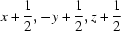
| O1—H9···N2ii | 0.89 (2) | 1.92 (2) | 2.8047 (17) | 175 |
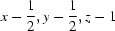
| C2—H2···O1iii | 0.93 | 2.59 | 3.5019 (17) | 166 |
| Symmetry codes: (ii) x+1/2, −y+1/2, z+1/2; (iii) x−1/2, y−1/2, z−1. |
Experimental details
| Crystal data | |
| Chemical formula | C12H18N4O2 |
| Mr | 250.30 |
| Crystal system, space group | Monoclinic, C2/c |
| Temperature (K) | 295 |
| a, b, c (Å) | 15.812 (3), 9.5961 (19), 9.3194 (19) |
| β (°) | 119.44 (3) |
| V (Å3) | 1231.5 (6) |
| Z | 4 |
| Radiation type | Mo Kα |
| µ (mm−1) | 0.10 |
| Crystal size (mm) | 0.56 × 0.48 × 0.37 |
| Data collection | |
| Diffractometer | Rigaku R-AXIS RAPID diffractometer |
| Absorption correction | Multi-scan (ABSCOR; Higashi, 1995) |
| Tmin, Tmax | 0.948, 0.970 |
| No. of measured, independent and observed [I > 2σ(I)] reflections | 4715, 1400, 1183 |
| Rint | 0.015 |
| (sin θ/λ)max (Å−1) | 0.649 |
| Refinement | |
| R[F2 > 2σ(F2)], wR(F2), S | 0.036, 0.104, 1.07 |
| No. of reflections | 1400 |
| No. of parameters | 86 |
| H-atom treatment | H atoms treated by a mixture of independent and constrained refinement |
| Δρmax, Δρmin (e Å−3) | 0.17, −0.23 |
Computer programs: RAPID-AUTO (Rigaku, 1998), CrystalStructure (Rigaku/MSC, 2002), SHELXS97 (Sheldrick, 2008), SHELXL97 (Sheldrick, 2008), SHELXL (Sheldrick, 2008).
| D—H···A | D—H | H···A | D···A | D—H···A |
| O1—H9···N2i | 0.89 (2) | 1.92 (2) | 2.8047 (17) | 175 |
| C2—H2···O1ii | 0.93 | 2.59 | 3.5019 (17) | 166 |
| Symmetry codes: (i) x+1/2, −y+1/2, z+1/2; (ii) x−1/2, y−1/2, z−1. |
Acknowledgements
This project was sponsored by the Scientific Research Foundation of the State Education Ministry for Returned Overseas Chinese Scholars (2006331), the Critical Projects in Science and Technology Department of Zhejiang Province (2007 C21113), the Education Committee of Zhejiang Province (20061696), the Natural Science Foundation of Ningbo City (2007 A610021), K. C. Wong Magna Fund in Ningbo University and Ningbo University (2005062). We thank Mr W. Xu for collecting the crystal data.
References
 Barnett, W. M., Baughman, R. G., Collier, H. L. & Vizuete, W. G. (1999). J. Chem. Crystallogr. 29, 765–768. Web of Science CSD CrossRef CAS Google Scholar
Barnett, W. M., Baughman, R. G., Secondo, P. M. & Hermansen, C. J. (2002). Acta Cryst. C58, o565–o567. Web of Science CSD CrossRef CAS IUCr Journals Google Scholar
Barnett, W. M., Lin, G., Collier, H. L. & Baughman, R. G. (1997). J. Chem. Crystallogr. 27, 423–427. CrossRef CAS Google Scholar
Forster, R. J., Walsh, D. A., Mano, N., Mao, F. & Heller, A. (2004). Langmuir, 20, 862–868. Web of Science CrossRef PubMed CAS Google Scholar
Fortin, S. & Beauchamp, A. L. (2000). Inorg. Chem. 39, 4886–4893. Web of Science CSD CrossRef PubMed CAS Google Scholar
Fu, Y. M., Zhao, Y. H., Lan, Y. Q., Wang, Y., Qiu, Y. Q., Shao, K. Z. & Su, Z. M. (2007). Inorg. Chem. Commun. 10, 720–723. Web of Science CSD CrossRef CAS Google Scholar
Higashi, T. (1995). ABSCOR. Rigaku Corporation, Tokyo, Japan. Google Scholar
Ion, L., Morales, D., Nieto, S., Perez, J., Riera, L., Riera, V., Miguel, D., Kowenicki, R. A. & Mcpartlin, M. (2007). Inorg. Chem. 46, 2846–2853. Web of Science CSD CrossRef PubMed CAS Google Scholar
Mao, F., Mano, N. & Heller, A. (2003). J. Am. Chem. Soc. 125, 4951–4957. Web of Science CrossRef PubMed CAS Google Scholar
Pereira, C. C. L., Costa, P. J., Calhorda, M. J., Freire, C., Rodrigues, S. S., Herdtweck, E. & Romão, C. C. (2006). Organometallics, 25, 5223–5234. Web of Science CSD CrossRef CAS Google Scholar
Rigaku (1998). RAPID-AUTO. Rigaku Cooperation, Tokyo, Japan. Google Scholar
Rigaku/MSC (2002). CrystalStructure. Rigaku/MSc Inc., The Woodlands, Texas, USA. Google Scholar
Secondo, P. M., Barnett, W. M., Collier, H. L. & Baughman, R. G. (1996). Acta Cryst. C52, 2636–2638. CSD CrossRef CAS Web of Science IUCr Journals Google Scholar
Secondo, P. M., Baughman, R. G. & Collier, H. L. (1997). J. Chem. Crystallogr. 27, 371–375. CrossRef CAS Web of Science Google Scholar
Sheldrick, G. M. (2008). Acta Cryst. A64, 112–122. Web of Science CrossRef CAS IUCr Journals Google Scholar
Xiao, J. C. & Shreeve, J. M. (2005). J. Org. Chem. 70, 3072–3078. Web of Science CrossRef PubMed CAS Google Scholar
Xiao, J. C., Twamley, B. & Shreeve, J. M. (2004). Org. Lett. 6, 3845–3847. Web of Science CSD CrossRef PubMed CAS Google Scholar
This is an open-access article distributed under the terms of the Creative Commons Attribution (CC-BY) Licence, which permits unrestricted use, distribution, and reproduction in any medium, provided the original authors and source are cited.
| CRYSTALLOGRAPHIC COMMUNICATIONS |


2,2'-Biimidazole (H2biim) derivatives as versatile ligands are widely used in the construction of metal complexes (Ion et al., 2007; Pereira et al., 2006; Fortin et al., 2000). In addition to the study of metal complexes, attention has also been devoted to the polymeric systems (Fu et al., 2007; Forster et al., 2004; Mao et al., 2003) and the ionic liquids (Xiao et al., 2005, 2004). The title compound (I), as a hydroxy-terminated derivative can be easily synthesized by Michael addition of dianion biim2- to alkyl acrylate (Barnett et al., 1999) and subsequent mild reduction by NaBH4 in an excellent yield.
The crystal structure of (I), shown in Fig. 1, adopts a trans conformation, and consists of half-molecule asymmetric units related by a twofold rotation. Exceptionally, unlike the other unconjugated 1,1'-disubstituted compounds reported before (Barnett et al., 1997, 2002; Secondo et al., 1996, 1996), the imidazole rings of the investigated compound (I) exhibit a rather large torsion angle of 51.27 (4)°, as shown in Fig. 1. The terminal hydroxyl groups are responsible for this noncoplanarity. The imdazole rings are forced to rotate by intermolecular interactions via strong O–H···N hydrogen bonds. The N1–C4–C5–C6 moiety is essentially planar with an r.m.s. deviation of 0.054 Å. This plane is at angle of 71.90 (7)° with respect to the adjacent imidazole ring, which is consistent with the reported analogous compounds referenced before. While the atom O1 does not lie in the N1–C4–C5–C6 plane, rather it lies 1.116 Å from this plane. The bond length and bond angle in (I) are within normal ranges.
The molecules of (I) are linked into a three-dimensional framework with parallel laminated construction by a combination of one strong O–H···N hydrogen bond and the other weak C–H···O hydrogen bond (Table 1). It can be analyzed in terms of thousands of one-dimensional substructures, linked by C–H···O hydrogen bonds, which generate series of two-dimensional sheets through C–H···O hydrogen bonds (Fig.2).