 | Acta Crystallographica Section E Acta Crystallographica Section E CRYSTALLOGRAPHIC COMMUNICATIONS |


 journal menu


organic compounds
| CRYSTALLOGRAPHIC COMMUNICATIONS |
 access
Redetermination of 1-carboxycyclohexan-1-aminium chloride

aLaboratorio de Cristalografía, Departamento de Química, Facultad de Ciencias, Universidad de Los Andes, Mérida 5101, Venezuela, and bCentro de Química, Instituto Venezolano de Investigaciones Científicas (IVIC), Apartado 21827, Caracas 1020-A, Venezuela
*Correspondence e-mail: [email protected]
The of the title compound, C7H14NO2+·Cl−, was reported previously [Chacko, Srinivasan & Zand (1975![[Chacko, K. K., Srinivasan, R. & Zand, R. (1975). J. Cryst. Mol. Struct. 5, 353-357.]](../../../../../../logos/arrows/e_arr.gif "Chacko, K. K., Srinivasan, R. & Zand, R. (1975). J. Cryst. Mol. Struct. 5, 353-357.") ). J. Cryst. Mol. Struct. 5, 353–357] from Weissenberg photographic data with R = 0.113. It has now been redetermined, providing a significant increase in the precision of the derived geometric parameters, viz. mean σ(C—C) = 0.003 Å in the present work compared with 0.021 Å for the previous work. The complete cation is generated by crystallographic mirrror symmetry, with three C atoms, two O atoms and the N atom lying on the reflecting plane; the chloride anion also has m The is established by a two-dimensional network of O—H⋯Cl and N—H⋯Cl hydrogen bonds, generating C12(4) and C12(7) chains, and R24(8) and R24(14) rings.
). J. Cryst. Mol. Struct. 5, 353–357] from Weissenberg photographic data with R = 0.113. It has now been redetermined, providing a significant increase in the precision of the derived geometric parameters, viz. mean σ(C—C) = 0.003 Å in the present work compared with 0.021 Å for the previous work. The complete cation is generated by crystallographic mirrror symmetry, with three C atoms, two O atoms and the N atom lying on the reflecting plane; the chloride anion also has m The is established by a two-dimensional network of O—H⋯Cl and N—H⋯Cl hydrogen bonds, generating C12(4) and C12(7) chains, and R24(8) and R24(14) rings.
Related literature
For the earlier of the title salt, see: Chacko et al. (1971, 1975). For related literature, see Rodríguez-Ropero et al. (2008). For the crystal structure of the pure amino acid, see: Valle et al. (1988). For ring conformation analysis, see: Cremer & Pople (1975). For hydrogen-bond motifs in graph-set notation, see: Etter (1990).
![[Scheme 1]](bh2212scheme1.gif)
Experimental
Crystal data
|
Refinement
|
|
 ; (ii)
 Data collection: CrystalClear (Rigaku, 2002); cell refinement: CrystalClear; data reduction: CrystalStructure (Rigaku/MSC, 2004); program(s) used to solve structure: SHELXS97 (Sheldrick, 2008); program(s) used to refine structure: SHELXL97 (Sheldrick, 2008); molecular graphics: DIAMOND (Brandenburg, 1999); software used to prepare material for publication: PLATON (Spek, 2003) and publCIF (Westrip, 2009).
Supporting information
contains datablocks I, global. DOI: 10.1107/S1600536808044243/bh2212sup1.cif
Structure factors: contains datablock I. DOI: 10.1107/S1600536808044243/bh2212Isup2.hkl
1-Amino-cyclohexanecarboxylic acid and hydrochloric acid in equal molar ratio were mixed together with enough water, and heated to a temperature where a clear solution was obtained. Colorless crystals of (I) suitable for X-ray were grown by slow evaporation of this solution.
All H atoms were located in a difference map and their positions were freely refined, with the Uiso(H) values set at 1.2Ueq(carrier C), 1.5Ueq(carrier O) and 1.5Ueq(carrier N), respectively.
Data collection: CrystalClear (Rigaku, 2002); cell CrystalClear (Rigaku, 2002); data reduction: CrystalStructure (Rigaku/MSC, 2004); program(s) used to solve structure: SHELXS97 (Sheldrick, 2008); program(s) used to refine structure: SHELXL97 (Sheldrick, 2008); molecular graphics: DIAMOND (Brandenburg, 1999); software used to prepare material for publication: PLATON (Spek, 2003) and publCIF (Westrip, 2009).
![[Figure 1]](./bh2212fig1thm.gif) | Fig. 1. The molecular structure of (I), with atom labels and 50% probability displacement ellipsoids for non-H atoms. |
![[Figure 2]](./bh2212fig2thm.gif) | Fig. 2. A partial packing view of (I). Hydrogen bonds are shown as dashed lines. H atoms not involved in hydrogen bonding have been omitted for clarity. Symmetry codes: (i) x, y, z - 1; (ii) 1 - x, y - 1/2, 1 - z. |
| C7H14NO2+·Cl− | F(000) = 192 |
| Mr = 179.64 | Dx = 1.364 Mg m−3 |
| Monoclinic, P21/m | Mo Kα radiation, λ = 0.71070 Å |
| Hall symbol: -P 2yb | Cell parameters from 1650 reflections |
| a = 7.382 (3) Å | θ = 2.2–27.2° |
| b = 6.357 (2) Å | µ = 0.39 mm−1 |
| c = 9.374 (3) Å | T = 298 K |
| β = 96.239 (10)° | Block, colourless |
| V = 437.3 (3) Å3 | 0.31 × 0.27 × 0.18 mm |
| Z = 2 |
| Rigaku AFC-7S Mercury diffractometer | 845 independent reflections |
| Radiation source: Normal-focus sealed tube | 789 reflections with I > 2σ(I) |
| Graphite monochromator | Rint = 0.023 |
| Detector resolution: 14.6306 pixels mm-1 | θmax = 25.0°, θmin = 2.2° |
| ω scans | h = −8→8 |
| Absorption correction: multi-scan (Jacobson, 1998) | k = −6→7 |
| Tmin = 0.880, Tmax = 0.930 | l = −11→11 |
| 4638 measured reflections |
| Refinement on F2 | Secondary atom site location: difference Fourier map |
| Least-squares matrix: full | Hydrogen site location: inferred from neighbouring sites |
| R[F2 > 2σ(F2)] = 0.033 | H atoms treated by a mixture of independent and constrained refinement |
| wR(F2) = 0.088 | w = 1/[σ2(Fo2) + (0.047P)2 + 0.1831P] where P = (Fo2 + 2Fc2)/3 |
| S = 1.01 | (Δ/σ)max < 0.001 |
| 845 reflections | Δρmax = 0.18 e Å−3 |
| 85 parameters | Δρmin = −0.15 e Å−3 |
| 0 restraints | Extinction correction: SHELXL97 (Sheldrick, 2008), Fc*=kFc[1+0.001xFc2λ3/sin(2θ)]-1/4 |
| 0 constraints | Extinction coefficient: 0.042 (10) |
| Primary atom site location: structure-invariant direct methods |
| C7H14NO2+·Cl− | V = 437.3 (3) Å3 |
| Mr = 179.64 | Z = 2 |
| Monoclinic, P21/m | Mo Kα radiation |
| a = 7.382 (3) Å | µ = 0.39 mm−1 |
| b = 6.357 (2) Å | T = 298 K |
| c = 9.374 (3) Å | 0.31 × 0.27 × 0.18 mm |
| β = 96.239 (10)° |
| Rigaku AFC-7S Mercury diffractometer | 845 independent reflections |
| Absorption correction: multi-scan (Jacobson, 1998) | 789 reflections with I > 2σ(I) |
| Tmin = 0.880, Tmax = 0.930 | Rint = 0.023 |
| 4638 measured reflections |
| R[F2 > 2σ(F2)] = 0.033 | 0 restraints |
| wR(F2) = 0.088 | H atoms treated by a mixture of independent and constrained refinement |
| S = 1.01 | Δρmax = 0.18 e Å−3 |
| 845 reflections | Δρmin = −0.15 e Å−3 |
| 85 parameters |
| x | y | z | Uiso*/Ueq | ||
| Cl | 0.41343 (8) | 0.2500 | 0.64377 (6) | 0.0414 (3) | |
| O2 | 0.5446 (2) | 0.2500 | 0.04758 (18) | 0.0511 (5) | |
| O1 | 0.2629 (3) | 0.2500 | −0.06850 (18) | 0.0528 (5) | |
| H1 | 0.324 (5) | 0.2500 | −0.146 (4) | 0.079* | |
| N1 | 0.4370 (3) | 0.2500 | 0.3054 (2) | 0.0343 (5) | |
| H1A | 0.506 (3) | 0.138 (3) | 0.300 (2) | 0.051* | |
| H1B | 0.398 (4) | 0.2500 | 0.393 (3) | 0.051* | |
| C1 | 0.2863 (3) | 0.2500 | 0.1837 (2) | 0.0292 (5) | |
| C2 | 0.1715 (2) | 0.4484 (3) | 0.19289 (19) | 0.0408 (5) | |
| H2A | 0.251 (3) | 0.566 (3) | 0.1923 (19) | 0.049* | |
| H2B | 0.090 (3) | 0.452 (3) | 0.107 (2) | 0.049* | |
| C3 | 0.0597 (3) | 0.4450 (4) | 0.3193 (2) | 0.0539 (6) | |
| H3A | 0.140 (3) | 0.449 (4) | 0.409 (2) | 0.065* | |
| H3B | −0.018 (3) | 0.571 (4) | 0.315 (2) | 0.065* | |
| C4 | −0.0557 (4) | 0.2500 | 0.3201 (3) | 0.0626 (9) | |
| H4A | −0.145 (5) | 0.2500 | 0.232 (4) | 0.075* | |
| H4B | −0.148 (5) | 0.2500 | 0.397 (4) | 0.075* | |
| C5 | 0.3819 (3) | 0.2500 | 0.0475 (2) | 0.0358 (5) |
| U11 | U22 | U33 | U12 | U13 | U23 | |
| Cl | 0.0457 (4) | 0.0544 (4) | 0.0238 (4) | 0.000 | 0.0025 (2) | 0.000 |
| O2 | 0.0359 (10) | 0.0837 (14) | 0.0345 (10) | 0.000 | 0.0078 (7) | 0.000 |
| O1 | 0.0443 (11) | 0.0932 (15) | 0.0205 (9) | 0.000 | 0.0023 (7) | 0.000 |
| N1 | 0.0335 (11) | 0.0449 (12) | 0.0238 (10) | 0.000 | −0.0002 (8) | 0.000 |
| C1 | 0.0303 (11) | 0.0355 (12) | 0.0211 (11) | 0.000 | −0.0004 (8) | 0.000 |
| C2 | 0.0439 (10) | 0.0402 (10) | 0.0373 (10) | 0.0074 (8) | −0.0004 (8) | 0.0024 (7) |
| C3 | 0.0497 (11) | 0.0707 (14) | 0.0412 (10) | 0.0221 (10) | 0.0052 (9) | −0.0058 (10) |
| C4 | 0.0386 (15) | 0.105 (3) | 0.0449 (17) | 0.000 | 0.0076 (13) | 0.000 |
| C5 | 0.0385 (13) | 0.0425 (13) | 0.0262 (12) | 0.000 | 0.0025 (10) | 0.000 |
| O2—C5 | 1.201 (3) | C2—C3 | 1.516 (3) |
| O1—C5 | 1.322 (3) | C2—H2A | 0.95 (2) |
| O1—H1 | 0.89 (4) | C2—H2B | 0.95 (2) |
| N1—C1 | 1.504 (3) | C3—C4 | 1.505 (3) |
| N1—H1A | 0.88 (2) | C3—H3A | 0.97 (2) |
| N1—H1B | 0.90 (3) | C3—H3B | 0.98 (2) |
| C1—C5 | 1.524 (3) | C4—H4A | 0.99 (3) |
| C1—C2 | 1.528 (2) | C4—H4B | 1.05 (4) |
| C5—O1—H1 | 109 (2) | C4—C3—C2 | 111.85 (19) |
| C1—N1—H1A | 110.2 (13) | C4—C3—H3A | 107.9 (13) |
| C1—N1—H1B | 114.0 (18) | C2—C3—H3A | 109.9 (12) |
| H1A—N1—H1B | 107.1 (16) | C4—C3—H3B | 110.2 (13) |
| N1—C1—C5 | 105.28 (18) | C2—C3—H3B | 108.4 (13) |
| N1—C1—C2 | 109.04 (12) | H3A—C3—H3B | 108.5 (17) |
| C5—C1—C2 | 110.97 (12) | C3—C4—H4A | 108.6 (10) |
| C3—C2—C1 | 112.64 (16) | C3—C4—H4B | 114.6 (8) |
| C3—C2—H2A | 113.8 (11) | H4A—C4—H4B | 99 (3) |
| C1—C2—H2A | 107.7 (12) | O2—C5—O1 | 125.2 (2) |
| C3—C2—H2B | 108.3 (11) | O2—C5—C1 | 123.6 (2) |
| C1—C2—H2B | 105.8 (12) | O1—C5—C1 | 111.2 (2) |
| H2A—C2—H2B | 108.2 (16) |
| D—H···A | D—H | H···A | D···A | D—H···A |
| N1—H1B···Cl | 0.90 (3) | 2.34 (3) | 3.196 (2) | 158 (2) |
| N1—H1A···Cli | 0.88 (2) | 2.58 (2) | 3.3816 (13) | 152.4 (17) |
| O1—H1···Clii | 0.89 (4) | 2.15 (4) | 3.027 (2) | 168 (3) |
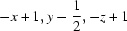
| Symmetry codes: (i) −x+1, y−1/2, −z+1; (ii) x, y, z−1. |
Experimental details
| Crystal data | |
| Chemical formula | C7H14NO2+·Cl− |
| Mr | 179.64 |
| Crystal system, space group | Monoclinic, P21/m |
| Temperature (K) | 298 |
| a, b, c (Å) | 7.382 (3), 6.357 (2), 9.374 (3) |
| β (°) | 96.239 (10) |
| V (Å3) | 437.3 (3) |
| Z | 2 |
| Radiation type | Mo Kα |
| µ (mm−1) | 0.39 |
| Crystal size (mm) | 0.31 × 0.27 × 0.18 |
| Data collection | |
| Diffractometer | Rigaku AFC-7S Mercury diffractometer |
| Absorption correction | Multi-scan (Jacobson, 1998) |
| Tmin, Tmax | 0.880, 0.930 |
| No. of measured, independent and observed [I > 2σ(I)] reflections | 4638, 845, 789 |
| Rint | 0.023 |
| (sin θ/λ)max (Å−1) | 0.594 |
| Refinement | |
| R[F2 > 2σ(F2)], wR(F2), S | 0.033, 0.088, 1.01 |
| No. of reflections | 845 |
| No. of parameters | 85 |
| H-atom treatment | H atoms treated by a mixture of independent and constrained refinement |
| Δρmax, Δρmin (e Å−3) | 0.18, −0.15 |
Computer programs: CrystalClear (Rigaku, 2002), CrystalStructure (Rigaku/MSC, 2004), SHELXS97 (Sheldrick, 2008), SHELXL97 (Sheldrick, 2008), DIAMOND (Brandenburg, 1999), PLATON (Spek, 2003) and publCIF (Westrip, 2009).
| D—H···A | D—H | H···A | D···A | D—H···A |
| N1—H1B···Cl | 0.90 (3) | 2.34 (3) | 3.196 (2) | 158 (2) |
| N1—H1A···Cli | 0.88 (2) | 2.58 (2) | 3.3816 (13) | 152.4 (17) |
| O1—H1···Clii | 0.89 (4) | 2.15 (4) | 3.027 (2) | 168 (3) |
| Symmetry codes: (i) −x+1, y−1/2, −z+1; (ii) x, y, z−1. |
Acknowledgements
This work was supported by CDCHT-ULA (grant Nos. C-1618-08-A, C-1615-08-B and C-1620-08-08-Em) and FONACIT (grant No. LAB-97000821).
References
 Brandenburg, K. (1999). DIAMOND. Crystal Impact GbR, Bonn, Germany. Google Scholar
Chacko, K. K., Srinivasan, R. & Zand, R. (1971). J. Cryst. Mol. Struct. 1, 261–269. CSD CrossRef CAS Google Scholar
Chacko, K. K., Srinivasan, R. & Zand, R. (1975). J. Cryst. Mol. Struct. 5, 353–357. CSD CrossRef CAS Web of Science Google Scholar
Cremer, D. & Pople, J. A. (1975). J. Am. Chem. Soc. 97, 1354–1358. CrossRef CAS Web of Science Google Scholar
Etter, M. C. (1990). Acc. Chem. Res. 23, 120–126. CrossRef CAS Web of Science Google Scholar
Jacobson, R. (1998). Private communication to Rigaku Corporation, Tokyo, Japan. Google Scholar
Rigaku (2002). CrystalClear. Rigaku Corporation, Tokyo, Japan. Google Scholar
Rigaku/MSC (2004). CrystalStructure. Rigaku/MSC, The Woodlands, Texas, USA. Google Scholar
Rodríguez-Ropero, F., Zanuy, D., Casanovas, J., Nussinov, R. & Alemán, C. (2008). J. Chem. Inf. Model. 48, 333–343. Web of Science PubMed Google Scholar
Sheldrick, G. M. (2008). Acta Cryst. A64, 112–122. Web of Science CrossRef CAS IUCr Journals Google Scholar
Spek, A. L. (2003). J. Appl. Cryst. 36, 7–13. Web of Science CrossRef CAS IUCr Journals Google Scholar
Valle, G., Crisma, M., Toniolo, C., Sen, N., Sukumar, M. & Balaram, P. (1988). J. Chem. Soc. Perkin Trans. 2, pp. 393–398. CSD CrossRef Google Scholar
Westrip, S. P. (2009). publCIF. In preparation. Google Scholar
This is an open-access article distributed under the terms of the Creative Commons Attribution (CC-BY) Licence, which permits unrestricted use, distribution, and reproduction in any medium, provided the original authors and source are cited.
| CRYSTALLOGRAPHIC COMMUNICATIONS |


1-Amino-cyclohexanecarboxylic acid is a promising amino acid candidate to serve as basic piece in redesigned protein motifs which constitute the basic modules in synthetic nanoconstructs (Rodríguez-Ropero et al., 2008). It structure was reported by Valle et al. (1988). The title compound, (I), 1-amino-cyclohexanecarboxylic acid hydrochloride, C7H14NO2+.Cl-, was first reported in the noncentric space group P21 (Chacko et al., 1971) and later reported in the centrosymmetric space group P21/m (Chacko et al., 1975) with R = 0.113. The present paper reports a redetermination of the crystal structure of (I), with greater precision and accuracy. Both, the cation and anion are located on a mirror plane, which confirms the space group P21/m instead of P21. In this compound, the cyclohexane ring adopts a chair conformation, with the ammonium and carboxylate groups in axial and equatorial positions, respectively (Cremer & Pople, 1975), while the pure amino acid has an opposite conformation (Valle et al., 1988). In (I), 1-amino-cyclohexanecarboxylic acid is protonated and is linked to the Cl- anion by a O—H···Cl hydrogen bond (Fig. 1, Table 1). The hydrogen bonds O1—H1···Cl1 (x, y, z - 1) and N1—H1B···Cl1 (1 - x, y - 1/2, 1 - z) form infinite chains running along the [001] direction (Fig. 2) and may be described in graph-set notation as C12(7) (Etter, 1990). The intramolecular hydrogen bonds N1—H1A···Cl1 form infinite chains, with graph-set C12(4), running along the b cell axis. The combination of these interactions produces rings with graph-set R24(8) and R24(14), parallel to the bc plane (Fig. 2).