 | Acta Crystallographica Section E Acta Crystallographica Section E CRYSTALLOGRAPHIC COMMUNICATIONS |


 journal menu


organic compounds
| CRYSTALLOGRAPHIC COMMUNICATIONS |
 access
(2S)-1,1-Dichloro-2-(2-chlorophenyl)-2-(4-chlorophenyl)ethane

aDepartment of Environmental Chemistry, Stockholm University, SE-106 91 Stockholm, Sweden, and bDepartment of Physical, Inorganic and Structural Chemistry, Stockholm University, SE-106 91 Stockholm, Sweden
*Correspondence e-mail: [email protected]
The title compound, C14H10Cl4, is easily crystallized while the other enantiomorph only forms an oil upon crystallization attempts. The title compound has a considerably higher density, ρ ≃ 1.562 Mg m−3 compared to the racemic substance, ρ ≃ 1.514 Mg m−3. This is supported by the fact there are two intermolecular halogen–halogen contacts in the title compound compared with only one the racemic compound. The dihedral angle between the two phenyl rings is 76.83 (5)°
Related literature
For related literature regarding the structure of the see: Arora & Bates (1976![[Arora, S. K. & Bates, R. B. (1976). J. Org. Chem. 41, 554-556.]](../../../../../../logos/arrows/e_arr.gif "Arora, S. K. & Bates, R. B. (1976). J. Org. Chem. 41, 554-556.") ). For related literature on the toxicological effects, see: Allolio & Fassnacht (2006), Benecke et al. (1991), Bergenstal et al. (1960); Cantillana et al. (2009).
). For related literature on the toxicological effects, see: Allolio & Fassnacht (2006), Benecke et al. (1991), Bergenstal et al. (1960); Cantillana et al. (2009).
![[Scheme 1]](bq2116scheme1.gif)
Experimental
Crystal data
|
| ||||||||
 ; (ii)
  .
. Data collection: CrysAlis CCD (Oxford Diffraction, 2008); cell refinement: CrysAlis RED (Oxford Diffraction, 2008); data reduction: CrysAlis RED; program(s) used to solve structure: SHELXS97 (Sheldrick, 2008); program(s) used to refine structure: SHELXL97 (Sheldrick, 2008); molecular graphics: DIAMOND (Bergerhoff, 1996); software used to prepare material for publication: PLATON (Spek, 2003) and SHELXL97.
Supporting information
contains datablocks I, global. DOI: 10.1107/S160053680804405X/bq2116sup1.cif
Structure factors: contains datablock I. DOI: 10.1107/S160053680804405X/bq2116Isup2.hkl
The title compound was purified from a present in the commercially available product, 1,1-Dichloro-2-(2-chlorophenyl)-2-(4-chlorophenyl)ethane (o,p'-DDD) using high performance (HPLC), Shimadzu LC-9 A (Kyoto, Japan) equipped with an UV detector, UV100 from Spectra-Physics (Fremont, USA) and a permethylated γ-cyclodextrin column, Nucleodex gamma-PM (250 x 10 mm, 5µm, Macherey-Nagel GmbH & Co, Düren, Germany). The detection wavelength was 240 nm and the flow rate was 4 ml/min and injection volume of 200µl. The mobile phase was methanol:water (80:20) and 1% triethylamine:acetic acid (1:2 v/v). Thin plate-like crystals suitable for X-ray analysis were obtained upon recrystallization from methanol.
The hydrogen atoms were geometrically positioned at C—H distances of 0.95 and 1.00 Å for the aromatic and methine hydrogen's. Both types of hydrogen's were given U(iso) = 1.2Ueq(C). The completeness of the data increases to 0.994 if one cuts the reflection data at 2θ = 50°.
Data collection: CrysAlis CCD (Oxford Diffraction, 2008); cell CrysAlis RED (Oxford Diffraction, 2008); data reduction: CrysAlis RED (Oxford Diffraction, 2008); program(s) used to solve structure: SHELXS97 (Sheldrick, 2008); program(s) used to refine structure: SHELXL97 (Sheldrick, 2008); molecular graphics: DIAMOND (Bergerhoff, 1996); software used to prepare material for publication: PLATON (Spek, 2003) and SHELXL97 (Sheldrick, 2008).
![[Figure 1]](./bq2116fig1thm.gif) | Fig. 1. The title compound (I) with displacement ellipsoids at 50% probability with the unique atoms labeled. |
| C14H10Cl4 | F(000) = 324 |
| Mr = 320.02 | Dx = 1.562 Mg m−3 |
| Monoclinic, P21 | Mo Kα radiation, λ = 0.71073 Å |
| Hall symbol: P 2yb | Cell parameters from 11963 reflections |
| a = 6.1353 (1) Å | θ = 3.8–32.1° |
| b = 12.0715 (2) Å | µ = 0.85 mm−1 |
| c = 9.4525 (2) Å | T = 100 K |
| β = 103.5490 (18)° | Plate, colourless |
| V = 680.59 (2) Å3 | 0.34 × 0.24 × 0.04 mm |
| Z = 2 |
| Oxford Diffraction Xcalibur-3 κ- diffractometer with Sapphire-III CCD | 4258 independent reflections |
| Radiation source: Enhance (Mo) X-ray Source | 3935 reflections with I > 2σ(I) |
| Graphite monochromator | Rint = 0.032 |
| Detector resolution: 16.54 pixels mm-1 | θmax = 32.2°, θmin = 3.8° |
| ω scans at different ϕ | h = −9→9 |
| Absorption correction: gaussian (CrysAlis RED; Oxford Diffraction, 2008) | k = −17→15 |
| Tmin = 0.814, Tmax = 0.968 | l = −13→14 |
| 18569 measured reflections |
| Refinement on F2 | Hydrogen site location: inferred from neighbouring sites |
| Least-squares matrix: full | H-atom parameters constrained |
| R[F2 > 2σ(F2)] = 0.026 | w = 1/[σ2(Fo2) + (0.0358P)2] where P = (Fo2 + 2Fc2)/3 |
| wR(F2) = 0.060 | (Δ/σ)max = 0.001 |
| S = 1.01 | Δρmax = 0.40 e Å−3 |
| 4258 reflections | Δρmin = −0.31 e Å−3 |
| 164 parameters | Extinction correction: SHELXL97 (Sheldrick, 2008), Fc*=kFc[1+0.001xFc2λ3/sin(2θ)]-1/4 |
| 1 restraint | Extinction coefficient: 0.009 (2) |
| Primary atom site location: structure-invariant direct methods | Absolute structure: Flack (1983), 1755 Friedel pairs |
| Secondary atom site location: difference Fourier map | Absolute structure parameter: 0.00 (4) |
| C14H10Cl4 | V = 680.59 (2) Å3 |
| Mr = 320.02 | Z = 2 |
| Monoclinic, P21 | Mo Kα radiation |
| a = 6.1353 (1) Å | µ = 0.85 mm−1 |
| b = 12.0715 (2) Å | T = 100 K |
| c = 9.4525 (2) Å | 0.34 × 0.24 × 0.04 mm |
| β = 103.5490 (18)° |
| Oxford Diffraction Xcalibur-3 κ- diffractometer with Sapphire-III CCD | 4258 independent reflections |
| Absorption correction: gaussian (CrysAlis RED; Oxford Diffraction, 2008) | 3935 reflections with I > 2σ(I) |
| Tmin = 0.814, Tmax = 0.968 | Rint = 0.032 |
| 18569 measured reflections |
| R[F2 > 2σ(F2)] = 0.026 | H-atom parameters constrained |
| wR(F2) = 0.060 | Δρmax = 0.40 e Å−3 |
| S = 1.01 | Δρmin = −0.31 e Å−3 |
| 4258 reflections | Absolute structure: Flack (1983), 1755 Friedel pairs |
| 164 parameters | Absolute structure parameter: 0.00 (4) |
| 1 restraint |
Geometry. All e.s.d.'s (except the e.s.d. in the dihedral angle between two l.s. planes) are estimated using the full covariance matrix. The cell e.s.d.'s are taken into account individually in the estimation of e.s.d.'s in distances, angles and torsion angles; correlations between e.s.d.'s in cell parameters are only used when they are defined by crystal symmetry. An approximate (isotropic) treatment of cell e.s.d.'s is used for estimating e.s.d.'s involving l.s. planes. |
Refinement. Refinement of F2 against ALL reflections. The weighted R-factor wR and goodness of fit S are based on F2, conventional R-factors R are based on F, with F set to zero for negative F2. The threshold expression of F2 > σ(F2) is used only for calculating R-factors(gt) etc. and is not relevant to the choice of reflections for refinement. R-factors based on F2 are statistically about twice as large as those based on F, and R- factors based on ALL data will be even larger. |
| x | y | z | Uiso*/Ueq | ||
| C1 | 0.5723 (2) | 0.58327 (13) | 0.35281 (15) | 0.0153 (3) | |
| H1 | 0.4179 | 0.5513 | 0.3360 | 0.018* | |
| C2 | 0.5682 (2) | 0.70231 (12) | 0.40708 (16) | 0.0136 (3) | |
| H2 | 0.7233 | 0.7330 | 0.4219 | 0.016* | |
| Cl1 | 0.75951 (6) | 0.50047 (3) | 0.48348 (4) | 0.02031 (8) | |
| Cl2 | 0.66068 (6) | 0.58092 (3) | 0.18581 (4) | 0.02172 (9) | |
| C3 | 0.4118 (2) | 0.77539 (12) | 0.29597 (15) | 0.0143 (3) | |
| C4 | 0.4896 (3) | 0.87540 (13) | 0.25332 (16) | 0.0178 (3) | |
| H4 | 0.6434 | 0.8943 | 0.2871 | 0.021* | |
| C5 | 0.3459 (3) | 0.94815 (14) | 0.16209 (16) | 0.0196 (3) | |
| H5 | 0.4006 | 1.0162 | 0.1335 | 0.024* | |
| C6 | 0.1222 (3) | 0.92006 (14) | 0.11361 (15) | 0.0174 (3) | |
| C7 | 0.0412 (3) | 0.81928 (14) | 0.15077 (17) | 0.0197 (3) | |
| H7 | −0.1116 | 0.7996 | 0.1141 | 0.024* | |
| C8 | 0.1859 (2) | 0.74824 (14) | 0.24185 (17) | 0.0185 (3) | |
| H8 | 0.1310 | 0.6796 | 0.2683 | 0.022* | |
| Cl3 | −0.06289 (6) | 1.01373 (3) | 0.00690 (4) | 0.02230 (9) | |
| C9 | 0.5012 (2) | 0.70772 (12) | 0.55256 (16) | 0.0149 (3) | |
| C10 | 0.3199 (3) | 0.64714 (13) | 0.57858 (16) | 0.0177 (3) | |
| H10 | 0.2424 | 0.5974 | 0.5062 | 0.021* | |
| C11 | 0.2503 (3) | 0.65801 (14) | 0.70765 (17) | 0.0192 (3) | |
| H11 | 0.1263 | 0.6162 | 0.7223 | 0.023* | |
| C12 | 0.3609 (3) | 0.72933 (15) | 0.81459 (17) | 0.0212 (3) | |
| H12 | 0.3129 | 0.7366 | 0.9026 | 0.025* | |
| C13 | 0.5417 (3) | 0.79019 (14) | 0.79373 (17) | 0.0207 (3) | |
| H13 | 0.6192 | 0.8389 | 0.8674 | 0.025* | |
| C14 | 0.6088 (2) | 0.77922 (13) | 0.66334 (16) | 0.0157 (3) | |
| Cl4 | 0.83309 (6) | 0.86142 (3) | 0.64058 (4) | 0.02012 (8) |
| U11 | U22 | U33 | U12 | U13 | U23 | |
| C1 | 0.0144 (6) | 0.0158 (7) | 0.0172 (6) | 0.0000 (5) | 0.0071 (5) | −0.0006 (6) |
| C2 | 0.0121 (6) | 0.0131 (7) | 0.0159 (6) | −0.0025 (5) | 0.0041 (5) | −0.0019 (5) |
| Cl1 | 0.01984 (16) | 0.01761 (17) | 0.02400 (17) | 0.00417 (14) | 0.00622 (12) | 0.00057 (14) |
| Cl2 | 0.02671 (18) | 0.02192 (19) | 0.02051 (16) | −0.00424 (15) | 0.01356 (14) | −0.00507 (14) |
| C3 | 0.0158 (6) | 0.0140 (7) | 0.0139 (6) | −0.0016 (5) | 0.0054 (5) | −0.0012 (5) |
| C4 | 0.0171 (6) | 0.0189 (8) | 0.0175 (6) | −0.0054 (6) | 0.0042 (5) | −0.0007 (6) |
| C5 | 0.0261 (8) | 0.0167 (7) | 0.0162 (7) | −0.0061 (6) | 0.0054 (6) | 0.0018 (5) |
| C6 | 0.0210 (7) | 0.0189 (7) | 0.0129 (6) | 0.0025 (6) | 0.0052 (5) | 0.0020 (5) |
| C7 | 0.0173 (7) | 0.0212 (8) | 0.0202 (7) | −0.0024 (6) | 0.0039 (6) | 0.0019 (6) |
| C8 | 0.0171 (7) | 0.0174 (7) | 0.0206 (7) | −0.0043 (6) | 0.0037 (5) | 0.0021 (6) |
| Cl3 | 0.02784 (18) | 0.02156 (19) | 0.01717 (15) | 0.00582 (15) | 0.00459 (13) | 0.00309 (14) |
| C9 | 0.0156 (6) | 0.0138 (7) | 0.0154 (6) | 0.0041 (5) | 0.0034 (5) | 0.0005 (5) |
| C10 | 0.0205 (7) | 0.0166 (7) | 0.0172 (6) | 0.0015 (6) | 0.0070 (5) | 0.0021 (6) |
| C11 | 0.0186 (7) | 0.0203 (8) | 0.0205 (7) | 0.0034 (6) | 0.0081 (6) | 0.0048 (6) |
| C12 | 0.0263 (8) | 0.0224 (8) | 0.0163 (7) | 0.0089 (7) | 0.0077 (6) | 0.0029 (6) |
| C13 | 0.0258 (8) | 0.0189 (8) | 0.0158 (7) | 0.0070 (6) | 0.0020 (6) | −0.0012 (6) |
| C14 | 0.0146 (6) | 0.0126 (7) | 0.0185 (6) | 0.0029 (5) | 0.0013 (5) | −0.0002 (5) |
| Cl4 | 0.01702 (16) | 0.01679 (17) | 0.02510 (18) | −0.00235 (13) | 0.00201 (13) | −0.00440 (14) |
| C1—C2 | 1.528 (2) | C7—C8 | 1.381 (2) |
| C1—Cl1 | 1.7831 (15) | C7—H7 | 0.9500 |
| C1—Cl2 | 1.7855 (14) | C8—H8 | 0.9500 |
| C1—H1 | 1.0000 | C9—C14 | 1.398 (2) |
| C2—C9 | 1.526 (2) | C9—C10 | 1.400 (2) |
| C2—C3 | 1.526 (2) | C10—C11 | 1.390 (2) |
| C2—H2 | 1.0000 | C10—H10 | 0.9500 |
| C3—C4 | 1.392 (2) | C11—C12 | 1.379 (2) |
| C3—C8 | 1.399 (2) | C11—H11 | 0.9500 |
| C4—C5 | 1.391 (2) | C12—C13 | 1.382 (2) |
| C4—H4 | 0.9500 | C12—H12 | 0.9500 |
| C5—C6 | 1.383 (2) | C13—C14 | 1.394 (2) |
| C5—H5 | 0.9500 | C13—H13 | 0.9500 |
| C6—C7 | 1.390 (2) | C14—Cl4 | 1.7503 (16) |
| C6—Cl3 | 1.7462 (16) | ||
| Cl1···Cl4i | 3.4370 (5) | Cl2···Cl3ii | 3.4888 (5) |
| C2—C1—Cl1 | 110.68 (10) | C8—C7—C6 | 119.01 (14) |
| C2—C1—Cl2 | 110.12 (10) | C8—C7—H7 | 120.5 |
| Cl1—C1—Cl2 | 108.88 (8) | C6—C7—H7 | 120.5 |
| C2—C1—H1 | 109.0 | C7—C8—C3 | 121.31 (14) |
| Cl1—C1—H1 | 109.0 | C7—C8—H8 | 119.3 |
| Cl2—C1—H1 | 109.0 | C3—C8—H8 | 119.3 |
| C9—C2—C3 | 109.67 (11) | C14—C9—C10 | 116.49 (13) |
| C9—C2—C1 | 111.82 (12) | C14—C9—C2 | 121.46 (13) |
| C3—C2—C1 | 111.69 (12) | C10—C9—C2 | 121.92 (13) |
| C9—C2—H2 | 107.8 | C11—C10—C9 | 121.65 (15) |
| C3—C2—H2 | 107.8 | C11—C10—H10 | 119.2 |
| C1—C2—H2 | 107.8 | C9—C10—H10 | 119.2 |
| C4—C3—C8 | 118.35 (14) | C12—C11—C10 | 120.19 (15) |
| C4—C3—C2 | 119.83 (13) | C12—C11—H11 | 119.9 |
| C8—C3—C2 | 121.69 (13) | C10—C11—H11 | 119.9 |
| C5—C4—C3 | 121.07 (14) | C11—C12—C13 | 120.04 (14) |
| C5—C4—H4 | 119.5 | C11—C12—H12 | 120.0 |
| C3—C4—H4 | 119.5 | C13—C12—H12 | 120.0 |
| C6—C5—C4 | 119.09 (15) | C12—C13—C14 | 119.25 (15) |
| C6—C5—H5 | 120.5 | C12—C13—H13 | 120.4 |
| C4—C5—H5 | 120.5 | C14—C13—H13 | 120.4 |
| C5—C6—C7 | 121.11 (15) | C13—C14—C9 | 122.37 (15) |
| C5—C6—Cl3 | 119.54 (13) | C13—C14—Cl4 | 117.29 (12) |
| C7—C6—Cl3 | 119.33 (12) | C9—C14—Cl4 | 120.33 (12) |
| Cl1—C1—C2—C9 | −57.58 (13) | C2—C3—C8—C7 | 174.53 (14) |
| Cl2—C1—C2—C9 | −178.02 (9) | C3—C2—C9—C14 | −96.67 (15) |
| Cl1—C1—C2—C3 | 179.08 (9) | C1—C2—C9—C14 | 138.85 (14) |
| Cl2—C1—C2—C3 | 58.64 (13) | C3—C2—C9—C10 | 78.99 (17) |
| C9—C2—C3—C4 | 107.05 (15) | C1—C2—C9—C10 | −45.48 (18) |
| C1—C2—C3—C4 | −128.40 (14) | C14—C9—C10—C11 | 0.2 (2) |
| C9—C2—C3—C8 | −68.77 (17) | C2—C9—C10—C11 | −175.63 (14) |
| C1—C2—C3—C8 | 55.78 (18) | C9—C10—C11—C12 | −0.3 (2) |
| C8—C3—C4—C5 | 1.6 (2) | C10—C11—C12—C13 | −0.1 (2) |
| C2—C3—C4—C5 | −174.36 (14) | C11—C12—C13—C14 | 0.6 (2) |
| C3—C4—C5—C6 | 0.1 (2) | C12—C13—C14—C9 | −0.7 (2) |
| C4—C5—C6—C7 | −2.1 (2) | C12—C13—C14—Cl4 | 178.08 (12) |
| C4—C5—C6—Cl3 | 176.66 (12) | C10—C9—C14—C13 | 0.3 (2) |
| C5—C6—C7—C8 | 2.3 (2) | C2—C9—C14—C13 | 176.15 (14) |
| Cl3—C6—C7—C8 | −176.42 (12) | C10—C9—C14—Cl4 | −178.44 (11) |
| C6—C7—C8—C3 | −0.6 (2) | C2—C9—C14—Cl4 | −2.55 (19) |
| C4—C3—C8—C7 | −1.3 (2) |
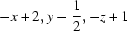
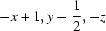
| Symmetry codes: (i) −x+2, y−1/2, −z+1; (ii) −x+1, y−1/2, −z. |
Experimental details
| Crystal data | |
| Chemical formula | C14H10Cl4 |
| Mr | 320.02 |
| Crystal system, space group | Monoclinic, P21 |
| Temperature (K) | 100 |
| a, b, c (Å) | 6.1353 (1), 12.0715 (2), 9.4525 (2) |
| β (°) | 103.5490 (18) |
| V (Å3) | 680.59 (2) |
| Z | 2 |
| Radiation type | Mo Kα |
| µ (mm−1) | 0.85 |
| Crystal size (mm) | 0.34 × 0.24 × 0.04 |
| Data collection | |
| Diffractometer | Oxford Diffraction Xcalibur-3 κ- diffractometer with Sapphire-III CCD |
| Absorption correction | Gaussian (CrysAlis RED; Oxford Diffraction, 2008) |
| Tmin, Tmax | 0.814, 0.968 |
| No. of measured, independent and observed [I > 2σ(I)] reflections | 18569, 4258, 3935 |
| Rint | 0.032 |
| (sin θ/λ)max (Å−1) | 0.751 |
| Refinement | |
| R[F2 > 2σ(F2)], wR(F2), S | 0.026, 0.060, 1.01 |
| No. of reflections | 4258 |
| No. of parameters | 164 |
| No. of restraints | 1 |
| H-atom treatment | H-atom parameters constrained |
| Δρmax, Δρmin (e Å−3) | 0.40, −0.31 |
| Absolute structure | Flack (1983), 1755 Friedel pairs |
| Absolute structure parameter | 0.00 (4) |
Computer programs: CrysAlis CCD (Oxford Diffraction, 2008), CrysAlis RED (Oxford Diffraction, 2008), SHELXS97 (Sheldrick, 2008), DIAMOND (Bergerhoff, 1996), PLATON (Spek, 2003) and SHELXL97 (Sheldrick, 2008).
| Cl1···Cl4i | 3.4370 (5) | Cl2···Cl3ii | 3.4888 (5) |
| Symmetry codes: (i) −x+2, y−1/2, −z+1; (ii) −x+1, y−1/2, −z. |
Acknowledgements
This work was supported by a grant from the Swedish Research Council and by the Faculty of Natural Sciences at Stockholm University.
References
 Allolio, B. & Fassnacht, M. (2006). J. Clin. Endocrinol. Metab. 91, 2027–2037. Web of Science CrossRef PubMed CAS Google Scholar
Arora, S. K. & Bates, R. B. (1976). J. Org. Chem. 41, 554–556. CSD CrossRef PubMed CAS Web of Science Google Scholar
Benecke, R., Keller, E., Vetter, B. & de Zeeuw, R. A. (1991). Eur. J. Clin. Pharmacol. 41, 259–261. CrossRef PubMed CAS Web of Science Google Scholar
Bergenstal, D. M., Hertz, R., Lipsett, M. B. & Moy, R. H. (1960). Ann. Intern. Med. 53, 672–682. CAS Google Scholar
Bergerhoff, G. (1996). DIAMOND. Gerhard-Domagk Strasse 1, D-53121 Bonn, Germany. Google Scholar
Cantillana, T., Lindström, V., Eriksson, L., Brandt, I. & Bergman, Å. (2009). In preparation. Google Scholar
Flack, H. D. (1983). Acta Cryst. A39, 876–881. CrossRef CAS Web of Science IUCr Journals Google Scholar
Oxford Diffraction. (2008). CrysAlis CCD and CrysAlis RED. Oxford Diffraction Ltd, Abingdon, Oxfordshire, England. Google Scholar
Sheldrick, G. M. (2008). Acta Cryst. A64, 112–122. Web of Science CrossRef CAS IUCr Journals Google Scholar
Spek, A. L. (2003). J. Appl. Cryst. 36, 7–13. Web of Science CrossRef CAS IUCr Journals Google Scholar
This is an open-access article distributed under the terms of the Creative Commons Attribution (CC-BY) Licence, which permits unrestricted use, distribution, and reproduction in any medium, provided the original authors and source are cited.
| CRYSTALLOGRAPHIC COMMUNICATIONS |


The title compound is commercially available as a racemate which has been structurally characterized earlier (Arora & Bates, 1976). When purifying and separating the two enantiomers of the racemate, one of the enantiomers, the title compound easily formed crystals while the other enantiomer only formed an oil upon crystallization attempts. A salient feature of the racemic compound o,p'-DDD (Mitotane) is its selective toxicity to the adrenal cortex. It has been used for 40 years for treatment of adrenocortical carcinoma (ACC) (Bergenstal et al., 1960) and Cushing's syndrome (Benecke et al., 1991). The efficacy and potency is however low, and o,p'-DDD treatment is frequently associated with severe side effects (Allolio & Fassnacht, 2006). The differences in toxicity of the two enantiomers of o,p'-DDD and the pharmacokinetics connected with these two compounds has recently been examined in Göttingen mini pigs and will be reported elsewhere (Cantillana et al., 2009).
The crystal structure of (I) shown in Fig. 1 show normal bond distances and angles. The dihedral angle between the two phenyl rings is 76.83 (5)°. Both phenyl rings are planar within 0.01 Å with the Cl3 deviating 0.103 (2) Å from the least square plane calculated from C3→C8 and the Cl4 deviating 0.048 (2) from the least square plane of C9→C14. All four chlorines are involved in the intermolecular Cl···Cl contacts between the different molecules building up a corrugated layer extending in the [010] and [101] directions. The title compound has a considerably higher density, ρ≈ 1.562 g/cm3 compared to the racemate, ρ≈ 1.514 g/cm3 (Arora & Bates, 1976). A tentative model for the higher density of the pure enantiomer is that it may be a result of the more numerous intermolecular short halogen-halogen contacts.