 | Acta Crystallographica Section E Acta Crystallographica Section E CRYSTALLOGRAPHIC COMMUNICATIONS |


 journal menu


organic compounds
| CRYSTALLOGRAPHIC COMMUNICATIONS |
 access
Methyl 1H-1,2,3-triazole-4-carboxylate

aChemistry Division, School of Science and Humanities, VIT University, Vellore 632 014, Tamil Nadu, India, bSolid State and Structural Chemistry Unit, Indian Institute of Science, Bangalore 560 012, Karnataka, India, and cOndokuz Mayıs University, Arts and Sciences Faculty, Department of Physics, 55139 Samsun, Turkey
*Correspondence e-mail: [email protected]
The title compound, C4H5N3O2, features an essentially planar molecule (r.m.s. deviation for all non-H atoms = 0.013 Å). The crystal structure is stabilized by intermolecular N—H⋯O hydrogen bonds and π–π stacking interactions (centroid–centroid distance 3.882 Å).
Related literature
For general background, see: Abu-Orabi et al. (1989![[Abu-Orabi, S. T., Alfah, M. A., Jibril, I., Mari'i, F. M. & Ali, A. A. S. (1989). J. Heterocycl. Chem. 26, 1461-1468.]](../../../../../../logos/arrows/e_arr.gif "Abu-Orabi, S. T., Alfah, M. A., Jibril, I., Mari'i, F. M. & Ali, A. A. S. (1989). J. Heterocycl. Chem. 26, 1461-1468.") ); Fan & Katritzky (1996); Dehne (1994). For a related structure, see: Wang et al. (1998).
); Fan & Katritzky (1996); Dehne (1994). For a related structure, see: Wang et al. (1998).
![[Scheme 1]](bt2847scheme1.gif)
Experimental
Crystal data
|
Refinement
|
| |||||||||||||||||
 .
. Data collection: SMART (Bruker, 2004); cell refinement: SAINT (Bruker, 2004); data reduction: SAINT; program(s) used to solve structure: SHELXS97 (Sheldrick, 2008); program(s) used to refine structure: SHELXL97 (Sheldrick, 2008); molecular graphics: ORTEP-3 (Farrugia, 1999) and CAMERON (Watkin et al., 1993); software used to prepare material for publication: PLATON (Spek, 2003).
Supporting information
contains datablocks global, I. DOI: 10.1107/S1600536809000877/bt2847sup1.cif
Structure factors: contains datablock I. DOI: 10.1107/S1600536809000877/bt2847Isup2.hkl
A mixture of methylpropiolate, 1 and trimethylsilylazide, 2 were heated at 100 °C till the completion of reaction, monitored by TLC. Then reaction mixture was cooled and methanol was added dropwise with cooling. The solid formed was allowed to stand for 30 min and filtered off, washed with ether, then with hexane. The product was then isolated as a colourless solid by using 10% pet.ether/EtOAc. The single-crystal for X-ray structue anlaysis was obtained from ether solution by slow evaporation.
All the H atoms in (I) were positioned geometrically and refined using a riding model with C—H bond lengths of 0.93 Å and 0.97 Å for aromatic and for methyl H atoms respectively and Uiso(H) = 1.2Ueq(C) for all carbon bound H atoms.
Data collection: SMART (Bruker, 2004); cell SAINT (Bruker, 2004); data reduction: SAINT (Bruker, 2004); program(s) used to solve structure: SHELXS97 (Sheldrick, 2008); program(s) used to refine structure: SHELXL97 (Sheldrick, 2008); molecular graphics: ORTEP-3 (Farrugia, 1999) and CAMERON (Watkin et al., 1993); software used to prepare material for publication: PLATON (Spek, 2003).
![[Figure 1]](./bt2847fig1thm.gif) | Fig. 1. ORTEP diagram of the of the title compound with 50% probability displacement ellipsoids. |
![[Figure 2]](./bt2847fig2thm.gif) | Fig. 2. The crystal packing diagram of the title compound. The dotted lines indicate intermolecular N—H···O hydrogen bonds. |
| C4H5N3O2 | F(000) = 264 |
| Mr = 127.11 | Dx = 1.436 Mg m−3 |
| Monoclinic, P21/n | Mo Kα radiation, λ = 0.71073 Å |
| Hall symbol: -P 2yn | Cell parameters from 1804 reflections |
| a = 3.8823 (7) Å | θ = 2.4–25.5° |
| b = 17.499 (3) Å | µ = 0.12 mm−1 |
| c = 8.8171 (17) Å | T = 290 K |
| β = 100.938 (3)° | Block, pale yellow |
| V = 588.12 (19) Å3 | 0.30 × 0.23 × 0.20 mm |
| Z = 4 |
| Bruker SMART CCD area-detector diffractometer | 1098 independent reflections |
| Radiation source: fine-focus sealed tube | 917 reflections with I > 2σ(I) |
| Graphite monochromator | Rint = 0.016 |
| ϕ and ω scans | θmax = 25.5°, θmin = 2.3° |
| Absorption correction: multi-scan (SADABS; Bruker, 2004) | h = −4→4 |
| Tmin = 0.956, Tmax = 0.977 | k = −21→20 |
| 4285 measured reflections | l = −10→10 |
| Refinement on F2 | Primary atom site location: structure-invariant direct methods |
| Least-squares matrix: full | Secondary atom site location: difference Fourier map |
| R[F2 > 2σ(F2)] = 0.039 | Hydrogen site location: inferred from neighbouring sites |
| wR(F2) = 0.116 | H atoms treated by a mixture of independent and constrained refinement |
| S = 1.06 | w = 1/[σ2(Fo2) + (0.0657P)2 + 0.085P] where P = (Fo2 + 2Fc2)/3 |
| 1098 reflections | (Δ/σ)max < 0.001 |
| 91 parameters | Δρmax = 0.20 e Å−3 |
| 0 restraints | Δρmin = −0.12 e Å−3 |
| C4H5N3O2 | V = 588.12 (19) Å3 |
| Mr = 127.11 | Z = 4 |
| Monoclinic, P21/n | Mo Kα radiation |
| a = 3.8823 (7) Å | µ = 0.12 mm−1 |
| b = 17.499 (3) Å | T = 290 K |
| c = 8.8171 (17) Å | 0.30 × 0.23 × 0.20 mm |
| β = 100.938 (3)° |
| Bruker SMART CCD area-detector diffractometer | 1098 independent reflections |
| Absorption correction: multi-scan (SADABS; Bruker, 2004) | 917 reflections with I > 2σ(I) |
| Tmin = 0.956, Tmax = 0.977 | Rint = 0.016 |
| 4285 measured reflections |
| R[F2 > 2σ(F2)] = 0.039 | 0 restraints |
| wR(F2) = 0.116 | H atoms treated by a mixture of independent and constrained refinement |
| S = 1.06 | Δρmax = 0.20 e Å−3 |
| 1098 reflections | Δρmin = −0.12 e Å−3 |
| 91 parameters |
Geometry. All e.s.d.'s (except the e.s.d. in the dihedral angle between two l.s. planes) are estimated using the full covariance matrix. The cell e.s.d.'s are taken into account individually in the estimation of e.s.d.'s in distances, angles and torsion angles; correlations between e.s.d.'s in cell parameters are only used when they are defined by crystal symmetry. An approximate (isotropic) treatment of cell e.s.d.'s is used for estimating e.s.d.'s involving l.s. planes. |
| x | y | z | Uiso*/Ueq | ||
| H3N | 0.668 (5) | 0.1865 (11) | 0.529 (2) | 0.069 (6)* | |
| H1 | 0.630 (5) | 0.3213 (10) | 0.510 (2) | 0.067 (5)* | |
| O1 | 0.2633 (4) | 0.39888 (6) | 0.89548 (14) | 0.0672 (4) | |
| O2 | 0.4220 (4) | 0.44536 (7) | 0.68279 (14) | 0.0670 (4) | |
| C3 | 0.3702 (4) | 0.38941 (9) | 0.77686 (18) | 0.0502 (4) | |
| N3 | 0.5970 (4) | 0.21920 (8) | 0.59504 (15) | 0.0520 (4) | |
| C2 | 0.4540 (4) | 0.31459 (8) | 0.71907 (16) | 0.0440 (4) | |
| N2 | 0.5029 (4) | 0.19156 (8) | 0.72315 (16) | 0.0577 (4) | |
| C1 | 0.5704 (4) | 0.29447 (9) | 0.58856 (18) | 0.0495 (4) | |
| N1 | 0.4149 (4) | 0.25012 (7) | 0.79947 (15) | 0.0541 (4) | |
| C4 | 0.3391 (8) | 0.52244 (11) | 0.7273 (3) | 0.0937 (8) | |
| H4A | 0.0894 | 0.5296 | 0.7056 | 0.141* | |
| H4B | 0.4472 | 0.5590 | 0.6700 | 0.141* | |
| H4C | 0.4261 | 0.5295 | 0.8358 | 0.141* |
| U11 | U22 | U33 | U12 | U13 | U23 | |
| O1 | 0.0984 (10) | 0.0524 (7) | 0.0599 (8) | −0.0045 (6) | 0.0379 (7) | −0.0077 (5) |
| O2 | 0.0959 (10) | 0.0450 (7) | 0.0671 (8) | 0.0012 (6) | 0.0330 (7) | 0.0062 (5) |
| C3 | 0.0556 (9) | 0.0481 (9) | 0.0482 (9) | −0.0045 (7) | 0.0137 (7) | −0.0012 (7) |
| N3 | 0.0643 (9) | 0.0499 (8) | 0.0443 (8) | 0.0026 (6) | 0.0167 (6) | −0.0038 (6) |
| C2 | 0.0478 (8) | 0.0464 (8) | 0.0384 (8) | −0.0034 (6) | 0.0095 (6) | 0.0015 (6) |
| N2 | 0.0754 (10) | 0.0480 (8) | 0.0532 (8) | 0.0009 (6) | 0.0213 (7) | 0.0017 (6) |
| C1 | 0.0597 (10) | 0.0499 (9) | 0.0410 (9) | −0.0013 (7) | 0.0152 (7) | 0.0031 (7) |
| N1 | 0.0702 (9) | 0.0480 (8) | 0.0478 (8) | −0.0016 (6) | 0.0207 (7) | 0.0011 (5) |
| C4 | 0.134 (2) | 0.0464 (11) | 0.1117 (18) | 0.0019 (11) | 0.0499 (16) | 0.0029 (11) |
| O1—C3 | 1.2075 (19) | C2—N1 | 1.3561 (19) |
| O2—C3 | 1.3231 (19) | C2—C1 | 1.360 (2) |
| O2—C4 | 1.458 (2) | N2—N1 | 1.3065 (19) |
| C3—C2 | 1.464 (2) | C1—H1 | 0.906 (19) |
| N3—C1 | 1.322 (2) | C4—H4A | 0.9600 |
| N3—N2 | 1.3416 (19) | C4—H4B | 0.9600 |
| N3—H3N | 0.90 (2) | C4—H4C | 0.9600 |
| C3—O2—C4 | 116.63 (15) | N3—C1—C2 | 104.91 (14) |
| O1—C3—O2 | 124.02 (15) | N3—C1—H1 | 121.4 (12) |
| O1—C3—C2 | 124.05 (14) | C2—C1—H1 | 133.7 (12) |
| O2—C3—C2 | 111.92 (13) | N2—N1—C2 | 108.49 (13) |
| C1—N3—N2 | 111.36 (14) | O2—C4—H4A | 109.5 |
| C1—N3—H3N | 129.6 (12) | O2—C4—H4B | 109.5 |
| N2—N3—H3N | 119.0 (12) | H4A—C4—H4B | 109.5 |
| N1—C2—C1 | 108.37 (14) | O2—C4—H4C | 109.5 |
| N1—C2—C3 | 120.51 (13) | H4A—C4—H4C | 109.5 |
| C1—C2—C3 | 131.12 (14) | H4B—C4—H4C | 109.5 |
| N1—N2—N3 | 106.88 (13) | ||
| C4—O2—C3—O1 | −0.7 (3) | N2—N3—C1—C2 | 0.00 (17) |
| C4—O2—C3—C2 | 178.67 (17) | N1—C2—C1—N3 | −0.01 (17) |
| O1—C3—C2—N1 | −0.2 (2) | C3—C2—C1—N3 | −179.24 (16) |
| O2—C3—C2—N1 | −179.54 (14) | N3—N2—N1—C2 | −0.03 (18) |
| O1—C3—C2—C1 | 178.95 (17) | C1—C2—N1—N2 | 0.03 (18) |
| O2—C3—C2—C1 | −0.4 (2) | C3—C2—N1—N2 | 179.35 (13) |
| C1—N3—N2—N1 | 0.02 (18) |
| D—H···A | D—H | H···A | D···A | D—H···A |
| N3—H3N···O1i | 0.896 (19) | 1.980 (19) | 2.8659 (19) | 169.56 (18) |
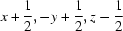
| Symmetry code: (i) x+1/2, −y+1/2, z−1/2. |
Experimental details
| Crystal data | |
| Chemical formula | C4H5N3O2 |
| Mr | 127.11 |
| Crystal system, space group | Monoclinic, P21/n |
| Temperature (K) | 290 |
| a, b, c (Å) | 3.8823 (7), 17.499 (3), 8.8171 (17) |
| β (°) | 100.938 (3) |
| V (Å3) | 588.12 (19) |
| Z | 4 |
| Radiation type | Mo Kα |
| µ (mm−1) | 0.12 |
| Crystal size (mm) | 0.30 × 0.23 × 0.20 |
| Data collection | |
| Diffractometer | Bruker SMART CCD area-detector diffractometer |
| Absorption correction | Multi-scan (SADABS; Bruker, 2004) |
| Tmin, Tmax | 0.956, 0.977 |
| No. of measured, independent and observed [I > 2σ(I)] reflections | 4285, 1098, 917 |
| Rint | 0.016 |
| (sin θ/λ)max (Å−1) | 0.606 |
| Refinement | |
| R[F2 > 2σ(F2)], wR(F2), S | 0.039, 0.116, 1.06 |
| No. of reflections | 1098 |
| No. of parameters | 91 |
| H-atom treatment | H atoms treated by a mixture of independent and constrained refinement |
| Δρmax, Δρmin (e Å−3) | 0.20, −0.12 |
Computer programs: SMART (Bruker, 2004), SAINT (Bruker, 2004), SHELXS97 (Sheldrick, 2008), SHELXL97 (Sheldrick, 2008), ORTEP-3 (Farrugia, 1999) and CAMERON (Watkin et al., 1993), PLATON (Spek, 2003).
| D—H···A | D—H | H···A | D···A | D—H···A |
| N3—H3N···O1i | 0.896 (19) | 1.980 (19) | 2.8659 (19) | 169.56 (18) |
| Symmetry code: (i) x+1/2, −y+1/2, z−1/2. |
Acknowledgements
We thank the Department of Science and Technology, India, for use of the CCD facility set up under the IRHPA–DST program at IISc. We thank Prof T. N. Guru Row, IISc, Bangalore, for useful crystallographic discussions. FNK thanks the DST for Fast Track Proposal funding.
References
 Abu-Orabi, S. T., Alfah, M. A., Jibril, I., Mari'i, F. M. & Ali, A. A. S. (1989). J. Heterocycl. Chem. 26, 1461–1468. CrossRef CAS Google Scholar
Bruker (2004). SMART, SAINT and SADABS. Bruker AXS Inc., Madison, Wisconsin, USA. Google Scholar
Dehne, H. (1994). Methoden der Organischen Chemie, Vol. E8d, edited by E. Schaumann, pp. 305–405. Stuttgart: Thieme. Google Scholar
Fan, W.-Q. & Katritzky, A. R. (1996). Comprehensive Heterocyclic Chemistry II, Vol. 4, edited by A. R. Katritzky, C. W. Rees & E. F. V Scriven, pp. 1–126. Oxford: Pergamon. Google Scholar
Farrugia, L. J. (1999). J. Appl. Cryst. 32, 837–838. CrossRef CAS IUCr Journals Google Scholar
Sheldrick, G. M. (2008). Acta Cryst. A64, 112–122. Web of Science CrossRef CAS IUCr Journals Google Scholar
Spek, A. L. (2003). J. Appl. Cryst. 36, 7–13. Web of Science CrossRef CAS IUCr Journals Google Scholar
Wang, Z., Jian, F., Duan, C., Bai, Z. & You, X. (1998). Acta Cryst. C54, 1927–1929. Web of Science CSD CrossRef CAS IUCr Journals Google Scholar
Watkin, D. J., Pearce, L. & Prout, C. K. (1993). CAMERON. Chemical Crystallography Laboratory, University of Oxford, England. Google Scholar
This is an open-access article distributed under the terms of the Creative Commons Attribution (CC-BY) Licence, which permits unrestricted use, distribution, and reproduction in any medium, provided the original authors and source are cited.
| CRYSTALLOGRAPHIC COMMUNICATIONS |


Triazoles play an important role in pharmaceuticals, agrochemicals, dyes, photographic materials, and in corrosion inhibition (Fan & Katritzky, 1996; Dehne, 1994; Abu-Orabi et al., 1989).
The crystal structure of the title compound is stabilized by intermolecular N—H···O hydrogen bonds and π···π stacking interactions between the triazole rings at (symmetry operator 1+X,Y,Z; centroid-centroid distance 3.882 Å).