 | Acta Crystallographica Section E Acta Crystallographica Section E CRYSTALLOGRAPHIC COMMUNICATIONS |


 journal menu


organic compounds
| CRYSTALLOGRAPHIC COMMUNICATIONS |
 access
Redetermination of 1,4-dimethoxybenzene

aDepartment of Chemistry, Washington and Jefferson College, 60 South Lincoln Street, Washington, PA 15301, USA, and bDepartment of Chemistry, University of Utah, Salt Lake City, UT 84112, USA
*Correspondence e-mail: [email protected]
The structure of the centrosymmetric title compound, C8H10O2, originally determined by Goodwin et al. [Acta Cryst.(1950), 3, 279–284], has been redetermined to modern standards of precision to aid in its use as a model compound for 13C chemical-shift tensor measurements in single-crystal NMR studies. In the crystal structure, a C—H⋯O interaction helps to establish the packing.
Related literature
For previous structural studies of the title compound, see: Goodwin et al. (1950![[Goodwin, T. H., Przybylska, M. & Robertson, J. M. (1950). Acta Cryst. 3, 279-284.]](../../../../../../logos/arrows/e_arr.gif "Goodwin, T. H., Przybylska, M. & Robertson, J. M. (1950). Acta Cryst. 3, 279-284.") ); Carter et al. (1988).
); Carter et al. (1988).
![[Scheme 1]](hb2878scheme1.gif)
Experimental
Crystal data
|
Refinement
|
| |||||||||||||||||
 .
. Data collection: COLLECT (Hooft, 1998); cell refinement: DENZO–SMN (Otwinowski & Minor, 1997); data reduction: DENZO–SMN; program(s) used to solve structure: SIR97 (Altomare et al., 1999); program(s) used to refine structure: SHELXL97 (Sheldrick, 2008); molecular graphics: WinGX (Farrugia, 1999) and ORTEP-3 (Farrugia, 1997); software used to prepare material for publication: publCIF (Westrip, 2009).
Supporting information
contains datablocks I, global. DOI: 10.1107/S1600536808044231/hb2878sup1.cif
Structure factors: contains datablock I. DOI: 10.1107/S1600536808044231/hb2878Isup2.hkl
The H atoms were located in difference maps and their positions and Uiso values were freely refined.
Data collection: COLLECT (Hooft, 1998); cell DENZO–SMN (Otwinowski & Minor, 1997); data reduction: DENZO–SMN (Otwinowski & Minor, 1997); program(s) used to solve structure: SIR97 (Altomare et al., 1999); program(s) used to refine structure: SHELXL97 (Sheldrick, 2008); molecular graphics: WinGX (Farrugia, 1999) and ORTEP-3 (Farrugia, 1997); software used to prepare material for publication: publCIF (Westrip, 2009).
![[Figure 1]](./hb2878fig1thm.gif) | Fig. 1. The structure of (I) according to Goodwin et al. (1950). |
![[Figure 2]](./hb2878fig2thm.gif) | Fig. 2. The redetermined structure of (I) from the present study. |
| C8H10O2 | Dx = 1.231 Mg m−3 |
| Mr = 138.16 | Melting point: 329 K |
| Orthorhombic, Pbca | Mo Kα radiation, λ = 0.71073 Å |
| Hall symbol: -P 2ac 2ab | Cell parameters from 13221 reflections |
| a = 7.1757 (3) Å | θ = 1.0–27.5° |
| b = 6.2769 (2) Å | µ = 0.09 mm−1 |
| c = 16.5573 (7) Å | T = 150 K |
| V = 745.76 (5) Å3 | Prism, colorless |
| Z = 4 | 0.33 × 0.30 × 0.23 mm |
| F(000) = 296 |
| Nonius KappaCCD diffractometer | 847 independent reflections |
| Radiation source: fine-focus sealed tube | 732 reflections with I > 2σ(I) |
| Graphite monochromator | Rint = 0.013 |
| ϕ and ω scans | θmax = 27.5°, θmin = 3.8° |
| Absorption correction: multi-scan (DENZO–SMN; Otwinowski & Minor, 1997) | h = −9→9 |
| Tmin = 0.972, Tmax = 0.980 | k = −8→8 |
| 1510 measured reflections | l = −21→21 |
| Refinement on F2 | Primary atom site location: structure-invariant direct methods |
| Least-squares matrix: full | Secondary atom site location: difference Fourier map |
| R[F2 > 2σ(F2)] = 0.037 | Hydrogen site location: difference Fourier map |
| wR(F2) = 0.101 | All H-atom parameters refined |
| S = 1.09 | w = 1/[σ2(Fo2) + (0.0517P)2 + 0.1487P] where P = (Fo2 + 2Fc2)/3 |
| 847 reflections | (Δ/σ)max < 0.001 |
| 66 parameters | Δρmax = 0.19 e Å−3 |
| 0 restraints | Δρmin = −0.16 e Å−3 |
| none constraints |
| C8H10O2 | V = 745.76 (5) Å3 |
| Mr = 138.16 | Z = 4 |
| Orthorhombic, Pbca | Mo Kα radiation |
| a = 7.1757 (3) Å | µ = 0.09 mm−1 |
| b = 6.2769 (2) Å | T = 150 K |
| c = 16.5573 (7) Å | 0.33 × 0.30 × 0.23 mm |
| Nonius KappaCCD diffractometer | 847 independent reflections |
| Absorption correction: multi-scan (DENZO–SMN; Otwinowski & Minor, 1997) | 732 reflections with I > 2σ(I) |
| Tmin = 0.972, Tmax = 0.980 | Rint = 0.013 |
| 1510 measured reflections |
| R[F2 > 2σ(F2)] = 0.037 | 0 restraints |
| wR(F2) = 0.101 | All H-atom parameters refined |
| S = 1.09 | Δρmax = 0.19 e Å−3 |
| 847 reflections | Δρmin = −0.16 e Å−3 |
| 66 parameters |
Experimental. The program DENZO-SMN (Otwinowski & Minor, 1997) uses a scaling algorithm (Fox & Holmes, 1966) which effectively corrects for absorption effects. High redundancy data were used in the scaling program hence the 'multi-scan' code word was used. No transmission coefficients are available from the program (only scale factors for each frame). The scale factors in the experimental table are calculated from the 'size' command in the SHELXL97 input file. |
Geometry. All e.s.d.'s (except the e.s.d. in the dihedral angle between two l.s. planes) are estimated using the full covariance matrix. The cell e.s.d.'s are taken into account individually in the estimation of e.s.d.'s in distances, angles and torsion angles; correlations between e.s.d.'s in cell parameters are only used when they are defined by crystal symmetry. An approximate (isotropic) treatment of cell e.s.d.'s is used for estimating e.s.d.'s involving l.s. planes. |
Refinement. Refinement of F2 against ALL reflections. The weighted R-factor wR and goodness of fit S are based on F2, conventional R-factors R are based on F, with F set to zero for negative F2. The threshold expression of F2 > 2σ(F2) is used only for calculating R-factors(gt) etc. and is not relevant to the choice of reflections for refinement. R-factors based on F2 are statistically about twice as large as those based on F, and R- factors based on ALL data will be even larger. |
| x | y | z | Uiso*/Ueq | ||
| O1 | 0.01305 (11) | 0.15781 (13) | 0.15601 (4) | 0.0315 (3) | |
| C2 | 0.09537 (13) | −0.10269 (16) | 0.06126 (6) | 0.0257 (3) | |
| C3 | −0.09472 (14) | 0.18955 (17) | 0.01604 (6) | 0.0264 (3) | |
| C1 | 0.00160 (12) | 0.08587 (17) | 0.07767 (6) | 0.0243 (3) | |
| C4 | −0.0849 (2) | 0.3490 (2) | 0.17534 (8) | 0.0410 (3) | |
| H2 | 0.1619 (17) | −0.175 (2) | 0.1048 (8) | 0.033 (3)* | |
| H3 | −0.1604 (18) | 0.319 (2) | 0.0253 (7) | 0.031 (3)* | |
| H4A | −0.061 (2) | 0.375 (2) | 0.2352 (10) | 0.050 (4)* | |
| H4B | −0.221 (3) | 0.323 (2) | 0.1672 (9) | 0.057 (5)* | |
| H4C | −0.036 (2) | 0.470 (3) | 0.1413 (11) | 0.056 (4)* |
| U11 | U22 | U33 | U12 | U13 | U23 | |
| O1 | 0.0387 (5) | 0.0328 (5) | 0.0231 (4) | 0.0040 (3) | −0.0018 (3) | −0.0031 (3) |
| C2 | 0.0249 (5) | 0.0268 (5) | 0.0255 (5) | 0.0015 (4) | −0.0017 (4) | 0.0043 (4) |
| C3 | 0.0259 (5) | 0.0244 (5) | 0.0288 (6) | 0.0029 (4) | 0.0012 (4) | 0.0014 (4) |
| C1 | 0.0241 (5) | 0.0267 (5) | 0.0220 (5) | −0.0028 (4) | 0.0012 (3) | 0.0007 (4) |
| C4 | 0.0534 (8) | 0.0377 (7) | 0.0321 (6) | 0.0092 (6) | −0.0004 (5) | −0.0104 (5) |
| O1—C1 | 1.3759 (12) | C3—C1 | 1.3937 (14) |
| O1—C4 | 1.4269 (14) | C3—H3 | 0.953 (13) |
| C2—C1 | 1.3883 (15) | C4—H4A | 1.020 (16) |
| C2—C3i | 1.3912 (15) | C4—H4B | 0.998 (18) |
| C2—H2 | 0.977 (13) | C4—H4C | 1.010 (18) |
| C3—C2i | 1.3912 (15) | ||
| C1—O1—C4 | 117.26 (9) | O1—C1—C3 | 124.51 (10) |
| C1—C2—C3i | 120.83 (9) | C2—C1—C3 | 119.68 (10) |
| C1—C2—H2 | 119.4 (7) | O1—C4—H4A | 105.8 (8) |
| C3i—C2—H2 | 119.8 (7) | O1—C4—H4B | 108.4 (9) |
| C2i—C3—C1 | 119.48 (10) | H4A—C4—H4B | 108.8 (12) |
| C2i—C3—H3 | 118.7 (8) | O1—C4—H4C | 109.7 (9) |
| C1—C3—H3 | 121.8 (8) | H4A—C4—H4C | 111.2 (12) |
| O1—C1—C2 | 115.81 (9) | H4B—C4—H4C | 112.6 (12) |
| C4—O1—C1—C2 | −178.76 (10) | C3i—C2—C1—C3 | 0.10 (16) |
| C4—O1—C1—C3 | 1.69 (15) | C2i—C3—C1—O1 | 179.44 (9) |
| C3i—C2—C1—O1 | −179.47 (9) | C2i—C3—C1—C2 | −0.10 (16) |
| Symmetry code: (i) −x, −y, −z. |
| D—H···A | D—H | H···A | D···A | D—H···A |
| C4—H4A···O1ii | 1.019 (16) | 2.552 (15) | 3.4381 (15) | 145.1 (10) |
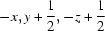
| Symmetry code: (ii) −x, y+1/2, −z+1/2. |
Experimental details
| Crystal data | |
| Chemical formula | C8H10O2 |
| Mr | 138.16 |
| Crystal system, space group | Orthorhombic, Pbca |
| Temperature (K) | 150 |
| a, b, c (Å) | 7.1757 (3), 6.2769 (2), 16.5573 (7) |
| V (Å3) | 745.76 (5) |
| Z | 4 |
| Radiation type | Mo Kα |
| µ (mm−1) | 0.09 |
| Crystal size (mm) | 0.33 × 0.30 × 0.23 |
| Data collection | |
| Diffractometer | Nonius KappaCCD diffractometer |
| Absorption correction | Multi-scan (DENZO–SMN; Otwinowski & Minor, 1997) |
| Tmin, Tmax | 0.972, 0.980 |
| No. of measured, independent and observed [I > 2σ(I)] reflections | 1510, 847, 732 |
| Rint | 0.013 |
| (sin θ/λ)max (Å−1) | 0.649 |
| Refinement | |
| R[F2 > 2σ(F2)], wR(F2), S | 0.037, 0.101, 1.09 |
| No. of reflections | 847 |
| No. of parameters | 66 |
| H-atom treatment | All H-atom parameters refined |
| Δρmax, Δρmin (e Å−3) | 0.19, −0.16 |
Computer programs: COLLECT (Hooft, 1998), DENZO–SMN (Otwinowski & Minor, 1997), SIR97 (Altomare et al., 1999), SHELXL97 (Sheldrick, 2008), WinGX (Farrugia, 1999) and ORTEP-3 (Farrugia, 1997), publCIF (Westrip, 2009).
| D—H···A | D—H | H···A | D···A | D—H···A |
| C4—H4A···O1i | 1.019 (16) | 2.552 (15) | 3.4381 (15) | 145.1 (10) |
| Symmetry code: (i) −x, y+1/2, −z+1/2. |
Acknowledgements
This work was supported by NSF grant ECC0304433 and NIH grant 5R01GM08521-44. Financial support for CLH was provided by Presidential Discretionary Funds from Washington and Jefferson College.
References
 Altomare, A., Burla, M. C., Camalli, M., Cascarano, G. L., Giacovazzo, C., Guagliardi, A., Moliterni, A. G. G., Polidori, G. & Spagna, R. (1999). J. Appl. Cryst. 32, 115–119. Web of Science CrossRef CAS IUCr Journals Google Scholar
Carter, C. M., Facelli, J. C., Alderman, D. W., Grant, D. M., Dalley, N. K. & Wilson, B. E. (1988). J. Chem. Soc. Faraday Trans. 1, 84, 3673–3690. Google Scholar
Farrugia, L. J. (1997). J. Appl. Cryst. 30, 565. CrossRef IUCr Journals Google Scholar
Farrugia, L. J. (1999). J. Appl. Cryst. 32, 837–838. CrossRef CAS IUCr Journals Google Scholar
Goodwin, T. H., Przybylska, M. & Robertson, J. M. (1950). Acta Cryst. 3, 279–284. CSD CrossRef CAS IUCr Journals Web of Science Google Scholar
Hooft, R. W. W. (1998). COLLECT. Nonius BV, Delft, The Netherlands. Google Scholar
Otwinowski, Z. & Minor, W. (1997). Methods in Enzymology, Vol. 276, Macromolecular Crystallography, Part A, edited by C. W. Carter Jr & R. M. Sweet, pp. 307–326. New York: Academic Press. Google Scholar
Sheldrick, G. M. (2008). Acta Cryst. A64, 112–122. Web of Science CrossRef CAS IUCr Journals Google Scholar
Westrip, S. P. (2009). publCIF. In preparation. Google Scholar
This is an open-access article distributed under the terms of the Creative Commons Attribution (CC-BY) Licence, which permits unrestricted use, distribution, and reproduction in any medium, provided the original authors and source are cited.
| CRYSTALLOGRAPHIC COMMUNICATIONS |


Large single-crystals of organic compounds can be challenging to grow. Substituted methoxybenzenes are one exception and single-crystals on the order of centimeters can be obtained. The ease of crystal growth has enabled substituted methoxybenzenes to be studied by single-crystal NMR experiments. Pioneering work on the development of the two-dimensional single-crystal chemical-shift chemical-shift correlation NMR experiments utilized large crystals of 1,4-dimethoxybenzene (Carter et al., 1988). In 1950 Goodwin et al. obtained the first X-ray diffraction structure for 1,4-dimethoxybenzene. This structure (R-factor = 0.12) is shown in Fig. 1 and reported an unusual H–C–C angle of 75.7°, which prompted the acquisition of a second structure (Carter et al., 1988). More typical H–C–C angles were observed with this new refinement and this structure (R-factor = 0.067) was used to assign tensor orientations in the single-crystal NMR analysis. Inadvertently, the second structure was never submitted to the Cambridge Crystallographic database. Here, the acquisition of a third structure is reported to correct this oversight. The new structure (R-factor = 0.038) is shown in Fig. 2. The unit-cell and space group of the previous studies are confirmed.
Acquisition of this third, more accurate, structure is beneficial to NMR studies because the 13C chemical shift tensor data of 1,4-dimethoxybenzene continue to serve as a standard to evaluate new chemical-shift tensor measurement methods as well as to assess electronic structure methods for computing magnetic properties of molecules.