 | Acta Crystallographica Section E Acta Crystallographica Section E CRYSTALLOGRAPHIC COMMUNICATIONS |


 journal menu


organic compounds
| CRYSTALLOGRAPHIC COMMUNICATIONS |
 access
Redetermination of 2,6-dimethoxybenzoic acid

aChemistry Department, "Sapienza" University of Rome, P.le A. Moro, 5, I-00185 Rome, Italy
*Correspondence e-mail: [email protected]
The of the title compound, C9H10O4, was first reported by Swaminathan, Vimala & Lotter [Acta Cryst. (1976), B32, 1897–1900]. It has been re-examined, improving the precision of the derived geometric parameters. The asymmetric unit comprises a non-planar independent molecule, as the methoxy substituents force the carboxy group to be twisted away from the plane of the aromatic ring by 56.12 (9)°. Due to the antiplanar conformation adopted by the OH group, the molecular components do not form the conventional dimeric units, but are associated in the crystal in chains stabilized by linear O—H⋯O hydrogen bonds, involving the OH groups and the carbonyl O atoms, which form C(3) motifs.
Related literature
For previous structure determinations, see: Swaminathan et al. (1976![[Swaminathan, S., Vimala, T. M. & Lotter, H. (1976). Acta Cryst. B32, 1897-1900.]](../../../../../../logos/arrows/e_arr.gif "Swaminathan, S., Vimala, T. M. & Lotter, H. (1976). Acta Cryst. B32, 1897-1900.") ); Bryan & White (1982). For related literature, see: Gopalakrishna & Cartz, 1972; Leiserowitz, 1976; Byriel et al., 1991; Chen et al., 2007. For computation of ring patterns formed by hydrogen bonds in crystal structures, see: Etter et al. (1990); Bernstein et al. (1995); Motherwell et al. (1999). For a description of the Cambridge Structural Database, see: Allen (2002).
); Bryan & White (1982). For related literature, see: Gopalakrishna & Cartz, 1972; Leiserowitz, 1976; Byriel et al., 1991; Chen et al., 2007. For computation of ring patterns formed by hydrogen bonds in crystal structures, see: Etter et al. (1990); Bernstein et al. (1995); Motherwell et al. (1999). For a description of the Cambridge Structural Database, see: Allen (2002).
![[Scheme 1]](kp2203scheme1.gif)
Experimental
Crystal data
|
Refinement
|
| |||||||||||||||||
 .
. Data collection: CrysAlis CCD (Oxford Diffraction, 2006); cell refinement: CrysAlis RED (Oxford Diffraction, 2006); data reduction: CrysAlis RED; program(s) used to solve structure: SIR97 (Altomare et al., 1999); program(s) used to refine structure: SHELXL97 (Sheldrick, 2008); molecular graphics: ORTEP-3 (Farrugia, 1997); software used to prepare material for publication: WinGX (Farrugia, 1999).
Supporting information
contains datablocks global, I. DOI: 10.1107/S1600536809001408/kp2203sup1.cif
Structure factors: contains datablock I. DOI: 10.1107/S1600536809001408/kp2203Isup2.hkl
2,6-Dimethoxybenzoic acid (0.1 mmol, Sigma Aldrich at 99% purity) was dissolved in ethanol (95%, 9 mL) and gently heated under reflux for 1 h. After cooling the solution to an ambient temperature, crystals suitable for single-crystal X-ray diffraction were grown by slow evaporation of the solvent after two days.
All H atoms were found in a difference map and then treated as riding atoms, with C—H = 0.97 (phenyl) and 0.96–0.98 Å (methyl); their Uiso values were kept equal to 1.2Ueq(C, phenyl). and to 1.5Ueq(C, methyl). The remaining H atom of the carboxy group was freely refined. In the absence of significant in this light-atom study, Friedel pairs were merged.
Data collection: CrysAlis CCD (Oxford Diffraction, 2006); cell CrysAlis RED (Oxford Diffraction, 2006); data reduction: CrysAlis RED (Oxford Diffraction, 2006); program(s) used to solve structure: SIR97 (Altomare et al., 1999); program(s) used to refine structure: SHELXL97 (Sheldrick, 2008); molecular graphics: ORTEP-3 (Farrugia, 1997); software used to prepare material for publication: WinGX (Farrugia, 1999).
![[Figure 1]](./kp2203fig1thm.gif) | Fig. 1. The molecular structure of (I) showing the atom-labelling scheme. Displacements ellipsoids are at the 50% probability level. |
![[Figure 2]](./kp2203fig2thm.gif) | Fig. 2. Crystal packing diagram for (I) viewed approximately down b. All atoms are shown as small spheres of arbitrary radii. For the sake of clarity, H atoms not involved in hydrogen bonding have been omitted. Hydrogen bonding is indicated by dashed lines. |
| C9H10O4 | F(000) = 384 |
| Mr = 182.17 | Dx = 1.380 Mg m−3 |
| Orthorhombic, P212121 | Mo Kα radiation, λ = 0.71073 Å |
| Hall symbol: P 2ac 2ab | Cell parameters from 75565 reflections |
| a = 7.12255 (13) Å | θ = 2.7–32.6° |
| b = 8.92296 (15) Å | µ = 0.11 mm−1 |
| c = 13.79430 (18) Å | T = 298 K |
| V = 876.69 (2) Å3 | Tablets, colourless |
| Z = 4 | 0.12 × 0.10 × 0.10 mm |
| Oxford Diffraction Xcalibur S CCD diffractometer | 1246 independent reflections |
| Radiation source: Enhance (Mo) X-ray Source | 1241 reflections with I > 2σ(I) |
| Graphite monochromator | Rint = 0.039 |
| Detector resolution: 16.0696 pixels mm-1 | θmax = 28.0°, θmin = 2.7° |
| ω and ϕ scans | h = −9→9 |
| Absorption correction: multi-scan (CrysAlis RED; Oxford Diffraction, 2006) | k = −11→11 |
| Tmin = 0.967, Tmax = 0.999 | l = −18→18 |
| 234729 measured reflections |
| Refinement on F2 | Primary atom site location: structure-invariant direct methods |
| Least-squares matrix: full | Secondary atom site location: difference Fourier map |
| R[F2 > 2σ(F2)] = 0.042 | Hydrogen site location: inferred from neighbouring sites |
| wR(F2) = 0.110 | H atoms treated by a mixture of independent and constrained refinement |
| S = 1.25 | w = 1/[σ2(Fo2) + (0.059P)2 + 0.1016P] where P = (Fo2 + 2Fc2)/3 |
| 1246 reflections | (Δ/σ)max < 0.001 |
| 129 parameters | Δρmax = 0.17 e Å−3 |
| 0 restraints | Δρmin = −0.20 e Å−3 |
| C9H10O4 | V = 876.69 (2) Å3 |
| Mr = 182.17 | Z = 4 |
| Orthorhombic, P212121 | Mo Kα radiation |
| a = 7.12255 (13) Å | µ = 0.11 mm−1 |
| b = 8.92296 (15) Å | T = 298 K |
| c = 13.79430 (18) Å | 0.12 × 0.10 × 0.10 mm |
| Oxford Diffraction Xcalibur S CCD diffractometer | 1246 independent reflections |
| Absorption correction: multi-scan (CrysAlis RED; Oxford Diffraction, 2006) | 1241 reflections with I > 2σ(I) |
| Tmin = 0.967, Tmax = 0.999 | Rint = 0.039 |
| 234729 measured reflections |
| R[F2 > 2σ(F2)] = 0.042 | 0 restraints |
| wR(F2) = 0.110 | H atoms treated by a mixture of independent and constrained refinement |
| S = 1.25 | Δρmax = 0.17 e Å−3 |
| 1246 reflections | Δρmin = −0.20 e Å−3 |
| 129 parameters |
Experimental. CrysAlis RED (Oxford Diffraction, 2008) Version 1.171.32.15 (release 10-01-2008 CrysAlis171 .NET) (compiled Jan 10 2008,16:37:18) Empirical absorption correction using spherical harmonics, implemented in SCALE3 ABSPACK scaling algorithm. |
Geometry. All e.s.d.'s (except the e.s.d. in the dihedral angle between two l.s. planes) are estimated using the full covariance matrix. The cell e.s.d.'s are taken into account individually in the estimation of e.s.d.'s in distances, angles and torsion angles; correlations between e.s.d.'s in cell parameters are only used when they are defined by crystal symmetry. An approximate (isotropic) treatment of cell e.s.d.'s is used for estimating e.s.d.'s involving l.s. planes. |
Refinement. Refinement of F2 against ALL reflections. The weighted R-factor wR and goodness of fit S are based on F2, conventional R-factors R are based on F, with F set to zero for negative F2. The threshold expression of F2 > σ(F2) is used only for calculating R-factors(gt) etc. and is not relevant to the choice of reflections for refinement. R-factors based on F2 are statistically about twice as large as those based on F, and R- factors based on ALL data will be even larger. |
| x | y | z | Uiso*/Ueq | ||
| O1 | −0.0502 (3) | 0.05267 (15) | 0.21547 (10) | 0.0450 (4) | |
| O2 | −0.0480 (3) | −0.18967 (17) | 0.19834 (12) | 0.0488 (4) | |
| H2 | −0.005 (6) | −0.272 (4) | 0.224 (2) | 0.080 (11)* | |
| O3 | 0.3469 (2) | −0.20799 (17) | 0.23289 (11) | 0.0456 (4) | |
| O4 | −0.1001 (2) | 0.03782 (19) | 0.42166 (10) | 0.0523 (4) | |
| C1 | 0.1298 (3) | −0.08417 (18) | 0.33092 (12) | 0.0313 (4) | |
| C2 | 0.3031 (3) | −0.1561 (2) | 0.32308 (14) | 0.0357 (4) | |
| C3 | 0.4215 (3) | −0.1652 (3) | 0.40281 (17) | 0.0499 (5) | |
| H3 | 0.5420 | −0.2152 | 0.3977 | 0.067 (8)* | |
| C4 | 0.3658 (4) | −0.1025 (3) | 0.48919 (17) | 0.0561 (6) | |
| H4 | 0.4487 | −0.1092 | 0.5448 | 0.077 (9)* | |
| C5 | 0.1956 (4) | −0.0304 (3) | 0.49927 (14) | 0.0501 (6) | |
| H5 | 0.1605 | 0.0144 | 0.5607 | 0.050 (7)* | |
| C6 | 0.0752 (3) | −0.0228 (2) | 0.42020 (13) | 0.0379 (4) | |
| C7 | 0.0046 (3) | −0.06772 (19) | 0.24441 (13) | 0.0324 (4) | |
| C8 | 0.4849 (4) | −0.3237 (3) | 0.2261 (2) | 0.0635 (7) | |
| H8A | 0.609 | −0.2823 | 0.2415 | 0.095* | |
| H8B | 0.486 | −0.364 | 0.1600 | 0.095* | |
| H8C | 0.4545 | −0.4040 | 0.2722 | 0.095* | |
| C9 | −0.1665 (5) | 0.1023 (4) | 0.5097 (2) | 0.0737 (9) | |
| H9A | −0.088 | 0.186 | 0.5271 | 0.111* | |
| H9B | −0.163 | 0.0284 | 0.5603 | 0.111* | |
| H9C | −0.293 | 0.136 | 0.5010 | 0.111* |
| U11 | U22 | U33 | U12 | U13 | U23 | |
| O1 | 0.0636 (10) | 0.0332 (7) | 0.0383 (7) | 0.0092 (7) | −0.0096 (7) | 0.0031 (6) |
| O2 | 0.0596 (9) | 0.0361 (8) | 0.0508 (8) | 0.0029 (7) | −0.0232 (8) | −0.0080 (7) |
| O3 | 0.0458 (8) | 0.0453 (8) | 0.0458 (8) | 0.0111 (7) | 0.0029 (7) | −0.0009 (7) |
| O4 | 0.0604 (10) | 0.0590 (9) | 0.0374 (7) | 0.0120 (8) | 0.0070 (7) | −0.0056 (7) |
| C1 | 0.0411 (9) | 0.0241 (7) | 0.0287 (7) | −0.0036 (7) | −0.0042 (7) | 0.0020 (6) |
| C2 | 0.0387 (9) | 0.0293 (8) | 0.0392 (9) | −0.0036 (7) | −0.0016 (8) | 0.0048 (7) |
| C3 | 0.0438 (11) | 0.0493 (11) | 0.0566 (12) | −0.0013 (10) | −0.0146 (10) | 0.0096 (10) |
| C4 | 0.0653 (15) | 0.0587 (13) | 0.0442 (11) | −0.0136 (13) | −0.0232 (11) | 0.0081 (11) |
| C5 | 0.0726 (16) | 0.0481 (11) | 0.0297 (9) | −0.0132 (11) | −0.0051 (10) | 0.0000 (9) |
| C6 | 0.0495 (11) | 0.0309 (8) | 0.0333 (8) | −0.0061 (8) | 0.0014 (8) | 0.0026 (7) |
| C7 | 0.0379 (8) | 0.0299 (8) | 0.0295 (7) | 0.0028 (7) | −0.0014 (7) | 0.0002 (7) |
| C8 | 0.0588 (14) | 0.0612 (15) | 0.0704 (16) | 0.0217 (13) | 0.0115 (14) | 0.0042 (14) |
| C9 | 0.083 (2) | 0.0840 (19) | 0.0544 (14) | 0.0126 (18) | 0.0152 (15) | −0.0216 (14) |
| O1—C7 | 1.211 (2) | C3—H3 | 0.9700 |
| O2—C7 | 1.314 (2) | C4—C5 | 1.379 (4) |
| O2—H2 | 0.87 (4) | C4—H4 | 0.9700 |
| O3—C2 | 1.364 (2) | C5—C6 | 1.389 (3) |
| O3—C8 | 1.429 (3) | C5—H5 | 0.9700 |
| O4—C6 | 1.361 (3) | C8—H8A | 0.9819 |
| O4—C9 | 1.424 (3) | C8—H8B | 0.9819 |
| C1—C2 | 1.395 (3) | C8—H8C | 0.9819 |
| C1—C6 | 1.403 (2) | C9—H9A | 0.9607 |
| C1—C7 | 1.497 (2) | C9—H9B | 0.9607 |
| C2—C3 | 1.388 (3) | C9—H9C | 0.9607 |
| C3—C4 | 1.375 (4) | ||
| C7—O2—H2 | 114 (2) | O4—C6—C5 | 125.03 (19) |
| C2—O3—C8 | 117.56 (18) | O4—C6—C1 | 114.99 (17) |
| C6—O4—C9 | 118.6 (2) | C5—C6—C1 | 120.0 (2) |
| C2—C1—C6 | 119.51 (17) | O1—C7—O2 | 118.91 (17) |
| C2—C1—C7 | 120.69 (16) | O1—C7—C1 | 122.81 (16) |
| C6—C1—C7 | 119.77 (17) | O2—C7—C1 | 118.28 (15) |
| O3—C2—C3 | 124.32 (19) | O3—C8—H8A | 109.5 |
| O3—C2—C1 | 115.42 (16) | O3—C8—H8B | 109.5 |
| C3—C2—C1 | 120.20 (18) | H8A—C8—H8B | 109.5 |
| C4—C3—C2 | 119.2 (2) | O3—C8—H8C | 109.5 |
| C4—C3—H3 | 120.4 | H8A—C8—H8C | 109.5 |
| C2—C3—H3 | 120.4 | H8B—C8—H8C | 109.5 |
| C3—C4—C5 | 122.1 (2) | O4—C9—H9A | 109.5 |
| C3—C4—H4 | 119.0 | O4—C9—H9B | 109.5 |
| C5—C4—H4 | 119.0 | H9A—C9—H9B | 109.5 |
| C4—C5—C6 | 119.1 (2) | O4—C9—H9C | 109.5 |
| C4—C5—H5 | 120.5 | H9A—C9—H9C | 109.5 |
| C6—C5—H5 | 120.5 | H9B—C9—H9C | 109.5 |
| C8—O3—C2—C3 | 23.9 (3) | C9—O4—C6—C1 | 179.9 (2) |
| C8—O3—C2—C1 | −159.0 (2) | C4—C5—C6—O4 | 176.4 (2) |
| C6—C1—C2—O3 | −177.98 (16) | C4—C5—C6—C1 | −1.9 (3) |
| C7—C1—C2—O3 | 0.1 (2) | C2—C1—C6—O4 | −176.68 (16) |
| C6—C1—C2—C3 | −0.7 (3) | C7—C1—C6—O4 | 5.2 (2) |
| C7—C1—C2—C3 | 177.33 (18) | C2—C1—C6—C5 | 1.7 (3) |
| O3—C2—C3—C4 | 176.9 (2) | C7—C1—C6—C5 | −176.37 (17) |
| C1—C2—C3—C4 | −0.1 (3) | C2—C1—C7—O1 | −122.8 (2) |
| C2—C3—C4—C5 | −0.1 (4) | C6—C1—C7—O1 | 55.3 (3) |
| C3—C4—C5—C6 | 1.0 (4) | C2—C1—C7—O2 | 57.4 (3) |
| C9—O4—C6—C5 | 1.6 (3) | C6—C1—C7—O2 | −124.5 (2) |
| D—H···A | D—H | H···A | D···A | D—H···A |
| O2—H2···O1i | 0.87 (4) | 1.82 (4) | 2.681 (2) | 172 (4) |
| Symmetry code: (i) −x, y−1/2, −z+1/2. |
Experimental details
| Crystal data | |
| Chemical formula | C9H10O4 |
| Mr | 182.17 |
| Crystal system, space group | Orthorhombic, P212121 |
| Temperature (K) | 298 |
| a, b, c (Å) | 7.12255 (13), 8.92296 (15), 13.79430 (18) |
| V (Å3) | 876.69 (2) |
| Z | 4 |
| Radiation type | Mo Kα |
| µ (mm−1) | 0.11 |
| Crystal size (mm) | 0.12 × 0.10 × 0.10 |
| Data collection | |
| Diffractometer | Oxford Diffraction Xcalibur S CCD diffractometer |
| Absorption correction | Multi-scan (CrysAlis RED; Oxford Diffraction, 2006) |
| Tmin, Tmax | 0.967, 0.999 |
| No. of measured, independent and observed [I > 2σ(I)] reflections | 234729, 1246, 1241 |
| Rint | 0.039 |
| (sin θ/λ)max (Å−1) | 0.660 |
| Refinement | |
| R[F2 > 2σ(F2)], wR(F2), S | 0.042, 0.110, 1.25 |
| No. of reflections | 1246 |
| No. of parameters | 129 |
| H-atom treatment | H atoms treated by a mixture of independent and constrained refinement |
| Δρmax, Δρmin (e Å−3) | 0.17, −0.20 |
Computer programs: CrysAlis CCD (Oxford Diffraction, 2006), CrysAlis RED (Oxford Diffraction, 2006), SIR97 (Altomare et al., 1999), SHELXL97 (Sheldrick, 2008), ORTEP-3 (Farrugia, 1997), WinGX (Farrugia, 1999).
| D—H···A | D—H | H···A | D···A | D—H···A |
| O2—H2···O1i | 0.87 (4) | 1.82 (4) | 2.681 (2) | 172 (4) |
| Symmetry code: (i) −x, y−1/2, −z+1/2. |
Acknowledgements
We thank MIUR (Rome) for 2006 financial support of the project `X-ray diffractometry and spectrometry'.
References
 Allen, F. H. (2002). Acta Cryst. B58, 380–388. Web of Science CrossRef CAS IUCr Journals Google Scholar
Altomare, A., Burla, M. C., Camalli, M., Cascarano, G. L., Giacovazzo, C., Guagliardi, A., Moliterni, A. G. G., Polidori, G. & Spagna, R. (1999). J. Appl. Cryst. 32, 115–119. Web of Science CrossRef CAS IUCr Journals Google Scholar
Bernstein, J., Davis, R. E., Shimoni, L. & Chang, N.-L. (1995). Angew. Chem. Int. Ed. Engl. 34, 1555–1573. CrossRef CAS Web of Science Google Scholar
Bryan, R. F. & White, D. H. (1982). Acta Cryst. B38, 1014–1016. CSD CrossRef CAS Web of Science IUCr Journals Google Scholar
Byriel, K. A., Lynch, D. E., Smith, G. & Kennard, C. H. L. (1991). Aust. J. Chem. 44, 1459–1464. CrossRef CAS Google Scholar
Chen, Q., Qin, J.-K., Zeng, M.-H. & Ng, S. W. (2007). Acta Cryst. E63, o453–o454. Web of Science CSD CrossRef IUCr Journals Google Scholar
Etter, M. C., MacDonald, J. C. & Bernstein, J. (1990). Acta Cryst. B46, 256–262. CrossRef CAS Web of Science IUCr Journals Google Scholar
Farrugia, L. J. (1997). J. Appl. Cryst. 30, 565. CrossRef IUCr Journals Google Scholar
Farrugia, L. J. (1999). J. Appl. Cryst. 32, 837–838. CrossRef CAS IUCr Journals Google Scholar
Gopalakrishna, E. M. & Cartz, L. (1972). Acta Cryst. B28, 2917–2924. CSD CrossRef CAS IUCr Journals Web of Science Google Scholar
Leiserowitz, L. (1976). Acta Cryst. B32, 775–802. CrossRef CAS IUCr Journals Web of Science Google Scholar
Motherwell, W. D. S., Shields, G. P. & Allen, F. H. (1999). Acta Cryst. B55, 1044–1056. Web of Science CrossRef CAS IUCr Journals Google Scholar
Oxford Diffraction (2006). CrysAlis CCD and CrysAlis RED. Oxford Diffraction Ltd, Abingdon, England. Google Scholar
Sheldrick, G. M. (2008). Acta Cryst. A64, 112–122. Web of Science CrossRef CAS IUCr Journals Google Scholar
Swaminathan, S., Vimala, T. M. & Lotter, H. (1976). Acta Cryst. B32, 1897–1900. CSD CrossRef CAS IUCr Journals Web of Science Google Scholar
This is an open-access article distributed under the terms of the Creative Commons Attribution (CC-BY) Licence, which permits unrestricted use, distribution, and reproduction in any medium, provided the original authors and source are cited.
| CRYSTALLOGRAPHIC COMMUNICATIONS |


2,6-Dimethoxybenzoic acid was determined some 30 years ago (Swaminathan et al., 1976) but the final refinement was carried only to R=0.15 and no atomic coordinates were provided. Subsequently, a new X-ray structure determination was reported (Bryan & White, 1982). In this study, 775 unique reflections were collected at ambient temperature on an automatic diffractometer using Cu Kα radiation. Data were corrected for Lp effects, but not for absorption [µ(Cu Kα)= 94 mm-1]. 708 reflections having values significantly above background were used in the block-diagonal least-squares refinement. The final calculations, carried out on a fairly small data set, led to R = 0.035 for 158 refined parameters, a data-to-parameter ratio of 4.5, the maximum shift-to-error in the final cycle being equal to 1/4, and standard deviations of 0.005Å in C—C bond lengths and 0.4° in bond angles.
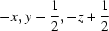
The asymmetric unit of (I) comprises a non-planar independent molecule, as the methoxy substituents force the carboxy group to be twisted away from the plane of the aromatic ring by 56.12 (9)° (Fig. 1). The values of bond lengths and bond angles are consistent with that reported in the previous determination (Bryan & White, 1982) with the exception of the geometrical parameters of the carboxy group. Analysis of the crystal packing of (I), (Table 1, Fig. 2) shows that the molecular components do not form the conventional dimeric units observed in monocarboylic acids (Leiserowitz, 1976). The structure is stabilized by intermolecular O—H···O interactions of descriptor C(3) (Etter et al., 1990; Bernstein et al., 1995; Motherwell et al., 1999) (Table 1, Fig. 2) between the OH moieties and the carbonyl O atom (O1i) [symmetry code: (i) -x, y - 1/2, -z + 1/2] which link the molecules into endless chains approximately parallel to b. A search of the Cambridge Structural Database (version 5.29; Allen, 2002) for crystal structures containing the o-methoxy benzoic acid residue yields only three structures having the OH group in the unusual antiplanar conformation (Gopalakrishna & Cartz, 1972; Byriel et al., 1991; Chen et al., 2007). For these compounds, the antiplanar conformation is favoured by the formation of intramolecular hydrogen bonding.