 | Acta Crystallographica Section E Acta Crystallographica Section E CRYSTALLOGRAPHIC COMMUNICATIONS |


 journal menu


inorganic compounds
| CRYSTALLOGRAPHIC COMMUNICATIONS |
 access
Redetermination of EuScO3

aUniversity of Innsbruck, Institute for Mineralogy and Petrography, Innrain 52, 6020 Innsbruck, Austria, and bLeibniz-Institute for Crystal Growth, Max-Born-Strasse 2, 12489 Berlin, Germany
*Correspondence e-mail: [email protected]
Single crystals of europium(III) scandate(III), with ideal formula EuScO3, were grown from the melt using the micro-pulling-down method. The title compound crystallizes in an orthorhombic distorted perovskite-type structure, where Eu occupies the eightfold coordinated A sites (site symmetry m) and Sc resides on the centres of corner-sharing [ScO6] octahedra (B sites with  ). The structure of EuScO3 has been reported previously based on powder diffraction data [Liferovich & Mitchell (2004). J. Solid State Chem. 177, 2188–2197]. The results of the current redetermination based on single-crystal diffraction data shows an improvement in the precision of the structral and geometric parameters and reveals a defect-type structure. Site-occupancy refinements indicate an Eu deficiency on the A site coupled with O defects on one of the two O-atom positions. The crystallochemical formula of the investigated sample may thus be written as A(□0.032Eu0.968)BScO2.952.
Related literature
Details of the synthesis are described by Maier et al. (2007![[Maier, D., Rhede, D., Bertram, R., Klimm, D. & Fornari, R. (2007). Opt. Mater. 30, 11-14.]](../../../../../../logos/arrows/e_arr.gif "Maier, D., Rhede, D., Bertram, R., Klimm, D. & Fornari, R. (2007). Opt. Mater. 30, 11-14.") ). Rietveld refinements on powders of LnScO3 with Ln = La3+ to Ho3+ are reported by Liferovich & Mitchell (2004). The crystal structures of the Dy, Gd, Sm and Nd members refined from single-crystal diffraction data have been recently provided by Veličkov et al. (2007). The crystal structure of the isotypic TbScO3 is described by Veličkov et al. (2008). Specific geometrical parameters have been calculated by means of the atomic coordinates following the concept of Zhao et al. (1993).
). Rietveld refinements on powders of LnScO3 with Ln = La3+ to Ho3+ are reported by Liferovich & Mitchell (2004). The crystal structures of the Dy, Gd, Sm and Nd members refined from single-crystal diffraction data have been recently provided by Veličkov et al. (2007). The crystal structure of the isotypic TbScO3 is described by Veličkov et al. (2008). Specific geometrical parameters have been calculated by means of the atomic coordinates following the concept of Zhao et al. (1993).
Experimental
Crystal data
|
Refinement
|
|
 ; (ii)
 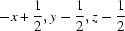 ; (v)
; (v) 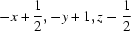 ; (vii)
  .
. Data collection: X-AREA (Stoe & Cie, 2006); cell refinement: X-AREA; data reduction: X-RED (Stoe & Cie, 2006); program(s) used to solve structure: SHELXS97 (Sheldrick, 2008); program(s) used to refine structure: SHELXL97 (Sheldrick, 2008); molecular graphics: ATOMS for Windows (Dowty, 2004); software used to prepare material for publication: SHELXL97.
Supporting information
contains datablocks I, global. DOI: 10.1107/S1600536809001433/wm2214sup1.cif
Structure factors: contains datablock I. DOI: 10.1107/S1600536809001433/wm2214Isup2.hkl
An EuScO3 fiber was grown using a micro-pulling-down apparatus with induction heating (Maier et al., 2007). The starting material was prepared from 4 N Eu2O3 and Sc2O3 powders by grinding a total weight of 5 g in a plastic mortar and pressing the mixture into pellets. An 5 ml iridium crucible with 500 mg of the starting material was placed on an iridium after-heater and heated by the inductor coil of a 10 kW rf Generator. The crucible after-heater arrangement was surrounded by a zirconia fiber tube and a high-purity alumina tube for thermal insulation. The experiments were carried out in a vacuum-tight steel chamber. It was evacuated before each experiment to 5 x10⁻³ mbar and filled with 5 N argon gas. Subsequently, a constant flow of about 900 ml/min was kept. During growth the height of the molten zone and consequently the diameter of the fiber (~1 mm) was carefully controlled by manually increasing or decreasing the rf-power. Several starting compositions with different Eu to Sc ratios were tested, resulting in the optimal batch with 47.5 mol% Eu2O3 and 52.5 mol% Sc2O3.
The grown single-crystal was colourless. A part of the single-crystal fiber was crushed and the irregular shaped fragments were screened using a polarizing light microscope to find a sample of good optical quality for the diffraction experiments.
Site occupation refinements indicated deviations from full occupancy on the Eu1 (A-site) and the O2 sites. For the final cycle a constraint ensuring charge neutrality was included. The crystallochemical formula of the investigated sample can thus be written as A(□0.032Eu0.968)BScO2.952. The highest peak and deepest hole of the difference Fourier map are located 0.84 Å and 1.42 Å away from the Eu1 position. In contrast to the previous where the Pbnm setting of no. 62 was chosen, the standard setting Pnma was used for the present redetermination.
Data collection: X-AREA (Stoe & Cie, 2006); cell X-AREA (Stoe & Cie, 2006); data reduction: X-RED (Stoe & Cie, 2006); program(s) used to solve structure: SHELXS97 (Sheldrick, 2008); program(s) used to refine structure: SHELXL97 (Sheldrick, 2008); molecular graphics: ATOMS for Windows (Dowty, 2004); software used to prepare material for publication: SHELXL97 (Sheldrick, 2008).
![[Figure 1]](./wm2214fig1thm.gif) | Fig. 1. The orthorhombic perovskite structure of EuScO3 is characterized by a tilted corner sharing ScO6 framework incorporating the 8-fold coordinated Eu sites. The ScO6 octahedra are yellow, the Eu atoms are given in grey and the O atoms are presented in red. |
![[Figure 2]](./wm2214fig2thm.gif) | Fig. 2. Projection of the EuScO3 structure along [010], showing the Eu atoms and the Sc coordination with displacement ellipsoids at the 80% probability level. |
| Eu0.968ScO2.952 | F(000) = 422.4 |
| Mr = 239.24 | Dx = 6.307 Mg m−3 |
| Orthorhombic, Pnma | Mo Kα radiation, λ = 0.71073 Å |
| Hall symbol: -P 2ac 2n | Cell parameters from 2218 reflections |
| a = 5.7554 (7) Å | θ = 2.6–29.2° |
| b = 7.9487 (10) Å | µ = 26.28 mm−1 |
| c = 5.5087 (6) Å | T = 293 K |
| V = 252.01 (5) Å3 | Platy fragment, colourless |
| Z = 4 | 0.14 × 0.12 × 0.02 mm |
| Stoe IPDS-2 diffractometer | 362 independent reflections |
| Radiation source: fine-focus sealed tube | 345 reflections with I > 2σ(I) |
| Graphite monochromator | Rint = 0.055 |
| Detector resolution: 6.67 pixels mm-1 | θmax = 29.1°, θmin = 4.5° |
| ω scans | h = −7→7 |
| Absorption correction: analytical (Alcock, 1970) | k = −10→9 |
| Tmin = 0.139, Tmax = 0.397 | l = −7→7 |
| 2168 measured reflections |
| Refinement on F2 | Primary atom site location: structure-invariant direct methods |
| Least-squares matrix: full | Secondary atom site location: difference Fourier map |
| R[F2 > 2σ(F2)] = 0.021 | w = 1/[σ2(Fo2) + (0.0211P)2 + 0.9412P] where P = (Fo2 + 2Fc2)/3 |
| wR(F2) = 0.051 | (Δ/σ)max = 0.011 |
| S = 1.27 | Δρmax = 1.40 e Å−3 |
| 362 reflections | Δρmin = −0.84 e Å−3 |
| 31 parameters | Extinction correction: SHELXL97 (Sheldrick, 2008), Fc*=kFc[1+0.001xFc2λ3/sin(2θ)]-1/4 |
| 1 restraint | Extinction coefficient: 0.113 (5) |
| Eu0.968ScO2.952 | V = 252.01 (5) Å3 |
| Mr = 239.24 | Z = 4 |
| Orthorhombic, Pnma | Mo Kα radiation |
| a = 5.7554 (7) Å | µ = 26.28 mm−1 |
| b = 7.9487 (10) Å | T = 293 K |
| c = 5.5087 (6) Å | 0.14 × 0.12 × 0.02 mm |
| Stoe IPDS-2 diffractometer | 362 independent reflections |
| Absorption correction: analytical (Alcock, 1970) | 345 reflections with I > 2σ(I) |
| Tmin = 0.139, Tmax = 0.397 | Rint = 0.055 |
| 2168 measured reflections |
| R[F2 > 2σ(F2)] = 0.021 | 31 parameters |
| wR(F2) = 0.051 | 1 restraint |
| S = 1.27 | Δρmax = 1.40 e Å−3 |
| 362 reflections | Δρmin = −0.84 e Å−3 |
Geometry. All e.s.d.'s (except the e.s.d. in the dihedral angle between two l.s. planes) are estimated using the full covariance matrix. The cell e.s.d.'s are taken into account individually in the estimation of e.s.d.'s in distances, angles and torsion angles; correlations between e.s.d.'s in cell parameters are only used when they are defined by crystal symmetry. An approximate (isotropic) treatment of cell e.s.d.'s is used for estimating e.s.d.'s involving l.s. planes. |
Refinement. Refinement of F2 against ALL reflections. The weighted R-factor wR and goodness of fit S are based on F2, conventional R-factors R are based on F, with F set to zero for negative F2. The threshold expression of F2 > σ(F2) is used only for calculating R-factors(gt) etc. and is not relevant to the choice of reflections for refinement. R-factors based on F2 are statistically about twice as large as those based on F, and R- factors based on ALL data will be even larger. |
| x | y | z | Uiso*/Ueq | Occ. (<1) | |
| Eu1 | 0.05854 (5) | 0.25 | 0.01589 (6) | 0.0090 (2) | 0.9677 (13) |
| Sc2 | 0 | 0 | 0.5 | 0.0078 (3) | |
| O1 | 0.4506 (8) | 0.25 | 0.8815 (9) | 0.0111 (9) | |
| O2 | 0.1954 (6) | 0.9378 (4) | 0.8078 (6) | 0.0112 (7) | 0.9758 (10) |
| U11 | U22 | U33 | U12 | U13 | U23 | |
| Eu1 | 0.0070 (3) | 0.0102 (3) | 0.0098 (3) | 0 | 0.00051 (11) | 0 |
| Sc2 | 0.0064 (6) | 0.0079 (6) | 0.0090 (6) | 0.0006 (6) | 0.0000 (3) | 0.0000 (3) |
| O1 | 0.011 (2) | 0.008 (2) | 0.014 (2) | 0 | −0.0025 (17) | 0 |
| O2 | 0.0096 (16) | 0.0121 (17) | 0.0119 (14) | −0.0019 (12) | −0.0018 (11) | 0.0005 (12) |
| Eu1—O1i | 2.276 (5) | Sc2—O2ii | 2.094 (3) |
| Eu1—O2ii | 2.304 (3) | Sc2—O2xii | 2.094 (3) |
| Eu1—O2iii | 2.304 (3) | Sc2—O2vi | 2.107 (3) |
| Eu1—O1iv | 2.375 (5) | Sc2—O2xiii | 2.107 (3) |
| Eu1—O2v | 2.611 (3) | Sc2—O1xiv | 2.1108 (16) |
| Eu1—O2vi | 2.611 (3) | Sc2—O1x | 2.1108 (16) |
| Eu1—O2vii | 2.845 (3) | Sc2—Eu1xv | 3.2268 (4) |
| Eu1—O2viii | 2.845 (3) | Sc2—Eu1i | 3.2268 (4) |
| Eu1—Sc2ix | 3.2268 (4) | Sc2—Eu1xvi | 3.3428 (4) |
| Eu1—Sc2x | 3.2268 (4) | Sc2—Eu1xvii | 3.4841 (4) |
| Eu1—Sc2xi | 3.3428 (4) | Sc2—Eu1xviii | 3.4841 (4) |
| Eu1—Sc2 | 3.3428 (4) | ||
| O1i—Eu1—O2ii | 103.43 (12) | O2xii—Sc2—O2vi | 90.88 (6) |
| O1i—Eu1—O2iii | 103.43 (12) | O2ii—Sc2—O2xiii | 90.88 (6) |
| O2ii—Eu1—O2iii | 80.77 (17) | O2xii—Sc2—O2xiii | 89.12 (6) |
| O1i—Eu1—O1iv | 87.69 (11) | O2vi—Sc2—O2xiii | 180 |
| O2ii—Eu1—O1iv | 137.24 (9) | O2ii—Sc2—O1xiv | 87.46 (16) |
| O2iii—Eu1—O1iv | 137.24 (9) | O2xii—Sc2—O1xiv | 92.54 (16) |
| O1i—Eu1—O2v | 137.77 (9) | O2vi—Sc2—O1xiv | 92.67 (15) |
| O2ii—Eu1—O2v | 117.06 (6) | O2xiii—Sc2—O1xiv | 87.33 (15) |
| O2iii—Eu1—O2v | 73.38 (8) | O2ii—Sc2—O1x | 92.54 (16) |
| O1iv—Eu1—O2v | 71.14 (12) | O2xii—Sc2—O1x | 87.46 (16) |
| O1i—Eu1—O2vi | 137.77 (9) | O2vi—Sc2—O1x | 87.33 (15) |
| O2ii—Eu1—O2vi | 73.38 (8) | O2xiii—Sc2—O1x | 92.67 (15) |
| O2iii—Eu1—O2vi | 117.06 (6) | O1xiv—Sc2—O1x | 180 |
| O1iv—Eu1—O2vi | 71.14 (12) | Sc2xix—O1—Sc2xv | 140.6 (2) |
| O2v—Eu1—O2vi | 69.74 (15) | Sc2xix—O1—Eu1xx | 105.10 (13) |
| O1i—Eu1—O2vii | 71.82 (8) | Sc2xv—O1—Eu1xx | 105.10 (13) |
| O2ii—Eu1—O2vii | 77.31 (12) | Sc2xix—O1—Eu1xviii | 91.82 (14) |
| O2iii—Eu1—O2vii | 155.61 (9) | Sc2xv—O1—Eu1xviii | 91.82 (14) |
| O1iv—Eu1—O2vii | 67.12 (8) | Eu1xx—O1—Eu1xviii | 124.0 (2) |
| O2v—Eu1—O2vii | 126.63 (6) | Sc2xxi—O2—Sc2xxii | 143.00 (18) |
| O2vi—Eu1—O2vii | 66.38 (5) | Sc2xxi—O2—Eu1ii | 98.83 (13) |
| O1i—Eu1—O2viii | 71.82 (8) | Sc2xxii—O2—Eu1ii | 117.90 (14) |
| O2ii—Eu1—O2viii | 155.61 (9) | Sc2xxi—O2—Eu1xxii | 85.85 (11) |
| O2iii—Eu1—O2viii | 77.31 (12) | Sc2xxii—O2—Eu1xxii | 89.57 (12) |
| O1iv—Eu1—O2viii | 67.12 (8) | Eu1ii—O2—Eu1xxii | 103.48 (13) |
| O2v—Eu1—O2viii | 66.38 (5) | Sc2xxi—O2—Eu1xxiii | 88.37 (12) |
| O2vi—Eu1—O2viii | 126.63 (6) | Sc2xxii—O2—Eu1xxiii | 79.82 (10) |
| O2vii—Eu1—O2viii | 121.45 (13) | Eu1ii—O2—Eu1xxiii | 102.69 (12) |
| O2ii—Sc2—O2xii | 180 | Eu1xxii—O2—Eu1xxiii | 153.77 (14) |
| O2ii—Sc2—O2vi | 89.12 (6) |
| Symmetry codes: (i) x−1/2, y, −z+1/2; (ii) −x, −y+1, −z+1; (iii) −x, y−1/2, −z+1; (iv) x, y, z−1; (v) −x+1/2, y−1/2, z−1/2; (vi) −x+1/2, −y+1, z−1/2; (vii) x, y−1, z−1; (viii) x, −y+3/2, z−1; (ix) x+1/2, −y+1/2, −z+1/2; (x) −x+1/2, −y, z−1/2; (xi) −x, y+1/2, −z+1; (xii) x, y−1, z; (xiii) x−1/2, y−1, −z+3/2; (xiv) x−1/2, y, −z+3/2; (xv) −x+1/2, −y, z+1/2; (xvi) −x, −y, −z+1; (xvii) −x, −y, −z; (xviii) x, y, z+1; (xix) x+1/2, −y+1/2, −z+3/2; (xx) x+1/2, y, −z+1/2; (xxi) x, y+1, z; (xxii) −x+1/2, −y+1, z+1/2; (xxiii) x, y+1, z+1. |
Experimental details
| Crystal data | |
| Chemical formula | Eu0.968ScO2.952 |
| Mr | 239.24 |
| Crystal system, space group | Orthorhombic, Pnma |
| Temperature (K) | 293 |
| a, b, c (Å) | 5.7554 (7), 7.9487 (10), 5.5087 (6) |
| V (Å3) | 252.01 (5) |
| Z | 4 |
| Radiation type | Mo Kα |
| µ (mm−1) | 26.28 |
| Crystal size (mm) | 0.14 × 0.12 × 0.02 |
| Data collection | |
| Diffractometer | Stoe IPDS2 diffractometer |
| Absorption correction | Analytical (Alcock, 1970) |
| Tmin, Tmax | 0.139, 0.397 |
| No. of measured, independent and observed [I > 2σ(I)] reflections | 2168, 362, 345 |
| Rint | 0.055 |
| (sin θ/λ)max (Å−1) | 0.685 |
| Refinement | |
| R[F2 > 2σ(F2)], wR(F2), S | 0.021, 0.051, 1.27 |
| No. of reflections | 362 |
| No. of parameters | 31 |
| No. of restraints | 1 |
| Δρmax, Δρmin (e Å−3) | 1.40, −0.84 |
Computer programs: X-AREA (Stoe & Cie, 2006), X-RED (Stoe & Cie, 2006), SHELXS97 (Sheldrick, 2008), SHELXL97 (Sheldrick, 2008), ATOMS for Windows (Dowty, 2004).
| Eu1—O1i | 2.276 (5) | Eu1—O2v | 2.845 (3) |
| Eu1—O2ii | 2.304 (3) | Sc2—O2ii | 2.094 (3) |
| Eu1—O1iii | 2.375 (5) | Sc2—O2vi | 2.107 (3) |
| Eu1—O2iv | 2.611 (3) | Sc2—O1vii | 2.1108 (16) |
| Symmetry codes: (i) x−1/2, y, −z+1/2; (ii) −x, −y+1, −z+1; (iii) x, y, z−1; (iv) −x+1/2, y−1/2, z−1/2; (v) x, y−1, z−1; (vi) −x+1/2, −y+1, z−1/2; (vii) x−1/2, y, −z+3/2. |
References
 Alcock, N. W. (1970). Crystallographic Computing, edited by F. R. Ahmed, S. R. Hall & C. P. Huber, p. 271. Copenhagen: Munksgaard. Google Scholar
Dowty, E. (2004). ATOMS for Windows. Shape Software, Kingsport, Tennessee, USA. Google Scholar
Liferovich, R. P. & Mitchell, R. H. (2004). J. Solid State Chem. 177, 2188–2197. Web of Science CrossRef CAS Google Scholar
Maier, D., Rhede, D., Bertram, R., Klimm, D. & Fornari, R. (2007). Opt. Mater. 30, 11–14. Web of Science CrossRef CAS Google Scholar
Sheldrick, G. M. (2008). Acta Cryst. A64, 112–122. Web of Science CrossRef CAS IUCr Journals Google Scholar
Stoe & Cie (2006). X-AREA and X-RED. Stoe & Cie, Darmstadt, Germany. Google Scholar
Veličkov, B., Kahlenberg, V., Bertram, R. & Bernhagen, M. (2007). Z. Kristallogr. 222, 466–473. Google Scholar
Veličkov, B., Kahlenberg, V., Bertram, R. & Uecker, R. (2008). Acta Cryst. E64, i79. Web of Science CrossRef IUCr Journals Google Scholar
Zhao, Y., Weidner, D. J., Parise, J. B. & Cox, D. E. (1993). Phys. Earth Planet. Inter., 76, 1–16. CrossRef CAS Web of Science Google Scholar
This is an open-access article distributed under the terms of the Creative Commons Attribution (CC-BY) Licence, which permits unrestricted use, distribution, and reproduction in any medium, provided the original authors and source are cited.
| CRYSTALLOGRAPHIC COMMUNICATIONS |


Liferovich & Mitchell (2004) studied the crystal structure of lanthanoid scandates, including EuScO3, by Rietveld analysis from powder diffraction data. Crystallographic data of DyScO3, GdScO3, SmScO3 and NdScO3 obtained from single crystals were recently reported by Veličkov et al. (2007), and for TbScO3 by Veličkov et al. (2008). Based on these results it was possible to resolve disagreements concerning some structural characteristics and their dependence on the Ln-substitution. Whereas Liferovich & Mitchell (2004) observed no obvious continuous evolution, Veličkov et al. (2007) were able to show that the geometry and the distortion of the sites are linearly coupled with the size of the lanthanoid in the series from DyScO3 to NdScO3. With the structural refinement based on diffraction data collected from single crystalline EuScO3, the present results provide further data for this series.
The orthorhombic distorted perovskite structure for EuScO3 (Fig. 1) is confirmed from our refinements. Whereas the lattice parameters for EuScO3 compare well with the data of Liferovich & Mitchell (2004), the fractional atomic coordinates show deviations of up to 0.006, resulting in slightly different geometrical parameters. The A-site is occupied by Eu in an eightfold coordination and has an average bond length of [8]<A—O> = 2.521 Å with a polyhedral bond length distortion of AΔ8 = 7.98×10⁻³ (Δn = 1/n Σ{(ri-r)/r2). The B-site shows bond lengths typical for octahedrally coordinated scandium (<B—O> = 2.104 Å) and is rather distorted with BΔ6 = 0.015×10⁻³ and a bond angle variance of δ = 2.61°. The tilting of the corner sharing octahedra calculated after Zhao et al. (1993) are θ = 19.70° in [110] and Ø = 12.66° in [001] directions. From our data we can establish linear trends for the crystallochemical parameters from DyScO3 to NdScO3 depending on the Ln-substitution.