 | Acta Crystallographica Section E Acta Crystallographica Section E CRYSTALLOGRAPHIC COMMUNICATIONS |


 journal menu


inorganic compounds
| CRYSTALLOGRAPHIC COMMUNICATIONS |
 access
LiHo(PO3)4

aLaboratoire de Matériaux et Cristallochimie, Faculté des Sciences, Université Tunis-El Manar, 2092 El Manar, Tunis, Tunisia, and bUnité de Matériaux de Terres Rares, Centre National de Recherches en Sciences des Matériaux, BP 95 Hammam-Lif, Tunis 2050, Tunisia
*Correspondence e-mail: [email protected]
Lithium holmium(III) polyphosphate(V), LiHo(PO3)4, belongs to the type I of polyphosphates with general formula ALn(PO3)4, where A is a monovalent cation and Ln is a trivalent rare earth cation. In the the polyphosphate chains spread along the b-axis direction, with a repeat period of four tetrahedra and 21 internal symmetry. The Li and Ho atoms are both located on twofold rotation axes and are surrounded by four and eight O atoms, leading to a distorted tetrahedral and dodecahedral coordination, respectively. The HoO8 polyhedra are isolated from each other, the closest Ho⋯Ho distance being 5.570 (1) Å.
Related literature
For isotypic LiLn(PO3)4 structures, see: Ben Zarkouna & Driss (2004![[Ben Zarkouna, E. & Driss, A. (2004). Acta Cryst. E60, i102-i104.]](../../../../../../logos/arrows/e_arr.gif "Ben Zarkouna, E. & Driss, A. (2004). Acta Cryst. E60, i102-i104.") ) for Ln = Yb; Ben Zarkouna et al. (2005) for Ln = Er; Ben Zarkouna et al. (2007) for Ln = Tb. For related structures, see: Amami et al. (2004) (NaHo(PO3)4); Palkina et al. (1976) (β-KHo(PO3)4); Tranqui et al. (1972) (HoP5O14). For general background, see: Brown & Altermatt (1985); Durif (1995); Liu et al. (1999); Palkina et al. (1981); International Tables for X-Ray Crystallography (1968).
) for Ln = Yb; Ben Zarkouna et al. (2005) for Ln = Er; Ben Zarkouna et al. (2007) for Ln = Tb. For related structures, see: Amami et al. (2004) (NaHo(PO3)4); Palkina et al. (1976) (β-KHo(PO3)4); Tranqui et al. (1972) (HoP5O14). For general background, see: Brown & Altermatt (1985); Durif (1995); Liu et al. (1999); Palkina et al. (1981); International Tables for X-Ray Crystallography (1968).
Experimental
Crystal data
|
Data collection
Refinement
|
|
 ; (ii)
  ; (iii)
  .
. Data collection: CAD-4 EXPRESS (Duisenberg, 1992; Macíček & Yordanov, 1992); cell refinement: CAD-4 EXPRESS; Macíček & Yordanov, 1992); data reduction: XCAD4 (Harms & Wocadlo, 1995); program(s) used to solve structure: SHELXS97 (Sheldrick, 2008); program(s) used to refine structure: SHELXL97 (Sheldrick, 2008); molecular graphics: DIAMOND (Brandenburg, 1998); software used to prepare material for publication: SHELXL97.
Supporting information
contains datablocks I, global. DOI: 10.1107/S1600536809001767/wm2216sup1.cif
Structure factors: contains datablock I. DOI: 10.1107/S1600536809001767/wm2216Isup2.hkl
The title compound was prepared in single crystalline form using the method. At room temperature, 3 g of Li2CO3 and 0.5 g of Ho2O3 were slowly added to 10 ml of H3PO4 (85%wt) in a glassy carbon crucible. The resulting mixture was then progressively heated to 573 K and kept at this temperature for 8 days. After cooling to room temperature and removal of the excess phosphoric with boiling water, pale yellow crystals of LiHo(PO3)4 were separated.
The highest peak is located 0.87 Å from Ho and the deepest hole is located 1.00 Å from the same atom.
Data collection: CAD-4 EXPRESS (Duisenberg, 1992; Macíček & Yordanov, 1992); cell CAD-4 EXPRESS (Duisenberg, 1992; Macíček & Yordanov, 1992); data reduction: XCAD4 (Harms & Wocadlo, 1995); program(s) used to solve structure: SHELXS97 (Sheldrick, 2008); program(s) used to refine structure: SHELXL97 (Sheldrick, 2008); molecular graphics: DIAMOND (Brandenburg, 1998); software used to prepare material for publication: SHELXL97 (Sheldrick, 2008).
![[Figure 1]](./wm2216fig1thm.gif) | Fig. 1. : Alternating arrangement of HoO8 and LiO4 polyhedra projected along the a axis. PO4 tetrahedra are omitted for clarity. |
![[Figure 2]](./wm2216fig2thm.gif) | Fig. 2. : Projection of the LiHo(PO3)4 structure along the b axis. |
| LiHo(PO3)4 | F(000) = 904 |
| Mr = 487.75 | Dx = 3.654 Mg m−3 |
| Monoclinic, C2/c | Mo Kα radiation, λ = 0.71069 Å |
| Hall symbol: -C 2yc | Cell parameters from 25 reflections |
| a = 16.280 (3) Å | θ = 10.1–14.7° |
| b = 7.039 (2) Å | µ = 9.72 mm−1 |
| c = 9.561 (2) Å | T = 293 K |
| β = 125.99 (2)° | Plate, pale yellow |
| V = 886.5 (4) Å3 | 0.31 × 0.14 × 0.07 mm |
| Z = 4 |
| Enraf–Nonius CAD-4 diffractometer | 1076 reflections with I > 2σ(I) |
| Radiation source: fine-focus sealed tube | Rint = 0.016 |
| Graphite monochromator | θmax = 28.0°, θmin = 3.1° |
| ω/2θ scans | h = −21→17 |
| Absorption correction: ψ scan (North et al., 1968) | k = −2→9 |
| Tmin = 0.095, Tmax = 0.378 | l = 0→12 |
| 1500 measured reflections | 2 standard reflections every 120 min |
| 1078 independent reflections | intensity decay: none |
| Refinement on F2 | Primary atom site location: heavy method |
| Least-squares matrix: full | Secondary atom site location: difference Fourier map |
| R[F2 > 2σ(F2)] = 0.025 | w = 1/[σ2(Fo2) + (0.0459P)2 + 12.7265P] where P = (Fo2 + 2Fc2)/3 |
| wR(F2) = 0.071 | (Δ/σ)max < 0.001 |
| S = 1.12 | Δρmax = 2.75 e Å−3 |
| 1078 reflections | Δρmin = −3.18 e Å−3 |
| 84 parameters | Extinction correction: SHELXL97 (Sheldrick, 2008), Fc*=kFc[1+0.001xFc2λ3/sin(2θ)]-1/4 |
| 0 restraints | Extinction coefficient: 0.0014 (3) |
| LiHo(PO3)4 | V = 886.5 (4) Å3 |
| Mr = 487.75 | Z = 4 |
| Monoclinic, C2/c | Mo Kα radiation |
| a = 16.280 (3) Å | µ = 9.72 mm−1 |
| b = 7.039 (2) Å | T = 293 K |
| c = 9.561 (2) Å | 0.31 × 0.14 × 0.07 mm |
| β = 125.99 (2)° |
| Enraf–Nonius CAD-4 diffractometer | 1076 reflections with I > 2σ(I) |
| Absorption correction: ψ scan (North et al., 1968) | Rint = 0.016 |
| Tmin = 0.095, Tmax = 0.378 | 2 standard reflections every 120 min |
| 1500 measured reflections | intensity decay: none |
| 1078 independent reflections |
| R[F2 > 2σ(F2)] = 0.025 | 0 restraints |
| wR(F2) = 0.071 | w = 1/[σ2(Fo2) + (0.0459P)2 + 12.7265P] where P = (Fo2 + 2Fc2)/3 |
| S = 1.12 | Δρmax = 2.75 e Å−3 |
| 1078 reflections | Δρmin = −3.18 e Å−3 |
| 84 parameters |
Geometry. All e.s.d.'s (except the e.s.d. in the dihedral angle between two l.s. planes) are estimated using the full covariance matrix. The cell e.s.d.'s are taken into account individually in the estimation of e.s.d.'s in distances, angles and torsion angles; correlations between e.s.d.'s in cell parameters are only used when they are defined by crystal symmetry. An approximate (isotropic) treatment of cell e.s.d.'s is used for estimating e.s.d.'s involving l.s. planes. |
Refinement. Refinement of F2 against ALL reflections. The weighted R-factor wR and goodness of fit S are based on F2, conventional R-factors R are based on F, with F set to zero for negative F2. The threshold expression of F2 > σ(F2) is used only for calculating R-factors(gt) etc. and is not relevant to the choice of reflections for refinement. R-factors based on F2 are statistically about twice as large as those based on F, and R- factors based on ALL data will be even larger. |
| x | y | z | Uiso*/Ueq | ||
| Li | 0.0000 | 0.708 (2) | 0.2500 | 0.015 (3) | |
| Ho | 0.0000 | 0.20312 (4) | 0.2500 | 0.0073 (1) | |
| P1 | 0.13774 (8) | 0.5517 (2) | 0.6157 (1) | 0.0067 (2) | |
| P2 | 0.14654 (8) | 0.1504 (2) | 0.6961 (1) | 0.0068 (2) | |
| O1 | 0.1137 (3) | 0.7154 (5) | 0.6843 (5) | 0.0118 (7) | |
| O2 | 0.0711 (3) | 0.0845 (5) | 0.7255 (5) | 0.0116 (6) | |
| O3 | 0.1280 (3) | 0.1150 (5) | 0.5262 (4) | 0.0121 (7) | |
| O4 | 0.1568 (3) | 0.3740 (5) | 0.7337 (4) | 0.0107 (6) | |
| O5 | 0.2552 (2) | 0.0776 (5) | 0.8526 (4) | 0.0105 (6) | |
| O6 | 0.0652 (2) | 0.5022 (5) | 0.4280 (4) | 0.0104 (6) |
| U11 | U22 | U33 | U12 | U13 | U23 | |
| Li | 0.018 (6) | 0.011 (6) | 0.020 (7) | 0.000 | 0.012 (6) | 0.000 |
| Ho | 0.0063 (2) | 0.0076 (2) | 0.0071 (2) | 0.000 | 0.0034 (1) | 0.000 |
| P1 | 0.0052 (5) | 0.0069 (5) | 0.0072 (5) | −0.0002 (4) | 0.0031 (4) | −0.0001 (4) |
| P2 | 0.0051 (5) | 0.0072 (5) | 0.0073 (5) | −0.0001 (4) | 0.0032 (4) | 0.0009 (4) |
| O1 | 0.012 (2) | 0.009 (2) | 0.016 (2) | 0.001 (1) | 0.009 (1) | −0.002 (1) |
| O2 | 0.008 (1) | 0.012 (2) | 0.016 (2) | 0.001 (1) | 0.008 (1) | 0.002 (1) |
| O3 | 0.012 (2) | 0.014 (2) | 0.008 (1) | 0.002 (1) | 0.004 (1) | −0.000 (1) |
| O4 | 0.015 (2) | 0.007 (1) | 0.009 (1) | 0.001 (1) | 0.007 (1) | 0.002 (1) |
| O5 | 0.005 (1) | 0.016 (2) | 0.010 (1) | 0.002 (1) | 0.005 (1) | 0.002 (1) |
| O6 | 0.007 (1) | 0.014 (2) | 0.006 (1) | −0.001 (1) | 0.001 (1) | −0.000 (1) |
| Li—O2i | 1.962 (9) | Ho—O6 | 2.516 (3) |
| Li—O2ii | 1.962 (9) | Ho—O6iii | 2.516 (3) |
| Li—O6iii | 1.999 (9) | P1—O1 | 1.488 (4) |
| Li—O6 | 1.999 (9) | P1—O6 | 1.499 (3) |
| Ho—O3iii | 2.287 (3) | P1—O4 | 1.589 (4) |
| Ho—O3 | 2.287 (3) | P1—O5vi | 1.594 (3) |
| Ho—O1ii | 2.348 (4) | P2—O2 | 1.486 (3) |
| Ho—O1i | 2.348 (4) | P2—O3 | 1.488 (3) |
| Ho—O2iv | 2.411 (3) | P2—O5 | 1.588 (3) |
| Ho—O2v | 2.411 (3) | P2—O4 | 1.601 (4) |
| O2i—Li—O2ii | 83.7 (5) | O6—P1—O5vi | 105.0 (2) |
| O2i—Li—O6iii | 119.57 (14) | O4—P1—O5vi | 102.7 (2) |
| O2ii—Li—O6iii | 125.85 (14) | O2—P2—O3 | 119.6 (2) |
| O2i—Li—O6 | 125.85 (14) | O2—P2—O5 | 107.9 (2) |
| O2ii—Li—O6 | 119.57 (14) | O3—P2—O5 | 111.9 (2) |
| O6iii—Li—O6 | 87.2 (5) | O2—P2—O4 | 104.6 (2) |
| O1—P1—O6 | 118.8 (2) | O3—P2—O4 | 109.7 (2) |
| O1—P1—O4 | 106.8 (2) | O5—P2—O4 | 101.2 (2) |
| O6—P1—O4 | 110.8 (2) | P1—O4—P2 | 131.6 (2) |
| O1—P1—O5vi | 111.7 (2) | P2—O5—P1vii | 134.8 (2) |
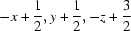
| Symmetry codes: (i) x, −y+1, z−1/2; (ii) −x, −y+1, −z+1; (iii) −x, y, −z+1/2; (iv) −x, −y, −z+1; (v) x, −y, z−1/2; (vi) −x+1/2, y+1/2, −z+3/2; (vii) −x+1/2, y−1/2, −z+3/2. |
Experimental details
| Crystal data | |
| Chemical formula | LiHo(PO3)4 |
| Mr | 487.75 |
| Crystal system, space group | Monoclinic, C2/c |
| Temperature (K) | 293 |
| a, b, c (Å) | 16.280 (3), 7.039 (2), 9.561 (2) |
| β (°) | 125.99 (2) |
| V (Å3) | 886.5 (4) |
| Z | 4 |
| Radiation type | Mo Kα |
| µ (mm−1) | 9.72 |
| Crystal size (mm) | 0.31 × 0.14 × 0.07 |
| Data collection | |
| Diffractometer | Enraf–Nonius CAD-4 diffractometer |
| Absorption correction | ψ scan (North et al., 1968) |
| Tmin, Tmax | 0.095, 0.378 |
| No. of measured, independent and observed [I > 2σ(I)] reflections | 1500, 1078, 1076 |
| Rint | 0.016 |
| (sin θ/λ)max (Å−1) | 0.660 |
| Refinement | |
| R[F2 > 2σ(F2)], wR(F2), S | 0.025, 0.071, 1.12 |
| No. of reflections | 1078 |
| No. of parameters | 84 |
| w = 1/[σ2(Fo2) + (0.0459P)2 + 12.7265P] where P = (Fo2 + 2Fc2)/3 | |
| Δρmax, Δρmin (e Å−3) | 2.75, −3.18 |
Computer programs: CAD-4 EXPRESS (Duisenberg, 1992; Macíček & Yordanov, 1992), XCAD4 (Harms & Wocadlo, 1995), SHELXS97 (Sheldrick, 2008), SHELXL97 (Sheldrick, 2008), DIAMOND (Brandenburg, 1998).
| Li—O2i | 1.962 (9) | P1—O6 | 1.499 (3) |
| Li—O6 | 1.999 (9) | P1—O4 | 1.589 (4) |
| Ho—O3 | 2.287 (3) | P1—O5iii | 1.594 (3) |
| Ho—O1i | 2.348 (4) | P2—O2 | 1.486 (3) |
| Ho—O2ii | 2.411 (3) | P2—O3 | 1.488 (3) |
| Ho—O6 | 2.516 (3) | P2—O5 | 1.588 (3) |
| P1—O1 | 1.488 (4) | P2—O4 | 1.601 (4) |
| Symmetry codes: (i) x, −y+1, z−1/2; (ii) x, −y, z−1/2; (iii) −x+1/2, y+1/2, −z+3/2. |
References
 Amami, J., Horchani, K., Merle, D. & Férid, M. (2004). J. Phys. IV Fr. 122, 111–115. CrossRef CAS Google Scholar
Ben Zarkouna, E. & Driss, A. (2004). Acta Cryst. E60, i102–i104. Web of Science CrossRef IUCr Journals Google Scholar
Ben Zarkouna, E., Férid, M. & Driss, A. (2005). Mater. Res. Bull. 40, 1985–1992. CAS Google Scholar
Ben Zarkouna, E., Horchani-Naifer, K., Férid, M. & Driss, A. (2007). Acta Cryst. E63, i1–i2. Web of Science CrossRef IUCr Journals Google Scholar
Brandenburg, K. (1998). DIAMOND. Crystal Impact GbR, Bonn, Germany. Google Scholar
Brown, I. D. & Altermatt, D. (1985). Acta Cryst. B41, 244–247. CrossRef CAS Web of Science IUCr Journals Google Scholar
Duisenberg, A. J. M. (1992). J. Appl. Cryst. 25, 92–96. CrossRef CAS Web of Science IUCr Journals Google Scholar
Durif, A. (1995). Crystal Chemistry of Condensed Phosphates. New York: Plenum Press. Google Scholar
Harms, K. & Wocadlo, S. (1995). XCAD4. University of Marburg, Germany. Google Scholar
International Tables for X-ray Crystallography (1968). Vol. III, 2nd ed. Birmingham: Kynoch Press. Google Scholar
Liu, G. K., Chen, Y. H. & Beitz, J. V. (1999). J. Lumin. 81, 7–12. Web of Science CrossRef CAS Google Scholar
Macíček, J. & Yordanov, A. (1992). J. Appl. Cryst. 25, 73–80. CrossRef Web of Science IUCr Journals Google Scholar
North, A. C. T., Phillips, D. C. & Mathews, F. S. (1968). Acta Cryst. A24, 351–359. CrossRef IUCr Journals Web of Science Google Scholar
Palkina, K. K., Chudinova, N. N., Litvin, B. N. & Vinogradova, N. V. (1981). Izv. Akad. Nauk SSSR Neorg. Mater. 17, 1501–1503. CAS Google Scholar
Palkina, K. K., Kuznetsov, V. G., Chudinova, N. N. & Chibiskova, N. T. (1976). Izv. Akad. Nauk SSSR Neorg. Mater. 12, 730–734. CAS Google Scholar
Sheldrick, G. M. (2008). Acta Cryst. A64, 112–122. Web of Science CrossRef CAS IUCr Journals Google Scholar
Tranqui, D., Bagieu-Beucher, M. & Durif, A. (1972). Bull. Soc. Fr. Minéral. Cryst. 95, 437–440. Google Scholar
This is an open-access article distributed under the terms of the Creative Commons Attribution (CC-BY) Licence, which permits unrestricted use, distribution, and reproduction in any medium, provided the original authors and source are cited.
| CRYSTALLOGRAPHIC COMMUNICATIONS |


The present paper is an extension of our earlier work on polyphosphates of general formula LiLn(PO3)4 [Ln = Yb (Ben Zarkouna & Driss, 2004), Er (Ben Zarkouna et al., 2005) and Tb (Ben Zarkouna et al., 2007)]. This family is now expanded to include the lithium holmium polyphosphate, LiHo(PO3)4, which might be of particular interest in the area of luminescent materials, because an avalanche up-conversion emission was observed previously for Ho3+-containing compounds (Liu et al., 1999).
The LiLn(PO3)4 polyphosphates are isostructural and belong to form I according to the classification of Palkina et al. (1981). In this type of arrangement, helical ribbons, ∞(PO3)n, formed by corner-sharing of PO4 tetrahedra, spread parallel to the b axis. The period of the chains corresponds to four tetrahedra but, owing to the presence of 21 screw axes, only two of them are crystallographically independent. The P—O bonds involving terminal O atoms are the shortest within a PO4 tetrahedron, because of the dπ-pπ orbital overlap (Durif, 1995). In LiHo(PO3)4, the mean P—O bond lengths for terminal and bridging O atoms, are of 1.490 and 1.593 Å, respectively. The O—P—O angles are within the range 101.2 (2)–119.6 (2) °, the smallest and the largest ones are those involving the longest and the shortest P—O bonds, respectively. The P—O—P bridges exhibit angles of 131.6 (2) and 134.8 (2)°, larger than the O—P—O angles. The Li and Ho atoms are arranged alternately on twofold rotation axes at roughly similar spacings [3.486 (1) and 3.553 (1) Å] in comparison with the quite different spacings between K and Ho atoms [3.721 (2) and 8.589 (2) Å] in β-KHo(PO3)4 (Palkina et al., 1976). The Ho atom is surrounded by eight terminal oxygen atoms forming a distorted dodecahedron, with an average Ho—O distance of 2.390 Å, while the Li atom is located inside an irregular tetrahedron with a mean Li—O distance of 1.980 Å. All these bond lengths are conform with those mentioned in the literature (International Tables for X-Ray Crystallography, 1968; Durif, 1995; Amami et al., 2004).
By sharing edges, the HoO8 and LiO4 polyhedra are joined to produce infinite linear chains running along the b axis (Fig. 1), in contrast to crystal structure of NaHo(PO3)4 (form II) (Amami et al., 2004) where zigzag chains of face-sharing HoO8 and NaO8 polyhedra are observed. As shown in Fig. 2, each chain shares corners of its polyhedra with four adjacent polyphosphate chains.
It is noteworthy that no O atom is common to two Ho atoms, and the closest Ho···Ho distance of 5.570 (1) Å in LiHo(PO3)4 is comparable with that found in HoP5O14 (Tranqui et al., 1972). Bond-valence-sum values (Brown & Altermatt, 1985) are 0.998, 3.054, 4.936 and 4.967 valence units for Li, Ho, P1 and P2, respectively, in good agreement with the expected formal charges.