 | Acta Crystallographica Section E Acta Crystallographica Section E CRYSTALLOGRAPHIC COMMUNICATIONS |


 journal menu


organic compounds
| CRYSTALLOGRAPHIC COMMUNICATIONS |
 access
2,5-Dichloroanilinium chloride monohydrate

aDepartment of Chemistry, Mangalore University, Mangalagangotri 574 199, Mangalore, India, bInstitute of Materials Science, Darmstadt University of Technology, Petersenstrasse 23, D-64287 Darmstadt, Germany, and cFaculty of Integrated Arts and Sciences, Tokushima University, Minamijosanjima-cho, Tokushima 770-8502, Japan
*Correspondence e-mail: [email protected]
The title compound, C6H6Cl2N+·Cl−·H2O, is composed of discrete cations, choride anions and water molecules, which are connected through N—H⋯Cl, O—H⋯Cl and N—H⋯O hydrogen bonding. Two H atoms of the positively charged –NH3+ group have two chloride acceptors and the other one has the O atom of the water molecule as acceptor. The chloride anions form hydrogen bonds with two H atoms from two different water molecules and two H atoms from two positively charged –NH3+ groups.
![[Scheme 1]](bt2865scheme1.gif)
Experimental
Crystal data
|
Refinement
|
|
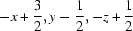 ; (ii)
 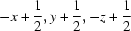 .
. Data collection: CAD-4-PC (Enraf–Nonius, 1996![[Enraf-Nonius (1996). CAD-4-PC. Enraf-Nonius, Delft, The Netherlands.]](../../../../../../logos/arrows/e_arr.gif "Enraf-Nonius (1996). CAD-4-PC. Enraf-Nonius, Delft, The Netherlands.") ); cell refinement: CAD-4-PC; data reduction: REDU4 (Stoe & Cie, 1987); program(s) used to solve structure: SHELXS97 (Sheldrick, 2008); program(s) used to refine structure: SHELXL97 (Sheldrick, 2008); molecular graphics: PLATON (Spek, 2003); software used to prepare material for publication: SHELXL97.
); cell refinement: CAD-4-PC; data reduction: REDU4 (Stoe & Cie, 1987); program(s) used to solve structure: SHELXS97 (Sheldrick, 2008); program(s) used to refine structure: SHELXL97 (Sheldrick, 2008); molecular graphics: PLATON (Spek, 2003); software used to prepare material for publication: SHELXL97.
Supporting information
contains datablocks I, global. DOI: 10.1107/S1600536809004395/bt2865sup1.cif
Structure factors: contains datablock I. DOI: 10.1107/S1600536809004395/bt2865Isup2.hkl
The solution of pure 2,5-dichloroaniline (0.02 mole) in ethanol (20 cc) was treated dropwise with dilute hydrochloric acid (>0.025 mole) with constant stirring. The resulting mixture was slowly evaporated at room temperature to obtain 2,5-dichloroanilinium hydrochloride monohydrate. The resultant solid was recrystallized to constant melting point from ethanol. The single crystals used in X-ray diffraction studies were grown in ethanolic solution by slow evaporation at room temperature.
H atoms were located in a difference map, and their positional parameters were refined freely except for the water H atoms which were refined with the O—H distances restrained to 0.85 (4) Å and H—H distance restrained to 1.37 (4)Å. All H atoms were refined with isotropic displacement parameters set to 1.2 times of the Ueq of the parent atom.
Data collection: CAD-4-PC (Enraf–Nonius, 1996); cell CAD-4-PC (Enraf–Nonius, 1996); data reduction: REDU4 (Stoe & Cie, 1987); program(s) used to solve structure: SHELXS97 (Sheldrick, 2008); program(s) used to refine structure: SHELXL97 (Sheldrick, 2008); molecular graphics: PLATON (Spek, 2003); software used to prepare material for publication: SHELXL97 (Sheldrick, 2008).
![[Figure 1]](./bt2865fig1thm.gif) | Fig. 1. Molecular structure of the title compound, showing the atom labeling scheme. The displacement ellipsoids are drawn at the 50% probability level. The H atoms are represented as small spheres of arbitrary radii. |
![[Figure 2]](./bt2865fig2thm.gif) | Fig. 2. Molecular packing of the title compound with hydrogen bonding shown as dashed lines. |
| C6H6Cl2N+·Cl−·H2O | F(000) = 440 |
| Mr = 216.48 | Dx = 1.528 Mg m−3 |
| Monoclinic, P21/n | Cu Kα radiation, λ = 1.54180 Å |
| Hall symbol: -P 2yn | Cell parameters from 25 reflections |
| a = 7.679 (1) Å | θ = 6.0–20.3° |
| b = 6.476 (1) Å | µ = 8.39 mm−1 |
| c = 19.060 (5) Å | T = 299 K |
| β = 96.95 (3)° | Plate, colourless |
| V = 940.9 (3) Å3 | 0.35 × 0.30 × 0.10 mm |
| Z = 4 |
| Enraf–Nonius CAD-4 diffractometer | 1421 reflections with I > 2σ(I) |
| Radiation source: fine-focus sealed tube | Rint = 0.068 |
| Graphite monochromator | θmax = 67.2°, θmin = 4.7° |
| ω/2θ scans | h = −9→9 |
| Absorption correction: ψ scan (North et al., 1968) | k = 0→7 |
| Tmin = 0.109, Tmax = 0.432 | l = −22→22 |
| 3331 measured reflections | 3 standard reflections every 120 min |
| 1669 independent reflections | intensity decay: 1.0% |
| Refinement on F2 | Secondary atom site location: difference Fourier map |
| Least-squares matrix: full | Hydrogen site location: difference Fourier map |
| R[F2 > 2σ(F2)] = 0.049 | Only H-atom coordinates refined |
| wR(F2) = 0.143 | w = 1/[σ2(Fo2) + (0.0831P)2 + 0.169P] where P = (Fo2 + 2Fc2)/3 |
| S = 1.10 | (Δ/σ)max = 0.012 |
| 1669 reflections | Δρmax = 0.39 e Å−3 |
| 125 parameters | Δρmin = −0.49 e Å−3 |
| 3 restraints | Extinction correction: SHELXL97 (Sheldrick, 2008), Fc*=kFc[1+0.001xFc2λ3/sin(2θ)]-1/4 |
| Primary atom site location: structure-invariant direct methods | Extinction coefficient: 0.0126 (16) |
| C6H6Cl2N+·Cl−·H2O | V = 940.9 (3) Å3 |
| Mr = 216.48 | Z = 4 |
| Monoclinic, P21/n | Cu Kα radiation |
| a = 7.679 (1) Å | µ = 8.39 mm−1 |
| b = 6.476 (1) Å | T = 299 K |
| c = 19.060 (5) Å | 0.35 × 0.30 × 0.10 mm |
| β = 96.95 (3)° |
| Enraf–Nonius CAD-4 diffractometer | 1421 reflections with I > 2σ(I) |
| Absorption correction: ψ scan (North et al., 1968) | Rint = 0.068 |
| Tmin = 0.109, Tmax = 0.432 | 3 standard reflections every 120 min |
| 3331 measured reflections | intensity decay: 1.0% |
| 1669 independent reflections |
| R[F2 > 2σ(F2)] = 0.049 | 3 restraints |
| wR(F2) = 0.143 | Only H-atom coordinates refined |
| S = 1.10 | Δρmax = 0.39 e Å−3 |
| 1669 reflections | Δρmin = −0.49 e Å−3 |
| 125 parameters |
Geometry. All e.s.d.'s (except the e.s.d. in the dihedral angle between two l.s. planes) are estimated using the full covariance matrix. The cell e.s.d.'s are taken into account individually in the estimation of e.s.d.'s in distances, angles and torsion angles; correlations between e.s.d.'s in cell parameters are only used when they are defined by crystal symmetry. An approximate (isotropic) treatment of cell e.s.d.'s is used for estimating e.s.d.'s involving l.s. planes. |
Refinement. Refinement of F2 against ALL reflections. The weighted R-factor wR and goodness of fit S are based on F2, conventional R-factors R are based on F, with F set to zero for negative F2. The threshold expression of F2 > σ(F2) is used only for calculating R-factors(gt) etc. and is not relevant to the choice of reflections for refinement. R-factors based on F2 are statistically about twice as large as those based on F, and R- factors based on ALL data will be even larger. |
| x | y | z | Uiso*/Ueq | ||
| Cl1 | 0.64647 (11) | −0.35617 (13) | 0.11963 (6) | 0.0720 (4) | |
| Cl2 | 0.84843 (12) | 0.33419 (16) | −0.08256 (4) | 0.0716 (4) | |
| N1 | 0.8342 (3) | 0.0359 (4) | 0.16645 (11) | 0.0476 (6) | |
| H11 | 0.872 (4) | −0.079 (6) | 0.1920 (19) | 0.057* | |
| H12 | 0.736 (5) | 0.083 (5) | 0.1868 (18) | 0.057* | |
| H13 | 0.917 (5) | 0.128 (6) | 0.179 (2) | 0.057* | |
| C1 | 0.7922 (3) | 0.0096 (5) | 0.09016 (13) | 0.0441 (6) | |
| C2 | 0.7056 (4) | −0.1657 (5) | 0.06338 (18) | 0.0529 (7) | |
| C3 | 0.6664 (4) | −0.1873 (6) | −0.0093 (2) | 0.0635 (9) | |
| H3 | 0.604 (5) | −0.303 (7) | −0.024 (2) | 0.076* | |
| C4 | 0.7107 (4) | −0.0333 (6) | −0.05366 (16) | 0.0626 (9) | |
| H4 | 0.681 (5) | −0.046 (6) | −0.100 (2) | 0.075* | |
| C5 | 0.7943 (4) | 0.1398 (5) | −0.02646 (15) | 0.0534 (7) | |
| C6 | 0.8371 (4) | 0.1651 (5) | 0.04598 (15) | 0.0474 (6) | |
| H6 | 0.905 (4) | 0.288 (5) | 0.065 (2) | 0.057* | |
| O1 | 0.0902 (3) | 0.3197 (4) | 0.19565 (15) | 0.0697 (7) | |
| H1A | 0.200 (4) | 0.301 (6) | 0.206 (3) | 0.084* | |
| H1B | 0.067 (5) | 0.413 (6) | 0.223 (2) | 0.084* | |
| Cl3 | 0.50259 (9) | 0.21839 (12) | 0.22100 (4) | 0.0565 (3) |
| U11 | U22 | U33 | U12 | U13 | U23 | |
| Cl1 | 0.0655 (6) | 0.0603 (5) | 0.0883 (6) | −0.0101 (3) | 0.0009 (5) | 0.0022 (4) |
| Cl2 | 0.0671 (6) | 0.0981 (7) | 0.0499 (4) | 0.0101 (4) | 0.0085 (4) | 0.0145 (4) |
| N1 | 0.0485 (13) | 0.0551 (13) | 0.0379 (10) | 0.0017 (11) | −0.0002 (9) | −0.0007 (10) |
| C1 | 0.0377 (13) | 0.0528 (14) | 0.0402 (11) | 0.0065 (11) | −0.0015 (10) | −0.0062 (11) |
| C2 | 0.0400 (13) | 0.0555 (16) | 0.0615 (17) | 0.0031 (12) | −0.0004 (13) | −0.0084 (13) |
| C3 | 0.0500 (17) | 0.0694 (19) | 0.0677 (19) | 0.0019 (15) | −0.0065 (15) | −0.0270 (17) |
| C4 | 0.0522 (16) | 0.086 (2) | 0.0470 (14) | 0.0111 (16) | −0.0034 (13) | −0.0205 (15) |
| C5 | 0.0436 (14) | 0.076 (2) | 0.0405 (13) | 0.0130 (13) | 0.0032 (12) | −0.0027 (13) |
| C6 | 0.0415 (13) | 0.0578 (15) | 0.0419 (13) | 0.0044 (12) | 0.0009 (11) | −0.0054 (12) |
| O1 | 0.0571 (14) | 0.0722 (16) | 0.0776 (15) | −0.0017 (11) | −0.0004 (12) | −0.0175 (12) |
| Cl3 | 0.0529 (5) | 0.0671 (5) | 0.0484 (4) | −0.0018 (3) | 0.0015 (3) | −0.0101 (3) |
| Cl1—C2 | 1.731 (3) | C3—C4 | 1.377 (6) |
| Cl2—C5 | 1.735 (3) | C3—H3 | 0.92 (4) |
| N1—C1 | 1.461 (3) | C4—C5 | 1.362 (5) |
| N1—H11 | 0.92 (4) | C4—H4 | 0.88 (4) |
| N1—H12 | 0.94 (4) | C5—C6 | 1.390 (4) |
| N1—H13 | 0.88 (4) | C6—H6 | 1.00 (4) |
| C1—C2 | 1.382 (4) | O1—H1A | 0.85 (3) |
| C1—C6 | 1.383 (4) | O1—H1B | 0.83 (3) |
| C2—C3 | 1.388 (5) | ||
| C1—N1—H11 | 117 (2) | C4—C3—H3 | 124 (3) |
| C1—N1—H12 | 111 (2) | C2—C3—H3 | 116 (3) |
| H11—N1—H12 | 105 (3) | C5—C4—C3 | 120.1 (3) |
| C1—N1—H13 | 114 (2) | C5—C4—H4 | 121 (3) |
| H11—N1—H13 | 104 (3) | C3—C4—H4 | 119 (3) |
| H12—N1—H13 | 105 (3) | C4—C5—C6 | 121.3 (3) |
| C2—C1—C6 | 121.2 (3) | C4—C5—Cl2 | 120.0 (2) |
| C2—C1—N1 | 120.1 (3) | C6—C5—Cl2 | 118.8 (3) |
| C6—C1—N1 | 118.7 (3) | C1—C6—C5 | 118.2 (3) |
| C1—C2—C3 | 119.2 (3) | C1—C6—H6 | 121 (2) |
| C1—C2—Cl1 | 120.5 (2) | C5—C6—H6 | 121 (2) |
| C3—C2—Cl1 | 120.3 (3) | H1A—O1—H1B | 104 (4) |
| C4—C3—C2 | 120.0 (3) | ||
| C6—C1—C2—C3 | 1.3 (4) | C3—C4—C5—C6 | 0.2 (5) |
| N1—C1—C2—C3 | 179.8 (3) | C3—C4—C5—Cl2 | −179.5 (3) |
| C6—C1—C2—Cl1 | −178.6 (2) | C2—C1—C6—C5 | −0.6 (4) |
| N1—C1—C2—Cl1 | −0.2 (4) | N1—C1—C6—C5 | −179.1 (3) |
| C1—C2—C3—C4 | −1.3 (5) | C4—C5—C6—C1 | −0.2 (4) |
| Cl1—C2—C3—C4 | 178.7 (3) | Cl2—C5—C6—C1 | 179.6 (2) |
| C2—C3—C4—C5 | 0.5 (5) |
| D—H···A | D—H | H···A | D···A | D—H···A |
| N1—H11···Cl3i | 0.92 (4) | 2.24 (4) | 3.123 (3) | 162 (3) |
| N1—H12···Cl3 | 0.94 (4) | 2.16 (4) | 3.099 (3) | 172 (3) |
| N1—H13···O1ii | 0.88 (4) | 1.82 (4) | 2.699 (4) | 175 (4) |
| O1—H1A···Cl3 | 0.85 (3) | 2.37 (3) | 3.212 (3) | 172 (4) |
| O1—H1B···Cl3iii | 0.83 (3) | 2.34 (3) | 3.158 (3) | 169 (4) |
| Symmetry codes: (i) −x+3/2, y−1/2, −z+1/2; (ii) x+1, y, z; (iii) −x+1/2, y+1/2, −z+1/2. |
Experimental details
| Crystal data | |
| Chemical formula | C6H6Cl2N+·Cl−·H2O |
| Mr | 216.48 |
| Crystal system, space group | Monoclinic, P21/n |
| Temperature (K) | 299 |
| a, b, c (Å) | 7.679 (1), 6.476 (1), 19.060 (5) |
| β (°) | 96.95 (3) |
| V (Å3) | 940.9 (3) |
| Z | 4 |
| Radiation type | Cu Kα |
| µ (mm−1) | 8.39 |
| Crystal size (mm) | 0.35 × 0.30 × 0.10 |
| Data collection | |
| Diffractometer | Enraf–Nonius CAD-4 diffractometer |
| Absorption correction | ψ scan (North et al., 1968) |
| Tmin, Tmax | 0.109, 0.432 |
| No. of measured, independent and observed [I > 2σ(I)] reflections | 3331, 1669, 1421 |
| Rint | 0.068 |
| (sin θ/λ)max (Å−1) | 0.598 |
| Refinement | |
| R[F2 > 2σ(F2)], wR(F2), S | 0.049, 0.143, 1.10 |
| No. of reflections | 1669 |
| No. of parameters | 125 |
| No. of restraints | 3 |
| H-atom treatment | Only H-atom coordinates refined |
| Δρmax, Δρmin (e Å−3) | 0.39, −0.49 |
Computer programs: CAD-4-PC (Enraf–Nonius, 1996), REDU4 (Stoe & Cie, 1987), SHELXS97 (Sheldrick, 2008), SHELXL97 (Sheldrick, 2008), PLATON (Spek, 2003).
| D—H···A | D—H | H···A | D···A | D—H···A |
| N1—H11···Cl3i | 0.92 (4) | 2.24 (4) | 3.123 (3) | 162 (3) |
| N1—H12···Cl3 | 0.94 (4) | 2.16 (4) | 3.099 (3) | 172 (3) |
| N1—H13···O1ii | 0.88 (4) | 1.82 (4) | 2.699 (4) | 175 (4) |
| O1—H1A···Cl3 | 0.85 (3) | 2.37 (3) | 3.212 (3) | 172 (4) |
| O1—H1B···Cl3iii | 0.83 (3) | 2.34 (3) | 3.158 (3) | 169 (4) |
| Symmetry codes: (i) −x+3/2, y−1/2, −z+1/2; (ii) x+1, y, z; (iii) −x+1/2, y+1/2, −z+1/2. |
Acknowledgements
BTG thanks the Alexander von Humboldt Foundation, Bonn, Germany, for extensions of his research fellowship.
References
 Enraf–Nonius (1996). CAD-4-PC. Enraf–Nonius, Delft, The Netherlands. Google Scholar
Gray, L. & Jones, P. G. (2002). Z. Naturforsch. Teil B, 57, 73–82. CAS Google Scholar
North, A. C. T., Phillips, D. C. & Mathews, F. S. (1968). Acta Cryst. A24, 351–359. CrossRef IUCr Journals Web of Science Google Scholar
Sheldrick, G. M. (2008). Acta Cryst. A64, 112–122. Web of Science CrossRef CAS IUCr Journals Google Scholar
Spek, A. L. (2003). J. Appl. Cryst. 36, 7–13. Web of Science CrossRef CAS IUCr Journals Google Scholar
Stoe & Cie (1987). REDU4. Stoe & Cie, Darmstadt, Germany. Google Scholar
This is an open-access article distributed under the terms of the Creative Commons Attribution (CC-BY) Licence, which permits unrestricted use, distribution, and reproduction in any medium, provided the original authors and source are cited.
| CRYSTALLOGRAPHIC COMMUNICATIONS |


The crystal structure of water free 2,5-dichloroanilinium chloride has been reported (Gray & Jones, 2002). We report herein the crystal structure of 2,5-dichloroanilinium chloride monohydrate. The title compound showed interesting H-bonding in its crystal structure (Fig. 1). Two H-atoms of the positively charged NH3 group have two chloride acceptors and the other H has O atom acceptor of the water molecule, while chloride anions are linked by four-center hydrogen bonds, with each chloride forming H-bonding with two H-atoms, one each from two different water molecules and two H-atoms, one each from two positively charged NH3 groups. This is in comparison with the usual set of hydrogen bonds from NH3 to chloride leading to layer structure observed with water free 2,5-dichloroanilinium chloride (Gray & Jones, 2002), with a short Cl1..Cl3 contact. Further, the water free structure involved four weak interactions, namely the three hydrogen bonds H4···Cl3, H6···Cl2 and H3···Cl1 and the chlorine-chlorine interaction Cl2···Cl3. The crystal packing of (I) through N—H···Cl, O—H···Cl and N—H···O hydrogen bonding (Table 1) is shown in Fig.2