 | Acta Crystallographica Section E Acta Crystallographica Section E CRYSTALLOGRAPHIC COMMUNICATIONS |


 journal menu


metal-organic compounds
| CRYSTALLOGRAPHIC COMMUNICATIONS |
 access
A correction has been published for this article. To view the correction, click here.
[N,N′-Bis(4-bromobenzylidene)-2,2-dimethylpropane-κ2N,N′]iodidocopper(I)

aX-ray Crystallography Unit, School of Physics, Universiti Sains Malaysia, 11800 USM, Penang, Malaysia, and bDepartment of Chemistry, School of Science, Payame Noor University (PNU), Ardakan, Yazd, Iran
*Correspondence e-mail: [email protected]
The title compound, [CuI(C19H20Br2N2)], lies across a crystallographic mirror plane. The coordination around the copper centre is distorted trigonal planar, with a bite angle of 94.7 (3)°. A six-membered chelate ring in a chair conformation is formed by the coordination of the imine N atoms of the bidentate ligand to the CuI atom. This conformation is required by the crystallographic mirror symmetry. The interplanar angle between the benzene rings is 74.85 (19)°. The exhibits weak intermolecular C—H⋯π interactions, which link the molecules into chains along the b axis.
Related literature
For the puckering parameters, see: Cremer & Pople (1975![[Cremer, D. & Pople, J. A. (1975). J. Am. Chem. Soc. 97, 1354-1358.]](../../../../../../logos/arrows/e_arr.gif "Cremer, D. & Pople, J. A. (1975). J. Am. Chem. Soc. 97, 1354-1358.") ). For related literature and the catalytic applications see, for example: Killian et al. (1996); Jung et al. (1996); Small et al. (1998). For a related structure, see: Kia et al. (2009). For the stability of the temperature controller, see Cosier & Glazer (1986).
). For related literature and the catalytic applications see, for example: Killian et al. (1996); Jung et al. (1996); Small et al. (1998). For a related structure, see: Kia et al. (2009). For the stability of the temperature controller, see Cosier & Glazer (1986).
![[Scheme 1]](ez2161scheme1.gif)
Experimental
Crystal data
|
Refinement
|
| |||||||||||||||||
 .
. Data collection: APEX2 (Bruker, 2005); cell refinement: APEX2; data reduction: SAINT (Bruker, 2005); program(s) used to solve structure: SHELXTL (Sheldrick, 2008); program(s) used to refine structure: SHELXTL; molecular graphics: SHELXTL; software used to prepare material for publication: SHELXTL and PLATON (Spek, 2009).
Supporting information
contains datablocks global, I. DOI: 10.1107/S1600536809005078/ez2161sup1.cif
Structure factors: contains datablock I. DOI: 10.1107/S1600536809005078/ez2161Isup2.hkl
N,N'-Bis(4-bromobenzylidene)-2,2-dimethylpropane (783 mg, 2 mmol) was added dropwise to a suspension of CuI (380 mg, 2.0 mmol) in 50 ml of THF. After 15 min a clear yellowish solution was obtained. The volume of the reaction mixture was reduced until the formation of a yellow precipitate occurred. Single crystals suitable for X-ray diffraction were grown from the acetonitrile solution.
All H atoms were positioned geometrically with C—H = 0.95–0.99 Å and refined in a riding model approximation with Uiso(H) = 1.2Ueq(C). The highest peak (2.64 e. Å-3) is located 1.02 Å from I1 and the deepest hole (-0.99 e. Å-3) is located 0.58 Å from H10A.
Data collection: APEX2 (Bruker, 2005); cell APEX2 (Bruker, 2005); data reduction: SAINT (Bruker, 2005); program(s) used to solve structure: SHELXTL (Sheldrick, 2008); program(s) used to refine structure: SHELXTL (Sheldrick, 2008); molecular graphics: SHELXTL (Sheldrick, 2008); software used to prepare material for publication: SHELXTL (Sheldrick, 2008) and PLATON (Spek, 2009).
![[Figure 1]](./ez2161fig1thm.gif) | Fig. 1. The molecular structure of (I), showing 40% probability displacement ellipsoids and the atomic numbering. Symmetry code for A atoms; x, -y + 1, z. |
![[Figure 2]](./ez2161fig2thm.gif) | Fig. 2. The crystal packing of (I), viewed down the c-axis, showing C—H···π interactions linking the molecules into chains along the b-axis. |
| [CuI(C19H20Br2N2)] | F(000) = 1200 |
| Mr = 626.63 | Dx = 1.966 Mg m−3 |
| Monoclinic, C2/m | Mo Kα radiation, λ = 0.71073 Å |
| Hall symbol: -C 2y | Cell parameters from 4080 reflections |
| a = 16.2224 (15) Å | θ = 2.5–29.5° |
| b = 12.2807 (12) Å | µ = 6.27 mm−1 |
| c = 10.6292 (12) Å | T = 100 K |
| β = 91.599 (6)° | Needle, yellow |
| V = 2116.8 (4) Å3 | 0.58 × 0.09 × 0.05 mm |
| Z = 4 |
| Bruker SMART APEXII CCD area-detector diffractometer | 1936 independent reflections |
| Radiation source: fine-focus sealed tube | 1474 reflections with I > 2σ(I) |
| Graphite monochromator | Rint = 0.099 |
| ϕ and ω scans | θmax = 25.0°, θmin = 2.1° |
| Absorption correction: multi-scan (SADABS; Bruker, 2005) | h = −19→19 |
| Tmin = 0.119, Tmax = 0.714 | k = −14→14 |
| 10374 measured reflections | l = −12→12 |
| Refinement on F2 | Primary atom site location: structure-invariant direct methods |
| Least-squares matrix: full | Secondary atom site location: difference Fourier map |
| R[F2 > 2σ(F2)] = 0.050 | Hydrogen site location: inferred from neighbouring sites |
| wR(F2) = 0.112 | H-atom parameters constrained |
| S = 1.16 | w = 1/[σ2(Fo2) + (0.0405P)2 + 16.0151P] where P = (Fo2 + 2Fc2)/3 |
| 1936 reflections | (Δ/σ)max < 0.001 |
| 121 parameters | Δρmax = 2.64 e Å−3 |
| 0 restraints | Δρmin = −0.99 e Å−3 |
| [CuI(C19H20Br2N2)] | V = 2116.8 (4) Å3 |
| Mr = 626.63 | Z = 4 |
| Monoclinic, C2/m | Mo Kα radiation |
| a = 16.2224 (15) Å | µ = 6.27 mm−1 |
| b = 12.2807 (12) Å | T = 100 K |
| c = 10.6292 (12) Å | 0.58 × 0.09 × 0.05 mm |
| β = 91.599 (6)° |
| Bruker SMART APEXII CCD area-detector diffractometer | 1936 independent reflections |
| Absorption correction: multi-scan (SADABS; Bruker, 2005) | 1474 reflections with I > 2σ(I) |
| Tmin = 0.119, Tmax = 0.714 | Rint = 0.099 |
| 10374 measured reflections |
| R[F2 > 2σ(F2)] = 0.050 | 0 restraints |
| wR(F2) = 0.112 | H-atom parameters constrained |
| S = 1.16 | w = 1/[σ2(Fo2) + (0.0405P)2 + 16.0151P] where P = (Fo2 + 2Fc2)/3 |
| 1936 reflections | Δρmax = 2.64 e Å−3 |
| 121 parameters | Δρmin = −0.99 e Å−3 |
Experimental. The crystal was placed in the cold stream of an Oxford Cryosystems Cobra open-flow nitrogen cryostat (Cosier & Glazer, 1986) operating at 100.0 (1) K. |
Geometry. All esds (except the esd in the dihedral angle between two l.s. planes) are estimated using the full covariance matrix. The cell esds are taken into account individually in the estimation of esds in distances, angles and torsion angles; correlations between esds in cell parameters are only used when they are defined by crystal symmetry. An approximate (isotropic) treatment of cell esds is used for estimating esds involving l.s. planes. |
Refinement. Refinement of F2 against ALL reflections. The weighted R-factor wR and goodness of fit S are based on F2, conventional R-factors R are based on F, with F set to zero for negative F2. The threshold expression of F2 > 2sigma(F2) is used only for calculating R-factors(gt) etc. and is not relevant to the choice of reflections for R-factors based on F2 are statistically about twice as large as those based on F, and R- factors based on ALL data will be even larger. |
| x | y | z | Uiso*/Ueq | ||
| I1 | 0.38486 (4) | 0.5000 | 0.14862 (6) | 0.0166 (2) | |
| Br1 | 0.11472 (5) | 0.16378 (8) | 0.54336 (7) | 0.0309 (3) | |
| Cu1 | 0.25251 (8) | 0.5000 | 0.02730 (11) | 0.0168 (3) | |
| N1 | 0.1853 (3) | 0.3798 (6) | −0.0519 (5) | 0.0167 (14) | |
| C1 | 0.1751 (5) | 0.3315 (7) | 0.2223 (7) | 0.0213 (18) | |
| H1A | 0.2085 | 0.3923 | 0.2022 | 0.026* | |
| C2 | 0.1683 (4) | 0.3023 (7) | 0.3463 (7) | 0.0210 (18) | |
| H2A | 0.1957 | 0.3426 | 0.4113 | 0.025* | |
| C3 | 0.1204 (5) | 0.2130 (7) | 0.3742 (6) | 0.0193 (18) | |
| C4 | 0.0779 (5) | 0.1560 (7) | 0.2811 (8) | 0.026 (2) | |
| H4A | 0.0442 | 0.0958 | 0.3021 | 0.031* | |
| C5 | 0.0852 (4) | 0.1878 (7) | 0.1556 (7) | 0.0188 (18) | |
| H5A | 0.0559 | 0.1496 | 0.0907 | 0.023* | |
| C6 | 0.1354 (4) | 0.2756 (7) | 0.1260 (7) | 0.0172 (18) | |
| C7 | 0.1428 (4) | 0.3030 (7) | −0.0085 (7) | 0.0184 (17) | |
| H7A | 0.1130 | 0.2590 | −0.0675 | 0.022* | |
| C8 | 0.1816 (5) | 0.3967 (7) | −0.1892 (7) | 0.0213 (18) | |
| H8A | 0.1542 | 0.3330 | −0.2292 | 0.026* | |
| H8B | 0.2387 | 0.3997 | −0.2198 | 0.026* | |
| C9 | 0.1360 (7) | 0.5000 | −0.2327 (9) | 0.020 (3) | |
| C10 | 0.0477 (6) | 0.5000 | −0.1869 (11) | 0.028 (3) | |
| H10A | 0.0492 | 0.5000 | −0.0947 | 0.041* | |
| H10B | 0.0187 | 0.4348 | −0.2177 | 0.041* | |
| C11 | 0.1346 (7) | 0.5000 | −0.3771 (10) | 0.024 (3) | |
| H11A | 0.1916 | 0.5000 | −0.4055 | 0.036* | |
| H11B | 0.1061 | 0.5652 | −0.4091 | 0.036* |
| U11 | U22 | U33 | U12 | U13 | U23 | |
| I1 | 0.0191 (4) | 0.0171 (4) | 0.0134 (4) | 0.000 | −0.0029 (3) | 0.000 |
| Br1 | 0.0371 (5) | 0.0400 (6) | 0.0154 (4) | −0.0155 (4) | −0.0026 (3) | 0.0048 (4) |
| Cu1 | 0.0195 (7) | 0.0188 (8) | 0.0121 (7) | 0.000 | −0.0020 (5) | 0.000 |
| N1 | 0.020 (3) | 0.018 (4) | 0.012 (3) | 0.001 (3) | 0.001 (2) | −0.002 (3) |
| C1 | 0.024 (4) | 0.021 (5) | 0.019 (4) | −0.007 (3) | 0.002 (3) | −0.003 (4) |
| C2 | 0.025 (4) | 0.023 (5) | 0.015 (4) | −0.009 (4) | −0.004 (3) | −0.007 (4) |
| C3 | 0.031 (4) | 0.022 (5) | 0.005 (4) | −0.003 (4) | 0.001 (3) | 0.002 (3) |
| C4 | 0.031 (5) | 0.022 (5) | 0.025 (5) | −0.010 (4) | 0.002 (4) | 0.003 (4) |
| C5 | 0.018 (4) | 0.025 (5) | 0.013 (4) | −0.001 (3) | −0.002 (3) | −0.002 (4) |
| C6 | 0.019 (4) | 0.014 (5) | 0.020 (4) | 0.005 (3) | 0.004 (3) | −0.002 (4) |
| C7 | 0.022 (4) | 0.016 (5) | 0.017 (4) | 0.000 (3) | −0.005 (3) | −0.010 (4) |
| C8 | 0.031 (4) | 0.019 (5) | 0.014 (4) | −0.003 (4) | 0.001 (3) | −0.002 (4) |
| C9 | 0.029 (6) | 0.024 (7) | 0.007 (5) | 0.000 | 0.003 (4) | 0.000 |
| C10 | 0.022 (6) | 0.034 (8) | 0.027 (7) | 0.000 | −0.009 (5) | 0.000 |
| C11 | 0.038 (7) | 0.020 (7) | 0.015 (6) | 0.000 | −0.006 (5) | 0.000 |
| I1—Cu1 | 2.4735 (14) | C5—C6 | 1.392 (11) |
| Br1—C3 | 1.902 (7) | C5—H5A | 0.9500 |
| Cu1—N1 | 2.006 (6) | C6—C7 | 1.477 (11) |
| Cu1—N1i | 2.006 (6) | C7—H7A | 0.9500 |
| N1—C7 | 1.263 (10) | C8—C9 | 1.533 (10) |
| N1—C8 | 1.474 (9) | C8—H8A | 0.9900 |
| C1—C2 | 1.374 (11) | C8—H8B | 0.9900 |
| C1—C6 | 1.378 (10) | C9—C10 | 1.527 (15) |
| C1—H1A | 0.9500 | C9—C8i | 1.533 (10) |
| C2—C3 | 1.381 (11) | C9—C11 | 1.535 (14) |
| C2—H2A | 0.9500 | C10—H10A | 0.9800 |
| C3—C4 | 1.381 (11) | C10—H10B | 0.9800 |
| C4—C5 | 1.398 (11) | C11—H11A | 0.9800 |
| C4—H4A | 0.9500 | C11—H11B | 0.9801 |
| N1—Cu1—N1i | 94.8 (4) | C5—C6—C7 | 117.3 (7) |
| N1—Cu1—I1 | 132.24 (18) | N1—C7—C6 | 125.7 (7) |
| N1i—Cu1—I1 | 132.24 (18) | N1—C7—H7A | 117.1 |
| C7—N1—C8 | 117.4 (6) | C6—C7—H7A | 117.1 |
| C7—N1—Cu1 | 133.8 (5) | N1—C8—C9 | 114.9 (7) |
| C8—N1—Cu1 | 108.5 (5) | N1—C8—H8A | 108.5 |
| C2—C1—C6 | 122.3 (8) | C9—C8—H8A | 108.5 |
| C2—C1—H1A | 118.9 | N1—C8—H8B | 108.5 |
| C6—C1—H1A | 118.9 | C9—C8—H8B | 108.5 |
| C1—C2—C3 | 118.3 (7) | H8A—C8—H8B | 107.5 |
| C1—C2—H2A | 120.9 | C10—C9—C8i | 110.7 (6) |
| C3—C2—H2A | 120.9 | C10—C9—C8 | 110.7 (6) |
| C4—C3—C2 | 121.4 (7) | C8i—C9—C8 | 111.7 (9) |
| C4—C3—Br1 | 118.7 (6) | C10—C9—C11 | 109.3 (9) |
| C2—C3—Br1 | 119.8 (6) | C8i—C9—C11 | 107.1 (6) |
| C3—C4—C5 | 119.2 (8) | C8—C9—C11 | 107.1 (6) |
| C3—C4—H4A | 120.4 | C9—C10—H10A | 108.7 |
| C5—C4—H4A | 120.4 | C9—C10—H10B | 109.8 |
| C6—C5—C4 | 119.8 (7) | H10A—C10—H10B | 109.5 |
| C6—C5—H5A | 120.1 | C9—C11—H11A | 108.6 |
| C4—C5—H5A | 120.1 | C9—C11—H11B | 109.9 |
| C1—C6—C5 | 118.9 (7) | H11A—C11—H11B | 109.5 |
| C1—C6—C7 | 123.8 (7) | ||
| N1i—Cu1—N1—C7 | −119.0 (7) | C4—C5—C6—C1 | −1.9 (11) |
| I1—Cu1—N1—C7 | 70.2 (8) | C4—C5—C6—C7 | 178.0 (7) |
| N1i—Cu1—N1—C8 | 54.2 (5) | C8—N1—C7—C6 | −177.4 (7) |
| I1—Cu1—N1—C8 | −116.5 (4) | Cu1—N1—C7—C6 | −4.5 (12) |
| C6—C1—C2—C3 | 0.8 (12) | C1—C6—C7—N1 | −0.3 (12) |
| C1—C2—C3—C4 | −2.2 (12) | C5—C6—C7—N1 | 179.8 (7) |
| C1—C2—C3—Br1 | 175.9 (6) | C7—N1—C8—C9 | 109.6 (8) |
| C2—C3—C4—C5 | 1.6 (13) | Cu1—N1—C8—C9 | −64.9 (7) |
| Br1—C3—C4—C5 | −176.6 (6) | N1—C8—C9—C10 | −57.8 (9) |
| C3—C4—C5—C6 | 0.5 (12) | N1—C8—C9—C8i | 66.0 (10) |
| C2—C1—C6—C5 | 1.3 (12) | N1—C8—C9—C11 | −176.9 (7) |
| C2—C1—C6—C7 | −178.6 (7) |
| Symmetry code: (i) x, −y+1, z. |
| D—H···A | D—H | H···A | D···A | D—H···A |
| C8—H8A···Cg1ii | 0.99 | 2.83 | 3.631 (9) | 138 |
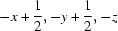
| Symmetry code: (ii) −x+1/2, −y+1/2, −z. |
Experimental details
| Crystal data | |
| Chemical formula | [CuI(C19H20Br2N2)] |
| Mr | 626.63 |
| Crystal system, space group | Monoclinic, C2/m |
| Temperature (K) | 100 |
| a, b, c (Å) | 16.2224 (15), 12.2807 (12), 10.6292 (12) |
| β (°) | 91.599 (6) |
| V (Å3) | 2116.8 (4) |
| Z | 4 |
| Radiation type | Mo Kα |
| µ (mm−1) | 6.27 |
| Crystal size (mm) | 0.58 × 0.09 × 0.05 |
| Data collection | |
| Diffractometer | Bruker SMART APEXII CCD area-detector diffractometer |
| Absorption correction | Multi-scan (SADABS; Bruker, 2005) |
| Tmin, Tmax | 0.119, 0.714 |
| No. of measured, independent and observed [I > 2σ(I)] reflections | 10374, 1936, 1474 |
| Rint | 0.099 |
| (sin θ/λ)max (Å−1) | 0.595 |
| Refinement | |
| R[F2 > 2σ(F2)], wR(F2), S | 0.050, 0.112, 1.16 |
| No. of reflections | 1936 |
| No. of parameters | 121 |
| H-atom treatment | H-atom parameters constrained |
| w = 1/[σ2(Fo2) + (0.0405P)2 + 16.0151P] where P = (Fo2 + 2Fc2)/3 | |
| Δρmax, Δρmin (e Å−3) | 2.64, −0.99 |
Computer programs: APEX2 (Bruker, 2005), SAINT (Bruker, 2005), SHELXTL (Sheldrick, 2008) and PLATON (Spek, 2009).
| D—H···A | D—H | H···A | D···A | D—H···A |
| C8—H8A···Cg1i | 0.99 | 2.83 | 3.631 (9) | 138 |
| Symmetry code: (i) −x+1/2, −y+1/2, −z. |
Acknowledgements
HKF and RK thank the Malaysian Government and Universiti Sains Malaysia for Science Fund grant No. 305/PFIZIK/613312. RK thanks Universiti Sains Malaysia for a post-doctoral research fellowship. HK thanks PNU for financial support.
References
 Bruker (2005). APEX2, SAINT and SADABS. Bruker AXS Inc., Madison, Wisconsin, USA. Google Scholar
Cosier, J. & Glazer, A. M. (1986). J. Appl. Cryst. 19, 105–107. CrossRef CAS Web of Science IUCr Journals Google Scholar
Cremer, D. & Pople, J. A. (1975). J. Am. Chem. Soc. 97, 1354–1358. CrossRef CAS Web of Science Google Scholar
Jung, B., Karlin, K. D. & Zuberbühler, A. D. (1996). J. Am. Chem. Soc. 118, 3763–3768. CrossRef CAS Web of Science Google Scholar
Kia, R., Fun, H.-K. & Kargar, H. (2009). Acta Cryst. E65, m197. Web of Science CSD CrossRef IUCr Journals Google Scholar
Killian, C. M., Tempel, D. J., Johnson, L. K. & Brookhart, M. (1996). J. Am. Chem. Soc. 118, 11664–11670. CrossRef CAS Web of Science Google Scholar
Sheldrick, G. M. (2008). Acta Cryst. A64, 112–122. Web of Science CrossRef CAS IUCr Journals Google Scholar
Small, B. L., Brookhart, M. & Bennett, A. M. A. (1998). J. Am. Chem. Soc. 120, 4049–4054. Web of Science CSD CrossRef CAS Google Scholar
Spek, A. L. (2009). Acta Cryst. D65, 148–155. Web of Science CrossRef CAS IUCr Journals Google Scholar
This is an open-access article distributed under the terms of the Creative Commons Attribution (CC-BY) Licence, which permits unrestricted use, distribution, and reproduction in any medium, provided the original authors and source are cited.
| CRYSTALLOGRAPHIC COMMUNICATIONS |


In recent years, an increasing amount of research has been focused on the design and preparation of mono- or dinuclear mixed ligand transition metal complexes with neutral, chelating nitrogen-containing ligands. Early and late transition metal complexes of this type have been extensively used as catalysts for a wide categories of reactions, including olefin polymerization (Killian et al., 1996) and oxygen activation (Jung et al., 1996). In this context, diverse chelating Schiff base type ligands, amines and pyridine derivatives (Small et al., 1998) have successfully been applied in the preparation of these homogeneous catalysts. Here we report the crystal structure of an aldimine Schiff base ligand with copper(I) iodide. To the best of our knowledge, only one such related compound has been published (Kia et al., 2009). The title compound is the second tricoordinate complex of an aldimine bis-Schiff base ligand with copper(I) iodide adopting trigonal planar geometry.
The title compound, I, Fig. 1, lies across a crystallographic mirror plane. Atoms I1, Cu1, C9, C10 and C11 lies on this mirror plane. The asymmetric unit of (I) is composed of one-half of the molecule. The coordination around the copper centre is distorted trigonal planar, with a bite angle of 94.7 (3)°. The deviation of the Cu atom from the N1/N1A/I1 plane is -0.105 (4) Å. A six-membered chelate ring with a chair conformation is formed by the coordination of iminic N atoms of the bidentate ligand to the Cu(I) atom, with ring puckering parameters (Cremer & Pople, 1975) of Q = 0.696 (7) Å, Θ = 172.2 (6)°, Φ = 180 (5)°. This conformation is required if the local symmetry of the metal coordination site is in accordance with the mirror plane that passes through the metal atom normal to the line connecting the nitrogen atoms. The dihedral angle between the phenyl rings is 74.85 (19)°. The crystal structure is stabilized by weak intermolecular C—H···π interactions (Cg1 is the centroid of the C1–C6 benzene ring) which link the molecules into chains along the b-axis (Fig. 2 and Table 1).