 | Acta Crystallographica Section E Acta Crystallographica Section E CRYSTALLOGRAPHIC COMMUNICATIONS |


 journal menu


metal-organic compounds
| CRYSTALLOGRAPHIC COMMUNICATIONS |
 access
Diaquabis(5-fluoro-2-hydroxybenzoato-κO1)zinc(II)

aChemistry Department, Francis Marion University, Florence, South Carolina 29501, USA, and bDepartment of Chemistry and Biochemistry, University of South Carolina, Columbia, South Carolina 29208, USA
*Correspondence e-mail: [email protected]
The title compound, [Zn(C7H4FO3)2(H2O)2], is a monomeric ZnII complex. The ZnII atom, which lies on a twofold rotation axis, is situated in a distorted tetrahedral environment composed of two monodentate carboxlyate O atoms and two water O atoms. O—H⋯O hydrogen bonds link these units, forming sheets that are stacked along the c axis.
Related literature
For general background, see: Ellsworth & zur Loye (2008![[Ellsworth, J. M. & zur Loye, H.-C. (2008). Dalton Trans. pp. 5823-5835.]](../../../../../../logos/arrows/e_arr.gif "Ellsworth, J. M. & zur Loye, H.-C. (2008). Dalton Trans. pp. 5823-5835.") ); Janiak (2003); Mehrotra & Bohra (1983); Wasuke et al. (2005). For related structures, see: Brownless et al. (1999); Wang et al. (2006).
); Janiak (2003); Mehrotra & Bohra (1983); Wasuke et al. (2005). For related structures, see: Brownless et al. (1999); Wang et al. (2006).
![[Scheme 1]](hy2183scheme1.gif)
Experimental
Crystal data
|
Refinement
|
| |||||||||||||||||||
 .
.
|
 .
. Data collection: SMART (Bruker, 2007); cell refinement: SAINT-Plus (Bruker, 2007); data reduction: SAINT-Plus; program(s) used to solve structure: SHELXS97 (Sheldrick, 2008); program(s) used to refine structure: SHELXL97 (Sheldrick, 2008); molecular graphics: DIAMOND (Brandenburg, 1999); software used to prepare material for publication: SHELXTL (Sheldrick, 2008).
Supporting information
contains datablocks global, I. DOI: 10.1107/S1600536809005716/hy2183sup1.cif
Structure factors: contains datablock I. DOI: 10.1107/S1600536809005716/hy2183Isup2.hkl
All chemicals and solvents were purchased from commercial sources and used without further purification. 5-Fluorosalicylic acid (3 mmol) was added to 100 ml of water and subsequently brought to pH 6.5 by the addition of 3M NaOH with constant stirring. To this solution was added 10 ml of a 0.10 M solution of Zn(NO3)2.6H2O. Single crystals of the title compound were formed in four weeks after complete evaporation of the solution under ambient conditions.
H atoms bonded to C atoms were positioned geometrically and refined as riding atoms. O-bound H atoms were located in a difference Fourier map and refined isotropically, with their O—H distances restrained to 0.84 (2) Å.
Data collection: SMART (Bruker, 2007); cell SAINT-Plus (Bruker, 2007); data reduction: SAINT-Plus (Bruker, 2007); program(s) used to solve structure: SHELXS97 (Sheldrick, 2008); program(s) used to refine structure: SHELXL97 (Sheldrick, 2008); molecular graphics: DIAMOND (Brandenburg, 1999); software used to prepare material for publication: SHELXTL (Sheldrick, 2008).
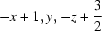
![[Figure 1]](./hy2183fig1thm.gif) | Fig. 1. Molecular structure of the title compound. Displacement ellipsoids are drawn at the 50% probability level. Hydrogen bonds are represented by dashed lines. [Symmetry code: (i) -x+1, y, -z+3/2.] |
![[Figure 2]](./hy2183fig2thm.gif) | Fig. 2. View of the crystal packing in the title compound. All H atoms except for those of water and the hydroxyl group are omitted for clarity. Hydrogen bonds are represented by dashed lines. |
| [Zn(C7H4FO3)2(H2O)2] | F(000) = 832 |
| Mr = 411.61 | Dx = 1.837 Mg m−3 |
| Monoclinic, C2/c | Mo Kα radiation, λ = 0.71073 Å |
| Hall symbol: -C 2yc | Cell parameters from 2066 reflections |
| a = 15.3096 (10) Å | θ = 2.7–24.1° |
| b = 5.4706 (4) Å | µ = 1.72 mm−1 |
| c = 17.7741 (12) Å | T = 150 K |
| β = 91.674 (1)° | Plate, colorless |
| V = 1487.99 (18) Å3 | 0.16 × 0.12 × 0.05 mm |
| Z = 4 |
| Bruker SMART APEX CCD diffractometer | 1520 independent reflections |
| Radiation source: fine-focus sealed tube | 1341 reflections with I > 2σ(I) |
| Graphite monochromator | Rint = 0.053 |
| ϕ and ω scans | θmax = 26.4°, θmin = 2.3° |
| Absorption correction: multi-scan (SADABS; Bruker, 2001) | h = −18→18 |
| Tmin = 0.893, Tmax = 1.000 | k = −6→6 |
| 8435 measured reflections | l = −22→22 |
| Refinement on F2 | Primary atom site location: structure-invariant direct methods |
| Least-squares matrix: full | Secondary atom site location: difference Fourier map |
| R[F2 > 2σ(F2)] = 0.035 | Hydrogen site location: mixed |
| wR(F2) = 0.081 | H atoms treated by a mixture of independent and constrained refinement |
| S = 1.09 | w = 1/[σ2(Fo2) + (0.0397P)2 + 0.7409P] where P = (Fo2 + 2Fc2)/3 |
| 1520 reflections | (Δ/σ)max < 0.001 |
| 126 parameters | Δρmax = 0.43 e Å−3 |
| 3 restraints | Δρmin = −0.27 e Å−3 |
| [Zn(C7H4FO3)2(H2O)2] | V = 1487.99 (18) Å3 |
| Mr = 411.61 | Z = 4 |
| Monoclinic, C2/c | Mo Kα radiation |
| a = 15.3096 (10) Å | µ = 1.72 mm−1 |
| b = 5.4706 (4) Å | T = 150 K |
| c = 17.7741 (12) Å | 0.16 × 0.12 × 0.05 mm |
| β = 91.674 (1)° |
| Bruker SMART APEX CCD diffractometer | 1520 independent reflections |
| Absorption correction: multi-scan (SADABS; Bruker, 2001) | 1341 reflections with I > 2σ(I) |
| Tmin = 0.893, Tmax = 1.000 | Rint = 0.053 |
| 8435 measured reflections |
| R[F2 > 2σ(F2)] = 0.035 | 3 restraints |
| wR(F2) = 0.081 | H atoms treated by a mixture of independent and constrained refinement |
| S = 1.09 | Δρmax = 0.43 e Å−3 |
| 1520 reflections | Δρmin = −0.27 e Å−3 |
| 126 parameters |
| x | y | z | Uiso*/Ueq | ||
| Zn1 | 0.5000 | 0.08063 (8) | 0.7500 | 0.01954 (15) | |
| C1 | 0.56321 (16) | 0.4151 (5) | 0.65619 (14) | 0.0204 (5) | |
| C2 | 0.62447 (16) | 0.5945 (5) | 0.62352 (14) | 0.0199 (5) | |
| C3 | 0.71316 (16) | 0.6031 (5) | 0.64632 (14) | 0.0191 (5) | |
| C4 | 0.76803 (16) | 0.7820 (5) | 0.61874 (14) | 0.0221 (6) | |
| H4 | 0.8278 | 0.7864 | 0.6346 | 0.026* | |
| C5 | 0.73553 (18) | 0.9533 (5) | 0.56829 (15) | 0.0246 (6) | |
| H5 | 0.7724 | 1.0775 | 0.5495 | 0.029* | |
| C6 | 0.64862 (18) | 0.9416 (5) | 0.54547 (15) | 0.0248 (6) | |
| C7 | 0.59321 (16) | 0.7666 (5) | 0.57150 (14) | 0.0223 (6) | |
| H7 | 0.5339 | 0.7624 | 0.5543 | 0.027* | |
| O1 | 0.59620 (11) | 0.2481 (3) | 0.69963 (10) | 0.0233 (4) | |
| O2 | 0.48283 (11) | 0.4310 (3) | 0.64435 (11) | 0.0265 (4) | |
| F1 | 0.61747 (11) | 1.1088 (3) | 0.49488 (10) | 0.0391 (5) | |
| O3 | 0.74885 (12) | 0.4400 (4) | 0.69676 (11) | 0.0266 (4) | |
| H3 | 0.7120 (18) | 0.341 (5) | 0.7060 (18) | 0.044 (10)* | |
| O4 | 0.42296 (13) | −0.1489 (4) | 0.69475 (13) | 0.0305 (5) | |
| H4A | 0.437 (2) | −0.271 (5) | 0.6700 (16) | 0.039 (10)* | |
| H4B | 0.3689 (13) | −0.132 (8) | 0.691 (2) | 0.068 (14)* |
| U11 | U22 | U33 | U12 | U13 | U23 | |
| Zn1 | 0.0113 (2) | 0.0184 (2) | 0.0290 (3) | 0.000 | 0.00249 (16) | 0.000 |
| C1 | 0.0169 (13) | 0.0199 (13) | 0.0245 (14) | 0.0015 (10) | 0.0036 (10) | −0.0063 (11) |
| C2 | 0.0174 (12) | 0.0209 (13) | 0.0214 (13) | −0.0025 (11) | 0.0021 (10) | −0.0012 (11) |
| C3 | 0.0149 (12) | 0.0239 (14) | 0.0186 (13) | 0.0015 (10) | 0.0019 (10) | −0.0007 (11) |
| C4 | 0.0118 (12) | 0.0293 (15) | 0.0252 (14) | −0.0026 (11) | 0.0016 (10) | −0.0009 (12) |
| C5 | 0.0224 (14) | 0.0238 (15) | 0.0277 (14) | −0.0068 (11) | 0.0065 (11) | 0.0003 (12) |
| C6 | 0.0233 (14) | 0.0255 (15) | 0.0256 (14) | 0.0021 (12) | 0.0000 (11) | 0.0056 (12) |
| C7 | 0.0151 (13) | 0.0263 (14) | 0.0253 (14) | −0.0005 (11) | −0.0013 (10) | 0.0008 (12) |
| O1 | 0.0150 (9) | 0.0239 (10) | 0.0312 (10) | 0.0009 (8) | 0.0054 (7) | 0.0060 (8) |
| O2 | 0.0121 (9) | 0.0233 (10) | 0.0443 (12) | −0.0014 (8) | 0.0025 (8) | −0.0025 (9) |
| F1 | 0.0282 (9) | 0.0390 (10) | 0.0500 (11) | 0.0008 (8) | −0.0028 (8) | 0.0232 (9) |
| O3 | 0.0132 (9) | 0.0315 (11) | 0.0350 (11) | −0.0020 (8) | −0.0020 (8) | 0.0111 (9) |
| O4 | 0.0139 (10) | 0.0277 (11) | 0.0497 (13) | 0.0020 (8) | −0.0017 (9) | −0.0155 (10) |
| Zn1—O4 | 1.966 (2) | C4—C5 | 1.380 (4) |
| Zn1—O4i | 1.966 (2) | C4—H4 | 0.9500 |
| Zn1—O1 | 1.9716 (17) | C5—C6 | 1.381 (4) |
| Zn1—O1i | 1.9717 (17) | C5—H5 | 0.9500 |
| C1—O2 | 1.246 (3) | C6—F1 | 1.359 (3) |
| C1—O1 | 1.289 (3) | C6—C7 | 1.369 (4) |
| C1—C2 | 1.487 (4) | C7—H7 | 0.9500 |
| C2—C7 | 1.394 (4) | O3—H3 | 0.803 (18) |
| C2—C3 | 1.406 (4) | O4—H4A | 0.834 (18) |
| C3—O3 | 1.367 (3) | O4—H4B | 0.834 (19) |
| C3—C4 | 1.388 (4) | ||
| O4—Zn1—O4i | 100.61 (13) | C5—C4—H4 | 120.1 |
| O4—Zn1—O1 | 121.01 (8) | C3—C4—H4 | 120.1 |
| O4i—Zn1—O1 | 94.50 (8) | C4—C5—C6 | 119.0 (2) |
| O4—Zn1—O1i | 94.50 (8) | C4—C5—H5 | 120.5 |
| O4i—Zn1—O1i | 121.01 (8) | C6—C5—H5 | 120.5 |
| O1—Zn1—O1i | 124.62 (11) | F1—C6—C7 | 119.0 (2) |
| O2—C1—O1 | 121.2 (2) | F1—C6—C5 | 118.7 (2) |
| O2—C1—C2 | 121.3 (2) | C7—C6—C5 | 122.3 (2) |
| O1—C1—C2 | 117.4 (2) | C6—C7—C2 | 119.5 (2) |
| C7—C2—C3 | 118.6 (2) | C6—C7—H7 | 120.3 |
| C7—C2—C1 | 119.8 (2) | C2—C7—H7 | 120.3 |
| C3—C2—C1 | 121.6 (2) | C1—O1—Zn1 | 108.44 (15) |
| O3—C3—C4 | 117.2 (2) | C3—O3—H3 | 108 (2) |
| O3—C3—C2 | 122.1 (2) | Zn1—O4—H4A | 128 (2) |
| C4—C3—C2 | 120.7 (2) | Zn1—O4—H4B | 123 (3) |
| C5—C4—C3 | 119.9 (2) | H4A—O4—H4B | 109 (4) |
| O2—C1—C2—C7 | −7.8 (4) | C4—C5—C6—F1 | −179.0 (2) |
| O1—C1—C2—C7 | 174.9 (2) | C4—C5—C6—C7 | 0.4 (4) |
| O2—C1—C2—C3 | 169.2 (2) | F1—C6—C7—C2 | −179.9 (2) |
| O1—C1—C2—C3 | −8.1 (4) | C5—C6—C7—C2 | 0.7 (4) |
| C7—C2—C3—O3 | −179.6 (2) | C3—C2—C7—C6 | −1.5 (4) |
| C1—C2—C3—O3 | 3.3 (4) | C1—C2—C7—C6 | 175.6 (2) |
| C7—C2—C3—C4 | 1.2 (4) | O2—C1—O1—Zn1 | −8.5 (3) |
| C1—C2—C3—C4 | −175.8 (2) | C2—C1—O1—Zn1 | 168.89 (17) |
| O3—C3—C4—C5 | −179.3 (2) | O4—Zn1—O1—C1 | 73.68 (18) |
| C2—C3—C4—C5 | −0.1 (4) | O4i—Zn1—O1—C1 | 178.91 (17) |
| C3—C4—C5—C6 | −0.7 (4) | O1i—Zn1—O1—C1 | −48.07 (15) |
| Symmetry code: (i) −x+1, y, −z+3/2. |
| D—H···A | D—H | H···A | D···A | D—H···A |
| O3—H3···O1 | 0.80 (2) | 1.84 (2) | 2.564 (3) | 149 (3) |
| O4—H4A···O2ii | 0.83 (2) | 1.83 (2) | 2.641 (3) | 162 (3) |
| O4—H4B···O3iii | 0.83 (2) | 1.89 (2) | 2.711 (3) | 170 (4) |
| Symmetry codes: (ii) x, y−1, z; (iii) x−1/2, y−1/2, z. |
Experimental details
| Crystal data | |
| Chemical formula | [Zn(C7H4FO3)2(H2O)2] |
| Mr | 411.61 |
| Crystal system, space group | Monoclinic, C2/c |
| Temperature (K) | 150 |
| a, b, c (Å) | 15.3096 (10), 5.4706 (4), 17.7741 (12) |
| β (°) | 91.674 (1) |
| V (Å3) | 1487.99 (18) |
| Z | 4 |
| Radiation type | Mo Kα |
| µ (mm−1) | 1.72 |
| Crystal size (mm) | 0.16 × 0.12 × 0.05 |
| Data collection | |
| Diffractometer | Bruker SMART APEX CCD diffractometer |
| Absorption correction | Multi-scan (SADABS; Bruker, 2001) |
| Tmin, Tmax | 0.893, 1.000 |
| No. of measured, independent and observed [I > 2σ(I)] reflections | 8435, 1520, 1341 |
| Rint | 0.053 |
| (sin θ/λ)max (Å−1) | 0.625 |
| Refinement | |
| R[F2 > 2σ(F2)], wR(F2), S | 0.035, 0.081, 1.09 |
| No. of reflections | 1520 |
| No. of parameters | 126 |
| No. of restraints | 3 |
| H-atom treatment | H atoms treated by a mixture of independent and constrained refinement |
| Δρmax, Δρmin (e Å−3) | 0.43, −0.27 |
Computer programs: SMART (Bruker, 2007), SAINT-Plus (Bruker, 2007), SHELXS97 (Sheldrick, 2008), SHELXL97 (Sheldrick, 2008), DIAMOND (Brandenburg, 1999), SHELXTL (Sheldrick, 2008).
| Zn1—O4 | 1.966 (2) | Zn1—O1 | 1.9716 (17) |
| O4—Zn1—O4i | 100.61 (13) | O4—Zn1—O1i | 94.50 (8) |
| O4—Zn1—O1 | 121.01 (8) | O1—Zn1—O1i | 124.62 (11) |
| Symmetry code: (i) −x+1, y, −z+3/2. |
| D—H···A | D—H | H···A | D···A | D—H···A |
| O3—H3···O1 | 0.803 (18) | 1.84 (2) | 2.564 (3) | 149 (3) |
| O4—H4A···O2ii | 0.834 (18) | 1.83 (2) | 2.641 (3) | 162 (3) |
| O4—H4B···O3iii | 0.834 (19) | 1.89 (2) | 2.711 (3) | 170 (4) |
| Symmetry codes: (ii) x, y−1, z; (iii) x−1/2, y−1/2, z. |
Acknowledgements
Financial support from the National Science Foundation, awards CHE-0714555 and CHE-0714439, is gratefully acknowledged.
References
 Brandenburg, K. (1999). DIAMOND. Crystal Impact GbR, Bonn, Germany. Google Scholar
Brownless, J. B., Edwards, D. A. & Mahon, M. F. (1999). Inorg. Chim. Acta, 287, 89–94. Web of Science CSD CrossRef CAS Google Scholar
Bruker (2001). SADABS. Bruker AXS Inc., Madison, Wisconsin, USA. Google Scholar
Bruker (2007). SMART and SAINT-Plus. Bruker AXS Inc., Madison, Wisconsin, USA. Google Scholar
Ellsworth, J. M. & zur Loye, H.-C. (2008). Dalton Trans. pp. 5823–5835. Web of Science CrossRef Google Scholar
Janiak, C. (2003). Dalton Trans. pp. 2781–2804. Web of Science CrossRef Google Scholar
Mehrotra, R. C. & Bohra, R. (1983). In Metal Carboxylates. London: Academic Press. Google Scholar
Sheldrick, G. M. (2008). Acta Cryst. A64, 112–122. Web of Science CrossRef CAS IUCr Journals Google Scholar
Wang, Z., Zhang, H., Chen, Y., Huang, C., Sun, R., Cao, Y. & Yu, X. (2006). J. Solid State Chem. 179, 1536–1544. Web of Science CSD CrossRef CAS Google Scholar
Wasuke, M., Tomohiko, S., Tesushi, O., Chika, N. K. & Tohru, T. (2005). J. Solid State Chem. 178, 2555–2573. Web of Science CrossRef Google Scholar
This is an open-access article distributed under the terms of the Creative Commons Attribution (CC-BY) Licence, which permits unrestricted use, distribution, and reproduction in any medium, provided the original authors and source are cited.
| CRYSTALLOGRAPHIC COMMUNICATIONS |


Metal carboxylate complexes have long been an extensively studied class of compounds (Mehrotra & Bohra, 1983), and in recent years they have become a major focus of study due to their potentally useful properties (Janiak, 2003; Wasuke et al., 2005). As a continuation of our own studies (Ellsworth & zur Loye, 2008), we report here the crystal structure of the title compound.
The structure of the title compound is built from the monomeric complex of formula Zn(5-fsalcyl)2(H2O)2 (Fig. 1) (5-fsalcyl = 5-fluorosalicylate). The asymmetric unit consists of one ZnII atom that lies on a twofold rotation axis, one 5-fsalcyl ligand, and one water molecule. The coordination environment of the ZnII atom is that of a distorted tetrahedron consisting of two equivalent O atoms from two monodentate carboxylates, and two equivalent O atoms from two water molecules. All four Zn—O bond distances fall within the normal range, with an average length of 1.969 (2) Å. It is worth noting that for the carboxylate O2 atom, the Zn···O2 distance of 2.692 (2)Å falls outside the range considered normal for a Zn—O coordination bond (Wang et al., 2006).
Due to its monodentate binding mode, the 5-fsalcyl carboxylate group adopts a highly asymmetrical configuration. This is manifested in a C1—O1 distance [1.289 (3) Å] for the coordinating O atom that is noticeably longer than the C1—O2 distance [1.246 (3) Å] corresponding to the noncoordinating O atom. In addition, the carboxylate group of the 5-fsalcyl ligand is twisted with a dihedral angle of 9.7 (2) ° with respect to the phenyl ring. As is typical for salicylates, the hydroxyl group of 5-fsalcyl is internally hydrogen bonded to its carboxylate O1 that is located on the same side of the ligand (Brownless et al., 1999).
The monomeric units are hydrogen bonded into chains that are themselves hydrogen bonded into sheets that are stacked along the c axis (Fig. 2).