 | Acta Crystallographica Section E Acta Crystallographica Section E CRYSTALLOGRAPHIC COMMUNICATIONS |


 journal menu


organic compounds
| CRYSTALLOGRAPHIC COMMUNICATIONS |
 access
2-Methylimidazolium hydrogen maleate

aCollege of Horticulture and Gardening, Yangtze University, Jingzhou 434025, Hubei, People's Republic of China, and College of Biological Science and Biotechnology, Beijing Forestry University, Beijing 100083, People's Republic of China
*Correspondence e-mail: [email protected]
Molecules in the title compound, C4H7N2+·C4H3O4−, are linked by intermolecular N—H⋯O hydrogen bonds into one-dimensional chains parallel to [101]. These chains are in turn linked by an R22(8) motif, formed by weak C—H⋯O hydrogen bonds, into corrugated sheets running parallel to (10 ). These sheets are further linked by weak intermolecular C—H⋯O hydrogen bonds, forming a three-dimensional network. Intramolecular N—H⋯O and O—H⋯O interactions are also present.
Related literature
For related structures, see: Aakeröy & Salmon (2005![[Aakeröy, C. B. & Salmon, D. J. (2005). CrystEngComm, 7, 439-448.]](../../../../../../logos/arrows/e_arr.gif "Aakeröy, C. B. & Salmon, D. J. (2005). CrystEngComm, 7, 439-448.") ); Liu & Meng (2006). For hydrogen-bond motifs, see: Bernstein et al. (1995).
); Liu & Meng (2006). For hydrogen-bond motifs, see: Bernstein et al. (1995).
![[Scheme 1]](lh2769scheme1.gif)
Experimental
Crystal data
|
Refinement
|
|
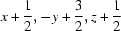 ; (ii)
 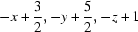 .
. Data collection: SMART (Bruker, 2001); cell refinement: SAINT-Plus (Bruker, 2001); data reduction: SAINT-Plus; program(s) used to solve structure: SHELXS97 (Sheldrick, 2008); program(s) used to refine structure: SHELXL97 (Sheldrick, 2008); molecular graphics: PLATON (Spek, 2003); software used to prepare material for publication: PLATON.
Supporting information
contains datablocks global, I. DOI: 10.1107/S1600536809004103/lh2769sup1.cif
Structure factors: contains datablock I. DOI: 10.1107/S1600536809004103/lh2769Isup2.hkl
All the reagents and solvents were used as obtained without further purification. A 1:2 molar amounts of maleic acid (0.1 mmol, 11.6 mg) and 2-methylimidazole (0.2 mmol, 16.4 mg) were dissolved in 95% methanol (10 ml). The mixture was stirred for half an hour at room temperature and then filtered. The resulting solution was kept in air for one week. Block-shaped crystals suitable for single-crystal X-ray were grown by slow evaporation of a solution of (I).
H atoms bonded to C atoms were located in difference maps and subsequently treated as riding modes, with C–H=0.93 Å, Uiso(H) = 1.2Ueq(C) and C–H=0.96 Å, 1.5Ueq(C) for methyl H atoms. H atoms bonded to N and O atoms were also found in the difference maps and their distances were refined freely (see Table 1 for the distances), and the Uiso(H) values being set k times of their carrier atoms (k=1.2 for N and 1.5 for O atoms)
Data collection: SMART (Bruker, 2001); cell SAINT-Plus (Bruker, 2001); data reduction: SAINT-Plus (Bruker, 2001); program(s) used to solve structure: SHELXS97 (Sheldrick, 2008); program(s) used to refine structure: SHELXL97 (Sheldrick, 2008); molecular graphics: PLATON (Spek, 2003); software used to prepare material for publication: PLATON (Spek, 2003).
![[Figure 1]](./lh2769fig1thm.gif) | Fig. 1. Molecular structure of (I), showing the atom-numbering scheme. Displacement ellipsoids are drawn at the 50% probability level. H-bonds are shown in dashed lines. |
![[Figure 2]](./lh2769fig2thm.gif) | Fig. 2. Part of the crystal structure of (I), showing the formation of the one-dimensional chain linked by intermolecular N-H···O hydrogen bonds parallel to the [101] direction. (symmetry code: i = 1/2+x, 3/2-y, 1/2+z) |
![[Figure 3]](./lh2769fig3thm.gif) | Fig. 3. Part of the crystal structure of (I), showing the formation of the two-dimensional corrugated sheet linked by intermolecular N-H···O and C-H···O hydrogen bonds (a) view perpendicular to the (101) plane and (b) view along to the (101) plane, respectively. Only H atoms involved in hydrogen bonds are shown. |
| C4H7N2+·C4H3O4− | F(000) = 832 |
| Mr = 198.18 | Dx = 1.336 Mg m−3 |
| Monoclinic, C2/c | Mo Kα radiation, λ = 0.71073 Å |
| Hall symbol: -C 2yc | Cell parameters from 1457 reflections |
| a = 13.9897 (14) Å | θ = 3.1–21.4° |
| b = 7.2274 (7) Å | µ = 0.11 mm−1 |
| c = 20.533 (2) Å | T = 295 K |
| β = 108.310 (2)° | Block, colorless |
| V = 1970.9 (3) Å3 | 0.10 × 0.10 × 0.08 mm |
| Z = 8 |
| Bruker SMART APEX CCD area-detector diffractometer | 2143 independent reflections |
| Radiation source: fine focus sealed Siemens Mo tube | 1273 reflections with I > 2σ(I) |
| Graphite monochromator | Rint = 0.027 |
| 0.3° wide ω exposures scans | θmax = 27.0°, θmin = 2.1° |
| Absorption correction: multi-scan (SADABS; Sheldrick, 2001) | h = −17→17 |
| Tmin = 0.979, Tmax = 0.991 | k = −9→9 |
| 7461 measured reflections | l = −26→24 |
| Refinement on F2 | Primary atom site location: structure-invariant direct methods |
| Least-squares matrix: full | Secondary atom site location: difference Fourier map |
| R[F2 > 2σ(F2)] = 0.046 | Hydrogen site location: inferred from neighbouring sites |
| wR(F2) = 0.130 | H atoms treated by a mixture of independent and constrained refinement |
| S = 0.99 | w = 1/[σ2(Fo2) + (0.0703P)2] where P = (Fo2 + 2Fc2)/3 |
| 2143 reflections | (Δ/σ)max = 0.001 |
| 137 parameters | Δρmax = 0.17 e Å−3 |
| 0 restraints | Δρmin = −0.13 e Å−3 |
| C4H7N2+·C4H3O4− | V = 1970.9 (3) Å3 |
| Mr = 198.18 | Z = 8 |
| Monoclinic, C2/c | Mo Kα radiation |
| a = 13.9897 (14) Å | µ = 0.11 mm−1 |
| b = 7.2274 (7) Å | T = 295 K |
| c = 20.533 (2) Å | 0.10 × 0.10 × 0.08 mm |
| β = 108.310 (2)° |
| Bruker SMART APEX CCD area-detector diffractometer | 2143 independent reflections |
| Absorption correction: multi-scan (SADABS; Sheldrick, 2001) | 1273 reflections with I > 2σ(I) |
| Tmin = 0.979, Tmax = 0.991 | Rint = 0.027 |
| 7461 measured reflections |
| R[F2 > 2σ(F2)] = 0.046 | 0 restraints |
| wR(F2) = 0.130 | H atoms treated by a mixture of independent and constrained refinement |
| S = 0.99 | Δρmax = 0.17 e Å−3 |
| 2143 reflections | Δρmin = −0.13 e Å−3 |
| 137 parameters |
Geometry. All esds (except the esd in the dihedral angle between two l.s. planes) are estimated using the full covariance matrix. The cell esds are taken into account individually in the estimation of esds in distances, angles and torsion angles; correlations between esds in cell parameters are only used when they are defined by crystal symmetry. An approximate (isotropic) treatment of cell esds is used for estimating esds involving l.s. planes. |
Refinement. Refinement of F2 against ALL reflections. The weighted R-factor wR and goodness of fit S are based on F2, conventional R-factors R are based on F, with F set to zero for negative F2. The threshold expression of F2 > 2sigma(F2) is used only for calculating R-factors(gt) etc. and is not relevant to the choice of reflections for R-factors based on F2 are statistically about twice as large as those based on F, and R- factors based on ALL data will be even larger. |
| x | y | z | Uiso*/Ueq | ||
| C1 | 0.77143 (12) | 0.6738 (2) | 0.65115 (8) | 0.0603 (4) | |
| C2 | 0.64878 (15) | 0.5430 (3) | 0.57064 (11) | 0.0810 (6) | |
| H2 | 0.5957 | 0.5264 | 0.5303 | 0.097* | |
| C3 | 0.68665 (14) | 0.4163 (3) | 0.61863 (11) | 0.0812 (6) | |
| H3 | 0.6654 | 0.2943 | 0.6183 | 0.097* | |
| C4 | 0.84501 (15) | 0.8105 (3) | 0.69038 (10) | 0.0855 (6) | |
| H4A | 0.8699 | 0.7731 | 0.7376 | 0.128* | |
| H4B | 0.8131 | 0.9293 | 0.6872 | 0.128* | |
| H4C | 0.9000 | 0.8183 | 0.6720 | 0.128* | |
| C5 | 0.61393 (13) | 1.0269 (2) | 0.46763 (9) | 0.0630 (5) | |
| C6 | 0.59800 (13) | 1.1982 (2) | 0.42603 (9) | 0.0641 (5) | |
| H6 | 0.6446 | 1.2915 | 0.4440 | 0.077* | |
| C7 | 0.52819 (11) | 1.2406 (2) | 0.36726 (9) | 0.0643 (5) | |
| H7 | 0.5327 | 1.3601 | 0.3517 | 0.077* | |
| C8 | 0.44457 (13) | 1.1297 (3) | 0.32255 (9) | 0.0652 (5) | |
| N1 | 0.70226 (11) | 0.7022 (2) | 0.59149 (8) | 0.0687 (4) | |
| H1 | 0.6924 (14) | 0.811 (3) | 0.5686 (9) | 0.082* | |
| N2 | 0.76299 (11) | 0.4998 (2) | 0.66877 (8) | 0.0665 (4) | |
| H2A | 0.8074 (14) | 0.439 (3) | 0.7076 (10) | 0.080* | |
| O1 | 0.55899 (10) | 0.88414 (17) | 0.44508 (7) | 0.0830 (4) | |
| O2 | 0.68111 (10) | 1.02685 (18) | 0.52321 (7) | 0.0844 (4) | |
| O3 | 0.43419 (11) | 0.96097 (18) | 0.33767 (7) | 0.0885 (5) | |
| H3A | 0.495 (2) | 0.916 (3) | 0.3917 (15) | 0.133* | |
| O4 | 0.38675 (9) | 1.20541 (19) | 0.27165 (6) | 0.0826 (4) |
| U11 | U22 | U33 | U12 | U13 | U23 | |
| C1 | 0.0574 (10) | 0.0627 (11) | 0.0610 (10) | 0.0021 (8) | 0.0187 (8) | −0.0008 (8) |
| C2 | 0.0663 (11) | 0.0887 (15) | 0.0787 (13) | −0.0016 (10) | 0.0093 (10) | −0.0184 (11) |
| C3 | 0.0727 (12) | 0.0667 (12) | 0.0994 (15) | −0.0082 (10) | 0.0202 (11) | −0.0139 (11) |
| C4 | 0.0861 (13) | 0.0770 (14) | 0.0872 (14) | −0.0151 (10) | 0.0186 (11) | −0.0040 (10) |
| C5 | 0.0611 (10) | 0.0644 (11) | 0.0618 (11) | −0.0024 (8) | 0.0169 (9) | −0.0047 (8) |
| C6 | 0.0662 (10) | 0.0583 (10) | 0.0644 (11) | −0.0138 (8) | 0.0158 (9) | −0.0052 (8) |
| C7 | 0.0649 (10) | 0.0580 (10) | 0.0660 (11) | −0.0100 (8) | 0.0147 (9) | −0.0006 (8) |
| C8 | 0.0631 (11) | 0.0734 (12) | 0.0588 (11) | −0.0047 (9) | 0.0188 (9) | −0.0052 (9) |
| N1 | 0.0679 (9) | 0.0715 (10) | 0.0631 (9) | 0.0079 (8) | 0.0154 (8) | 0.0042 (7) |
| N2 | 0.0633 (9) | 0.0610 (9) | 0.0712 (10) | 0.0041 (7) | 0.0156 (8) | 0.0035 (7) |
| O1 | 0.0929 (9) | 0.0625 (8) | 0.0787 (9) | −0.0138 (7) | 0.0056 (8) | 0.0039 (6) |
| O2 | 0.0830 (9) | 0.0878 (10) | 0.0658 (8) | −0.0080 (7) | −0.0005 (7) | 0.0060 (6) |
| O3 | 0.0962 (10) | 0.0716 (9) | 0.0768 (9) | −0.0281 (7) | −0.0028 (7) | −0.0017 (7) |
| O4 | 0.0748 (8) | 0.0894 (9) | 0.0693 (8) | −0.0015 (7) | 0.0021 (7) | 0.0008 (7) |
| C1—N1 | 1.317 (2) | C5—O1 | 1.283 (2) |
| C1—N2 | 1.324 (2) | C5—C6 | 1.481 (2) |
| C1—C4 | 1.471 (2) | C6—C7 | 1.328 (2) |
| C2—C3 | 1.327 (3) | C6—H6 | 0.9300 |
| C2—N1 | 1.366 (2) | C7—C8 | 1.476 (2) |
| C2—H2 | 0.9300 | C7—H7 | 0.9300 |
| C3—N2 | 1.369 (2) | C8—O4 | 1.2307 (19) |
| C3—H3 | 0.9300 | C8—O3 | 1.278 (2) |
| C4—H4A | 0.9600 | N1—H1 | 0.901 (19) |
| C4—H4B | 0.9600 | N2—H2A | 0.95 (2) |
| C4—H4C | 0.9600 | O1—H3A | 1.20 (3) |
| C5—O2 | 1.230 (2) | O3—H3A | 1.21 (3) |
| N1—C1—N2 | 107.46 (16) | C7—C6—C5 | 130.67 (15) |
| N1—C1—C4 | 125.99 (16) | C7—C6—H6 | 114.7 |
| N2—C1—C4 | 126.55 (16) | C5—C6—H6 | 114.7 |
| C3—C2—N1 | 107.26 (17) | C6—C7—C8 | 130.74 (16) |
| C3—C2—H2 | 126.4 | C6—C7—H7 | 114.6 |
| N1—C2—H2 | 126.4 | C8—C7—H7 | 114.6 |
| C2—C3—N2 | 106.84 (18) | O4—C8—O3 | 122.41 (17) |
| C2—C3—H3 | 126.6 | O4—C8—C7 | 117.90 (17) |
| N2—C3—H3 | 126.6 | O3—C8—C7 | 119.69 (16) |
| C1—C4—H4A | 109.5 | C1—N1—C2 | 109.26 (16) |
| C1—C4—H4B | 109.5 | C1—N1—H1 | 124.6 (12) |
| H4A—C4—H4B | 109.5 | C2—N1—H1 | 126.1 (12) |
| C1—C4—H4C | 109.5 | C1—N2—C3 | 109.18 (16) |
| H4A—C4—H4C | 109.5 | C1—N2—H2A | 125.4 (11) |
| H4B—C4—H4C | 109.5 | C3—N2—H2A | 125.1 (11) |
| O2—C5—O1 | 122.12 (17) | C5—O1—H3A | 111.7 (11) |
| O2—C5—C6 | 117.90 (15) | C5—O2—H1 | 113.4 (6) |
| O1—C5—C6 | 119.98 (16) | C8—O3—H3A | 112.4 (11) |
| N1—C2—C3—N2 | 0.3 (2) | C4—C1—N1—C2 | 179.34 (16) |
| O2—C5—C6—C7 | −175.16 (18) | C3—C2—N1—C1 | −0.1 (2) |
| O1—C5—C6—C7 | 5.4 (3) | N1—C1—N2—C3 | 0.27 (19) |
| C5—C6—C7—C8 | −1.9 (3) | C4—C1—N2—C3 | −179.18 (16) |
| C6—C7—C8—O4 | 176.67 (17) | C2—C3—N2—C1 | −0.3 (2) |
| C6—C7—C8—O3 | −3.0 (3) | O1—C5—O2—H1 | −0.7 (7) |
| N2—C1—N1—C2 | −0.11 (19) | C6—C5—O2—H1 | 179.9 (6) |
| D—H···A | D—H | H···A | D···A | D—H···A |
| O1—H3A···O3 | 1.20 (3) | 1.21 (3) | 2.4085 (18) | 174 (2) |
| N1—H1···O2 | 0.901 (19) | 1.80 (2) | 2.701 (2) | 176.3 (17) |
| N2—H2A···O4i | 0.95 (2) | 1.77 (2) | 2.713 (2) | 171.2 (17) |
| C3—H3···O3ii | 0.93 | 2.64 | 3.471 (2) | 150 |
| C4—H4A···O3i | 0.96 | 2.59 | 3.490 (2) | 155 |
| C6—H6···O2iii | 0.93 | 2.66 | 3.544 (2) | 158 |
| Symmetry codes: (i) x+1/2, −y+3/2, z+1/2; (ii) −x+1, −y+1, −z+1; (iii) −x+3/2, −y+5/2, −z+1. |
Experimental details
| Crystal data | |
| Chemical formula | C4H7N2+·C4H3O4− |
| Mr | 198.18 |
| Crystal system, space group | Monoclinic, C2/c |
| Temperature (K) | 295 |
| a, b, c (Å) | 13.9897 (14), 7.2274 (7), 20.533 (2) |
| β (°) | 108.310 (2) |
| V (Å3) | 1970.9 (3) |
| Z | 8 |
| Radiation type | Mo Kα |
| µ (mm−1) | 0.11 |
| Crystal size (mm) | 0.10 × 0.10 × 0.08 |
| Data collection | |
| Diffractometer | Bruker SMART APEX CCD area-detector diffractometer |
| Absorption correction | Multi-scan (SADABS; Sheldrick, 2001) |
| Tmin, Tmax | 0.979, 0.991 |
| No. of measured, independent and observed [I > 2σ(I)] reflections | 7461, 2143, 1273 |
| Rint | 0.027 |
| (sin θ/λ)max (Å−1) | 0.639 |
| Refinement | |
| R[F2 > 2σ(F2)], wR(F2), S | 0.046, 0.130, 0.99 |
| No. of reflections | 2143 |
| No. of parameters | 137 |
| H-atom treatment | H atoms treated by a mixture of independent and constrained refinement |
| Δρmax, Δρmin (e Å−3) | 0.17, −0.13 |
Computer programs: SMART (Bruker, 2001), SAINT-Plus (Bruker, 2001), SHELXS97 (Sheldrick, 2008), SHELXL97 (Sheldrick, 2008), PLATON (Spek, 2003).
| D—H···A | D—H | H···A | D···A | D—H···A |
| O1—H3A···O3 | 1.20 (3) | 1.21 (3) | 2.4085 (18) | 174 (2) |
| N1—H1···O2 | 0.901 (19) | 1.80 (2) | 2.701 (2) | 176.3 (17) |
| N2—H2A···O4i | 0.95 (2) | 1.77 (2) | 2.713 (2) | 171.2 (17) |
| C3—H3···O3ii | 0.93 | 2.64 | 3.471 (2) | 150 |
| C4—H4A···O3i | 0.96 | 2.59 | 3.490 (2) | 155 |
| C6—H6···O2iii | 0.93 | 2.66 | 3.544 (2) | 158 |
| Symmetry codes: (i) x+1/2, −y+3/2, z+1/2; (ii) −x+1, −y+1, −z+1; (iii) −x+3/2, −y+5/2, −z+1. |
Acknowledgements
This work received financial support mainly from Yangtze University.
References
 Aakeröy, C. B. & Salmon, D. J. (2005). CrystEngComm, 7, 439–448. Web of Science CrossRef Google Scholar
Bernstein, J., Davis, R. E., Shimoni, L. & Chang, N. (1995). Angew. Chem. Int. Ed. Engl. 34, 1555–1573. CrossRef CAS Web of Science Google Scholar
Bruker (2001). SAINT-Plus and SMART. Bruker AXS Inc., Madison, Wisconsin, USA. Google Scholar
Liu, Z.-X. & Meng, X.-G. (2006). Acta Cryst. E62, o1286–o1288. Web of Science CSD CrossRef CAS IUCr Journals Google Scholar
Sheldrick, G. M. (2001). SADABS. University of Göttingen, Germany. Google Scholar
Sheldrick, G. M. (2008). Acta Cryst. A64, 112–122. Web of Science CrossRef CAS IUCr Journals Google Scholar
Spek, A. L. (2003). J. Appl. Cryst. 36, 7–13. Web of Science CrossRef CAS IUCr Journals Google Scholar
This is an open-access article distributed under the terms of the Creative Commons Attribution (CC-BY) Licence, which permits unrestricted use, distribution, and reproduction in any medium, provided the original authors and source are cited.
| CRYSTALLOGRAPHIC COMMUNICATIONS |


As part of the continuing studies on the synthesis of co-crystal or organic salts involving imidazole (Liu & Meng, 2006), the crystal structure of title compound (I) is reported. It was obtained by mixing a 2:1 molar amounts of 2-methylimidazole and 2-maleic acid and in 95% methanol solution at room temperature.
According to Aakeröy and Salmon (2005) complex (I) is an organic salt. In (I), one of the carboxyl protons is transferred to the imidazole N atom, forming a 1:1 anhydrous organic adduct. The two carboxyl groups in the maleate anion are hydrogen-bonded to each other via atom H3A located approximately at the mid-point of atoms O1 and O3 (Fig.1).
In the crystal structure, by a combination of N1-H1···O2, N2-H2A···O4i and C4-H4A···O3i hydrogen bonds (symmetry codes as in Table 1) molecules in (I) are linked into a one-dimensional chain parallel to the [101] direction (Fig.2). These adjacent chains are linked by a R22(8) hydrogen motif (Bernstein et al., 1995) originating from two weak centrosymmetric C6-H6···O2 (3/2-x, 5/2-y, 1-z) hydrogen bonds, into a corrugated sheet running parallel to the (101) plane (Fig.3). These sheets are further linked by weak C3-H3···O3 (1-x, 1-y, 1-z) hydrogen bonds, forming a three-dimensional network.