 | Acta Crystallographica Section E Acta Crystallographica Section E CRYSTALLOGRAPHIC COMMUNICATIONS |


 journal menu


metal-organic compounds
| CRYSTALLOGRAPHIC COMMUNICATIONS |
 access
4-(3-Ammoniopropyl)morpholin-4-ium tetrachloridozincate(II)

aLaboratoire de Chimie des Matériaux, Faculté des Sciences de Bizerte, 7021 Zarzouna, Tunisia, and bUniverstié Lyon1, Centre de Diffractométrie Henri Longchambon, 43 Boulevard du 11 Novembre 1918, 69622 Villeurbanne Cedex, France
*Correspondence e-mail: [email protected]
In the title compound, (C7H18N2O)[ZnCl4], the ZnII ion is coordinated by four Cl atoms in a close to tetrahedral geometry. The crystal packing exhibits C—H⋯Cl, N—H⋯Cl and N—H⋯O hydrogen bonds.
Related literature
For common applications of this material, see: Bringley & Rajeswaran (2006![[Bringley, J. F. & Rajeswaran, M. (2006). Acta Cryst. E62, m1304-m1305.]](../../../../../../logos/arrows/e_arr.gif "Bringley, J. F. & Rajeswaran, M. (2006). Acta Cryst. E62, m1304-m1305.") ); Tao et al. (2003). For structure cohesion, see: Brammer et al. (2002). For a discussion of Zn—Cl distances and Cl—Zn—Cl bond angles, see: Guo et al. (2007); Valkonen et al. (2006). For computational details, see: Prince (1982); Watkin (1994).
); Tao et al. (2003). For structure cohesion, see: Brammer et al. (2002). For a discussion of Zn—Cl distances and Cl—Zn—Cl bond angles, see: Guo et al. (2007); Valkonen et al. (2006). For computational details, see: Prince (1982); Watkin (1994).
![[Scheme 1]](lx2089scheme1.gif)
Experimental
Crystal data
|
Refinement
|
|
 ; (ii)
  ; (iv)
  .
. Data collection: CrysAlis CCD (Oxford Diffraction, 2002); cell refinement: CrysAlis RED (Oxford Diffraction, 2002); data reduction: CrysAlis RED; program(s) used to solve structure: SIR97 (Altomare et al., 1999); program(s) used to refine structure: CRYSTALS (Betteridge et al., 2003); molecular graphics: CAMERON (Watkin et al., 1996); software used to prepare material for publication: CRYSTALS.
Supporting information
contains datablocks global, I. DOI: 10.1107/S1600536809004346/lx2089sup1.cif
Structure factors: contains datablock I. DOI: 10.1107/S1600536809004346/lx2089Isup2.hkl
ZnCl2, aqueous 1M HCl solution and 3-Morpholinopropylamine in a 1:2:1 molar ratio were mixed and dissolved in sufficient ethanol. Single crystals suitable for X-ray diffraction were prepared by evaporation of a solution of the title compound in ethanol at room temperature after a few days.
The H atoms were all located in a difference map, but those attached to carbon atoms were repositioned geometrically. The H atoms were initially refined with soft restraints on the bond lengths and angles to regularize their geometry (C—H in the range 0.93–0.98, N—H in the range 0.86–0.89 and O—H = 0.82 Å) and Uiso(H) (in the range 1.2–1.5 times Ueq of the parent atom), after which the positions were refined with riding constraints.
Data collection: Xcalibur User Manual (Oxford Diffraction, 2002); cell CrysAlis RED (Oxford Diffraction, 2002); data reduction: CrysAlis RED (Oxford Diffraction, 2002); program(s) used to solve structure: SIR97 (Altomare et al., 1999); program(s) used to refine structure: CRYSTALS (Betteridge et al., 2003); molecular graphics: CAMERON (Watkin et al., 1996); software used to prepare material for publication: CRYSTALS (Betteridge et al., 2003).
![[Figure 1]](./lx2089fig1thm.gif) | Fig. 1. The molecular structure of the title compound, showing displacement ellipsoids drawn at the 40% probability level. |
![[Figure 2]](./lx2089fig2thm.gif) | Fig. 2. Crystal structure of (I) viewed along b axis showing the layered organization. |
![[Figure 3]](./lx2089fig3thm.gif) | Fig. 3. The packing of (I) viewed down the a axis showing layers at y = 1/4 and y = 3/4. |
| (C7H18N2O)[ZnCl4] | F(000) = 720 |
| Mr = 353.42 | Dx = 1.712 Mg m−3 |
| Monoclinic, P21/c | Mo Kα radiation, λ = 0.7107 Å |
| Hall symbol: -P 2ybc | Cell parameters from 7336 reflections |
| a = 6.2765 (2) Å | θ = 2.8–29.2° |
| b = 14.3552 (4) Å | µ = 2.55 mm−1 |
| c = 15.4858 (6) Å | T = 293 K |
| β = 100.759 (4)° | Block, colorless |
| V = 1370.75 (8) Å3 | 0.17 × 0.09 × 0.08 mm |
| Z = 4 |
| Oxford Diffraction XCALIBUR area-detector diffractometer | 3304 independent reflections |
| Radiation source: Enhance (Mo) X-ray Source | 2815 reflections with I > 2σ(I) |
| Graphite monochromator | Rint = 0.021 |
| Detector resolution: 15.9897 pixels mm-1 | θmax = 29.3°, θmin = 2.8° |
| ϕ and ω scans | h = −8→8 |
| Absorption correction: multi-scan (CrysAlis RED; Oxford Diffraction, 2002) | k = −18→18 |
| Tmin = 0.63, Tmax = 0.82 | l = −18→20 |
| 13120 measured reflections |
| Refinement on F | Hydrogen site location: inferred from neighbouring sites |
| Least-squares matrix: full | H-atom parameters constrained |
| R[F2 > 2σ(F2)] = 0.019 | Method, part 1, Chebychev polynomial, (Watkin, 1994, Prince, 1982) [weight] = 1.0/[A0*T0(x) + A1*T1(x) ··· + An-1]*Tn-1(x)] where Ai are the Chebychev coefficients listed below and x = F /Fmax Method = Robust Weighting (Prince, 1982) W = [weight] * [1-(deltaF/6*sigmaF)2]2 Ai are: 8.69 -6.08 5.75 |
| wR(F2) = 0.020 | (Δ/σ)max = 0.001 |
| S = 1.04 | Δρmax = 0.27 e Å−3 |
| 2696 reflections | Δρmin = −0.19 e Å−3 |
| 137 parameters | Extinction correction: Larson (1970), Equation 22 |
| 0 restraints | Extinction coefficient: 64 (4) |
| Primary atom site location: structure-invariant direct methods |
| (C7H18N2O)[ZnCl4] | V = 1370.75 (8) Å3 |
| Mr = 353.42 | Z = 4 |
| Monoclinic, P21/c | Mo Kα radiation |
| a = 6.2765 (2) Å | µ = 2.55 mm−1 |
| b = 14.3552 (4) Å | T = 293 K |
| c = 15.4858 (6) Å | 0.17 × 0.09 × 0.08 mm |
| β = 100.759 (4)° |
| Oxford Diffraction XCALIBUR area-detector diffractometer | 3304 independent reflections |
| Absorption correction: multi-scan (CrysAlis RED; Oxford Diffraction, 2002) | 2815 reflections with I > 2σ(I) |
| Tmin = 0.63, Tmax = 0.82 | Rint = 0.021 |
| 13120 measured reflections |
| R[F2 > 2σ(F2)] = 0.019 | 0 restraints |
| wR(F2) = 0.020 | H-atom parameters constrained |
| S = 1.04 | Δρmax = 0.27 e Å−3 |
| 2696 reflections | Δρmin = −0.19 e Å−3 |
| 137 parameters |
| x | y | z | Uiso*/Ueq | ||
| Zn1 | 0.37044 (3) | 0.371470 (11) | 0.756164 (11) | 0.0273 | |
| Cl1 | 0.48665 (7) | 0.47971 (3) | 0.85946 (3) | 0.0402 | |
| Cl2 | 0.00747 (6) | 0.35230 (3) | 0.74949 (3) | 0.0367 | |
| Cl3 | 0.51658 (6) | 0.22854 (2) | 0.79921 (3) | 0.0372 | |
| Cl4 | 0.43433 (6) | 0.42069 (3) | 0.62551 (2) | 0.0402 | |
| C1 | 0.2040 (3) | 0.73398 (12) | 0.47182 (11) | 0.0383 | |
| C2 | 0.2358 (3) | 0.83554 (14) | 0.45739 (12) | 0.0468 | |
| C3 | −0.0795 (3) | 0.87396 (11) | 0.50847 (11) | 0.0441 | |
| C4 | −0.1308 (2) | 0.77313 (10) | 0.52356 (10) | 0.0319 | |
| C5 | 0.0385 (3) | 0.61461 (10) | 0.54896 (10) | 0.0319 | |
| C6 | −0.1030 (2) | 0.58498 (10) | 0.61278 (9) | 0.0310 | |
| C7 | −0.0059 (2) | 0.60272 (10) | 0.70780 (9) | 0.0284 | |
| O | 0.0323 (2) | 0.88265 (8) | 0.43720 (8) | 0.0456 | |
| N1 | 0.07386 (18) | 0.71776 (8) | 0.54268 (7) | 0.0256 | |
| N2 | −0.1501 (2) | 0.56344 (9) | 0.76395 (8) | 0.0355 | |
| H1 | 0.1513 | 0.7371 | 0.5924 | 0.0370* | |
| H2 | −0.0977 | 0.5758 | 0.8191 | 0.0530* | |
| H3 | −0.1610 | 0.5037 | 0.7569 | 0.0543* | |
| H4 | −0.2786 | 0.5881 | 0.7508 | 0.0540* | |
| H5 | 0.3391 | 0.7034 | 0.4902 | 0.0478* | |
| H6 | 0.1254 | 0.7059 | 0.4190 | 0.0461* | |
| H7 | 0.3247 | 0.8625 | 0.5090 | 0.0563* | |
| H8 | 0.3080 | 0.8410 | 0.4080 | 0.0566* | |
| H9 | 0.0095 | 0.9001 | 0.5612 | 0.0534* | |
| H10 | −0.2154 | 0.9071 | 0.4938 | 0.0536* | |
| H11 | −0.2037 | 0.7673 | 0.5727 | 0.0386* | |
| H12 | −0.2185 | 0.7468 | 0.4714 | 0.0373* | |
| H13 | 0.1820 | 0.5879 | 0.5638 | 0.0378* | |
| H14 | −0.0305 | 0.5963 | 0.4896 | 0.0376* | |
| H15 | −0.1224 | 0.5188 | 0.6059 | 0.0375* | |
| H16 | −0.2428 | 0.6161 | 0.5982 | 0.0365* | |
| H17 | 0.1334 | 0.5740 | 0.7240 | 0.0348* | |
| H18 | 0.0068 | 0.6679 | 0.7193 | 0.0354* |
| U11 | U22 | U33 | U12 | U13 | U23 | |
| Zn1 | 0.02689 (9) | 0.02429 (9) | 0.02946 (9) | −0.00028 (6) | 0.00203 (6) | 0.00055 (6) |
| Cl1 | 0.0496 (2) | 0.03524 (19) | 0.03582 (19) | −0.00756 (15) | 0.00812 (16) | −0.00963 (14) |
| Cl2 | 0.02569 (16) | 0.03157 (17) | 0.0513 (2) | −0.00010 (12) | 0.00342 (14) | 0.00177 (15) |
| Cl3 | 0.02699 (16) | 0.02632 (16) | 0.0545 (2) | 0.00182 (12) | −0.00201 (15) | 0.00397 (15) |
| Cl4 | 0.0402 (2) | 0.0493 (2) | 0.03073 (18) | −0.00006 (16) | 0.00604 (15) | 0.00497 (15) |
| C1 | 0.0350 (8) | 0.0496 (9) | 0.0336 (8) | 0.0016 (7) | 0.0147 (6) | 0.0046 (7) |
| C2 | 0.0456 (9) | 0.0538 (10) | 0.0415 (9) | −0.0109 (8) | 0.0096 (7) | 0.0126 (8) |
| C3 | 0.0648 (11) | 0.0334 (8) | 0.0370 (8) | 0.0071 (7) | 0.0177 (8) | 0.0041 (6) |
| C4 | 0.0333 (7) | 0.0331 (7) | 0.0306 (7) | 0.0031 (6) | 0.0093 (6) | 0.0007 (5) |
| C5 | 0.0405 (8) | 0.0261 (7) | 0.0297 (7) | 0.0009 (5) | 0.0084 (6) | −0.0024 (5) |
| C6 | 0.0367 (7) | 0.0256 (7) | 0.0300 (7) | −0.0060 (5) | 0.0047 (6) | −0.0010 (5) |
| C7 | 0.0318 (7) | 0.0238 (6) | 0.0293 (7) | −0.0020 (5) | 0.0052 (5) | 0.0007 (5) |
| O | 0.0610 (8) | 0.0437 (7) | 0.0337 (6) | 0.0007 (5) | 0.0133 (5) | 0.0131 (5) |
| N1 | 0.0283 (6) | 0.0286 (6) | 0.0192 (5) | −0.0033 (4) | 0.0027 (4) | −0.0002 (4) |
| N2 | 0.0441 (7) | 0.0331 (6) | 0.0310 (6) | −0.0010 (5) | 0.0119 (5) | 0.0018 (5) |
| Zn1—Cl1 | 2.2515 (4) | C5—H13 | 0.966 |
| Zn1—Cl2 | 2.2779 (4) | C5—H14 | 0.976 |
| Zn1—Cl3 | 2.2950 (4) | C6—C7 | 1.5056 (19) |
| Zn1—Cl4 | 2.2486 (4) | C6—H16 | 0.973 |
| O—C2 | 1.427 (2) | C6—H15 | 0.961 |
| O—C3 | 1.419 (2) | C7—N2 | 1.4790 (18) |
| C2—C1 | 1.494 (2) | C7—H18 | 0.954 |
| C2—H7 | 0.966 | C7—H17 | 0.957 |
| C2—H8 | 0.962 | N2—H2 | 0.875 |
| C1—N1 | 1.5036 (18) | N2—H3 | 0.866 |
| C1—H5 | 0.950 | N2—H4 | 0.869 |
| C1—H6 | 0.961 | C4—C3 | 1.510 (2) |
| N1—C5 | 1.5032 (17) | C4—H11 | 0.963 |
| N1—C4 | 1.4922 (18) | C4—H12 | 0.965 |
| N1—H1 | 0.875 | C3—H9 | 0.974 |
| C5—C6 | 1.508 (2) | C3—H10 | 0.966 |
| Cl1—Zn1—Cl2 | 107.710 (16) | C5—C6—C7 | 114.36 (12) |
| Cl1—Zn1—Cl3 | 110.593 (17) | C5—C6—H16 | 109.5 |
| Cl2—Zn1—Cl3 | 104.316 (14) | C7—C6—H16 | 109.4 |
| Cl1—Zn1—Cl4 | 109.501 (17) | C5—C6—H15 | 106.5 |
| Cl2—Zn1—Cl4 | 109.997 (17) | C7—C6—H15 | 107.2 |
| Cl3—Zn1—Cl4 | 114.428 (17) | H16—C6—H15 | 109.8 |
| C2—O—C3 | 109.87 (13) | C6—C7—N2 | 109.25 (12) |
| O—C2—C1 | 110.87 (14) | C6—C7—H18 | 110.7 |
| O—C2—H7 | 110.3 | N2—C7—H18 | 107.7 |
| C1—C2—H7 | 109.9 | C6—C7—H17 | 111.5 |
| O—C2—H8 | 108.8 | N2—C7—H17 | 108.1 |
| C1—C2—H8 | 107.1 | H18—C7—H17 | 109.5 |
| H7—C2—H8 | 109.9 | C7—N2—H2 | 109.7 |
| C2—C1—N1 | 111.48 (13) | C7—N2—H3 | 110.2 |
| C2—C1—H5 | 111.0 | H2—N2—H3 | 109.4 |
| N1—C1—H5 | 106.6 | C7—N2—H4 | 110.5 |
| C2—C1—H6 | 110.1 | H2—N2—H4 | 108.0 |
| N1—C1—H6 | 107.0 | H3—N2—H4 | 109.0 |
| H5—C1—H6 | 110.5 | N1—C4—C3 | 109.92 (13) |
| C1—N1—C5 | 107.86 (11) | N1—C4—H11 | 108.4 |
| C1—N1—C4 | 109.72 (11) | C3—C4—H11 | 110.6 |
| C5—N1—C4 | 113.91 (11) | N1—C4—H12 | 107.1 |
| C1—N1—H1 | 107.7 | C3—C4—H12 | 110.5 |
| C5—N1—H1 | 108.7 | H11—C4—H12 | 110.3 |
| C4—N1—H1 | 108.8 | C4—C3—O | 110.79 (13) |
| N1—C5—C6 | 115.63 (11) | C4—C3—H9 | 110.1 |
| N1—C5—H13 | 105.3 | O—C3—H9 | 109.2 |
| C6—C5—H13 | 111.7 | C4—C3—H10 | 107.7 |
| N1—C5—H14 | 104.5 | O—C3—H10 | 108.4 |
| C6—C5—H14 | 109.2 | H9—C3—H10 | 110.5 |
| H13—C5—H14 | 110.3 |
| D—H···A | D—H | H···A | D···A | D—H···A |
| N2—H2···Oi | 0.87 | 1.95 | 2.821 (2) | 173 |
| N2—H3···Cl2 | 0.87 | 2.43 | 3.209 (2) | 150 |
| C1—H6···Cl2ii | 0.96 | 2.72 | 3.653 (2) | 164 |
| C7—H18···Cl2iii | 0.95 | 2.70 | 3.644 (2) | 173 |
| C5—H14···Cl4ii | 0.98 | 2.82 | 3.657 (2) | 144 |
| N2—H4···Cl3iii | 0.87 | 2.54 | 3.320 (2) | 149 |
| N1—H1···Cl3iv | 0.88 | 2.42 | 3.206 (2) | 149 |
| C2—H7···Cl1iv | 0.97 | 2.74 | 3.677 (2) | 165 |
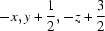
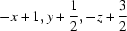
| Symmetry codes: (i) x, −y+3/2, z+1/2; (ii) −x, −y+1, −z+1; (iii) −x, y+1/2, −z+3/2; (iv) −x+1, y+1/2, −z+3/2. |
Experimental details
| Crystal data | |
| Chemical formula | (C7H18N2O)[ZnCl4] |
| Mr | 353.42 |
| Crystal system, space group | Monoclinic, P21/c |
| Temperature (K) | 293 |
| a, b, c (Å) | 6.2765 (2), 14.3552 (4), 15.4858 (6) |
| β (°) | 100.759 (4) |
| V (Å3) | 1370.75 (8) |
| Z | 4 |
| Radiation type | Mo Kα |
| µ (mm−1) | 2.55 |
| Crystal size (mm) | 0.17 × 0.09 × 0.08 |
| Data collection | |
| Diffractometer | Oxford Diffraction XCALIBUR area-detector diffractometer |
| Absorption correction | Multi-scan (CrysAlis RED; Oxford Diffraction, 2002) |
| Tmin, Tmax | 0.63, 0.82 |
| No. of measured, independent and observed [I > 2σ(I)] reflections | 13120, 3304, 2815 |
| Rint | 0.021 |
| (sin θ/λ)max (Å−1) | 0.688 |
| Refinement | |
| R[F2 > 2σ(F2)], wR(F2), S | 0.019, 0.020, 1.04 |
| No. of reflections | 2696 |
| No. of parameters | 137 |
| H-atom treatment | H-atom parameters constrained |
| Δρmax, Δρmin (e Å−3) | 0.27, −0.19 |
Computer programs: Xcalibur User Manual (Oxford Diffraction, 2002), CrysAlis RED (Oxford Diffraction, 2002), SIR97 (Altomare et al., 1999), CRYSTALS (Betteridge et al., 2003), CAMERON (Watkin et al., 1996).
| D—H···A | D—H | H···A | D···A | D—H···A |
| N2—H2···Oi | 0.87 | 1.95 | 2.821 (2) | 173 |
| N2—H3···Cl2 | 0.866 | 2.429 | 3.209 (2) | 150.2 |
| C1—H6···Cl2ii | 0.961 | 2.719 | 3.653 (2) | 164.1 |
| C7—H18···Cl2iii | 0.954 | 2.695 | 3.644 (2) | 173.3 |
| C5—H14···Cl4ii | 0.976 | 2.824 | 3.657 (2) | 143.6 |
| N2—H4···Cl3iii | 0.869 | 2.543 | 3.320 (2) | 149.3 |
| N1—H1···Cl3iv | 0.875 | 2.424 | 3.206 (2) | 149.1 |
| C2—H7···Cl1iv | 0.966 | 2.736 | 3.677 (2) | 164.8 |
| Symmetry codes: (i) x, −y+3/2, z+1/2; (ii) −x, −y+1, −z+1; (iii) −x, y+1/2, −z+3/2; (iv) −x+1, y+1/2, −z+3/2. |
Acknowledgements
We acknowledge the support provided by the Secretary of State for Scientific Research and Technology of Tunisia.
References
 Altomare, A., Burla, M. C., Camalli, M., Cascarano, G. L., Giacovazzo, C., Guagliardi, A., Moliterni, A. G. G., Polidori, G. & Spagna, R. (1999). J. Appl. Cryst. 32, 115–119. Web of Science CrossRef CAS IUCr Journals Google Scholar
Betteridge, P. W., Carruthers, J. R., Cooper, R. I., Prout, K. & Watkin, D. J. (2003). J. Appl. Cryst. 36, 1487. Web of Science CrossRef IUCr Journals Google Scholar
Brammer, L., Swearingen, J. K., Bruton, E. A. & Sherwood, P. (2002). Proc. Natl Acad. Sci. USA, 99, 4956–4961. Web of Science CSD CrossRef PubMed CAS Google Scholar
Bringley, J. F. & Rajeswaran, M. (2006). Acta Cryst. E62, m1304–m1305. Web of Science CSD CrossRef CAS IUCr Journals Google Scholar
Guo, N., Yi, J., Chen, Y., Liao, S. & Fu, Z. (2007). Acta Cryst. E63, m2571. Web of Science CSD CrossRef IUCr Journals Google Scholar
Oxford Diffraction (2002). CrysAlis CCD and CrysAlis RED. Oxford Diffraction Poland, Wrocław, Poland. Google Scholar
Prince, E. (1982). Mathematical Techniques in Crystallography and Materials Science. New York: Springer-Verlag. Google Scholar
Tao, J., Yin, X., Jiang, Y. B., Yang, L. F., Huang, R. B. & Zheng, L. S. (2003). Eur. J. Inorg. Chem. pp. 2678–2682. Web of Science CSD CrossRef Google Scholar
Valkonen, A., Ahonen, K. & Kolehmainen, E. (2006). Acta Cryst. C62, m290–m292. Web of Science CSD CrossRef CAS IUCr Journals Google Scholar
Watkin, D. (1994). Acta Cryst. A50, 411–437. CrossRef CAS Web of Science IUCr Journals Google Scholar
Watkin, D. J., Prout, C. K. & Pearce, L. J. (1996). CAMERON. Chemical Crystallography Laboratory, Oxford, England. Google Scholar
This is an open-access article distributed under the terms of the Creative Commons Attribution (CC-BY) Licence, which permits unrestricted use, distribution, and reproduction in any medium, provided the original authors and source are cited.
| CRYSTALLOGRAPHIC COMMUNICATIONS |


Hybrid compounds have many practical and potential applications in various field (Tao et al., 2003; Bringley and Rajeswaran, 2006). In these materials, the crystal packing is ensured by hydrogen bonds and coulombic interactions (Brammer et al., 2002). Here we report the crystal structure of the title compound, 4-(3-ammoniopropyl)morpholin-4-ium tetrachlorozincate (II) (Fig. 1).
As shown in Fig. 1, to ensure charge balance, the organic species is double protonated at N1 and N2 nitrogen atoms. The structure consists essentially of an 4-(3-ammoniopropyl)morpholin-4-ium and [ZnCl4]2- anion which are held together by N—H···Cl and C—H···Cl hydrogen bonds so as to build layers developing parallel to (a, c) planes (Fig. 2). These layers, situated at y = 1/4 and y = 3/4, are themselves interconnected by a set of N2—H···Cl hydrogen bonds (Table 1), alternating with layers, to form a three dimensional infinite network (Fig. 3). The Zn (II) ion is in tetrahedral coordination environment composed of four chloride ions. Each ZnCl42- anion is connected to its neighbors organic cations, which are associated via N—H···O hydrogen bonds, by N—H···Cl and C—H···Cl interactions involving four chlorine atoms (Table 1). The Cl1 and Cl4 are simple acceptors, the Cl3 is double acceptor and the Cl2 is triple acceptor of hydrogen bonds. The (N)—H···Cl distances, varying between 2.42 and 2.54 Å, are smaller than the sum of the Van der Walls radii of the chlorine and hydrogen atoms [r(Cl) + r(H) = 2.81 Å]. Consequently, these values correspond well to strong hydrogen bonds.
However, it is worth noticing that the Zn—Cl bond lengths and Cl—Zn—Cl bond angles in the [ZnCl4]2- anion are not equal to one another but vary with the environment around the Cl atoms(Valkonen et al., 2006). In the title compound, the Zn—Cl bond lengths vary between 2.2486 (4) and 2.2950 (4) Å. The Cl—Zn—Cl bond angles range from 104.32 (1) to 114.43 (2) °. These values indicate that the anionic [ZnCl4]2- tetrahedron is slightly distorted (Guo et al., 2007).